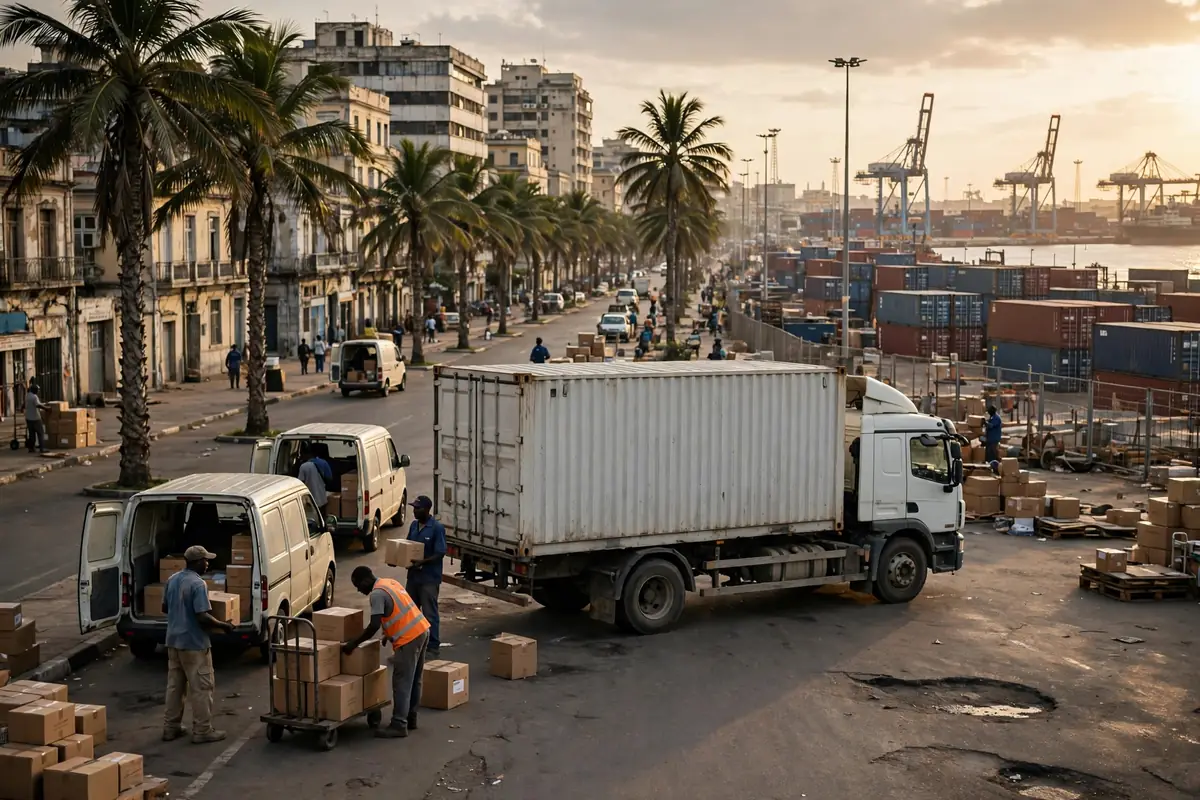
One Tuesday morning this past March, I waited outside the Port of Luanda to pick up a container. The box was off the ship, the paperwork was done, and the truck was stuck on the short stretch of road out of the port — forty minutes on a normal day. That is Luanda Angola urban warehouse distribution last mile in a nutshell: the cargo is not the problem, the road is. That day I waited from eight until twenty past eleven, and the container still had not cleared the gate. My driver called to say traffic was dead still, and he did not dare switch the engine off. The container held everyday goods for three small shops, whose owners started calling every half hour from midday. The goods reached our warehouse at three, and the shops lost half a day of sales. The time disappears into traffic.
Let me be straight: we are not a big company, just a handful of people running a small warehouse in Angola's capital. Public sources generally say the Port of Luanda handles more than seventy percent of Angola's container and general cargo. But getting that cargo into every shop in the city is a different job, and the big-company playbook does not fit us. We cannot afford to burn money the way they do.
Luanda Angola Urban Warehouse Distribution Last Mile Starts With Traffic, Not Rent
Ask most people about distribution in an African capital and the first question is rent. In Luanda, that is the wrong first question. The first question is traffic. A cheap warehouse means nothing if your trucks lose three hours a day sitting in jams. Whatever you saved on rent goes straight back into fuel and wasted trips. That is the first rule of Luanda Angola urban warehouse distribution last mile: price the traffic before you price the rent.
We learned this the expensive way. At first we rented close to the port, thinking a fast pickup was the whole game. Pickup was fast. Getting back out was the problem: after ten the roads into the city seize up, and four or five in the afternoon is the worst of it. One week I sat down with our own books and worked it out. A small van that should have made four city trips a day was managing two and a half. Fuel spend barely moved, but volume fell by almost forty percent. It is just how this city's traffic flows: a morning rush in, an evening rush out.
So we changed the rules. Every city delivery is picked and sorted the night before, and the first vans leave by half past six, before the morning peak. The second wave goes out before eleven, in the midday lull. After three, unless a customer is desperate, we stop taking new city orders. It sounds like giving up. It is arithmetic: a small warehouse that fights rush-hour traffic head-on always loses.
We also keep a hand-drawn traffic sheet on the warehouse wall, marked by every driver on return: which road jams at what hour, which one you can cut through. No software, just paper and a pen — and it beats any navigation app, because it was earned one trip at a time.
Luanda Angola Urban Warehouse Distribution Last Mile: Suburban Warehouse or City Depot?
Choosing the warehouse took us two months of arguing. A city depot is close to customers, but space is tight and big trucks cannot get in. A suburban warehouse is spacious and easy to work in, but every trip has to cross the worst stretches of traffic. Both sides had a point — and a trap.
We picked the suburbs for one reason: we could not afford to get a city location wrong. Suburban rent was easier to negotiate, the yard took container trucks, and we could strip containers and build mixed loads there before sending small vans into the city. It is an extra step. But it saves real money: big trucks only run the port-to-suburb leg and never sit in city traffic, while small vans can park outside a corner shop.
Here is how our three options compare, on our own operating figures:
| Approach | Our own cost per drop, indicative | Biggest trap |
|---|---|---|
| Big truck, port straight to city customer | Looks cheapest, actually costs most — one jam wipes out the saving | One blockage delays a whole truckload |
| Suburban warehouse, break bulk, vans in batches | Mid-range cost, most reliable | Needs hands on deck for sorting |
| Small city forward point, fast movers only | Fastest for urgent orders, but a second rent | Wrong stock there is dead stock |
The cheapest-looking option is not the cheapest. Direct delivery from the port to the city sounds smooth and fails easiest: one truck stuck in traffic means a dozen customers' orders all arriving late, and what you lose is not fuel money, it is trust. These days we only deliver direct when a customer takes a full truckload and has their own place to unload. Everything else goes through the suburban warehouse first. The suburban site has one unexpected bonus: it sits near the inland depots out toward Viana, so when volume spikes we can borrow space, and in busy weeks we share vans with the warehouse next door, fuel split down the middle.
Last Mile: The Uglier the Fix, the Better It Works
A cold splash of water on the last mile: do not start by buying software, equipment, or automation. We tried — we bought a dispatch tool that cost real money, and the drivers simply never used it. The routes on the screen were straight lines, and Luanda's roads are alive: which junction is closed today, which street has a market on it, the software had no idea and the drivers did. Two months later we threw it away.
This is what our last mile looks like now. Every morning at six, the drivers gather for a ten-minute stand-up, each holding a handwritten delivery sheet: customer name, address, phone, number of cartons, and one line of notes — "this shop opens at noon," "the owner must sign in person." I plan the sheets the night before. The only rule: follow one line. One van, one route, no backtracking.
And here is the counterintuitive part: the most expensive thing in the last mile is not fuel, it is waiting. Waiting for a customer to open up, check the goods, find the cash — half an hour gone, just like that. By our own books, a van doing ten drops a day loses two drops when three stops each eat half an hour. So we made a rule: the evening before delivery, someone calls the customer to confirm a time. The customer says ten in the morning, we arrive at ten to ten, and if nobody is there by half past, the goods come back for another day. Some customers grumbled at first, then got used to it — everyone's time is worth something.
One order from this past June still sticks with me. A small supermarket called at four in the afternoon: opening the next morning, goods needed that night. We had one driver and one small van left, and our rule says no new city orders after three. But this was someone's opening day. We loaded it ourselves at six, skipped the main road, threaded through the side streets, and delivered at twenty to nine. The owner bought us each a drink and said we were the most reliable people he had worked with. We made no extra money on that order, but that kind of reputation cannot be bought.
So if you ask me how a small warehouse handles Luanda Angola urban warehouse distribution last mile, my answer is three sentences. Put the warehouse in the suburbs and stop fighting the port. Break bulk before you send anything into the city, and keep big trucks out of the jams. Run the last mile on people, on sensible routing, and on confirming the time in advance. None of it sounds impressive. Every line of it was paid for with our own money.
One honest caveat: things move fast in Luanda — road conditions, port working arrangements, warehouse rates can all shift within a few months. Every figure I quoted is our own operating experience. Before you copy any of it, drive the routes yourself, ask around, and go by the latest local situation. Someone else's experience can help you dodge a few potholes. It cannot walk the road for you.
Small warehouses have their own way of surviving: no money to burn, so we burn brainpower instead. Luanda's roads will stay jammed, but the goods still have to reach the customer — get them there on time, and a small warehouse stays alive.
By Xiao Ma, Small Warehouse Owner