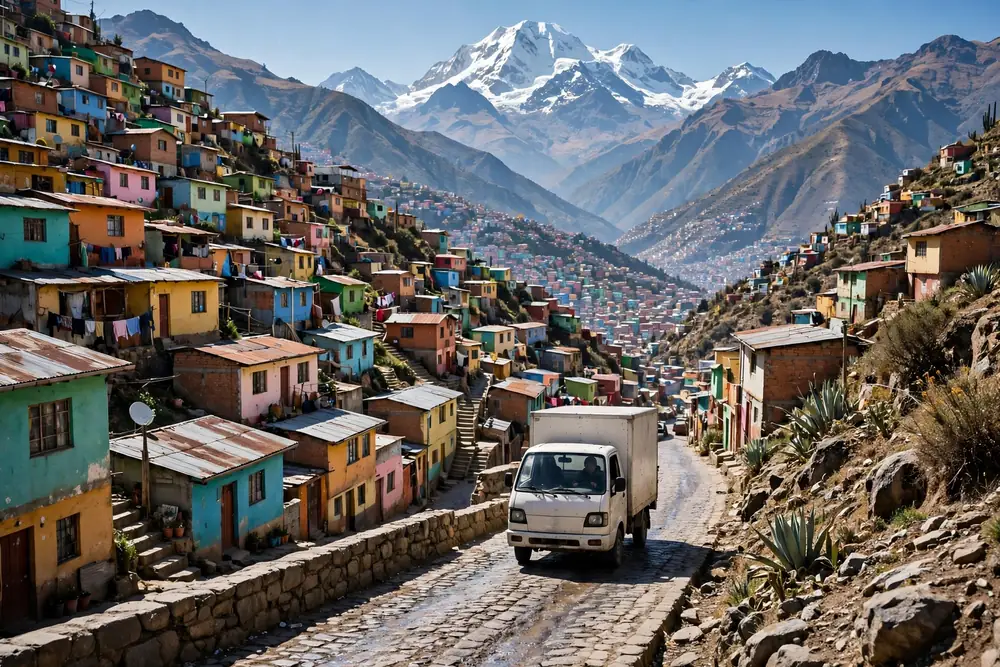
I've driven trucks for fifteen years, and La Paz urban warehouse distribution was the first job that humbled me — not because I didn't know the roads, but because the altitude didn't care what I knew.
It was the winter before last. I went to Bolivia with a freight forwarder who runs South America lanes, to look at warehouse space. The plane landed in El Alto, around 4,000 meters up, and the moment I stepped off, my head went tight and every second step left me winded. The forwarder, Old Chen, laughed at me: "You gasping is the small problem. Wait till the truck starts gasping." The next day we took a medium box truck from El Alto down into central La Paz with a load of household goods, a little over six tons, the kind of load that feels like nothing on flat ground. But the moment the road tilted up, the truck showed its true colors: foot flat on the pedal, speed barely crawling, engine groaning without getting anywhere. Old Chen said the truck had a naturally aspirated engine, and up at 3,600 meters the thin air can eat twenty or thirty percent of its power. A full load on a steep grade, that's just how it goes. I never forgot that trip. In La Paz, you negotiate with the altitude before you negotiate with anyone else.
La Paz Urban Warehouse Distribution Starts With an Altitude Budget
La Paz is one of the highest capitals in the world, the city sitting at roughly 3,600 meters, with neighboring El Alto higher still, around 4,000 meters. The whole city is built inside a bowl-shaped valley: downtown at the bottom, neighborhoods climbing the slopes, streets steep and narrow. In terrain like that, the delivery math is a different book from anything you know on flat ground.
The first line of that math is power. A naturally aspirated engine can't breathe up here, so it loses grunt, struggles on grades fully loaded, and burns more fuel doing it. A turbocharged truck does better. An electric delivery van doesn't care at all — an electric motor doesn't burn air, so altitude has nothing to say to it. Picking the drivetrain in La Paz isn't a branding choice. It's a question of whether the freight arrives on time. After all these years on the road, this is the first city where I've thought of an electric van as a necessity, not a gimmick.
The second line is brakes. Downhill wears a truck out worse than uphill, and that's something people who've never driven mountain roads don't expect. A full load coming down leans on the brakes the whole way, pads and drums heat up and fade, and after a few long descents the pedal can go soft enough to scare you. The old hands drop into a low gear, let the engine hold the truck back, and tap the brakes only in short bursts. But that's slow, and slow means fewer runs in a day. Half the delivery-time budget in La Paz urban warehouse distribution is really a brake budget.
The third line is people. Altitude sickness isn't just a visitor's problem. Local drivers climbing and dropping all day burn more energy, and warehouse hands moving freight at 3,600 meters work at a slower natural pace than they would on the plains. If your schedule doesn't leave room for that, your delivery promise is just words on paper.
Put the Warehouse in El Alto, or Squeeze Into Downtown?
Once you've seen the roads, the next question is where the warehouse goes. In La Paz there are basically two choices: down in the valley near downtown, or up on the plateau in El Alto.
Downtown puts you close to the customer, with short delivery runs. The downsides are just as clear: land costs more, space is tight, and big trucks can't get in. Plenty of streets in the old city are steep and narrow. A 9.6-meter truck can't make the turns, and stopping to load on the street blocks a whole lane while the cars behind you lay on their horns. Small vans can get in, but a small van carries little, and once the trips pile up, the labor and fuel eat you alive.
El Alto is the mirror image: flat ground, big plots, trucks in and out with no trouble, and cheaper rent. The catch is that every order has to roll downhill into the city, and the empty truck has to climb back up. The advantage is that you can run a real cross-dock there: big trucks bring freight in bulk to the El Alto warehouse, you break it down, sort it, consolidate orders, and send small vans into the city by zone. Old Chen and I worked that math out on paper.
| Approach | Warehouse location | Vehicle into the city | Best for |
|---|---|---|---|
| Small downtown warehouse, direct delivery | City center | Small van | Low volume, tight deadlines |
| El Alto cross-dock | Flat plateau | Big truck on the trunk leg, small van for delivery | Larger volume, consolidated orders |
That's a directional comparison only. For actual rents and freight rates, check the latest local quotes — I won't put numbers in your mouth.
I'll tell you this: most shippers doing La Paz urban warehouse distribution end up picking the second option. They keep the warehouse in El Alto and hold at most a small pickup point in the city, or none at all. The logic is simple. A downtown warehouse saves you time on the road. An El Alto warehouse saves you real money. Until your volume reaches a certain scale, that downtown warehouse is just an expensive storefront.
The Last Mile on the Hills: How to Run It Without Losing Money
With the warehouse settled, the last mile is what's left. La Paz's last mile runs on three rules of thumb, and every one of them was worn in by tires.
Rule one: don't fight the rush hours. Downtown has only a handful of main roads, and at commuting time they're jammed solid, big trucks and small cars stuck together, nobody moving. Better to send the trucks out early and bring them back late, around the peak. Let the warehouse wait an extra hour rather than let a truck burn fuel sitting on a slope.
Rule two: consolidate by zone, not by time. La Paz's neighborhoods sort themselves by altitude: the commercial district at the valley floor, residential streets halfway up, newer districts at the top, each with its own road conditions. One van runs one zone at a time, climbing steadily or descending steadily, and that burns far less fuel than zigzagging all over town. Sort the orders by zone first, then assign the trucks. That's lesson one for any dispatcher here.
Rule three: small vehicles go into the city, big trucks stay out. The big truck runs only the trunk leg from El Alto to a handoff point on the edge of town. Everything inside the city goes by small truck or van. They're nimble, they turn in narrow streets, and they pull away on steep grades without a fuss. The smaller the vehicle, the better it does in La Paz — a statement that would be wrong in a flat city and is exactly right here.
There's one more contrast worth mentioning. La Paz runs the world's largest urban cable car network, opened in 2014, and locals ride it to work, crossing the mountains in minutes. But the cable cars carry people, not freight. The freight still has to climb on wheels, inch by inch. People travel through the sky, goods travel on the ground. That's the reality of La Paz.
After all these years, I believe one thing: a driver who doesn't respect the altitude will pay for it on the slopes sooner or later. In this city, get the warehouse right, get the vehicles right, get the zones right, and the last-mile math finally works. Get any of them wrong, and every delivery you make is working for the altitude, not for you.
By Shifu Zhao, Trucking Veteran (15 yrs)