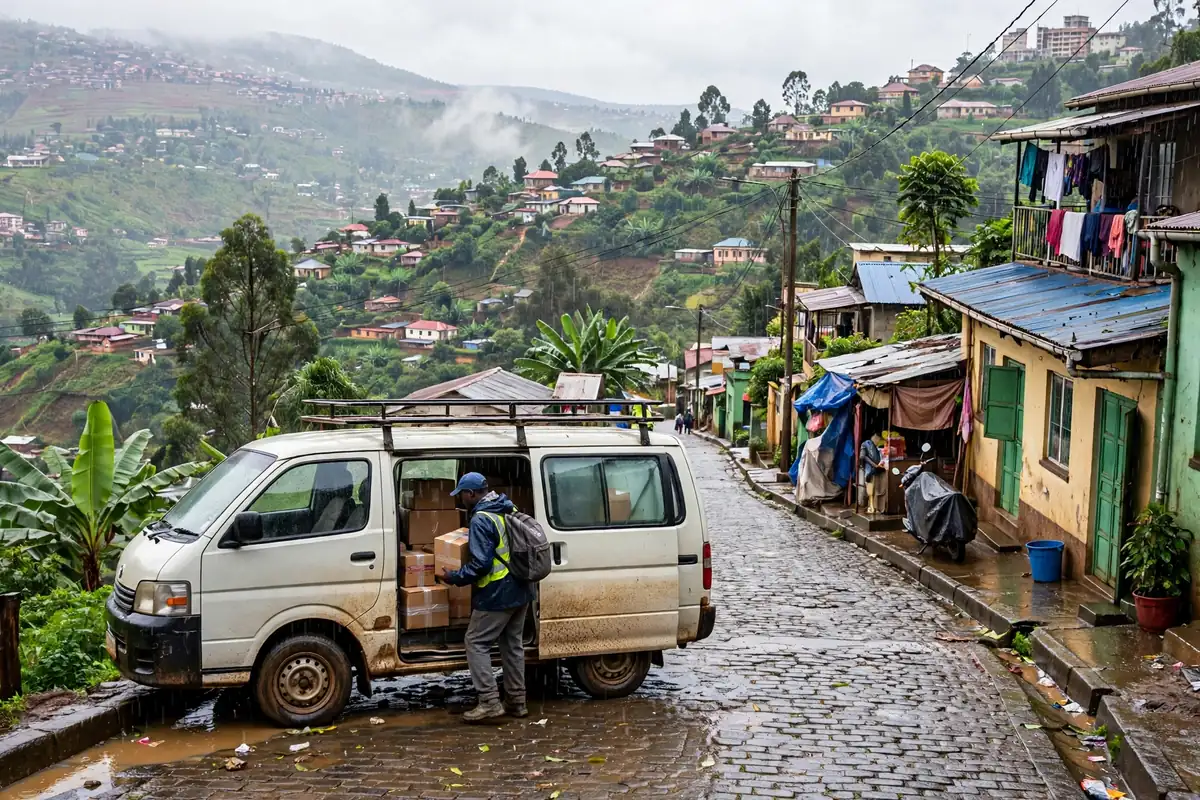
We small warehouses cannot afford to burn money like that. That is my first reaction to almost every big-company proposal. This time, though, I was not looking at a proposal. I was helping a friend who runs urban distribution in Kigali work out his numbers. His headache is the Kigali warehouse distribution last mile. His warehouse is not large, the goods are mostly daily necessities and small appliances, and his customers are scattered across a hilly city, with twenty or thirty deliveries a day. After listening to him for a while, my main takeaway was this: in Kigali, urban distribution is not mainly a question of whether the warehouse is big enough. It is whether hills, rain, and the last mile can be handled with practical, low-cost methods first. In short, Kigali warehouse distribution last mile work is won or lost on slopes and timing.
Start with the hills. Kigali is a city of slopes, and many routes go up one hill only to come down another, so a road that is easy in one direction can be awkward on the way back. My friend first planned routes the way you would in a flat city, and one small truck covered only 12 kilometres one morning while using far more fuel and time than expected, leaving two deliveries unfinished by the afternoon. He then switched to a decidedly unglamorous method: divide the city into zones by slope, send only small vans and motorcycles into the steep zones, and let light goods go first while heavy goods wait for a suitable combined trip. It does not sound advanced, but it worked immediately, because one truck struggling up a slope no longer delayed every delivery in the zone.
The Kigali last mile starts with the slope
In Kigali, the last mile begins as a slope problem. Slopes affect more than speed. They affect loading and safety. Unloading heavy goods on a slope means the vehicle must be parked securely and the load properly fixed, and a careless moment can easily become dangerous. My friend's warehouse now has an unwritten rule: for steep delivery points, the courier calls the customer before leaving, confirms someone is there and that there is somewhere safe to park, and only then sets off. That one phone call saves a wasted trip and a risky slope unloading.
Vehicle choice is part of the same slope problem. A large truck carries more but struggles to turn around on narrow hillside roads. A small van is flexible but may need two trips for heavy goods. My friend's answer is to match the vehicle to the zone rather than using one vehicle for everything. Flatter zones get a larger vehicle for consolidated deliveries, steep zones get small vans in batches, and the hardest-to-reach points get urgent items by motorcycle first. There is no software behind this, just a hand-drawn zone map on the wall that drivers check before leaving. It is crude, but drivers trust it, because it is drawn from routes they actually drove.
There is also a human detail. In steep zones, couriers burn far more energy in a day, so shifts cannot be divided evenly by order count alone. My friend now assigns two fewer orders in steep zones and two more in flat zones, with pay adjusted slightly for zone difficulty. Complaints dropped, and late deliveries dropped too. Small warehouses have their own way of surviving, and sometimes fairness does not mean the same number of orders. It means a similar level of exhaustion.
In the rainy season, Kigali warehouse distribution is a race for the time window
Then there is the rain. During the rainy season, Kigali often gets a heavy afternoon downpour, with standing water and poor visibility, and the whole delivery rhythm falls apart. My friend learned this the hard way in the first week of one rainy season, when he kept dry-season delivery density and three of six afternoon orders arrived late after a 3 p.m. storm, with customer calls coming one after another. After that he changed the rule: in the rainy season, afternoon order volume is deliberately cut by about a third. Better to run more in the morning than to push through the rain.
The time window is the key here. Rather than promising an exact hour, it is better to agree a morning or afternoon window with the customer, plus a clear note that rain may push delivery later. Customers may not love it at first, but the cost of explaining a late delivery afterwards is much higher than the cost of setting expectations in advance. My friend also writes one line on every dispatch sheet: in rain, safety comes first, an order may arrive late, but people and goods must not be put at risk. That is not a slogan. It is genuine permission for drivers to act on.
Inside the warehouse there are matching low-cost habits. Before the rainy season, goods that cannot get wet are moved to raised locations near the door, an extra waterproof cover goes on during loading, and returns and exchanges get their own zone so rain and mud do not contaminate normal stock. None of this costs much money. It costs a little foresight, and when a small warehouse cannot outspend anyone on equipment, foresight is what it has to compete with.
The small-warehouse playbook: split zones, split times, split vehicles
The money question deserves a straight answer. My friend worked through the numbers for one zone with 20 orders. One large truck could carry everything, but the time spent turning on slopes and waiting added up to more than two small vans running separately. Motorcycles alone were flexible but could not carry heavy or bulky goods. The cheapest combination was a mix matched to weight and slope: urgent light items by motorcycle, heavy goods by small van, and consolidated runs by larger vehicle only in flat zones. There is no standard answer here. Change the zone and the calculation has to be redone, which is exactly what makes urban distribution so grinding.
I drew him a simple decision framework, just three questions. First, how hard is this point to reach on a slope? If it is hard, step the vehicle down. Second, does this order mind the rain? If it does, move it to the morning or warn the customer in advance. Third, how urgent is it? Urgent items travel alone rather than sharing a trip with heavy goods. Answer those three questions and the vehicle and departure time more or less decide themselves. No system purchase is required. What is required is asking three extra questions before dispatch.
On permits, tax, and import compliance, I will offer only one reminder: always check the latest official policy on the official website rather than relying on a version passed along by word of mouth. My friend once prepared documents based on what other operators told him, only to find the actual requirement was different. An extra trip is a small waste. Preparing everything to the wrong version is the real waste of time.
Finally, a word for fellow small-warehouse owners. In a city like Kigali, distribution is not won by whoever has the most trucks or the most expensive system. It is won by whoever best understands the slopes and the rain in their own zones. Draw the zone map, agree the rainy-season time windows, and match vehicles to slopes. Get those three unglamorous things right and the last mile has a chance to hold steady. We can keep looking at big-company proposals slowly, but today's orders still have to go out one by one, using these practical methods.
By Xiao Ma, Small Warehouse Owner