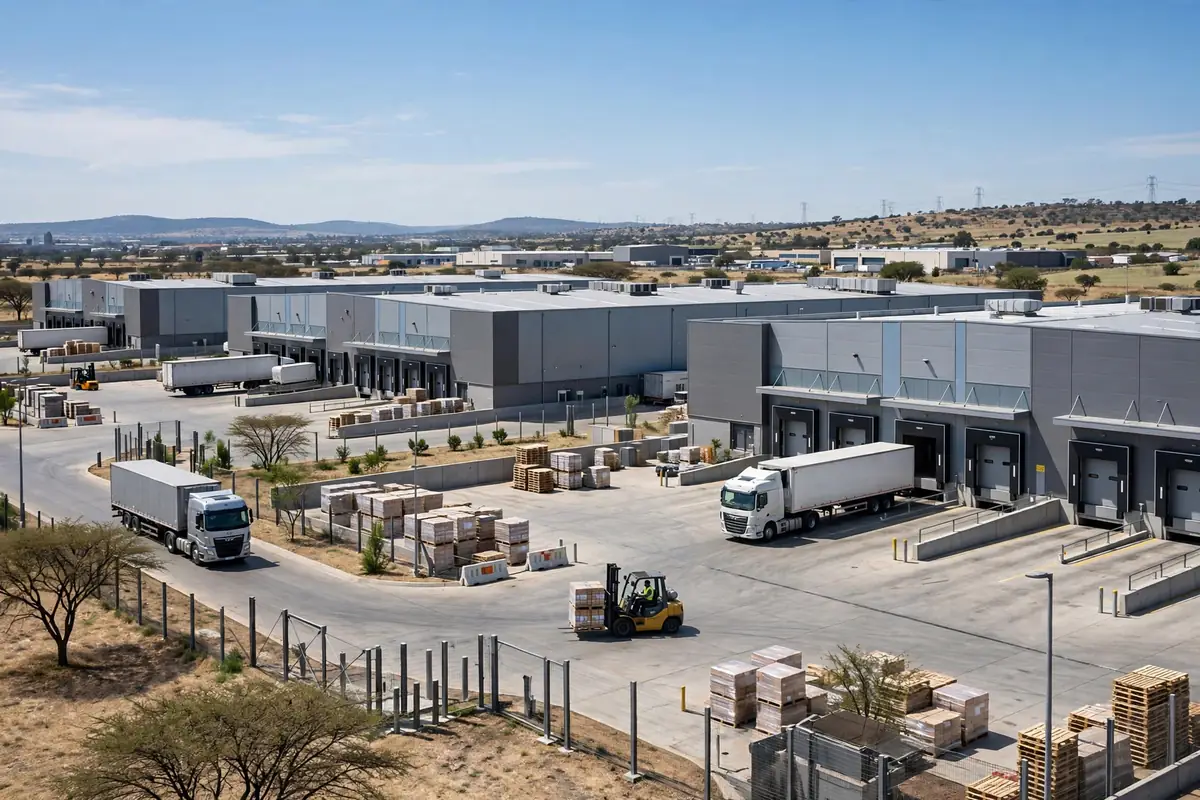
Start with the bill, because that is where every warehouse decision in Johannesburg South Africa warehouse logistics actually gets made. Gauteng is the backbone of South Africa's national logistics, home to the country's largest concentration of warehousing and distribution facilities. And yet good space is getting harder to find. Vacancy across Fortress's South African logistics portfolio sits at roughly 0.3%, as of 31 October 2025 — a historic low. At that level of scarcity, the tenant is not the one setting terms. The mistake most tenants make here is to start with the rental rate. Start with total cost, then location, and only then the rate per square metre.
Johannesburg South Africa Warehouse Logistics: The Five Nodes That Matter
Gauteng warehousing comes down to five names. Ekurhuleni is the heavyweight, with City Deep, Isando and Pomona carrying the deepest national distribution volumes. Alrode, to the south, is an established industrial area where the buildings tend to be older but the supporting services are mature. Linbro Park sits to the east, central to several directions at once. Midrand lies between Johannesburg and Pretoria, so it can serve both cities, which is exactly why dual-city distributors keep looking there. Spartan, in the East Rand, sits close to O.R. Tambo International Airport, which suits air freight and import-export flows.
None of these nodes is better than the others in the abstract. Each one is right for a different job, and picking the wrong node means the money saved on rent comes back multiplied in fuel and missed delivery windows:
| Node | Best for | Check first |
|---|---|---|
| Ekurhuleni (City Deep, Isando, Pomona) | National distribution, high-volume tenants | Whether trunk-road access stays fluid at peak hours, and whether trucks queue at the park gate |
| Alrode | Tenants needing industrial support services | Building age and retrofit headroom — are fire protection and clear height good enough |
| Linbro Park | Regional distribution | Balance in all directions, not just distance to one destination |
| Midrand | Dual-city distribution | The split of orders between the two cities — lean toward whichever side orders more |
| Spartan | Air freight, import-export | Real drive time to the airport, not straight-line distance |
Small-format urban distribution warehouses in this market are commonly 500–3,000 square metres, and tenants in that size band make the same error most often: comparing headline rents and nothing else. On a 500-square-metre unit, a ten percent rent difference is a small monthly sum. A badly located unit, by contrast, adds extra trips every day, and the late-delivery penalties pile up fast. That is money spent for nothing, wasted because the wrong number was used to compare.
What a 0.3% Vacancy Rate Actually Means
Two real cases show what the market is doing. The first is DHL Supply Chain, which is investing 2.2 billion rand in a new distribution centre in Johannesburg, with construction starting in July 2026 and operations beginning in July 2027. A global 3PL putting that kind of money into its own building is a calculation, not a gesture: waiting for good existing space to come up costs more than building. The window before that new supply lands is precisely the window when tenants have the least room to negotiate.
The second is Shoprite. Its Riverfields distribution centre in Kempton Park covers 94,000 square metres and serves more than 500 supermarkets across Gauteng. A retailer of that scale does not rent a network like this; it grows one. Once a facility of that size is in place, transport, labour and suppliers cluster around it, and the node itself becomes more valuable.
Here is the counterintuitive part: the lower the vacancy rate, the less sense it makes to rush into a long lease. At 0.3%, there is almost nothing left to choose from, and a long lease signed now locks in a peak price. The better move is to shorten the lease, negotiate the renewal terms explicitly, and watch the new supply arriving around July 2027. The day DHL's new centre opens is the day the market gains another option, and options are what make prices negotiable.
In practice, tenants should work backwards: start the search well before the current lease expires instead of scrambling in the final month, and use two nodes' quotes to anchor each other — a Midrand quote to pressure an Ekurhuleni price, Spartan's airport advantage to negotiate a rent-free period. A landlord who knows you have an alternative negotiates differently. A negotiation with only one option is not a negotiation; it is accepting a quote.
Power Costs Are Rewriting Johannesburg Warehouse Site Selection
Rising electricity prices and supply reliability are a major concern for tenants in South Africa, and more and more tenants are asking for rooftop solar. Translated into cost language: a warehouse without solar carries open-ended exposure on power; a warehouse with solar can be the cheaper option even at a higher rent.
The arithmetic below is an illustrative example — the figures are assumptions, not market quotes, included only to show the structure. Take a 2,000-square-metre urban distribution warehouse and split its monthly cost into 100 parts: rent 30, electricity 18, labour 32, transport 20. A ten percent rise in power prices adds 1.8 parts to total cost. If rooftop solar cuts the electricity share from 18 parts to 13, the 5 parts saved are equivalent to roughly a 17% discount on rent. That is why more tenants now put "does it have rooftop solar, and can the roof take it" on the must-check list, on the same line as the rental rate. Solar is not a green garnish here. It is a cost line.
Conclusion: Three Standards You Can Calculate
First, compare total cost, not headline rent. Add rent, power, labour and transport, divide by the orders processed each month, and you get a warehousing cost per order — the only number that lets different nodes be compared honestly. In Johannesburg South Africa warehouse logistics, that per-order figure is the number landlords least want you to calculate, which is exactly why it matters.
Second, let lease length follow supply. In a 0.3% vacancy market, a short lease with clear renewal terms beats a five-year lease locked at a peak price. July 2027 is a date worth marking.
Third, price power as its own line. A warehouse without solar potential needs the upside of power prices built into its quote, however low that quote looks. A warehouse with solar can cost up to ten percent more in rent and still come out cheaper.
Each of those three can be put on a spreadsheet and calculated. A site recommendation that cannot be calculated is worth hearing, not worth signing.
By Lao Zhou, Logistics Cost Analyst