Iran pistachio export warehouse storage comes down to one judgment, and I will give it to you straight: the money is not mainly in the freight, it is in grading and moisture control. Get the grades right early, keep moisture under control all the way through, and do not let a sailing date rush a shipment that is not ready. Put simply, this business has two sides: the nuts themselves, and whether you protect them all the way to the port. I have seen too many shipments lose money not on transport, but on rework and downgrades found at the port.
Too many people run the sequence backwards, rushing harvest, warehouse, and port, as if saving a day at each step automatically earns more. Then the shipment reaches the port and every hidden problem shows up at once. I will tell it in my own order: a costly mistake, then grading, then moisture, then a sequence you can follow.
Iran pistachio export warehouse storage: do the math first
Here is the mistake that still sticks with me. A lot came out of the Rafsanjan area looking dry enough on the surface, so it was bagged and sent toward Bandar Abbas without much waiting time in the warehouse. Nothing dramatic happened on the road. But when the bags were opened at the port, part of the lot had picked up dampness, the nuts felt sticky, and the colour was off. The buyer asked for regrading. That meant labour, floor space, and time, while the sailing date kept pressing from behind. For several days the whole team was wrapped around that one shipment.
The lesson was blunt: whatever time you save in the warehouse by rushing will be paid back at the port, with interest. Whether the nuts are truly dry, whether the bags are sealed, and whether any warehouse corner is damp all look like small matters at origin. At the port they become the whole matter. Since then my rule has been simple: let a lot sit until its condition is genuinely stable rather than sending it off with a hidden problem. That is not slowness; it saves money later.
Another lot from the same area was handled by a steadier crew. They graded roughly beside the orchard first, pulling out damaged nuts before they could take up warehouse space, then graded again in the warehouse by size and shell opening, storing each grade separately. Inspection at the port passed on the first attempt with almost no rework. The extra labour up front cost far less than rework at the port, and the buyer left with far more trust.
Grading: where the money is actually saved
The first instinct with grading is to grade finer and finer, and I disagree. Grading exists to give the buyer a clear promise, not to create work for yourself. Grade too finely and warehouse bays multiply until storage, picking, and loading all slow down. Grade too coarsely and good nuts mix with poor ones, dragging down the whole lot. So I set broad grades first, then split only where it genuinely helps.
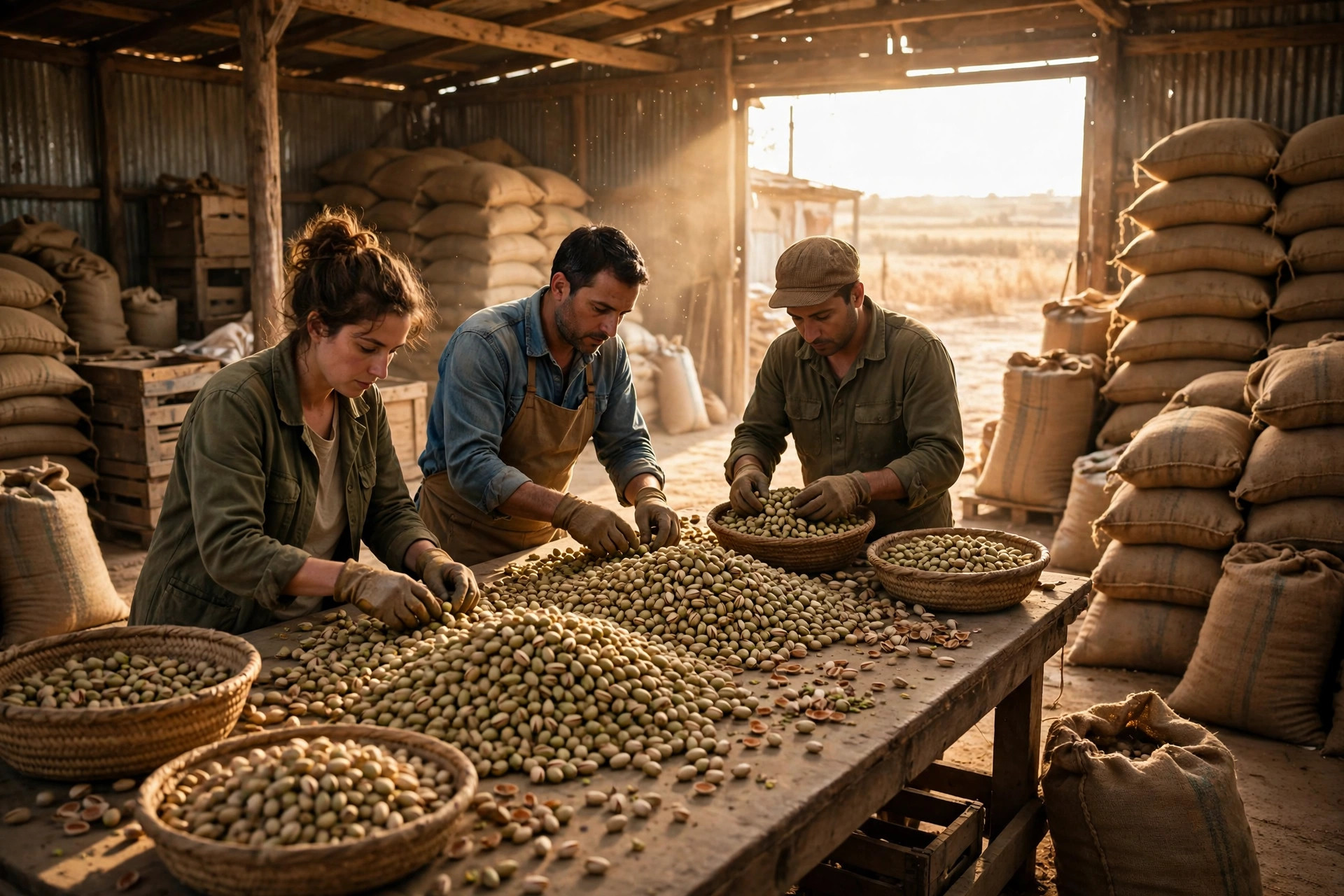
In practice I work in three passes. The first pass happens near the orchard: pull out broken, visibly mouldy, and badly undersized nuts, and do not let them enter the warehouse at all. The second pass happens in the warehouse: separate by size, shell opening, and colour, store each grade separately, and label every bag clearly. The third pass happens just before loading: sample the lot, check that grades have not been mixed, and check that the bag labels match what is actually inside. Three passes sounds like a lot, but each one saves trouble in the next.
Here is the counterintuitive judgment: grading earns more by being clearer, not stricter. I have seen a shipper set the top grade so high that most of the lot fell into lower grades, leaving too little top-grade volume to fill an order. I have also seen loose grading let poor nuts slip into the good grade, and the buyer remembered that inspection for a long time. What the buyer receives must match the grade promised. Matching once is luck; matching every time is reputation.
The table below is one I often use when talking through the trade-off with a partner. It shows where the work goes and where the risk lands.
| Approach | Work up front | Risk at the port | Best for | | Rough grade at origin plus fine grade in warehouse | Two extra passes, but grades are clear | Little rework, strong chance of passing inspection first time | Shippers building repeat export business | | One grade pass in the warehouse only | One pass saved, grades broadly clear | Some mixing risk remains, occasional rework | Smaller lots still proving the route | | No grading before loading | Least work up front | Highest risk of failed inspection or downgrade | One-off deals where speed matters more than repeat business |
Moisture control in Iran pistachio export warehouse storage
Moisture is where I have seen the most careless accounting. Too many people only count the warehouse stage and forget that the whole journey from orchard to port is a fight against dampness. Nuts bagged before they are truly dry carry that dampness all the way. A damp floor, a draughty corner, or bags stacked so tightly that air cannot move all add to the problem. Moisture control is work for the whole route, and whichever stage goes slack is where trouble starts.
I break moisture control into checks you can actually perform. Before intake, look at the lot itself: does it feel dry, or are you only assuming so because it looks fine on top? In the warehouse, check the conditions: is the floor dry, is ventilation working, and are bags kept off the floor and away from the walls? When stacking, leave aisles and gaps so air can move and staff can inspect. Before loading out, check again: are any bags torn, is there dampness, and is anything questionable set aside rather than mixed into the good lot?
There is a trade-off here worth stating plainly. Some people seal a warehouse up tight, and then the inside turns stuffy, which helps nobody. Others leave everything open and let damp weather blow straight in, which is just as bad. Moisture control is neither sealed shut nor wide open; it depends on the weather and the lot. Ventilate when it helps, close up when it does not, and have the warehouse keeper walk the floor every day and note what changed. That daily round is worth more than any fancy setup nobody checks.
One more point people overlook: the bag itself is part of the moisture bill. A torn or poorly sealed bag makes all the earlier drying pointless. Check bags before filling, spot-check seals after filling, and do not drag bags across sharp edges or handle them roughly at loading. These are small things, but the moisture bill is exactly the sum of small things. One leak can discount the work of the whole chain.
From orchard to port, in the right order
So here is the order I recommend. Grade roughly beside the orchard. Grade finely in the warehouse and let the condition stabilise. Bag only once the lot is stable. Recheck before loading. Send toward Bandar Abbas only after that check passes, and leave time at the port for inspection and fixing problems, rather than cutting the sailing date so fine that there is no room to move. A problem found at its own step can be fixed on the spot instead of turning into rework at the port.
Before any shipment leaves, I ask partners four questions. First, are the grades clear, and do bag labels match what is inside? Second, is the lot stable, with no sign of dampness? Third, have all moisture checkpoints along warehouse and transport been covered? Fourth, if rework is needed at the port, is there space, labour, and time? If all four answers are yes, the shipment is in good shape. If any answer is no, hold it and fix that point first.
In the end, this trade is not won by whoever moves fastest, but by whoever does the careful work early. Grade clearly, control moisture all the way through, and put the steps in the right order, and the port becomes a formality instead of a fire drill. Look at the lot you are holding: can it pass those four questions? Answer honestly before you decide whether to ship or steady it longer.
By Lao Mi, Supply Chain Veteran (20 yrs)