I've walked through more than twenty sensor-equipped warehouses in two years, and the truth is uncomfortable: in half of them, the sensors are still alive but the data is dead. In half of the remainder, the sensors were a vanity purchase — tens of thousands spent on the feeling of "we're digital now."
So let's talk ROI, operator to operator: temperature/humidity, door contacts, asset tracking tags, and vibration — which earn their keep, and which are money pits.
How warehouse IoT sensors actually work
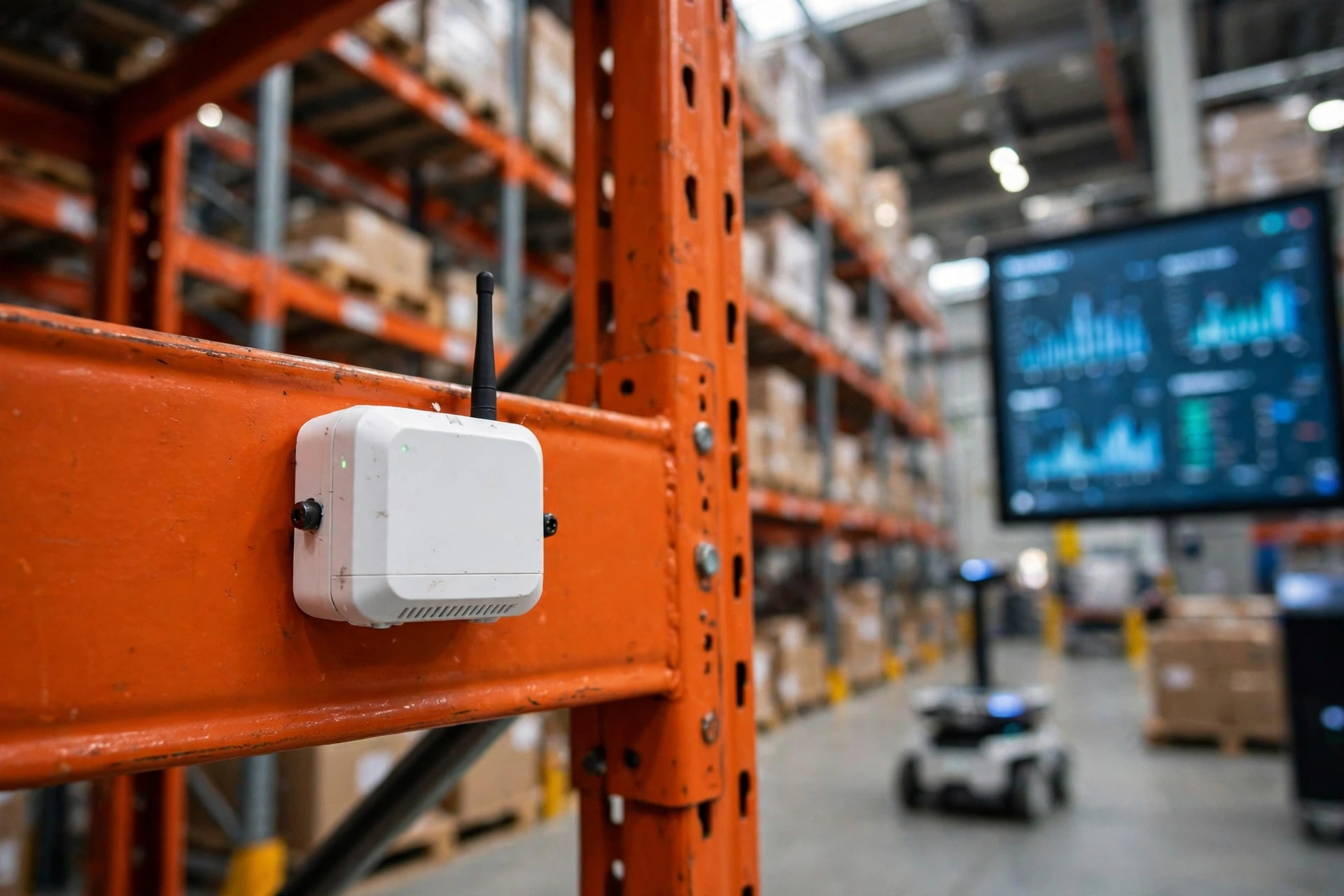
Strip away the marketing and a warehouse IoT sensor does exactly one thing: it turns changes nobody is around to see into numbers. Temperature probes watch the environment. Door contacts watch "how long has this door been open." Bluetooth tags watch "where is this thing." Vibration sensors watch "is this machine about to die."
Think of it as a night-shift inspector who never sleeps — he can't walk, but every few minutes he shouts: "26.5°C over here," "this door has been open 40 minutes."
Two layers: sensing (the probe — check the datasheet for accuracy and range) and connectivity (how data gets out). Get connectivity wrong and the priciest probe is wasted money.
Four IoT sensor warehouse use cases, ranked by actual ROI
Verdict first, stories after.
| Sensor type | Hardware cost per point | Typical spend for a 50,000 sq ft warehouse | What it prevents | Payback | | Temperature/humidity (cold storage) | ~$40/point | 20 points + gateway, ~$1,700 | One excursion scrapping a full batch | One prevented incident pays for it | | Door contacts | ~$15/point | 10 doors, ~$400 | Freezer door left open, after-hours entry | 6–12 months | | Asset tracking (BLE tags) | ~$7/tag | 800 tags + gateways, ~$7,000 | Lost pallets and totes, search time | 1–2 years | | Vibration | ~$70/point | 10 critical machines, ~$1,100 | Unplanned conveyor/lift downtime | One prevented stoppage pays for it |
Market reality behind the table: Bluetooth-class sensors $5–$25 a unit, LoRaWAN-class $25–$65, cellular NB-IoT $80–$150, gateways $100 to $1,000+. An integrator's rule-of-thumb band — confirm against vendor quotes.
Case one: temperature, genuinely worth it. July 2025, a cold-chain 3PL in Jiaxing. At 2:17 AM the compressor on freezer #1 tripped. Twenty-four LoRa probes reported every 15 minutes; at 3:05 AM the curve crossed the -18°C alarm line and the supervisor's phone lit up. Backup unit switched on remotely, room back at -22°C by 6 AM. The room held imported beef worth over half a million dollars. With the old four-hour manual rounds, they'd have found a room of write-offs. Peer-reviewed cold-chain literature puts temperature-related losses at 3–10% of cold-chain product loss, and a single excursion can mean a rejected shipment worth hundreds of thousands. The setup cost about $1,700 — one save, several hundred times over.
Case two: asset tracking, worth it — but calibrate expectations. Late 2024, an e-commerce fulfillment center in Kunshan ahead of the Singles' Day peak. Totes kept growing legs: about 6% went missing every year at roughly $11 apiece, a five-figure annual bleed, and worse, peak-season tote hunts ate half a day of labor each time. BLE tags plus six gateways, a little over $7,000 total. A year later the loss rate was under 1%, and finding a tote went from "half a day" to "glance at the phone." Payback: about eighteen months. One caveat: this stops honest mistakes, not theft — anyone who wants to steal a tote just rips the tag off. Don't buy it as a security system.
Door contacts are the most underrated sensor in the building. A freezer door propped open overnight: the extra electricity is the small bill; the thawed pallets by the door are the big one. A $15 contact screaming "door open over 20 minutes" is the cheapest insurance in this article.
Vibration? Critical equipment only. Conveyor motors, vertical lifts — a drifting spectrum warns you two weeks before a bearing dies. One unplanned stoppage, four dead hours, easily five figures. Note the qualifier: critical equipment. I once saw vibration sensors bolted to static racking. That's setting money on fire.
Here's the contrarian bit: in a warehouse sensor project, hardware is only about a third of the total spend. The other two-thirds burn on installation, platform integration, and eventually the labor of swapping batteries. Anyone who compares probe prices without totaling the project will blow the budget.
Picking the radio: NB-IoT vs WiFi vs Bluetooth vs LoRa
The most-asked question, and where most projects die. The dividing lines, in one sentence:
Battery-powered? Don't touch WiFi. Never leaves the building? Don't pay NB-IoT subscriptions. Needs to span cities? Don't build your own LoRa network.
| | WiFi | Bluetooth BLE | LoRa | NB-IoT | | Coverage | Tens of meters, needs APs | ~10 meters, needs gateways or phones | One building or campus per 1–2 gateways | Wherever the carrier has signal | | Battery life | Weeks to months | 1–2 years (broadcast mode) | 3–5 years (depends on reporting rate) | Several years (sparse reporting) | | Infrastructure | Reuse existing APs | BLE gateways required | Own gateway, hundreds to low thousands | None | | Recurring cost | None | None | None | Monthly data fee per device | | Best for | Powered, networked fixed points | Asset tags, door contacts | Temperature/humidity backbone | Multi-site, cold-storage alarms |
WiFi sounds like the easy win — "we already have full coverage." Easy, yes; power-hungry, absolutely. Battery units last weeks to a few months, so they all end up wired. If you can pull power, WiFi is fine. If not, stop dreaming.
Bluetooth tags are cheap but nearsighted — beyond a dozen meters they need gateway relays. Too few gateways means blind spots; too many and you've outspent a LoRa build. Best where tags are dense: totes, pallets.
LoRa is the sweet spot for a self-built warehouse network: one gateway covers the building, batteries measured in years, no subscriptions. The price: you own the gateway and its upkeep — and it can't follow assets off-site.
NB-IoT is for when the carrier runs the network instead of you — especially "must alarm even when everything else is down" scenarios. Site power and network go dark, the freezer sensor still gets the alarm out. The trade: a monthly fee per device, so do the fleet math first. Caution: some carriers are reshaping NB-IoT strategy (AT&T shut its network down in 2025); for multi-country rollouts, confirm local carrier policy first.
The maintenance graveyard: where sensor projects go to die
Principles covered, selection drawn. Now the causes of death:
Battery lies. That "3-year battery life" was measured at room temperature, reporting hourly. In a -25°C freezer, lithium capacity roughly halves — real life is closer to eighteen months. Crueler math: the swap labor costs more than the battery, and a probe on a high beam eats half a day per swap. During selection, ask first: can anyone reach where it's mounted?
Calibration drift. Probes drift a fraction of a degree per year — normal. In food and pharma, metrology compliance demands periodic recalibration, or your thresholds are fiction. Ask before buying: field calibration supported? Factory recal cost and turnaround?
Alarm fatigue. Thresholds too tight: fifty alarms a day, nobody reads them by day three. Too loose: might as well not have installed anything. My method: record two weeks without alarming, learn the normal band, then set thresholds — and tier them, so "take a look" and "act now" travel on different channels.
Single-point gateways. One gateway dies, the whole floor goes dark, and your dashboard cheerfully reports "all normal." Redundant gateways for critical zones — or at minimum, heartbeat monitoring on the gateway itself.
And the biggest killer: nobody reads the data. The sensor platform and the WMS live in separate universes; temperature blows past the limit and the WMS happily ships the batch anyway. The worst I saw: an ambient-goods warehouse with forty probes, data reviewed once a year, batteries found dead twelve months late. A sensor nobody watches is just e-waste that transmits. Before buying, settle three things — who watches, how often, who gets called. Until that's decided, don't buy.
The verdict: worth it or not comes down to one number
Cold-storage temperature monitoring: install it, no debate. Door contacts: install them. Asset tracking: run the numbers first. Vibration: critical equipment only. Temperature probes in an ambient dry-goods warehouse: skip it — that's a vanity sensor.
And the old Da Liu rule: whether the money is worth it comes down to one number. Add up everything your warehouse lost last year to the word "unknown" — thawed product, missing totes, dead lines — and divide by the sensor project's annual cost (hardware + platform + labor). Over 3, buy with confidence. Under 1, fix your processes first. Sensors can't fix management; they can only amplify it.
By Da Liu, Automation Engineer