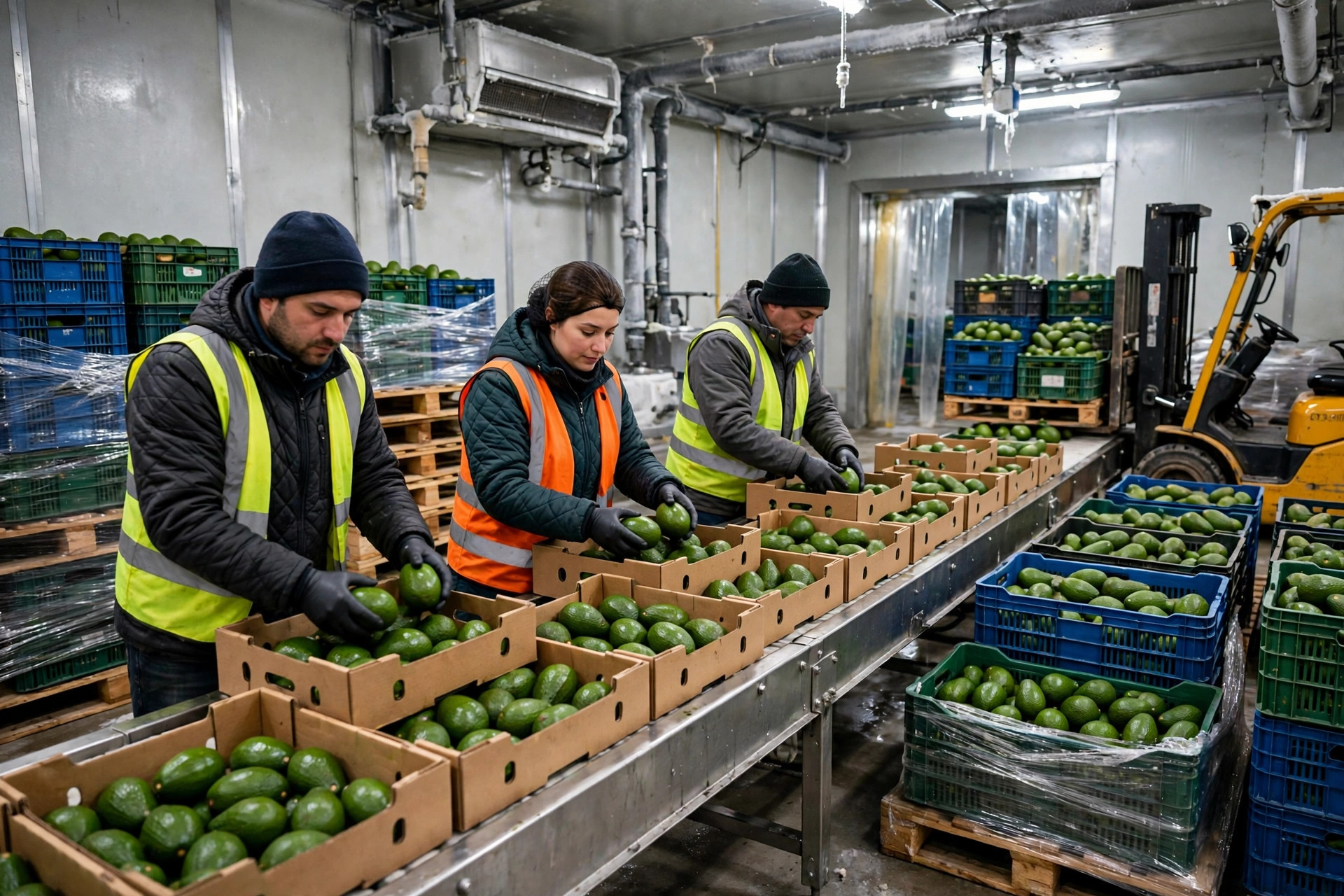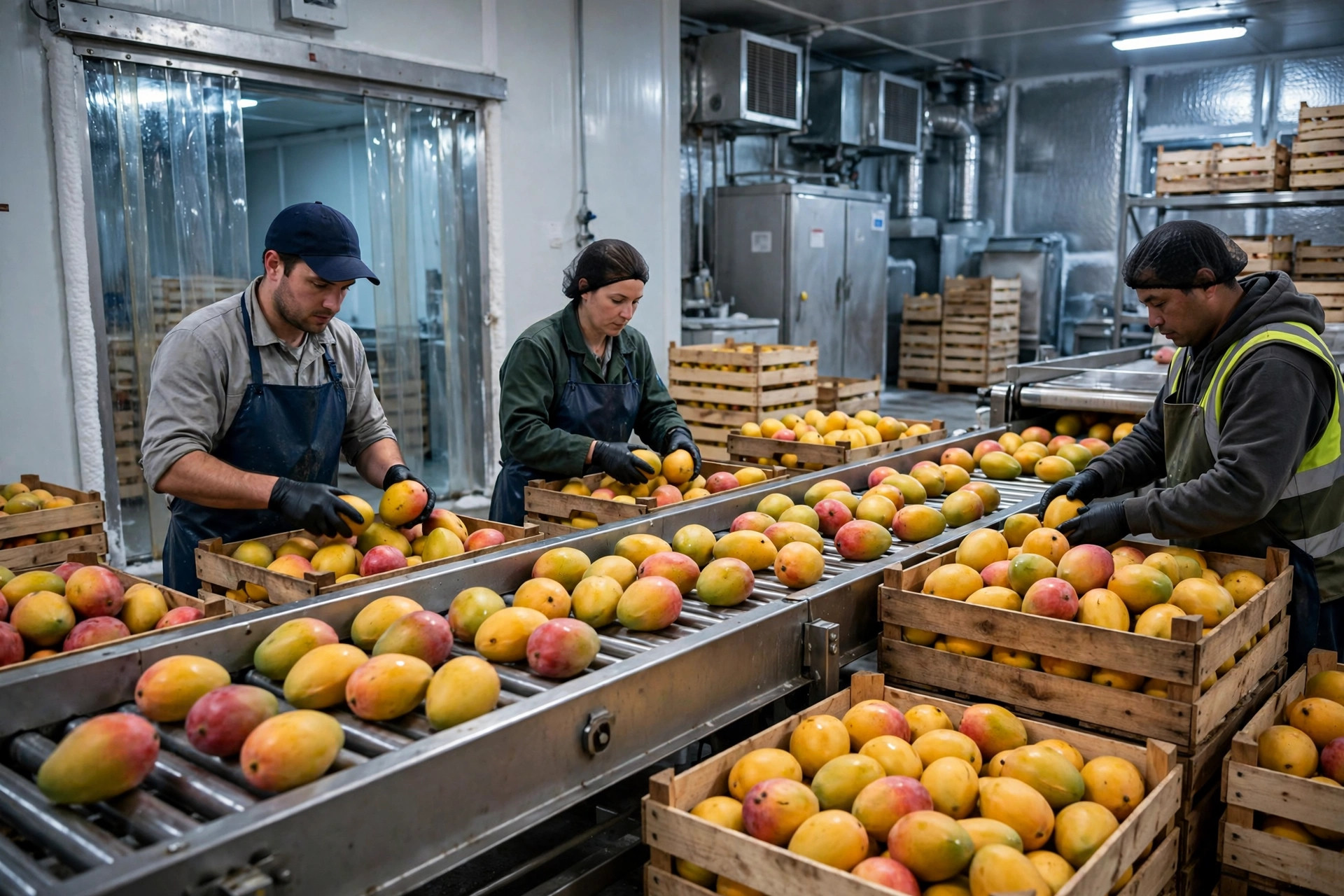
Let me be honest with you about the mango season. On the busiest days of the season, the packhouse lights are still on at three in the morning. The Alphonso crop is in, farmers' trucks queue at the gate, and inside, the team grades, washes, treats, pre-cools, and packs. If any step runs half a beat slow, the trucks back up onto the road. One morning I stood at the gate with the plant manager for ten minutes, watching a truck unload, and he pointed at the fruit and said: this load goes to the United States, and its treatment line is completely different from the Japan load. Mix them up once, and the whole plant's day is wasted.
That is the lifeblood of a mango packhouse. The same Alphonso mango goes to the United States, Japan, and the European Union on three different treatment lines. The United States line uses irradiation. The Japan line uses vapor heat treatment, or VHT. The European Union line follows its protocol, which may call for hot water treatment or VHT. Send fruit down the wrong line and it will not clear the destination port. Send it down the right line but skip proper pre-cooling, and the fruit warms up slowly on the plane or the ship and arrives downgraded anyway. A packhouse does not earn its money from treatment fees. It earns it from two things: getting the treatment right and never breaking the cold chain.
Three mango treatment lines: sort first, then start work
Our plant's rule now is to sort before anything else. When fruit arrives, the first job is not the treatment line. It is the order: which country is this batch going to? That decides the line. Each line entrance carries a sign with the destination country on it, and switching lines means switching the sign and the record. Nobody works from memory.
The United States line uses irradiation. A lot of people frown when they hear that word, as if treated fruit somehow becomes unsafe to eat. Let me be straight about it. Irradiation is one of the phytosanitary treatments recognized by the United States Department of Agriculture's Animal and Plant Health Inspection Service, and the treatment itself does not make the fruit radioactive. The exact dose and operating requirements follow the current protocol and the treatment facility's authorization. The packhouse follows the protocol and the certificate, not rumors.
The Japan line uses VHT. Vapor heat treatment is all about core temperature and time. Heat too fast and the fruit scalds. Heat too slowly and the pest control fails. After treatment, the fruit must be pre-cooled fast. In March 2026, trade news reported that Japan had suspended acceptance of Indian mangoes after a fumigation and disinfection failure at one VHT facility. Treat that as a news hook, not a fact to copy: the current position should be checked against notices from India's National Plant Protection Organization and APEDA. I raise it for one reason. When a treatment facility's authorization and records fail, it is not just one facility that stops. The whole export channel stops. When a packhouse chooses a treatment partner, it checks authorization and records first and price second.
The European Union line follows its protocol for the year, which may specify hot water treatment or VHT. Do not work from last year's experience. Protocols can change year to year. If last year was hot water and this year is VHT, and you still run the old method, the shipment will stall at the destination port.
| Destination | Treatment line | Where packhouses most often fail |
|---|---|---|
| United States | Irradiation | Certificates that do not match batches, expired facility authorization |
| Japan | VHT | Core temperature not reached, slow pre-cooling after treatment |
| European Union | Hot water or VHT, per the current protocol | Working from last year's experience without rechecking the protocol |
Mango pre-cooling: a step you cannot skip and cannot rush
After treatment comes pre-cooling. Brothers, pre-cooling is not "put it in the cold room and call it done." Pre-cooling is about speed and uniformity. Fruit comes off the treatment line still carrying heat. Pack it warm and load it onto a plane, and the fruit in the middle of the carton warms all the way to arrival. Open the carton at destination and you find the outer fruit fine and the middle fruit soft, and the whole carton gets discounted.
Our plant's fixed procedure now is this: fruit enters pre-cooling within two hours of treatment, it is only packed once it reaches the target temperature, and carton temperatures are spot-checked at packing. A carton that fails the spot check does not get sealed. Pre-cooling room temperature records are stapled to the batch number, so that if anything goes wrong, we can trace back to the batch, the room, and the hour it entered.
Here is a counterintuitive point: colder is not always better. Alphonso mangoes suffer chilling injury. Push the temperature too low and the fruit looks fine on the outside while the flesh is already damaged inside. Set the pre-cooling target from the buyer's contract and the packhouse's operating procedure, not from someone telling you that colder is safer. In cold chain work, steady beats low, fast beats slow, and uniform beats a single cold spot.
Air or sea: keep the two ledgers separate
Mango exporters always ask about air versus sea. Air is fast and sea is cheap, but the bill cannot be judged on freight rate alone. Air's advantage is short transit and low shelf-life loss, which suits early-season high-value fruit and orders with tight ripeness windows. Sea's advantage is low freight cost per kilo, which suits large volumes with wider ripeness windows, but sea transit is long, and pre-cooling, packaging, and in-carton temperature control have to be tighter, because a small problem grows into a big one at sea.
When our plant quotes a customer, we never quote freight alone. For air, we count treatment, pre-cooling, airport cold storage, and the time to clear customs and collect at destination. For sea, we count in-transit loss, shelf life left after arrival, and the discount if the shipment is delayed. Once both sides are counted in full, the customer usually knows which one to pick. Pick the wrong transport mode and even perfect treatment will not save the shipment.
The mango packhouse paper trail: batch, temperature, and certificate records
There is one more ledger in a packhouse that many people dislike counting: the records ledger. Mango export buyers and destination ports want three documents: the batch sheet, the temperature sheet, and the certificate sheet. The batch sheet says which batch, which farm, and which harvest day. The temperature sheet says when pre-cooling started and ended and what the carton spot checks showed. The certificate sheet says the treatment facility's authorization, the treatment record, and the phytosanitary certificate number. If those three do not match, the shipment waits at the port.
Our plant learned this the hard way once. A shipment bound for the European Union had a batch number on its treatment record that differed by one digit from the packing list. Customs held it for two days, the fruit spent two extra days in airport cold storage, and two days came straight off its shelf life. After that, the plant set a rule: the three sheets get reconciled before closing time every day, and no carton gets sealed until they match, with two signatures on the seal, the packer and the checker. One signature is never enough.
Good records have another benefit: they let you trace a problem backward. A buyer questions temperature, you open the temperature sheet. A buyer questions treatment, you open the certificate sheet. A buyer questions mixed batches, you open the batch sheet. With complete documents, even an argument has a foundation. Without them, everything sounds like an excuse. In the end, a packhouse's work comes down to whether those three sheets are complete.
One last reminder for fellow operators. On the surface, a packhouse grades, treats, and packs. In reality, it does three things: sorting, records, and temperature. Sort wrong and the shipment never clears the port. Break the records and you cannot explain a problem. Break the temperature and the fruit arrives unsellable. Do those three things right every day, and even in the busiest week, the plant will not fall apart.
By Chen Feng, Warehouse Operations Manager