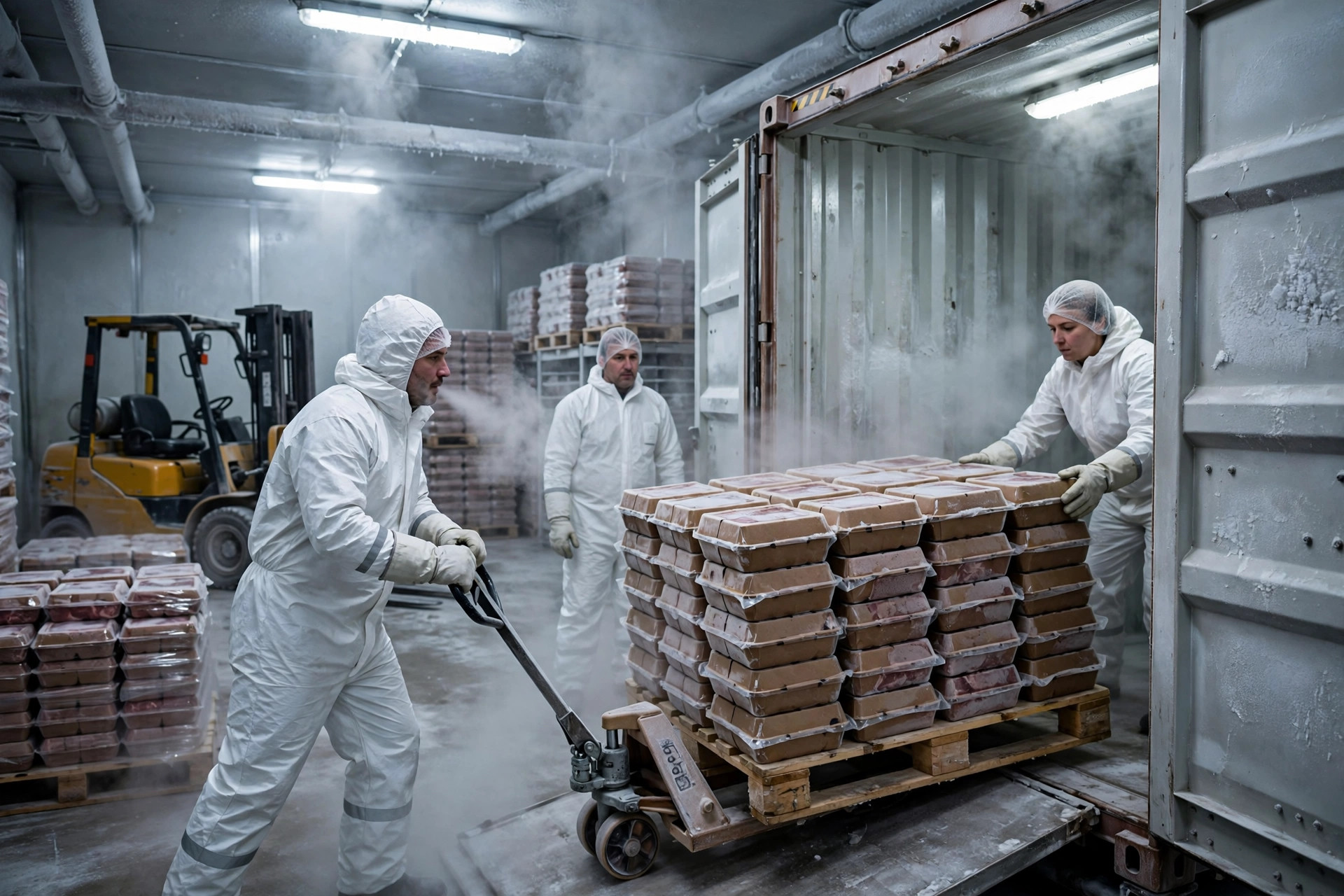
Ask an ice cream cold storage warehouse manager how cold the warehouse should be, and you will usually get the wrong conversation. It is like asking how much horsepower a truck needs without saying what it hauls or where it drives. The number alone means nothing. Ice cream does not fear cold. It fears temperature swings. A bar held steady at minus 18 degrees Celsius will taste better than one bounced between minus 25 and minus 15 all week. Swing the temperature and the ice crystals grow, the texture turns gritty, and the customer ends up eating ice chips, not ice cream.
Ice Cream Cold Storage Warehouse Physics: Ice Crystals First, Temperature Second
Texture in ice cream is mostly a story about crystal size. Fresh from the line, the crystals are tiny and the mouthfeel is smooth. Warm the product slightly and some small crystals melt. Cool it again and that water does not return to its old, fine crystals. It joins neighboring large crystals instead. This is recrystallization, and it is cumulative. A few cycles are invisible. A dozen cycles ruin the product.
That is why the controlling metric in ice cream cold storage is not the lowest temperature reached, but the size of the swing. The common storage standard is minus 18 degrees or below, and many brands set warehouse targets between minus 22 and minus 25 to leave headroom for loading, transport, and door openings. Think of it as a flood margin: you do not want the lowest possible water level, you want the smallest rise and fall.
Humidity is the quiet partner in this problem. Every time a dock door opens, warm moist air enters and frost builds on racks and packaging. Thick frost cuts heat-exchange efficiency, forces compressors to run longer, raises the power bill, and makes temperature less stable. Frost is not a housekeeping issue. It is a money and stability issue.
Two Cold-Storage Stories: One Lost at the Door, One Won on Layout
In the summer of 2023, a regional distributor in eastern China had a textbook mystery. The control panel showed a healthy minus 21 degrees, day after day. Yet by late July, complaints piled up from convenience stores: soft bars, frosted surfaces, sandy texture. The investigation finally looked away from the panel and toward the dock door. During the morning loading peak, the door stood open while forklifts moved in and out, and the two rack rows nearest the door regularly warmed to minus 12 degrees, then fell back to minus 22 in the afternoon. Two or three swings a day, for a month, destroyed the door-zone stock while the center of the warehouse stayed perfect. The sensor measured the middle. The damage happened at the edge.
In the same season, a different operator serving convenience chains made the opposite choice. Instead of buying a bigger refrigeration plant, it enclosed the dock, added an air curtain and strip curtain, and moved the ice cream picking zone from the door to the far side of the cold room. The change cost a fraction of a new compressor set. Temperature swings at the door racks narrowed from about 10 degrees to under 3 degrees, and summer complaints dropped to zero. Both stories point to the same lesson: in ice cream cold storage, the enemy is often the door and the layout, not the refrigeration plant.
Ice Cream Cold Storage Warehouse Selection: Four Lines Before You Buy Equipment
Before choosing equipment, place your operation on four dividing lines. Get them wrong and no equipment list will save you:
| Dividing line | Side A | Side B | Cost of choosing wrong |
|---|---|---|---|
| Storage duration | Turns over within two weeks | Stored for over a month | Long-stored stock in a short-turn room slowly recrystallizes |
| Order pattern | Full pallets in and out daily | Hundreds of small picks daily | A pick-heavy room without a buffer zone multiplies door openings |
| Temperature job | Hold at minus 18 degrees | Blast-freeze then hold at minus 25 | Running a blast freezer as a store room burns power for nothing |
| Delivery radius | Same-city, same-day | Cross-province, two to three days | Long-haul stock without pre-cooling and a chilled handover fails at the last mile |
The rule is blunt: if three of the four lines fall on the expensive side, do not build the cheap-side warehouse. The classic fake requirement here is demanding blast-freezing capacity from a storage room, or managing a cold room with ambient-warehouse routines. The specification grows longer, while the door, the layout, and swing control — the things that actually protect quality — get no attention.
On plant sizing, one hard rule matters more than brand debates: size the plant for the hottest day's peak load, plus roughly 20 percent headroom, never for the average load. A plant sized on averages will fall behind exactly when summer peaks. Insulation tells a similar story. Panel thickness matters less than joint treatment and door sealing, because most cold loss escapes through gaps, not through the middle of a panel.
Cold-Room Maintenance: Three Pits That Eat Money
Three maintenance pits deserve direct language.
The first is late defrosting. As frost thickens on evaporators, heat exchange falls, compressors run longer, power bills rise, and temperature grows less stable. Set defrost intervals by frost thickness, not by the calendar. In peak season, with frequent door openings, frost grows fast and defrost must follow. In the off-season, the reverse holds.
The second is averaging temperature records. A warehouse that logs two or three readings a day can show a perfect average while hiding every swing. What an ice cream freezer room needs is the maximum, the minimum, and the number of swings, logged at least hourly, with separate sensors at the door, the center, and the corners. Data without location is barely data.
The third is mixed storage. Ice cream stored beside strong-smelling frozen seafood or other pungent goods picks up off-flavors, and customers notice immediately. Worse, mixed storage usually means frequent door openings to hunt for stock, which adds more swings. Separate zones are not fussiness. They are a quality floor.
Doing the Math: What a Temperature Swing Actually Costs
Take a mid-sized ice cream freezer warehouse and run conservative numbers. Suppose standing stock is worth 2 million yuan, and the door zone holds 20 percent of it, or 400,000 yuan. If uncontrolled door swings damage just 10 percent of that door-zone stock over a summer quarter through downgrading or write-offs, the direct loss is 40,000 yuan. That excludes complaint handling, return freight, and brand damage.
Now price the fix. An enclosed dock, an air curtain, moving the picking zone inward, and adding door-zone sensors typically cost tens of thousands of yuan, paid once, and the benefit repeats every summer. By contrast, pushing the whole warehouse from minus 22 down to minus 28 degrees can raise refrigeration power costs by 20 to 30 percent a month, adding up over a year to more than twice the dock fix, without improving texture — because the swing was never addressed. Lower absolute temperature without swing control is money spent on the wrong variable.
That is the counterintuitive core of this business: spending on colder equipment does not necessarily protect quality, while spending on stability does. Most people hear cold chain and think colder machines. They should first think steadier rooms.
So here is the single test I would apply to any ice cream cold storage warehouse. Do not start with the compressor brand or the number on the control panel. Pull the last month of temperature curves for the racks nearest the door: how high did they go, and how many times did they swing? Whether the money was well spent comes down to that one number.
By Da Liu, Automation Engineer