slug: humanoid-robots-warehouse-2026-deployment-reality-guide lang: en title: Humanoid Robots in Warehouses: A 2026 Deployment Reality Check excerpt: 2026 is the first year humanoid robots moved from stage demos into factories and warehouses. Based on public data on humanoid robots warehouse deployment 2026, this article reviews real cases—Figure, Digit, Atlas—examines why 2026 was the turning point, and maps the four gaps to scale: uptime, unit economics, safety compliance, and task depth, with a pilot evaluation framework. section: ai subcategory: outlook region: common tags: ['humanoid-robots','warehouse-automation','robotics-deployment','industry-outlook','amr','warehouse-labor'] author: 陈博士
If you searched "humanoid robots warehouse deployment 2026" two years ago, you got press releases. Search it today and you get something different: deployment logs, customer names, and operating hours. 2026 is the first year in which the humanoid robot conversation in logistics moved from stage demos to site data. That shift deserves a careful accounting—because "deployed" is a word that can mean many things.
Three kinds of real humanoid deployments in 2026
It helps to separate what actually happened into three categories.
The first is automotive plant logistics. According to public reports, Figure 02 units took part in production work at BMW's Spartanburg plant in 2025—work touching roughly 30,000 vehicles—and in June 2026, the Figure 03 moved into the same plant for logistics tasks. This is not a demo bay; it is a continuous production environment.
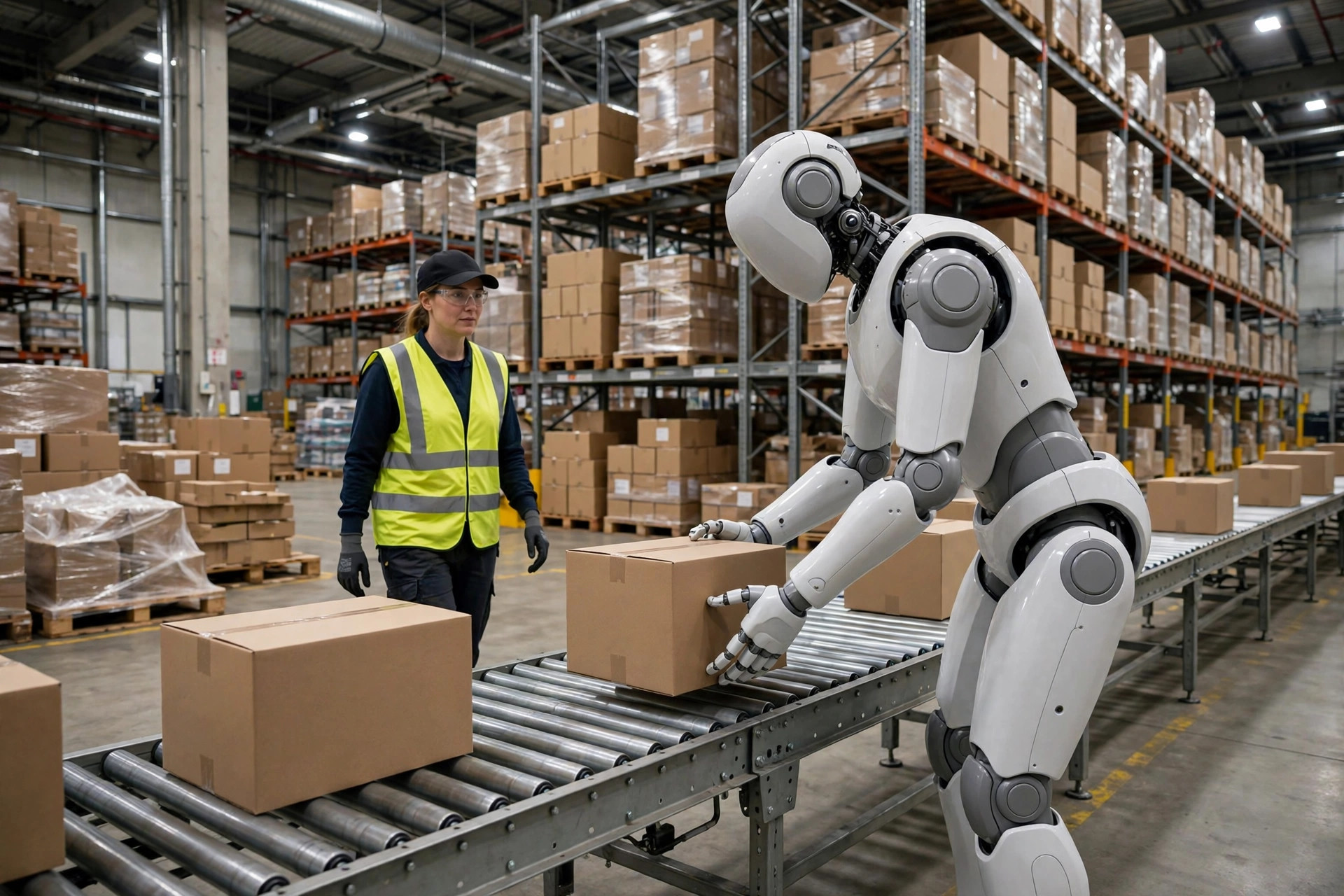
The second is third-party logistics warehouses. Agility's Digit fleet has logged more than 65,000 operating hours across customers including GXO, Schaeffler, Amazon, and Toyota; in one GXO logistics project, Digit units moved more than 100,000 totes. The 65,000-hour figure is worth pausing on: it marks the first time the industry's argument shifted from "look what it can do" to "look how much work it did."
The third is training grounds and factory floors. Boston Dynamics opened a robotics applications center at Hyundai's Georgia campus in September 2026, where Atlas trains on automotive logistics and sorting. In China, BYD and UBTech have deployed a combined 100–200 units, and Mercedes-Benz is working with Apptronik robots. A training ground is not a deployment—but it is the step before one.
The backdrop numbers come from the IFR's September 2026 data: 603,000 new industrial robots installed worldwide in 2025, up 11%, with the global installed base crossing 5 million units. The humanoid robot market is estimated at roughly $5.4 billion in 2026, projected to reach about $50.3 billion by 2035. And the number of companies entering the space grew from about 50 in 2025 to more than 250 in 2026.

Why humanoid warehouse deployment took off in 2026, not earlier
Three structural changes arrived together, and it is the combination that matters.
First, physical AI matured. Vision-language-action (VLA) models moved robots from hard-coded programs toward learning from demonstrations and instructions, lowering the barrier to task generalization for the first time. A new SKU used to mean reprogramming; in theory, it can now mean a demonstration. Note the qualifier: in theory.
Second, manufacturing capacity appeared. Figure's BotQ factory had produced more than 350 Figure 03 units by April 2026, with a demonstrated rate of about one unit per hour. The number itself is small, but it gives humanoids something they never had before: a capacity figure. Without capacity, talk of scale is empty.
Third, the evaluation standard changed. Operating hours, totes moved, units built—the industry started arguing with site data instead of highlight reels. That may be 2026's most durable contribution to the humanoid robots warehouse deployment story: the discussion finally has a dataset, not just a sizzle reel.
There is also a demand-side force worth naming. Warehouses in the US and Europe have lived with structural labor shortages for several years now, and the economics of night shifts and peak-season hiring keep deteriorating. None of this guarantees that humanoids are the answer—but it explains why operators were willing to open their doors to pilots in 2026 rather than 2028.
Four gaps between humanoid pilots and warehouse scale
The data is real, and so are the gaps.
The first is uptime. A warehouse needs year-round availability. A demo succeeds once; a site deployment has to run a thousand hours without a failure cascade. A humanoid has dozens of joints, and its fault-point density is far higher than an AGV or AMR. When a robot goes down mid-shift, a human fills the gap—and the labor math unravels.
The second is unit economics, and here is the contrarian point: the humanoid's real competitor is not the warehouse worker. It is the established combination of forklifts, AMRs, and fixed robotic arms, which a decade of price erosion has made remarkably cheap. The sticker price is only the down payment; the real calculation is three-year total cost of ownership—maintenance, spare parts, charging or battery swaps, on-site support staff. Any proposal that quotes a unit price without a TCO model can be skipped.
The third is safety compliance. Working alongside people in shared space is not a video release; it is a certification process measured in years. Warehouse managers should understand that the safety review timeline may exceed the equipment delivery timeline.
The fourth is the tension between generality and depth. A warehouse does not need a robot that can do a little of everything; it needs one that does picking, moving, and palletizing at 99.9% reliability. VLA models made generality easier, but pushing a single task to industrial-grade reliability remains hard engineering. Versatility and reliability are still opposite ends of a trade-off.
| Evaluation dimension | What to look at | Pass bar | Red flag |
|---|---|---|---|
| Task definition | Limited to one repetitive task with clear boundaries | Fixed task, enumerable exceptions | Task changes every week |
| Data dashboard | Real uptime, mean time to repair, error rate | Data from your own site | Demo videos only |
| Economics | Three-year TCO vs. current approach | Includes maintenance labor and spares | Unit price only |
| Exit terms | Can the pilot be unwound cleanly | Short term, returnable | Deposit plus long lock-in |
What a warehouse manager should do now
Four steps, in order.
First, don't buy generation one—buy generation two. Industrial equipment history is consistent on this point: first-generation products pay the vendor's tuition. Wait for a full year of real-site data.
Second, pilot before you purchase. Have the vendor run on your SKUs, on your aisles, for two weeks, and let the data speak. Write the data dashboard into the pilot contract—uptime, error rate, mean time to repair. If one is missing, don't sign.
Third, get your own house in order first. Standard operating procedures, exception lists, takt times—a robot amplifies the efficiency of your existing process, and it amplifies the chaos too. Putting a robot into an unsorted process is giving chaos a pair of legs.
Fourth, do the TCO math before the vendor meeting. Print the evaluation framework above and tape it to the meeting room wall; check every vendor claim against it.
The thing most worth recording about 2026 may not be "the humanoids finally arrived." It may be that, for the first time, we can discuss them with operating data instead of sizzle reels. Digit's 65,000 hours, BotQ's one unit per hour, 250 market entrants—which of these numbers will look like the watershed five years from now is impossible to say today. The only certainty is this: the next time a technology wave reaches the warehouse, we want data in our hands, not memories.
By Dr. Chen, Supply Chain Researcher