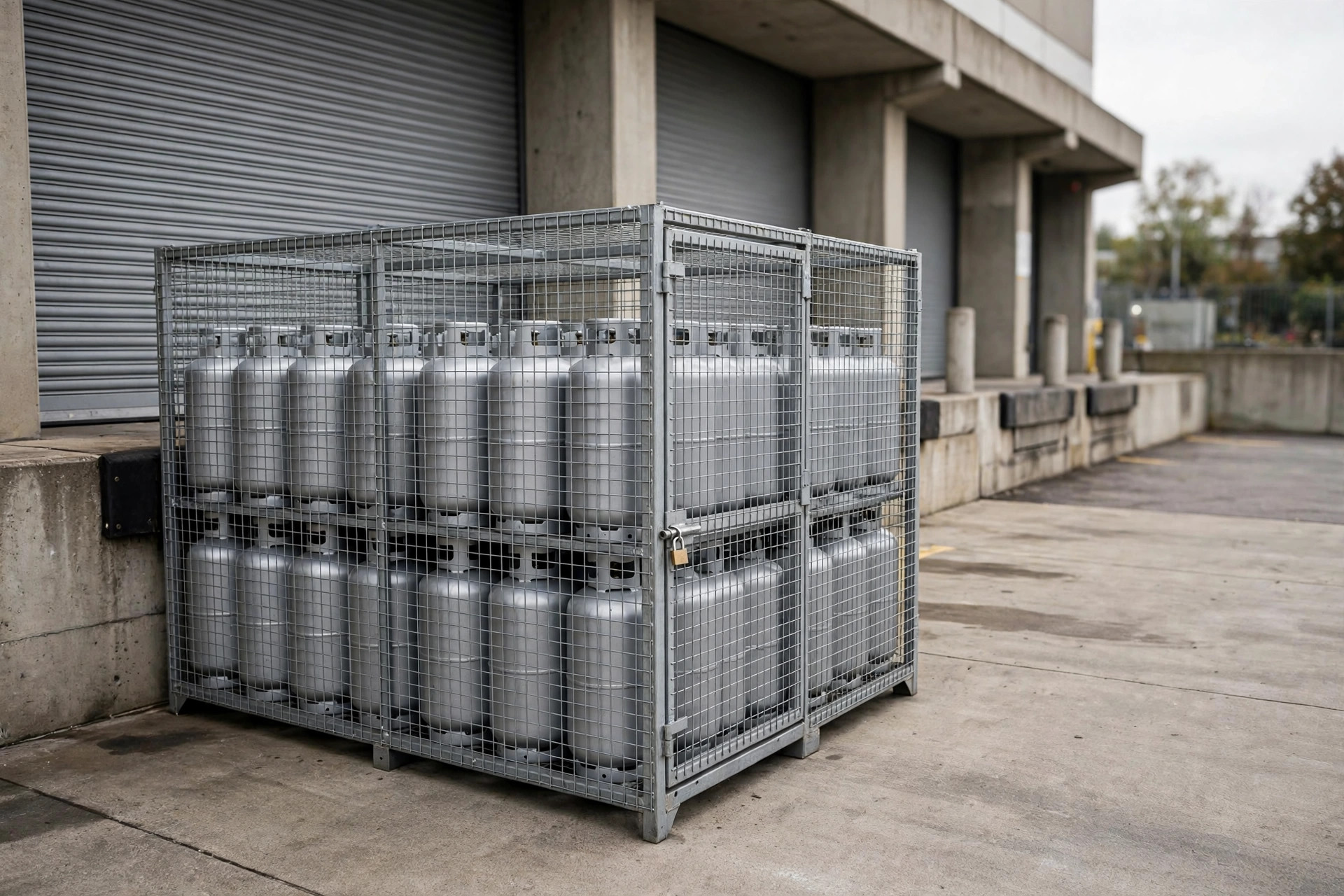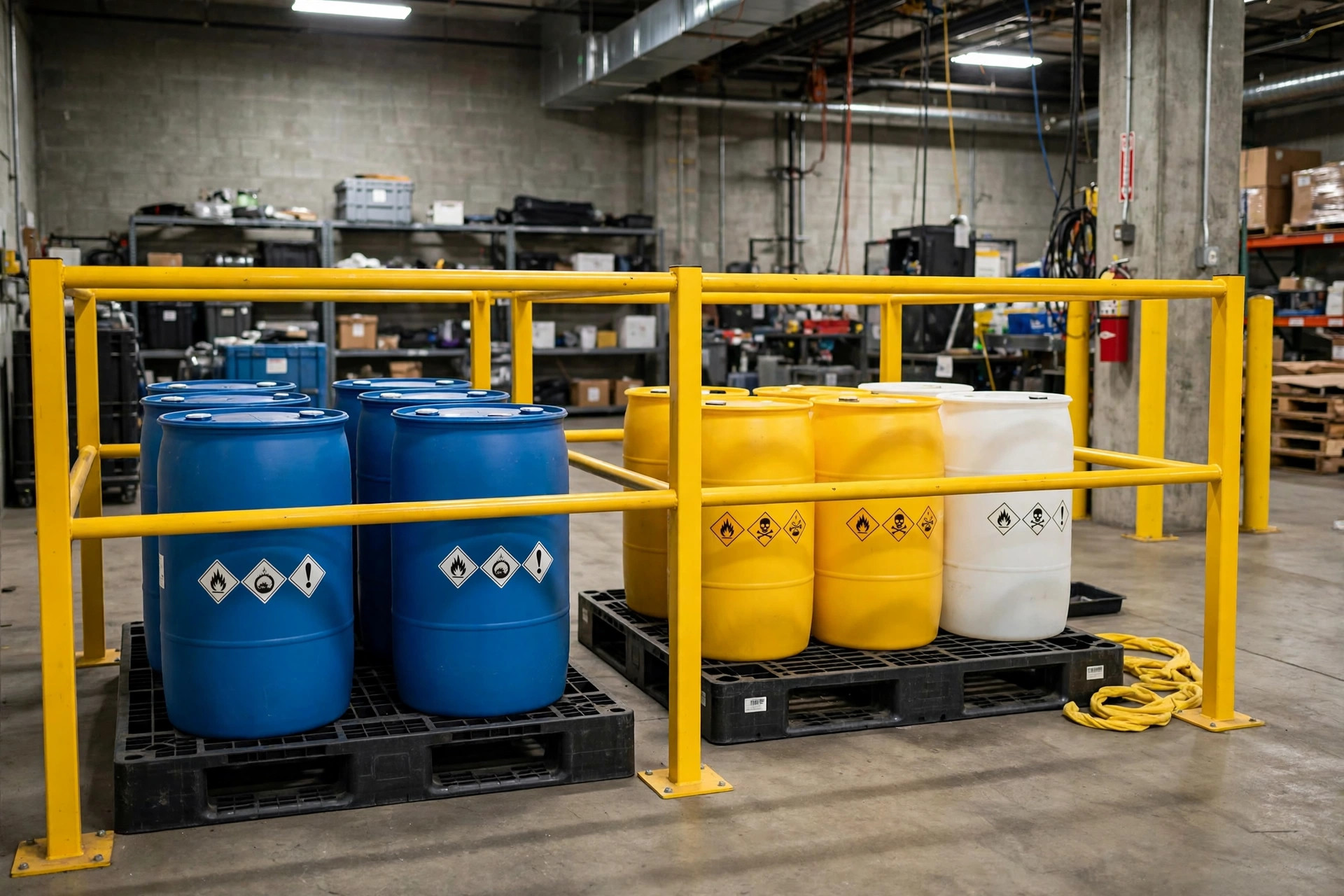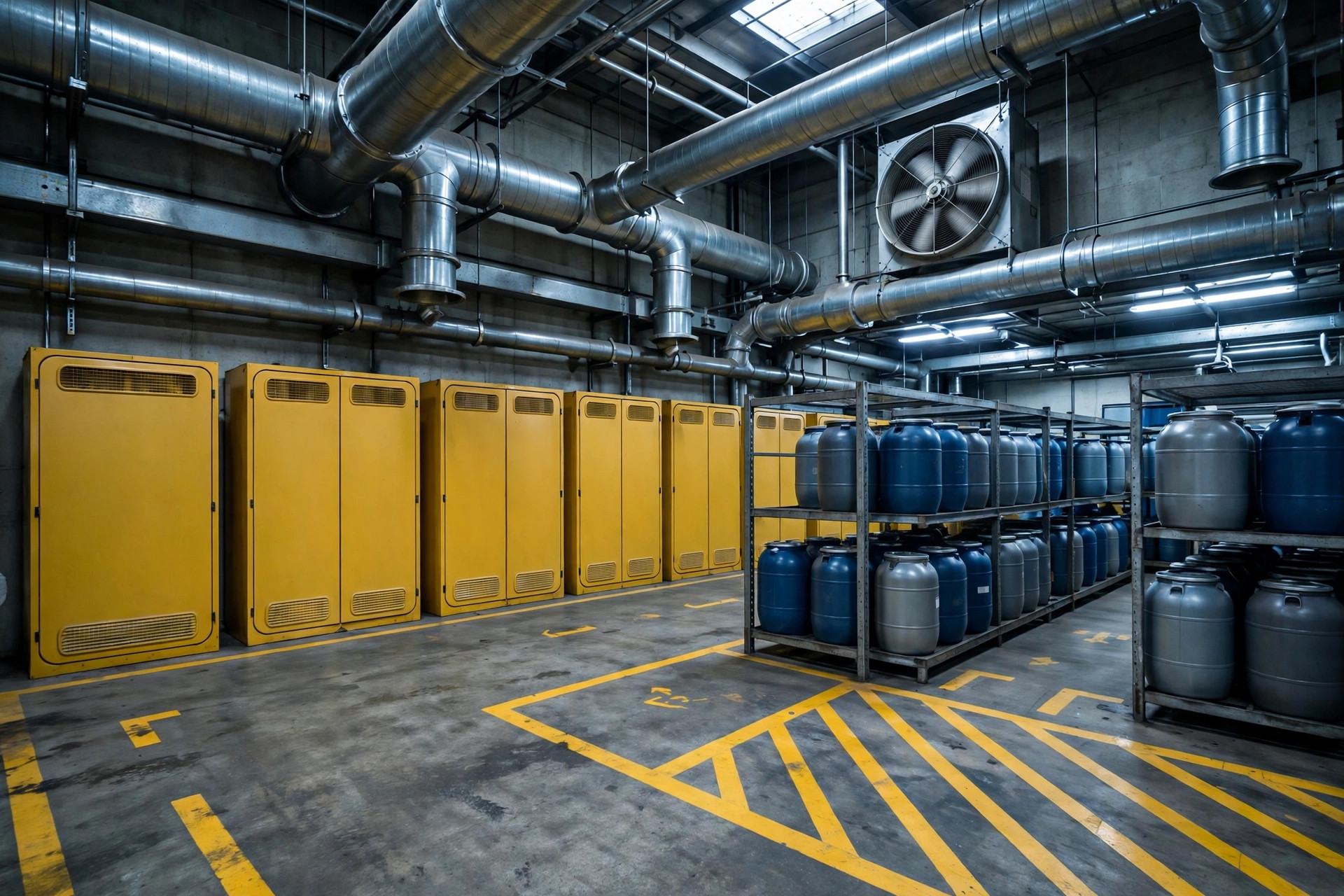
Fall 2023. I was walking a 3PL warehouse in Chino, California through its annual fire inspection — 40,000-plus square feet, mostly paint and thinners, Class III flammable liquids. The inspector held an anemometer up to the exhaust vent, ran it around the room, and turned to the site manager: "You're measuring under three air changes an hour. What was this designed for?" The manager went quiet. The contractor who installed the system had sized it like an ordinary warehouse. Never passed. The fix ran close to $40,000, and the hazmat area sat idle for two weeks.
Here's my verdict up front: hazmat ventilation comes down to three numbers — whether the fans are explosion-proof, whether the air changes are enough, and whether the gas alarms actually trigger the fans. If any one of those three collapses, everything you spent was wasted.
Pick the Wrong Fan and You Installed Nothing
A standard fan inside a hazmat room is an ignition source wearing a disguise. Motor start-up arcs, impeller-to-housing friction sparks, static from a slipping belt — once solvent vapor hits concentration, any of them can light the room. So the first rule is non-negotiable: the motor must be rated for the hazardous location. Under NFPA 70, a typical hazmat storage area is classified Class I, Division 2. That classification needs to be on the motor nameplate. A general-duty motor with a fresh coat of paint doesn't count.
Second, the impeller and housing have to be spark-resistant. The industry grades this under AMCA spark-resistant construction — Types A, B, and C, and you want Type B or better: aluminum alloy impellers, non-ferrous construction, anti-static coatings. The worst one I ever saw was a steel impeller in a steel housing. The inspector's face said everything.
Third, go direct-drive whenever you can. Belt drives slip, overheat, age out, and build static — every one of those is a failure mode you don't need in a hazmat room. If you must use a belt drive, the belt has to be static-conductive, and it goes on the daily inspection list.
Then there's placement, and I'd guess three out of ten warehouses get this wrong: exhaust intakes belong low. Toluene and acetone vapors are heavier than air. They leak, they sink, they pool at the floor. Mount your exhaust at the ceiling and the fan happily pulls clean air off the top while a blanket of vapor sits undisturbed at ground level. You've ventilated the ceiling. The right layout is exhaust low on one side, makeup air high on the opposite diagonal, so the airflow sweeps the whole room and drags the floor-level vapor out with it.
Air Changes Are Not a Guess
This number has a legal floor. OSHA 1910.106(d)(4) is explicit: inside storage rooms for flammable liquids, mechanical ventilation must provide at least six complete air changes per hour. "At least" — it's a floor, not a suggestion. The math is simple:
Room volume (cubic feet) × 6 ÷ 60 = minimum airflow (CFM)
Take a hazmat room of 5,000 square feet with a 20-foot clear height: 100,000 cubic feet, which means a minimum of 10,000 CFM. Add 15 to 20 percent margin when you pick the fan, because every duct elbow and every foot of duct run eats into delivered airflow. A fan rated 12,000 CFM on the nameplate delivering 10,000 after installation is a good install, not a bad fan.
But sizing the exhaust is only half the job — makeup air has to keep up. Exhaust without matching makeup air pulls the room into negative pressure. Doors become hard to push open, the fan starts choking, and measured airflow drops by half. That was part of what killed the Chino warehouse: the exhaust fan was big enough, but the makeup air openings were undersized, so the fan spent its life starved. The fix sized makeup openings at roughly 1.1 times the exhaust volume, and measured air changes finally cleared six.
In California there's another layer: CUPA agencies and the local fire marshal actually measure during annual inspections. They don't just glance at the drawings. Keep three things ready — the design calculations, the fan nameplates, and the commissioning measurements. Missing any one of them can earn you a correction notice.
An Alarm That Doesn't Trip the Fans Is Decoration
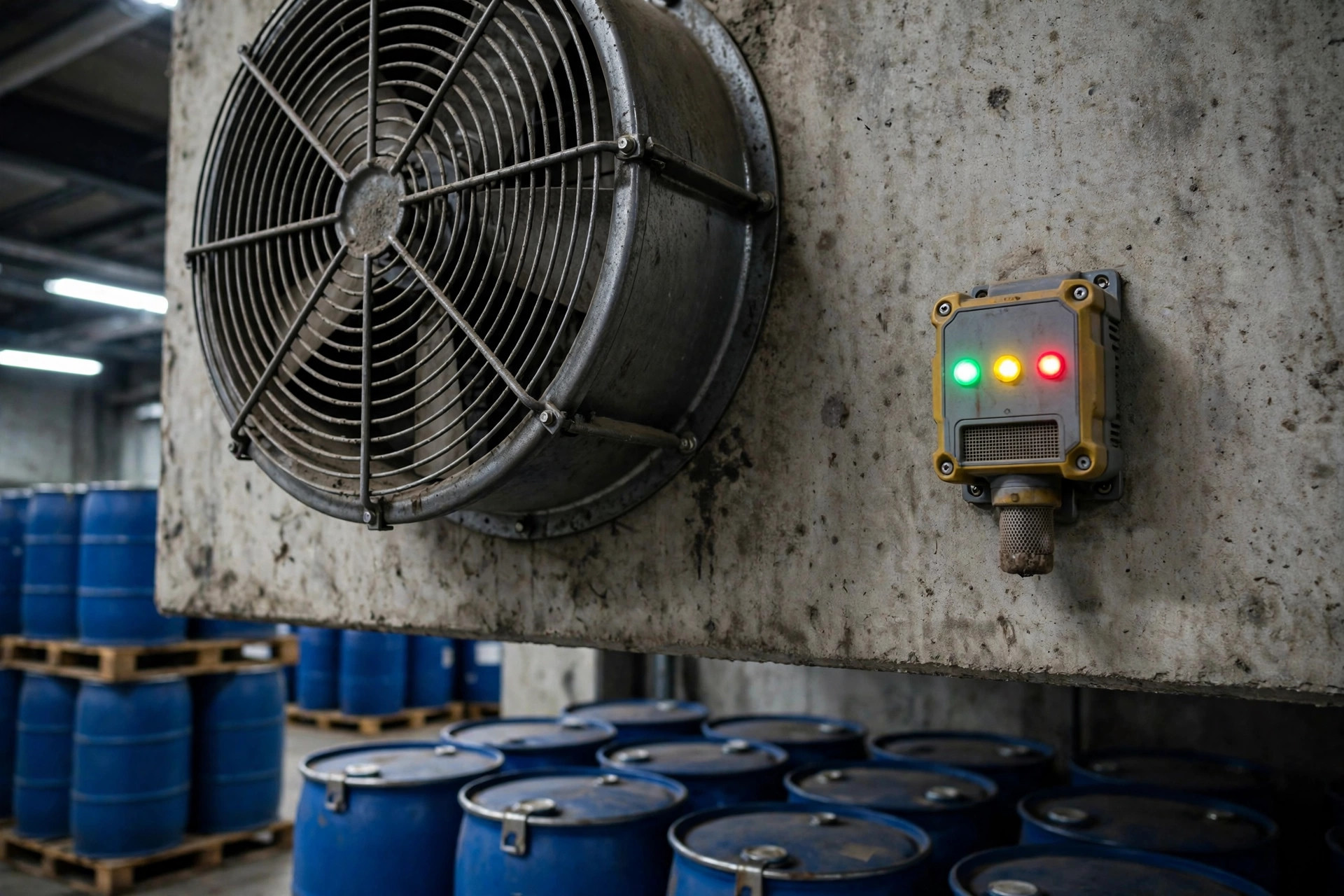
Combustible gas detectors aren't expensive. Getting them right is. The industry-standard two-stage setup: 10% LEL warning, 25% LEL high alarm. LEL is the lower explosive limit — at 10% you're being told the concentration is climbing, pay attention; at 25%, the system must act on its own: exhaust fans to full speed, non-explosion-proof electrical circuits de-energized, audible and visual alarms pushed to the duty phone and the fire control room. Every link in that chain has to be tested live during commissioning. A line on a drawing that was never energized doesn't count.
Sensor placement follows the same physics as the exhaust: heavy vapors sink, so sensors mount low, about a foot off the floor. A sensor on the ceiling may stay quiet while the floor reaches explosive concentration. And don't mount a sensor directly under an exhaust intake either — I've seen that one too. The fan keeps a pocket of clean air swirling around the sensor forever. It will never alarm. Sensors go near potential leak sources, in reasonably stable airflow.
Finally, calibration. Electrochemical and catalytic-bead sensors drift. Calibrate every six months, and keep the records on file. An uncalibrated sensor is a blind sensor. One warehouse had two false alarms in three years; the third time it went off, the night shift just pulled the plug. I walked out of that building. A high false-alarm rate is itself a diagnostic — wrong sensor location, or expired calibration. Find the cause. Never pull the plug.
A Ventilation Checklist You Can Run Tomorrow Morning
- Find the ventilation design. Confirm air changes ≥ 6 per hour. Lost the drawings? Do the volume math yourself and check the minimum CFM.
- Photograph the fan nameplates for your file: explosion-proof motor rating (Class I, Division 2 or better) and spark-resistant impeller construction. Both. Non-negotiable.
- Check placement: exhaust intakes low on one side, makeup air high on the opposite diagonal. If they're backwards, log it for correction.
- Run the system and measure: anemometer at every vent, total airflow ≥ 90% of design.
- Close the doors and try them: they should open normally, no obvious negative-pressure suction.
- Test the alarm chain end to end: sensor height, 10% LEL warning, 25% LEL high alarm, and confirm the interlocks really fire — fans to full speed, non-rated circuits cut, alarms pushed out.
- Calibration records: most recent calibration within six months, records retrievable and matching the installed sensors.
- Alarm log: any false or real alarms in the past year, with the cause written down.
- Fans and ductwork: look at dust buildup, corrosion, and belt wear (if belt-driven).
- Does your emergency plan have a "ventilation failure" section? When the fans die, does work stop, where do people go, and who makes that call?
If any of these ten gets a shrug, fix it before the inspector shows up. The anemometer in a fire marshal's hand is a lot more honest than my pen.