
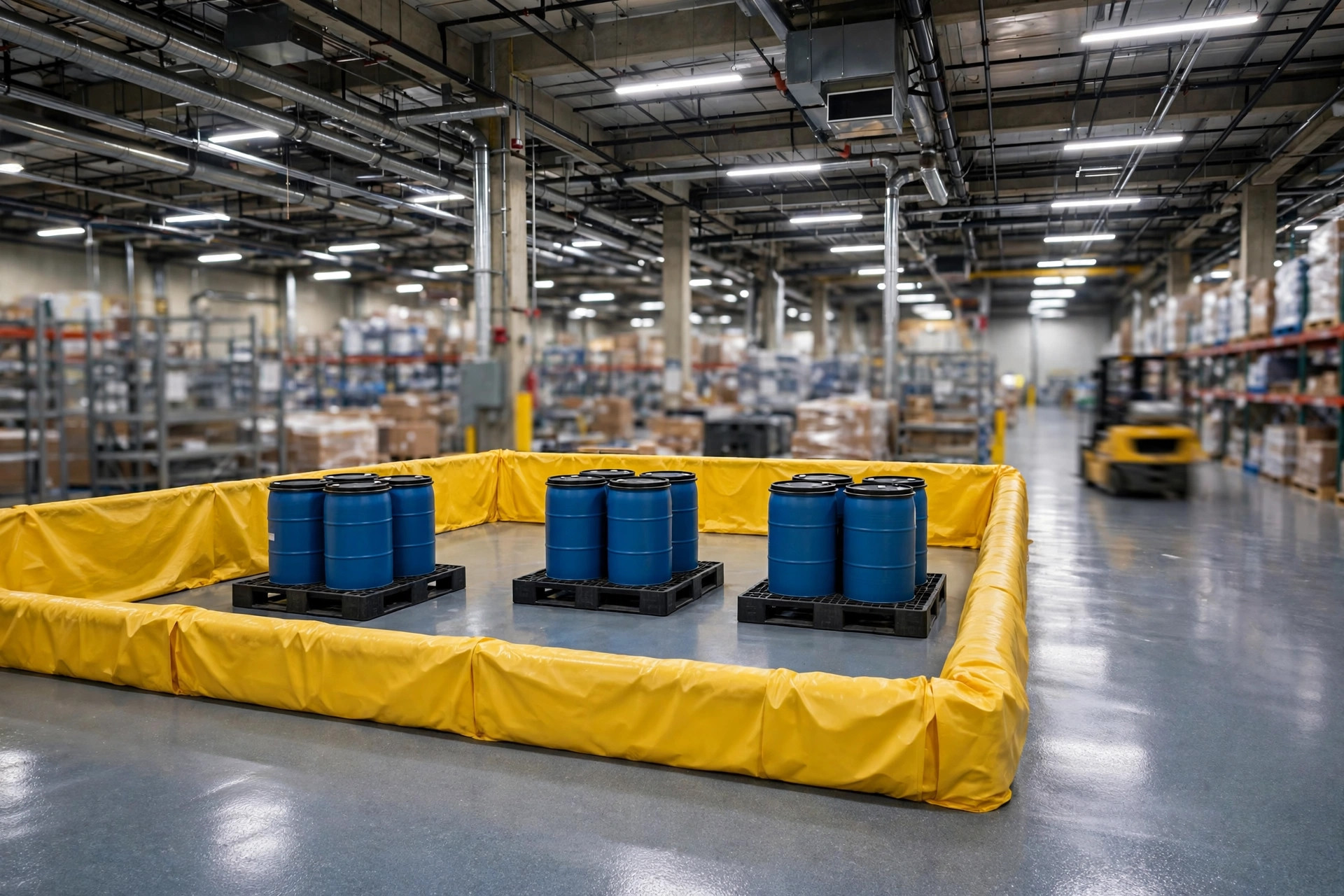
A 55-gallon drum costs under a hundred dollars wholesale. The 55 gallons of waste oil leaking out of it — seeping into the concrete slab, running toward a storm drain — can turn into a six-figure EPA cleanup bill. The difference between those two numbers is secondary containment, required in plain language by EPA under 40 CFR 112.7(c). Most warehouse operators file this under "environmental spending." I file it under arithmetic: spend a little to keep a spill inside a berm, or gamble on the big number.
What EPA Actually Requires: The Hard Numbers on Secondary Containment
People in finance hate "roughly" and "about." Fortunately, EPA gave us real numbers here. Four of them:
First, the capacity formula: containment must hold the greater of 100% of the largest single container or 10% of the total volume of all containers. Example: twenty 55-gallon drums total 1,100 gallons; 10% is 110 gallons, which beats a single 55-gallon drum, so the berm must hold at least 110 gallons. Four drums? Total 220 gallons, 10% is 22 gallons, less than one 55-gallon drum — so you size for 55 gallons. This is a floor, not a suggestion.
Second, the 1,320-gallon tripwire: facilities with more than 1,320 gallons of aboveground oil storage trigger a full SPCC (Spill Prevention, Control, and Countermeasure) Plan. Twenty-four 55-gallon drums equal exactly 1,320 gallons — not over. The 25th drum brings you to 1,375 gallons — over. Remember that number; it is the most expensive number in this article.
Third, eight acceptable methods: dikes, berms, curbing, culverting, weirs, booms, sumps, and spill diversion ponds, among others. Pick any — the only requirement that matters is that the spill cannot get out.
Fourth, containers cannot sit in their own spill: drums may not rest directly where leaked liquid could pool around them. Elevate them — for instance on grated spill pallets — or provide prompt drainage. This is the rule most facilities miss, and inspectors cite it.
Fall 2024, a 3PL warehouse outside Columbus, Ohio, taught me this lesson the expensive way. They stored 32 drums of hydraulic oil and cutting fluid directly on the concrete floor — no pallets, no berms, nothing. 32 × 55 = 1,760 gallons, well past the 1,320 line, and no SPCC Plan either. When the EPA regional inspection landed, the bill read like this: hire a licensed engineer to write the SPCC Plan, retrofit a concrete berm with chemical-resistant coating, train the whole crew on spill response. Three months of work, and in their own words, "enough money to buy 200 spill pallets." That is the classic move — save pennies, spend dollars. The containment money gets spent either way; the only question is whether you spend it proactively or reactively. Reactive usually costs 3–5x.
Three Containment Options, With the Money in the Right Columns
There are three mainstream approaches. Here is the cost table, using typical 2025–2026 U.S. market ranges — confirm with your own vendor quotes, but the order of magnitude will hold:
| Spill Pallets | Concrete Berm + Coating | Epoxy Floor, Full Area | |
|---|---|---|---|
| Upfront cost | $300–$600 per 4-drum pallet | $12–$23/sq ft for berm wall + coating | $5–$12/sq ft for epoxy |
| Cost at 20-drum scale | ~$1,500–$3,000 (5 pallets) | ~$3,000–$6,000 (250 sq ft zone) | ~$5,000–$12,000 (1,000 sq ft) |
| Lead time | Same day, drop and use | 1–2 weeks incl. coating cure | 3–7 days by area |
| Flexibility | Highest — move anytime | Lowest — poured in place | Low, but covers everything |
| Capacity ceiling | Limited by pallet sump volume | Engineered exactly to the formula | Needs local berms for capacity |
| Hidden costs | Eats floor space, forklift damage | Locks your layout permanently | Hard to spot damage, costly repairs |
| Best for | Few drums, changing layout, leased space | Fixed hazmat zone, owned long-term | Whole-floor coverage, cleanroom-grade needs |
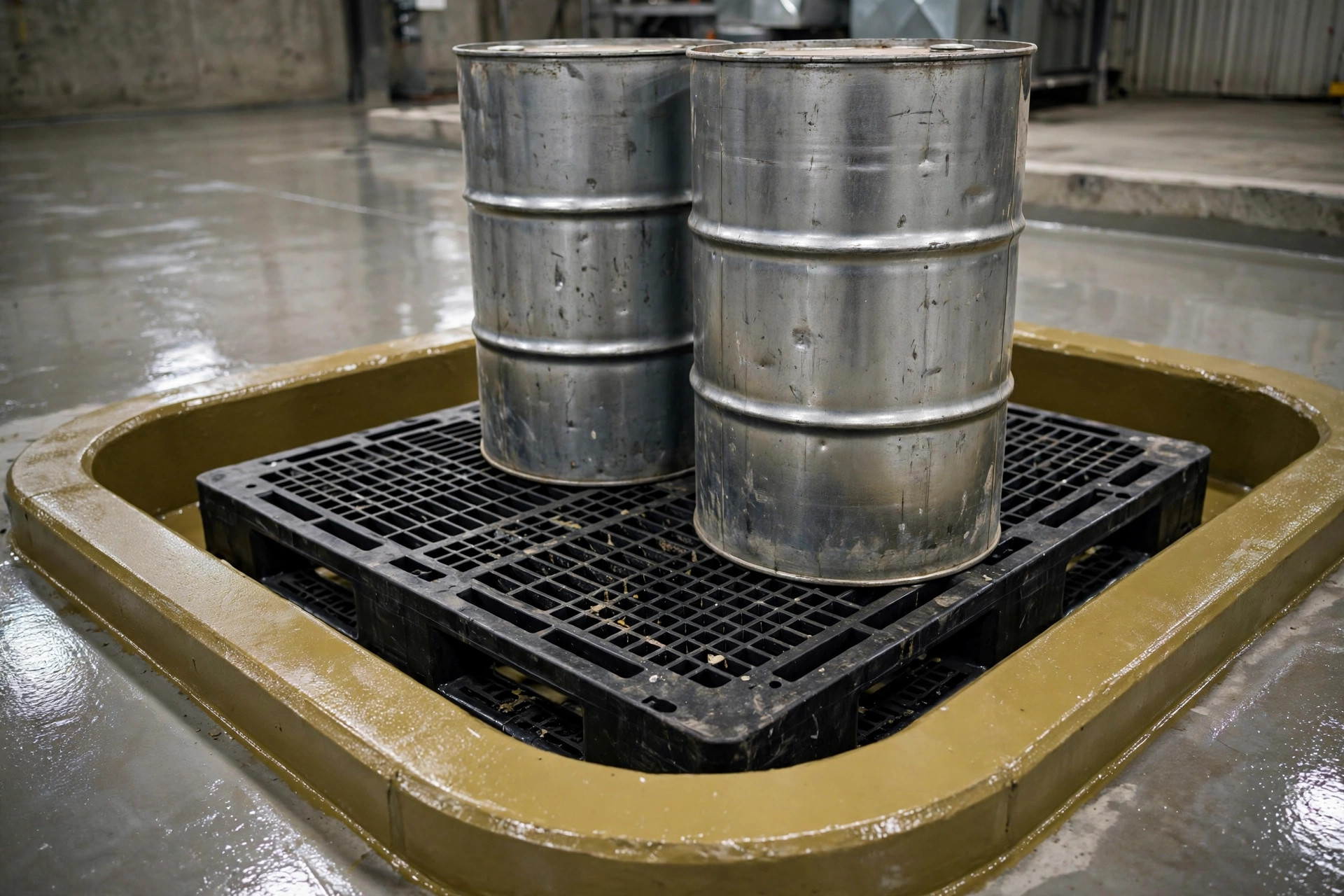
If you stop at the "upfront cost" row, spill pallets win and most buyers stop there. A cost analyst looks at the second table: holding cost.
Early 2025, a chemical distributor in Houston, Texas, leased their building and the landlord prohibited any floor modifications — pallets it was. They bought 60 four-drum spill pallets at roughly $400 each: $24,000 upfront, looked like a deal. Two years later I helped them true it up. The 60 pallets occupied nearly 300 square feet of floor space — at local warehouse rents, that is five figures a year in "rent" paid to plastic. Forklifts cracked 7 of them; replacements cost several thousand more. The gaps between pallets collected grime and required dedicated cleaning before inspections. Two years of holding cost had nearly reached what a concrete berm would have cost on day one — and the berm is a one-time spend, while pallets are an installment plan that gets more expensive the longer you keep it.
So my rule: under ~20 drums, or a layout that changes, pallets. Above that, or a permanent hazmat zone, pour the berm. Don't compare purchase prices; compare the 5-year cost per gallon of compliance plus the opportunity cost per square foot of floor space.
The Counterintuitive Bit: The Most Expensive Thing Is the 25th Drum, Not the Epoxy Floor
Most people assume epoxy flooring is the priciest option of the three. Wrong. The most expensive number in this whole article is the 25th 55-gallon drum.
Twenty-four drums: 1,320 gallons, under the SPCC threshold. The 25th drum goes in: 1,375 gallons, and the full SPCC compliance bill lands at once — a licensed engineer writing the Plan, the mandated inspection and recordkeeping regime, crew training, the five-year review cycle. None of that has anything to do with pallets versus berms. It is a "crossing-the-line tax."
I have seen more than one warehouse sitting permanently at 26–28 drums, the owner thinking "it's just two or three extra drums." By my math, those two or three drums have the highest marginal cost of any drums in the building. The leverage point: either keep inventory at 24 drums or fewer, handle secondary containment with spill pallets, and sleep well; or cross the line deliberately and pay for SPCC properly once. The 25–30 drum band is the most expensive place to live — don't hover there.
One more leverage point, from the "don't let drums sit in liquid" rule: grated spill pallets satisfy the elevation requirement automatically — one purchase, two compliance boxes checked. If you pour a concrete berm instead, remember to budget for grating or dunnage in the same project, or the inspector will admire your beautiful berm and then write you up because the drums sit flat on the floor.
The Computable Conclusion: Three Steps to Your Answer
No slogans. Here is the worksheet:
Step 1 — count drums. N drums × 55 gallons. N ≤ 24: no SPCC, secondary containment via spill pallets, lowest 5-year holding cost in most cases. N ≥ 25: SPCC is triggered, the Plan money is unavoidable, so build containment for the long term.
Step 2 — size it. Required capacity ≥ max(55 gallons, N × 55 × 10%). N = 20 → 110 gallons. N = 40 → 220 gallons. Take that number to vendors and watch the quote padding evaporate.
Step 3 — pick the method. N ≤ 20 with a changing layout or leased space: spill pallets. Fixed hazmat zone, long-term hold: concrete berm plus chemical-resistant coating — one capital spend, amortized over 5 years, lowest cost per gallon of compliance. Whole-floor, multi-product, cleanliness-critical: full epoxy floor, with local berms to meet the capacity formula.
EPA already made the spending decision for you: the money gets spent. The finance job is making sure it lands inside the formula — not inside a penalty notice.
By Lao Zhou, Logistics Cost Analyst



