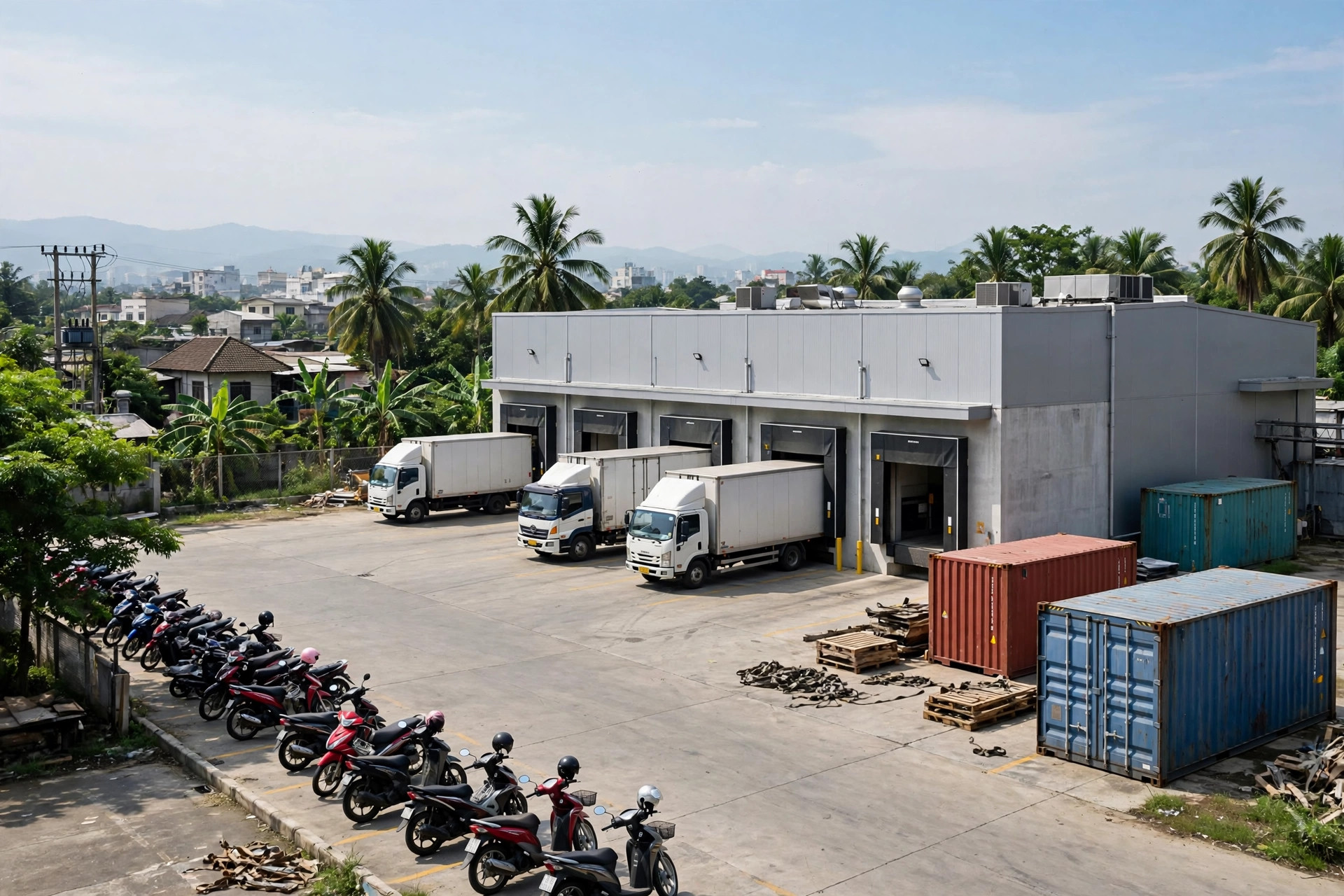
We have a client who sells small home appliances, and last March he asked me a very simple question: if we set up a warehouse around Hanoi, where should it actually go? He had three options on the table, and each one sounded reasonable. Near Haiphong, close to the port. Near Bac Ninh, close to the factories. Or in the Hanoi suburbs, close to his customers. He wanted a straight answer. I told him there is no straight answer, because those three places are not even the same kind of calculation.
Start with his real situation. He had more than a dozen distributors in central Hanoi, and they needed replenishment two or three times a week. His goods arrived by sea, came through Haiphong port, and then moved overland into Hanoi. Before he had his own warehouse, goods went straight from arrival to distribution. When the port was congested or city traffic controls kicked in, one truck could lose most of a day on the road. One Friday afternoon stands out: his distributors needed stock for the weekend, the truck was stuck on the way into the city, and his phone would not stop ringing. He told me later that he barely slept that weekend. That was when setting up a warehouse became urgent.
Hanoi Warehouse Math: The Haiphong Port Option
The Haiphong option looks obvious at first. The goods come off the ship and go straight into the warehouse, so you save one leg of inland transport. But you have to keep doing the math past that first step. After storage, every carton still has to travel to Hanoi, shipment by shipment. Once daily trips pile up, transport cost and time pile up with them. A port-side warehouse is also better suited to transit and bulk storage than to daily small-order replenishment. If a site has to break bulk, consolidate, and send out a dozen small orders a day, putting it beside the port will wear your people and your schedule down.
Bac Ninh tells a different story. The industrial belt there is dense: suppliers, packaging, components, and contract manufacturers are all close by. If you supply factories, or if your goods need simple local work such as assembly, labelling, or repacking, that area is genuinely convenient. Another client of ours, in electronic components, set up near Bac Ninh in 2024. His suppliers could deliver within half a day, and he no longer had to order replenishment materials a week ahead. But his finished-goods customers were in Hanoi, so the distribution problem simply moved to the second half of the journey. An industrial-belt warehouse is good for production support. That does not automatically make it good for distribution, and plenty of people confuse the two at the start.
A suburban Hanoi warehouse often looks expensive on rent alone, but it is answering a different question: how fast can you reach the customer, and how rarely do you run out? When a downtown distributor orders in the morning, an afternoon delivery is possible. For fast-moving goods, small appliances, and seasonal lines, one stockout can cost more than a single order; it can cost shelf space. The weakness is equally real. Large trucks face access limits, rush hour hurts, and the site is usually smaller, so it is a poor place to hold deep inventory. It works as a distribution centre, not as a bulk stockholding centre.
Hanoi Warehouse Math: Three Routes Side by Side
Put the three routes side by side and the trade-off becomes clear. The table below is the decision framework I often show clients. Treat any prices as subject to the latest local quotations; do not negotiate this year's contract with last year's numbers.
| Location direction | Best warehouse type | Strength | Weakness | Ask yourself first | | Haiphong port side | Transit and bulk storage | Off the ship and into stock, good for full-container flows | Long distribution leg into Hanoi, painful for small orders | Are my goods mostly full-in, full-out? | | Bac Ninh industrial belt | Production support and semi-finished stock | Close to factories, fast replenishment of materials | Finished goods still need distribution into Hanoi | Do my goods need local processing or factory support? | | Hanoi suburbs | Distribution centre and city replenishment | Close to customers, fast response | Limited space, truck access constraints | Does my business live or die on replenishment speed? |
Here is the seasoned, slightly uncomfortable part: many clients start site selection by asking about rent, and they stop once they hear a rent figure. That is the easiest trap in this business. Rent is only one block of total warehouse cost. The larger blocks are often transport, handling, rework, and stockout losses that follow. For comparable sites, quotations from different landlords and districts can differ by twenty or thirty percent, and that is only the visible part. The hidden part is worse: a badly located warehouse means extra trips every month, extra hands, and extra hours, and within half a year those costs can exceed whatever the cheaper rent saved. Read the quotation, but never read only one number on it.
There is also a counterintuitive judgment worth stating plainly. Closest to the port does not always mean lowest total cost, and closest to the customer does not always mean most expensive. It depends on how your goods flow. Are they full containers in and full containers out, or do they arrive in bulk and leave as dozens of small broken-down orders? The first pattern fits a port or industrial location. The second fits a customer-facing location. Many clients try to run both flows through one warehouse, and the result pleases nobody: bulk movements get interrupted by small orders, while small-order picking loses space and labour to bulk stock. My advice is often the opposite of what people expect: rather than finding one warehouse that does a bit of everything, split stockholding from distribution. Even with two sites, the total account can become clearer.
Hanoi Warehouse Negotiation: Ask These Three Questions
When you negotiate, do not only talk about rent and rent-free periods. Ask a few questions before signing. First, can the access roads and loading conditions handle your peak number of truck visits, or will you discover a queue at the gate in peak season? Second, does the contract give you flexibility on space, term, and early exit, since business volumes move up and down and the warehouse has to move with them? Third, who is responsible for local permits, fire compliance, and licences, and who steps in when something goes wrong? Do not assume those are automatically the landlord's problem. Once you have answers to those three, the quotation starts to make sense.
Back to the client from the beginning. He did not choose the cheapest site, and he did not choose the closest to the port. He put bulk stock near Bac Ninh and distribution in the Hanoi suburbs, giving each site one job. On paper it looked like paying rent twice. In practice, replenishment became reliable, stockouts fell, and peak season stopped being a scramble. Six months later he told me the arrangement looked expensive at first and cheap afterwards. Setting up a warehouse was never just about finding a place to put goods. It is about giving your goods flow a posture that works. Once the posture is right, everything after it gets easier.
Next time you negotiate a contract, remember to ask these three questions: can peak truck movements get in and out smoothly, is there flexibility on term and space, and who really owns permits and licences?
By Susan, 3PL Sales Director