Let me be honest with you: glass products warehouse storage handling is one bill our little warehouse cannot afford. When anything else breaks, you sweep it up and move on. When glass breaks, the whole pallet can go with it, and the customer is stuck waiting for a replacement while their installation crew stands idle. The first time I took on a glass job, I was thinking about freight rates and rent. I never priced in breakage. The first week taught me that lesson for free, or rather, at full price.
The job was tempered panels for shower enclosures, delivered flat on pallets, stacked neat and tidy. I was actually pleased — look how little floor space this takes. Then a forklift nudged the pallet, and the bottom panel chipped at the edge. The crack ran inward, the panel was scrap, and worse, glass shards dropped into the gap below and scratched the next panel when we lifted it. Two panels gone, and the customer's installers stopped work that same day. I had no good explanation when the phone rang, because there wasn't one.
That is the small-warehouse predicament in a nutshell: no climate-controlled glass hall, no budget for an automated vertical storage system. But glass does not care about your size. It only cares about how you treat it. And the first rule I learned about glass products warehouse storage handling is that it starts with posture, not equipment: panels must stand upright.
Glass Products Warehouse Storage Starts With Separation: Panels and Bottles Live Apart
Panels and bottles may both be glass, but in the warehouse they behave like different species, and mixing them is asking for trouble. Panels hate pressure, point loads, and edge knocks. Bottles hate squeezing, toppling, and dividers that have gone soft with moisture. My rule now is simple: separate them at receiving. Panels go to the upright zone, bottles go to the compartment zone, and the two areas do not share racks, dividers, or handling tools.
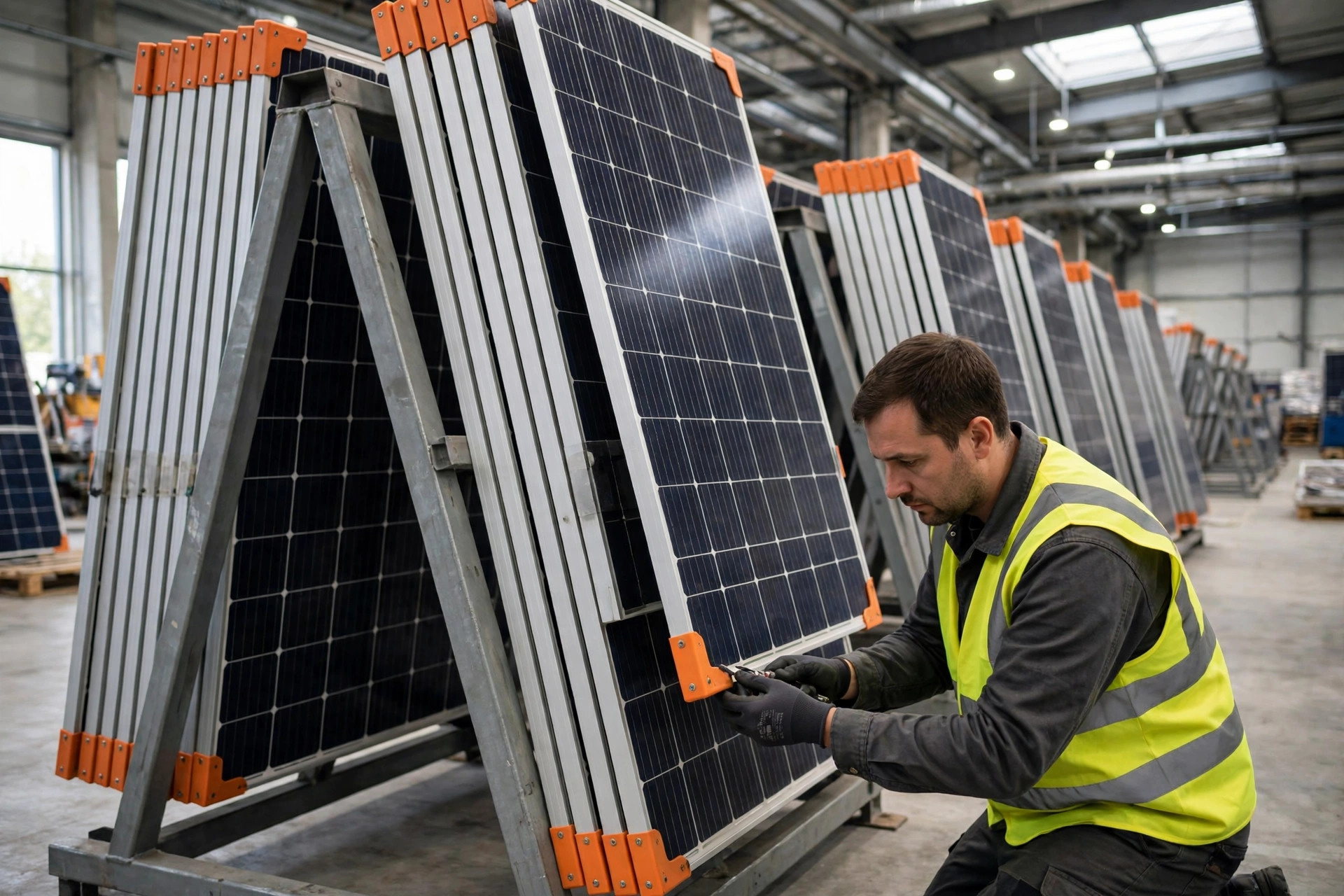
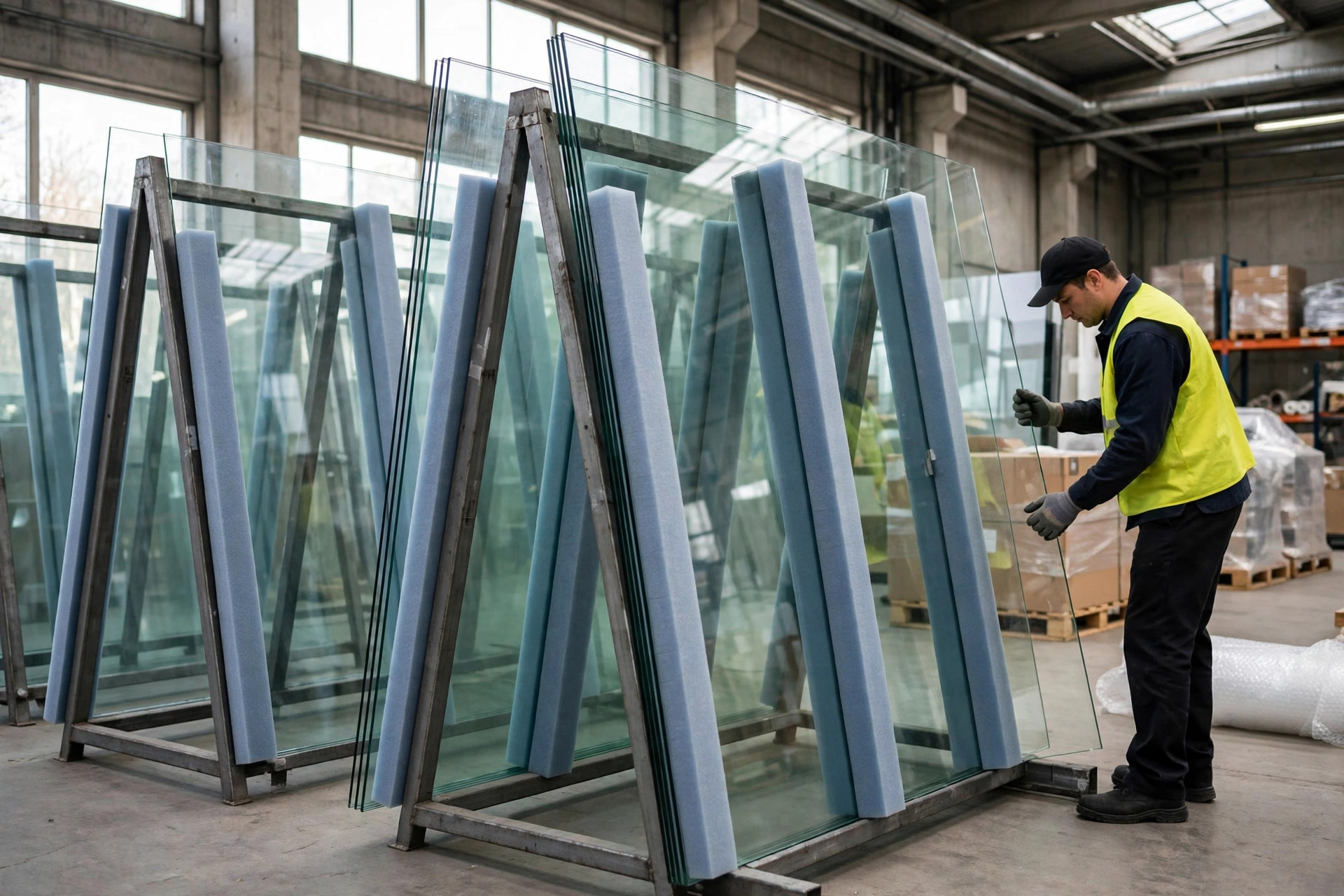
The panel zone runs on A-frames: panels lean on both sides, separated by soft dividers. Manufacturer guides generally put the A-frame lean angle at roughly 3 to 6 degrees, and that range is not arbitrary. Too vertical and a panel can tip outward; too steep and all the weight bears on the bottom edge, which is exactly where panels chip. I once tried to save money with a home-welded right-angle frame. Panels leaned against it looking perfectly stable, until a worker pulled a middle panel and the neighbors slid sideways, nearly onto his foot. With a proper sloped A-frame, pulling and inserting panels follows a routine, and workers are willing to handle them.
Slotting taught me another lesson. I used to put panels wherever a frame was free, so one customer's panels ended up spread across three frames. Pickers walked back and forth and sometimes grabbed the wrong spec. Now panels from the same order and spec sit in adjacent frame slots, each with a handwritten card showing spec and quantity, so a picker can match them at a glance.
Glass Handling on A-Frames: Dividers and the Least Valuable Log That Turned Out Priceless
Dividers are where small warehouses save the wrong money. I have seen people cut up old cardboard for everything. Cardboard goes soft when damp, panels touch each other, and one slide across a neighbor leaves a scratch. I now use two kinds: soft pads between panels, plus edge protectors on the corners; and for bottles, grid dividers or die-cut paperboard, replaced the moment they feel damp. No second chances for soggy dividers.
The bottle lesson came from a seasoning-bottle customer. The paperboard dividers looked fine at receiving, but the pallet sat in a wall-side slot through a humid season. The dividers absorbed moisture, bottles squeezed together, and a whole layer toppled. Shattered bottles mixed with seasoning, half a day of cleanup, and the entire case was unsellable. Since then, bottle slots never go in wall-side or door-side spots where rain blows in, and dividers get inspected at receiving. Soft or damp means replaced on the spot, not after something breaks.
Then there is the breakage log, the least impressive and most valuable document in my warehouse. Every broken panel and every shattered case gets written down: when, which slot, whose hands were on it, suspected cause. After one quarter of entries, patterns showed up on their own. Breakage clustered in two slots and on Friday afternoons during rush jobs. The slots had uneven floors; the Friday problem was one person pulling panels alone when we were short-handed. Once you can see the pattern, you know what to fix.
Claims Against Carriers: Gather the Evidence Before Loading
Here is a counterintuitive judgment: when glass breaks, the carrier is not always the one who should pay. Breakage caused by your own wrong posture or missing dividers is easy for a carrier to push back on. In claims, the evidence chain matters more than a loud voice.
My cheap method is photographing before loading: the full pallet, the strapping, the edge protectors, the dividers, one photo per pallet, filed by date and order number. At unloading, we count on the spot and write any damage on the delivery note right there, never signing a clean receipt first. Once, a load of bottles arrived with perfect-looking outer cartons and a toppled layer inside. Because we had written "subject to unpacking inspection, claim rights reserved" at signing, the carrier could not argue that our signature meant everything was fine. It costs nothing but a few minutes of fuss, and a small warehouse cannot afford fuzzy lawsuits, so we spend the fuss up front.
The accounting needs reframing too. Do not just compare the price of a frame or a divider. Compare the floor space saved by flat stacking against a scrapped panel, a stopped installation, and a lost customer. A-frames do take floor space, and upright storage holds less per square meter than flat stacking. That is the trade-off, plain and simple: save floor space and glass will collect the savings back in breakage, with interest. My choice is to give glass its upright floor space and save money elsewhere, like packing fast-moving bottle slots tighter or putting high-turnover goods near the door so every trip is shorter. Fewer steps are money too.
Here is the plain table I use when explaining breakage prevention to new workers:
| Approach | What it saves | What it quietly costs | | Flat stacking | Floor space, no frame investment | Bottom-panel edge chips, shard damage to neighbors, stopped customer jobs | | A-frame upright storage | Breakage, faster pulls, defensible claims | More floor space, upfront frame cost | | Dividers and edge protectors | Scratch and squeeze damage | Dividers need regular replacement, damp ones must go | | Breakage log plus loading photos | Claims you can win, problem slots you can find | A few minutes of logging and photos each day |
This table has no precise breakage rate, because every warehouse's goods, floors, and crew skill differ, and copying someone else's number is exactly how you get burned. The point of glass products warehouse storage handling is not the table itself; it is the habit of writing things down and changing one thing at a time. The useful calculation is your own: take your log's breakage entries, work through this table item by item, change one thing, and read the log again after a quarter. The numbers will speak for themselves.
That is glass products warehouse storage handling for small warehouses in one line: rules, not equipment. Three pieces of advice for warehouses like mine, all cheap, all tested: first, panels stand up the moment they enter your warehouse, no matter how the customer delivered them; the storage posture is your call. Second, never economize on dividers and edge protectors, and replace damp dividers immediately. Third, start the breakage log today, and take the loading photos before the truck leaves. Big companies prevent breakage by throwing equipment at it. Small warehouses prevent it with rules. Get the rules right, and the breakage bill shrinks on its own.
Small warehouses have their own way of surviving. By Xiao Ma, Small Warehouse Owner