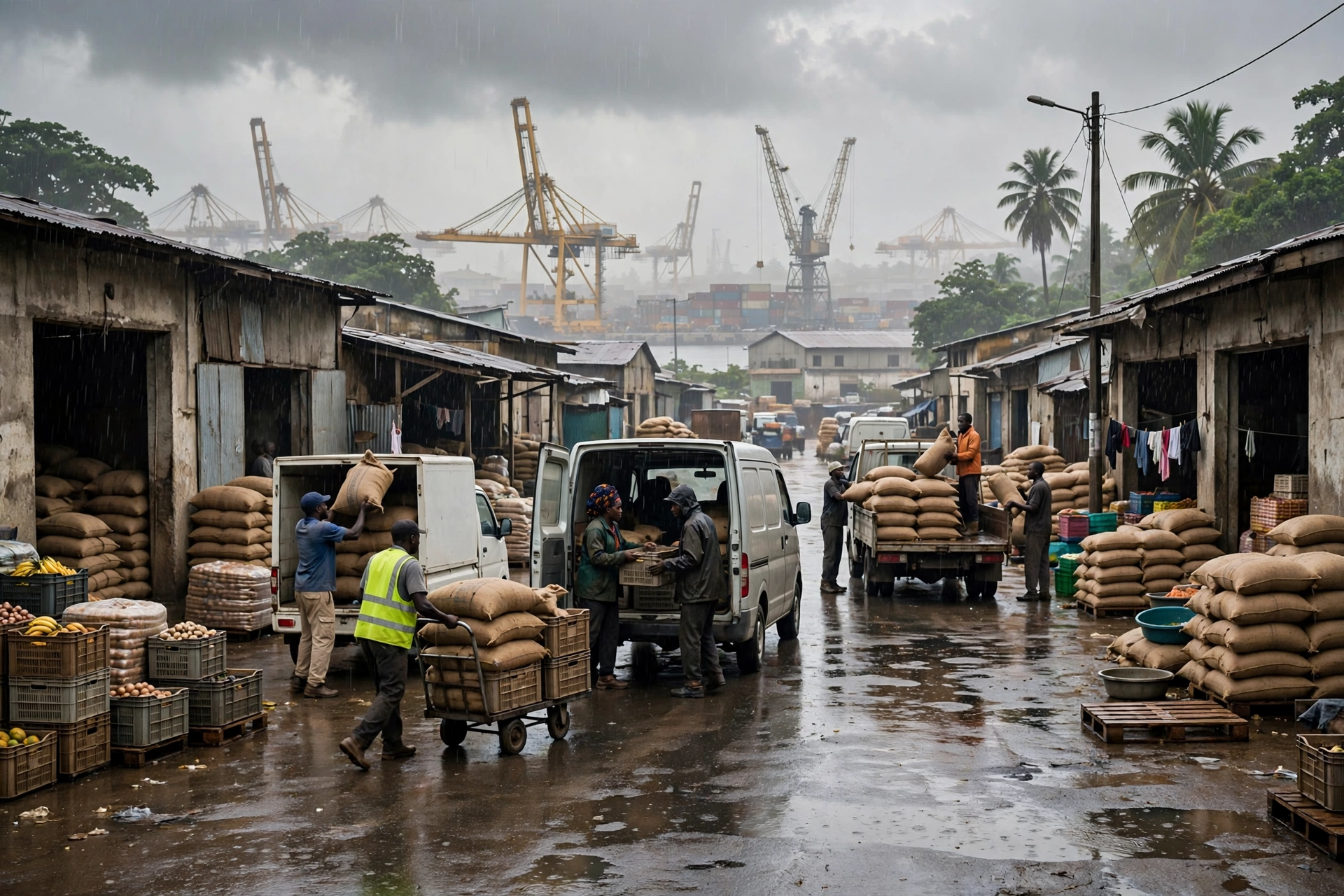
Freetown urban distribution starts with geography, not with a routing plan. A port on a peninsula, steep hills behind it, and dense markets threaded through narrow streets: that combination shapes every delivery before a truck ever leaves the yard. The work is therefore best read not as a single route problem, but as a handoff problem — between the port, the trunk road, and the last stretch into neighbourhoods that were never drawn for large vehicles.
The pattern of Freetown urban distribution: port, hills, and markets pulling in three directions
The visible pattern repeats often enough to be treated as structural. Goods arrive through the port area and then face a city that rises quickly from the waterfront. On a rainy-season morning, for example, a single delayed departure can mean a delivery misses the morning market peak entirely, not by minutes but by hours, because the uphill roads drain slowly and the traffic has nowhere else to go. The cost is not only the delay itself; it is the lost selling window for traders who live on daily turnover.
A second, quieter pattern sits at the other end of the chain. Consider a small retailer in a hillside neighbourhood: the main vehicle can reach the bottom of the hill, but the final stretch depends on a smaller vehicle or manual carrying. That last segment looks trivial on a map and absorbs a surprising share of time and handling in practice. When researchers describe last-mile cost in such cities, this is the segment they usually mean — short in distance, heavy in effort, and easy to underestimate in a spreadsheet.
Market day is another amplifier. On a Saturday morning, people and vehicles crowd every approach to the market, and a delivery truck can rarely get near the stalls at all; it parks on the fringe and transfers from there. A common sequence runs like this: the truck reaches the market fringe at nine in the morning, and the goods only reach the trader's hands around midday, with the hours in between spent finding a place to stop, waiting for foot traffic, and moving the truck again and again. The driver is not the problem. The delivery window and the market peak are simply colliding, and shifting by an hour or two — or dropping goods at a nearby holding point the day before — changes the whole trip.
The Freetown urban distribution cost ledger: time, loss, and access
A useful way to judge any delivery option here is to score it on three lines rather than one. First, time reliability: does the plan survive a rainy morning, or does it only work on a dry day? Second, product loss: how many extra touches, how much exposure to damp and heat, and how much repacking does the route require? Third, access: can the chosen vehicle actually reach the receiver, or does the plan quietly assume a final carry that nobody has staffed?
| Delivery option | Time reliability | Loss exposure | Access reality |
|---|---|---|---|
| Large truck direct to receiver | Low in rain, high on dry days | Low touches, but long hot waits | Often stops short of hillside receivers |
| Suburban cross-dock, then small vehicle | Higher, if the transfer is staffed | One extra touch, shorter exposure | Best fit for dense and hillside areas |
| Market-area consolidation point | Depends on market-day congestion | Shared handling needs clear ownership | Works where receivers cluster together |
Receivers can use a simple decision frame before choosing a method. First, can the vehicle reach the door? If not, do not choose direct delivery. Second, does the transfer point have staff and shelter? A transfer with nobody staffing it is just a queue in a different place. Third, can the timing avoid the market peak and the heaviest rain? If any of the three fails, change the plan rather than hoping the driver improvises on the spot. When delivery disputes are reviewed afterwards, the usual finding is that the plan worked on paper and failed on the ground.
The counterintuitive finding is that adding a transfer can reduce total loss even though it adds a touch. A shorter, sheltered final leg with the right vehicle often beats a long direct run that waits, idles, and then unloads in a hurry. According to publicly available accounts of comparable West African port cities, this trade-off — more handoffs, less exposure — recurs wherever hills, rain, and dense markets coincide. Precise local rates and charges should be checked against the latest official sources, since they move and vary by cargo and season.
Why the bottleneck sits inside the city, not at the port gate
Attribution matters here, because fixing the wrong bottleneck wastes money. Port throughput dominates headlines, but for city delivery the binding constraint is usually the urban handoff: road capacity on a few corridors, the absence of holding space near markets, and delivery windows that collide with market peaks. A faster port release that delivers trucks into the same congested corridor at the same hour does not shorten the receiver's wait; it lengthens the queue.
The trend to watch is therefore not only port investment but the slow professionalisation of the middle layer: suburban holding space, smaller fit-for-purpose vehicles, and receivers who consolidate orders so that one well-timed trip replaces several rushed ones. Where that middle layer thickens, delivery reliability improves without any single dramatic project. Where it stays thin, every rainy season re-teaches the same lesson.
The middle layer usually grows from small beginnings. A few neighbouring traders might share a small room near the market, receiving goods the day before and collecting them on market morning; or a small logistics firm might use an empty suburban room as a holding point and run small vehicles to several neighbourhoods through the day. None of this looks impressive, and it has no single name, but it solves exactly the handoff problem described above: big vehicles stop where they can stop, and small vehicles and manual carrying do what they are suited to. As a trend judgement, this kind of pieced-together practice is more likely to appear first than any single large project.
The open question is who builds that middle layer first. Will it be large shippers protecting their own service levels, market associations coordinating shared receiving, or small logistics firms stitching together storage and small-vehicle fleets? The answer will decide whether Freetown's last mile stays a daily improvisation or becomes a system — and that, more than any single road or vehicle, is what the next few years of observation should track.
By Dr. Chen, Supply Chain Researcher