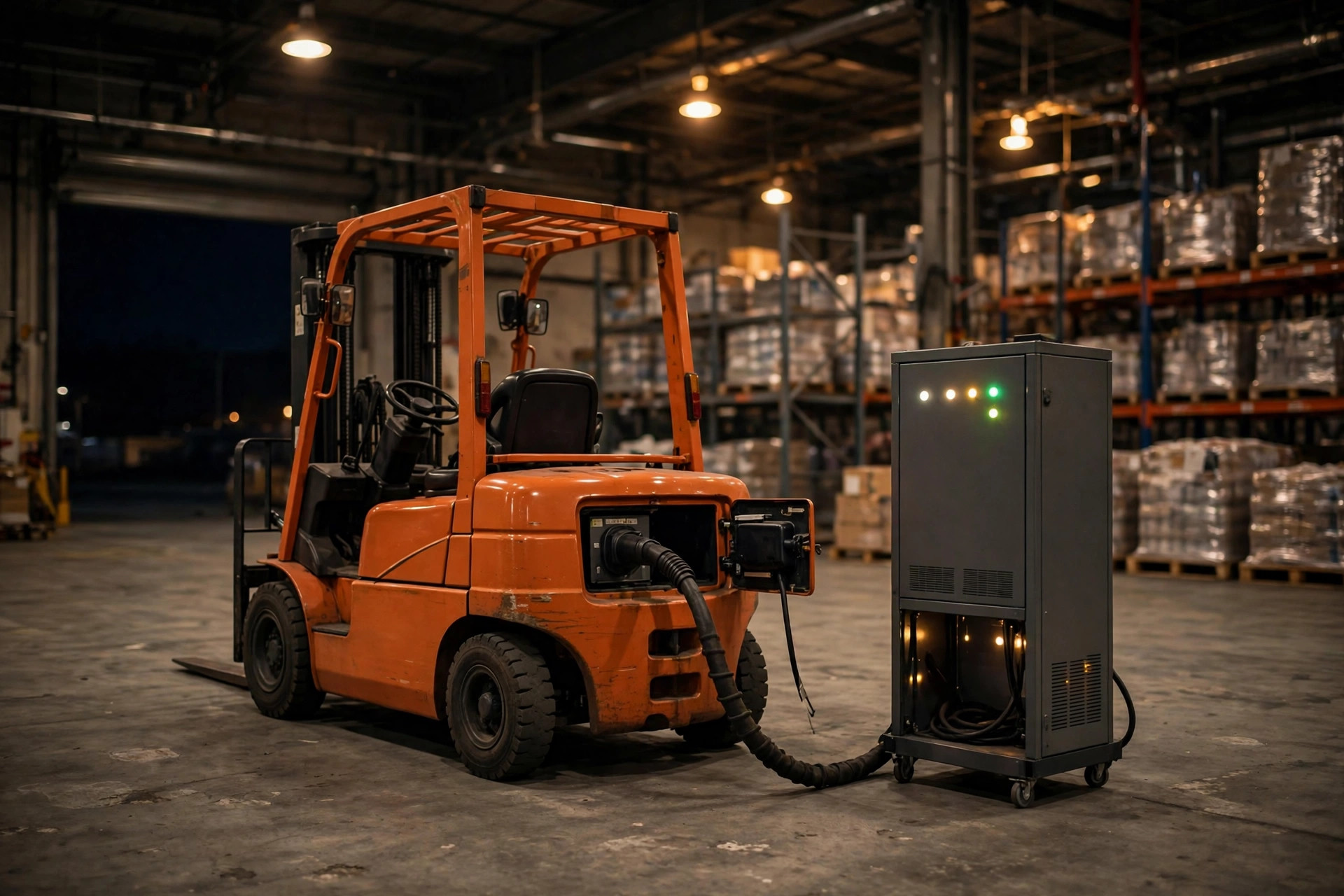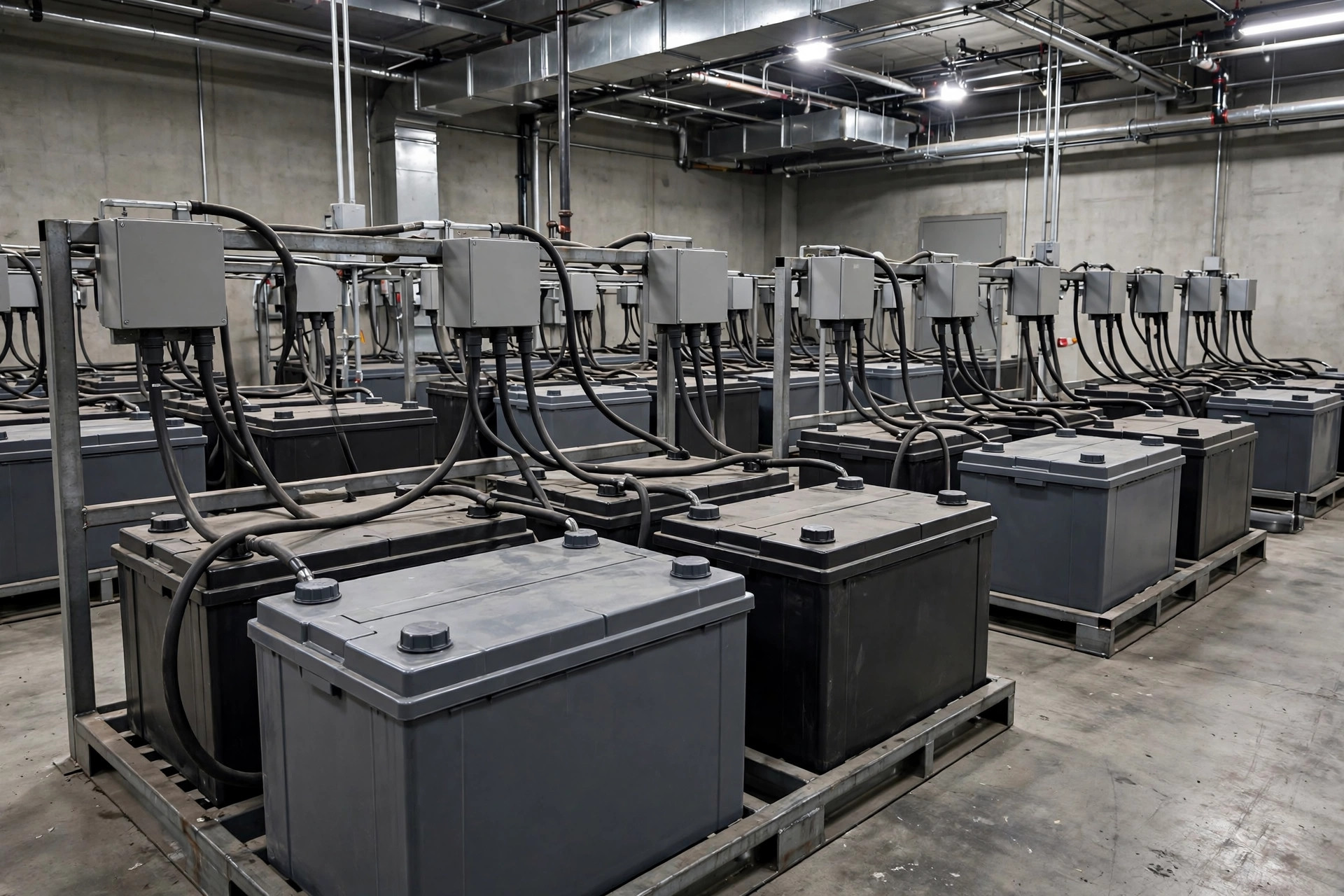
Hydrogen from lead-acid battery charging is the item most warehouse safety checklists have quietly skipped for years. OSHA requires battery charging areas to be adequately ventilated to disperse the gases batteries give off — yet ask most warehouse managers what "adequate" means in numbers, and you will get a shrug. Meanwhile, industry conversation about battery safety has been captured by lithium-ion thermal runaway: fires, smoke, propagation, each dramatic enough to dominate a headline. Hydrogen from lead-acid charging is colorless, odorless, and invisible, and once it reaches its lower explosive limit of 4%, all it takes is a millijoule-scale spark. The counterintuitive judgment: while everyone watches lithium batteries catch fire, hydrogen from lead-acid charging is the risk more warehouses face every single day. It happens in your charging room, the one where nobody has ever measured the concentration.
The hydrogen nobody spotlights: phenomenon and data
Hydrogen's explosive range is 4% to 75%, among the widest of any common flammable gas. OSHA's 29 CFR 1910.178(g)(2) requires "adequate ventilation" in charging areas to disperse gases from gassing batteries, and a 1976 OSHA interpretation letter quantified "adequate" as keeping hydrogen at the charging site below the lower explosive limit (4.1%). When citing standard numbers, always check the current version, and consult NFPA hydrogen and electrical safety requirements in their latest editions.
A battery-industry white paper documented a near miss at a North American distribution center: a dedicated charging room of roughly 450 square feet with four charging stations, where a night-shift guard noticed a sulfurous smell on patrol. Air monitoring found hydrogen already above the lower explosive limit. The fire department evacuated the area; power was cut and forced ventilation brought levels down. No injuries, no damage. But the white paper flagged the detail that matters most: the crew was alerted by the sulfur smell, which came from the electrolyte, not the hydrogen. Pure hydrogen is odorless — had that smell not been there, the over-limit hydrogen might never have been detected.
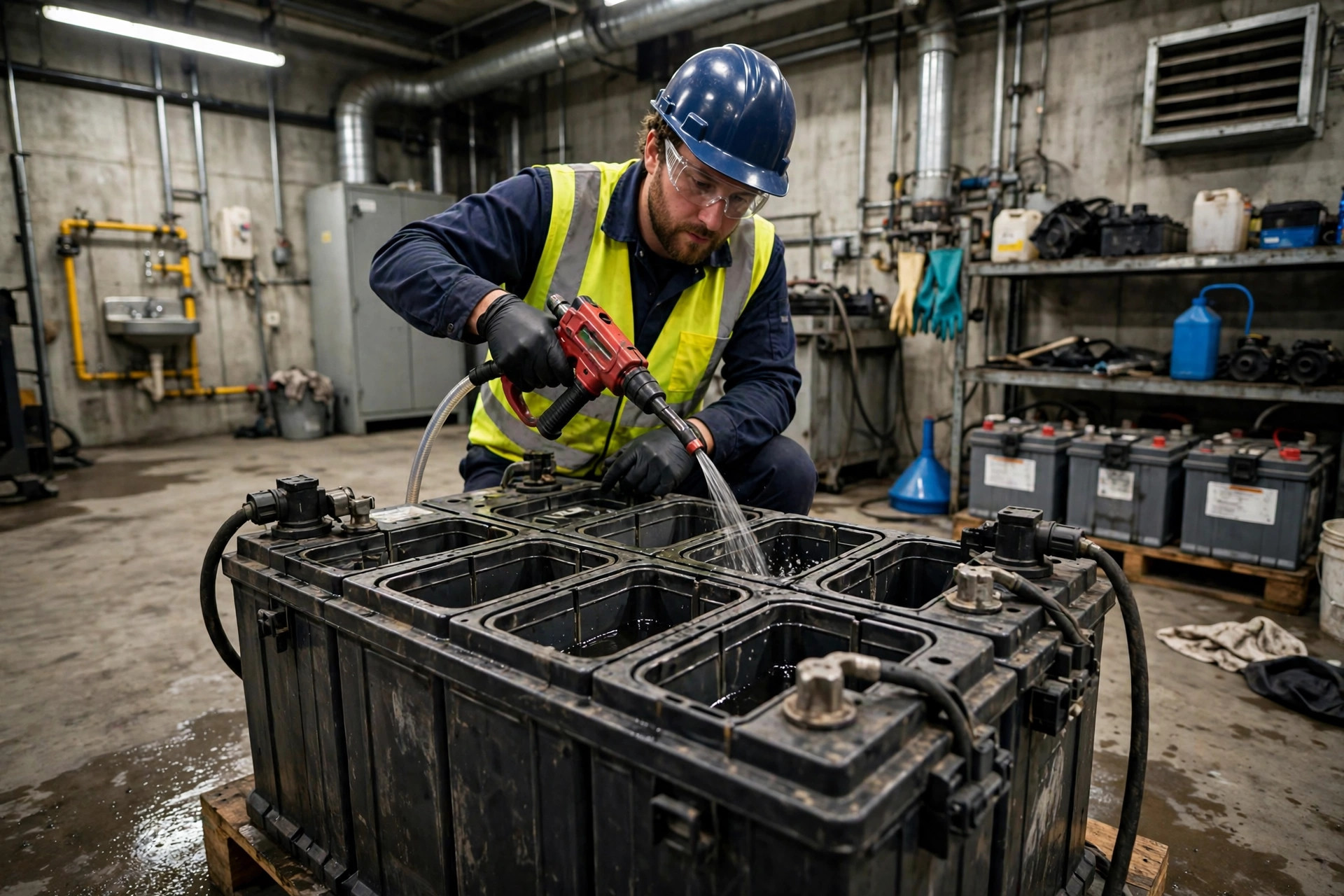
A second lesson comes from the maintenance side. In June 2021, at a forklift dealership service shop in Toronto, a worker replacing battery cells used oxygen from an oxyacetylene torch to "blow out" hydrogen accumulated in the cells, then triggered a reaction while welding an inter-cell connector — splashing sulfuric acid and burning the worker. An Ontario court found the employer had failed to adequately inform the worker of the task's hazards and imposed a CAD 60,000 fine. The lesson goes beyond charging-room ventilation: hydrogen hides in every corner of a battery's cells, and improvised methods of clearing it can themselves become the ignition source.
The contrast case is also worth noting: in May 2024, a hydrogen fuel-cell forklift explosion at a Louisiana plant killed one worker and injured six. That was a fuel-cell system incident — a different technology. Yet it illustrates the point: when hydrogen enters a warehouse as a fuel, everyone treats it with utmost seriousness; when it is generated daily as a charging byproduct, almost nobody measures it. The visibility of a risk determines the attention it receives.
Where the hydrogen comes from: the gassing chain of lead-acid batteries
The causal chain starts with electrochemistry. Late in a lead-acid battery's charge, current no longer converts lead sulfate but electrolyzes water: hydrogen evolves at the negative plates, oxygen at the positive. This intensifies during the finishing phase, equalization charges, overcharging, and as batteries age. Hydrogen evolution is not an anomaly — it is an inherent byproduct of lead-acid charging, differing only in magnitude.
After evolution comes accumulation. Hydrogen is roughly one-fourteenth the density of air; it rises and collects near ceilings and beams. A typical risk chain: a small room, low ceilings, many batteries in the finishing phase at once, doors and windows shut (most common in winter) — hydrogen concentrates overhead while ignition sources sit everywhere: relay arcs in chargers, light switches, mobile phones, static discharge, the arc of a forklift starting. Concentration, confinement, and an ignition source complete the circuit.
There is also an organizational layer of causation. Regulations give direction ("adequate ventilation") but no numbers, so compliance rests on each company's initiative. Hydrogen cannot be perceived, so routine walk-throughs see and smell nothing. And responsibility is split across operations, engineering, and EHS — nobody truly owns "the air in the charging room." Together, these make the charging area the gray zone of the warehouse: everyone knows there is a risk, and nobody specifically owns it.
A charging-area safety assessment framework: from hydrogen estimates to ventilation retrofits
From that causal analysis, whether a given charging area is safe can be assessed in four steps. This framework does not replace professional design, but it tells you where you stand.
Step one: estimate hydrogen evolution. By Faraday's law, roughly 0.42 liters of hydrogen evolve per cell per amp-hour of overcharge. An order-of-magnitude example: a 48V (24-cell), 600Ah battery with 10% overcharge (60Ah) evolves about 24 × 60 × 0.42 ≈ 600 liters, or roughly 0.6 cubic meters. A ten-truck charging area thus produces several cubic meters of hydrogen in a night. Treat this as an order-of-magnitude estimate, not a design basis; formal design should follow current standards and professional calculation.
Step two: check concentrations. The lower explosive limit is 4%, but no engineer designs to 4%. Common industry practice takes 25% of the LEL — 1% — as the design ceiling, preserving a safety margin. Divide the step-one hydrogen volume by the room's effective volume and factor in charge duration to roughly judge where concentrations climb under worst-case conditions.
Step three: size the ventilation. Inputs are room volume, batteries charging simultaneously, and the worst case (winter, windows shut, multiple batteries in the finishing phase at once); the output is the required air-change rate. Natural ventilation is unreliable in most existing charging rooms, so mechanical exhaust is usually needed. The key detail: hydrogen rises, so exhaust vents go high and make-up air intakes go low, creating bottom-up convection; and the exhaust fan itself must be explosion-proof, or the ventilation equipment becomes the ignition source.
Step four: the layout retrofit checklist. The first three steps answer "whether to retrofit"; this step answers "how":
- Make the charging area a dedicated zone or room, away from welding, maintenance, and other ignition-source work;
- High-level mechanical exhaust plus low-level make-up air, with the fan's explosion-proof rating matched to the area;
- Install hydrogen detectors alarmed at 25% LEL, interlocked with the exhaust fan and alarms;
- Specify explosion-proof electrical equipment in the charging area; prohibit smoking and open flames (already required by OSHA 1910.178(g)(10)–(11));
- Operating procedures: switch the charger off before disconnecting plugs (prevent arcing), keep battery or compartment covers open during charging, schedule equalization charges in the best-ventilated window, and stagger charging so not all batteries hit the high-gassing finishing phase at once;
- Periodic checks with a portable hydrogen detector.
Ventilation retrofits and explosion prevention: an actionable list
If only three things can be done, prioritize in this order. First, add hydrogen detection interlocked with exhaust — the only measure that turns the imperceptible into the perceptible, and the cheapest of the three. Second, fix the ventilation path: high exhaust, low make-up air, explosion-proof fan — the root-cause fix. Third, tighten procedures: charger-off-before-disconnect, no-smoking signage, staggered equalization — the human-factor fix. None requires a shutdown-level rebuild, yet each severs one link of the risk chain.
One caveat: alarm setpoints, fan selection, and explosion-proof classifications each have applicable standard clauses. This article gives the framework and direction; implementation should follow current standard versions and qualified professional advice.
Trend outlook: lead-acid is not going away, hydrogen management will only tighten
Three structural trends are worth watching. First, lithium-ion penetration in forklifts keeps rising, but the installed base of lead-acid is enormous, and lead-acid retains its place in heavy-duty, low-temperature, and cost-sensitive applications — the charging-room hydrogen problem will not vanish with lithium's arrival, and most warehouses will run mixed fleets for the coming decade. Second, hydrogen fuel-cell forklifts are entering large warehouses, which will elevate "hydrogen management" from a charging-room byproduct issue to a site-wide energy safety discipline. Third, detector costs keep falling while insurance and compliance pressure rises; active monitoring will move from "advanced practice" to "standard equipment."
My assessment: in the next few years, charging-area safety will shift from a compliance checkbox to an auditable item — concentration data, alarm records, and interlock actions will all be subject to review. Audit-driven management is precisely where a research-oriented perspective earns its keep: turning invisible risk into visible data.
One open question for the reader: when was your charging area's hydrogen concentration last measured? If you cannot answer, then what is happening in that room's air is something you do not actually know. And "not knowing" is the defining shape of this kind of risk.
By Dr. Chen, Supply Chain Researcher