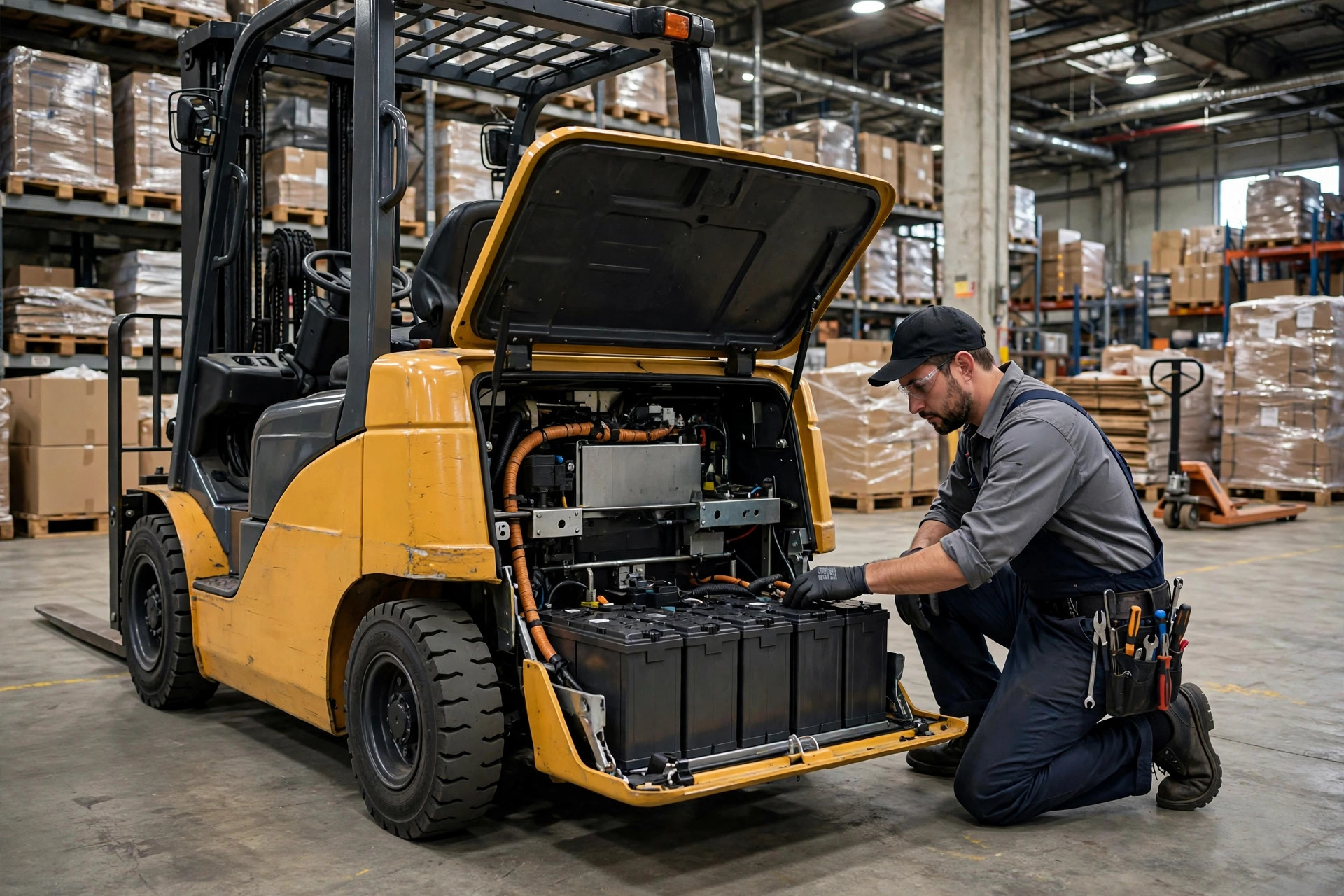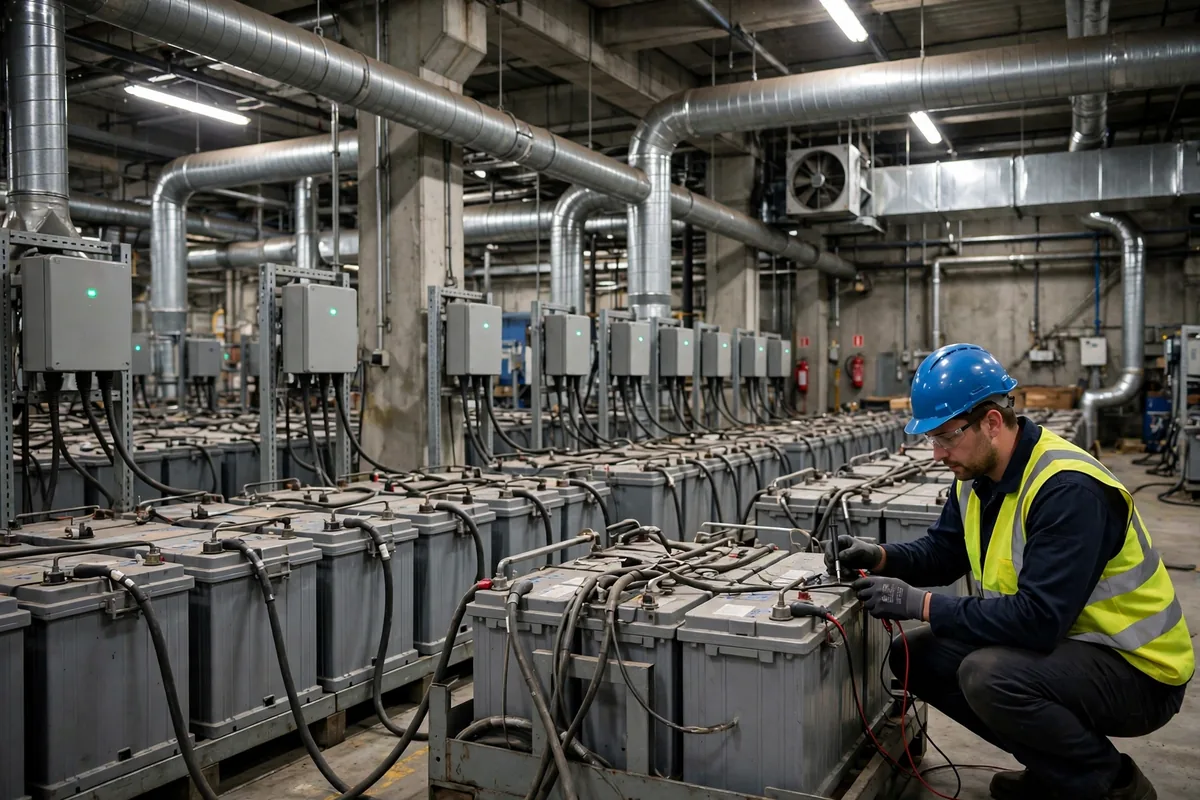
A forklift battery charging room warehouse project usually starts with one misleading number. The owner asks what the room costs. The contractor quotes walls and a floor. The owner nods, approves it, and discovers six months later that ventilation, safety equipment, spare batteries, and swap gear were never in the number.
Short version: a charging room is not a room. It is a system. Price the system, over its whole life, or do not sign.
Forklift Battery Charging Room Warehouse Costs Come in Five Lines
Last year I rebuilt this calculation for an auto parts warehouse in southern China with a mid-sized electric fleet. Batteries had been charging wherever floor space existed at the end of an aisle, cables across the walkway. It failed every safety walk. The first contractor quote covered only the partition and the floor, and it looked cheap. I told the owner to hold the pen and split the bill properly.
It splits into five lines. Line one is construction: partitions, acid-resistant flooring, and drainage. Floor treatment routinely costs more than the walls, and it is the line contractors understate most. Line two is ventilation and safety equipment. Charging lead-acid batteries produces gas, so ventilation, detection, eyewash, and protective gear belong in the budget from day one. I will not print specific design values here — get them from local regulations and the manufacturers' latest official requirements, because an error in this line is measured in injuries, not dollars. Line three is the chargers themselves, matched to battery capacity and shift pattern, including a spare unit if you run multiple shifts. Line four is spare batteries and swap equipment. A two- or three-shift operation cannot rotate on one battery per truck; the hoist or changer that moves those batteries costs money too. Line five is the invisible line: labor for swapping and watering, routine battery care, and the cost of batteries dying early because nobody owned them.
Line five is the one everyone skips, and it decides the outcome. I audited a food warehouse in the middle of the country with a beautiful, newly built charging room and no battery owner. Watering went unrecorded. Charging went unchecked. Within a couple of years, several traction batteries had faded well ahead of schedule. A large traction battery costs serious money — enough to cover months of wages for the person who should have been looking after it. That money was not lost in construction. It leaked out through an empty cell in the spreadsheet.
A simplified comparison, with figures deliberately left as relative scale — get real numbers from local quotes and current official pricing:
| Cost factor | Central battery room | Distributed opportunity charging |
|---|---|---|
| Upfront spend | High, one-time build plus equipment | Low to medium, added point by point |
| Footprint | One full dedicated area | No whole room, edges of work areas |
| Management load | Low, one zone, one owner | High, many points to police |
| Best fit | Two-plus shifts, larger fleets | Single shift, few trucks, light use |
| Hidden risk | Wrong spec means expensive rework | Cable sprawl, failed safety audits |
Opportunity Charging and a Battery Room Are Different Bets
Opportunity charging seduces managers for an obvious reason: no room to build, just plug in during breaks. That story is half true.
It can work well for suitable battery chemistries and for single-shift fleets with modest utilization. Traditional lead-acid, though, expects a complete charge and rest cycle. Constant shallow top-ups and pulling a battery back to work half-charged will cost service life — check the battery maker's latest official guidance for the specifics on your model. The construction money you saved has a habit of returning, with interest, inside the battery replacement line.
A battery room is the opposite bet. Heavy upfront, strict routine, but at fleet scale the arithmetic turns friendly: one battery working, one charging, one cooling and waiting, with records showing who charged and who swapped what. Drivers never wait on a charger. Trucks do not stop.
Use three numbers to choose. How many trucks, how many shifts per day, and how many real working hours per truck. A fleet you can count on one hand, running one shift, should seriously consider opportunity charging or a simple compliant charging area — a full room will drown it in fixed cost. A larger fleet on two or more shifts spreads the room's fixed cost thin, and then the detailed math usually favors the room. The middle ground is hardest: make the charging area compliant now, and pre-wire power, water, and ventilation capacity so an upgrade does not start from zero.
And here is the counterintuitive finding from these audits: the biggest waste is not building too big. It is building in the wrong place. A charging room must sit near the work without blocking aisles, and the battery travel route matters — a traction battery is heavy, and pushing one across the building several times a day puts labor and accident risk on every meter of that route. I saw a site tuck its room into the far corner to save prime floor space, then watch the battery handler cross the entire warehouse daily, fighting pickers for the same aisles. The saved rent was repaid in risk within months. Location first, rent second. Contractors will not run that calculation for you.
When the Room Is Simply Overkill
Three situations should stop your pen. First, a short lease. With only a few years left on a rented building, construction spending cannot move with you, and restoring the space at exit means paying twice. Build a compliant, tidy charging area, hold the safety line, and keep your capital mobile.
Second, a fleet mid-transition. If you are already evaluating lithium options, remember that lithium charging follows a different logic from lead-acid and does not need the same swap room or ventilation setup — again, confirm specifics against local regulations and the manufacturer's latest official requirements. Building a full lead-acid room on the eve of a chemistry change is building a palace for the previous generation. Bridge with a compliant interim setup instead.
Third, a small, gentle operation. A handful of trucks, one shift, long idle nights for slow charging — a full-spec room with dedicated staffing loads each truck with fixed cost it can never justify. Compliant, safe, and tidy is enough.
Do one thing tomorrow morning. List every battery you own: purchase year, current real-world runtime, and the named person responsible for it. In most warehouses I audit, that list has gaps you can drive a forklift through. The loss rarely starts with the room. It starts with batteries nobody owns. Complete that table first, then argue about construction. Reverse the order and even a perfect room will not save the money.
By Lao Zhou, Logistics Cost Analyst