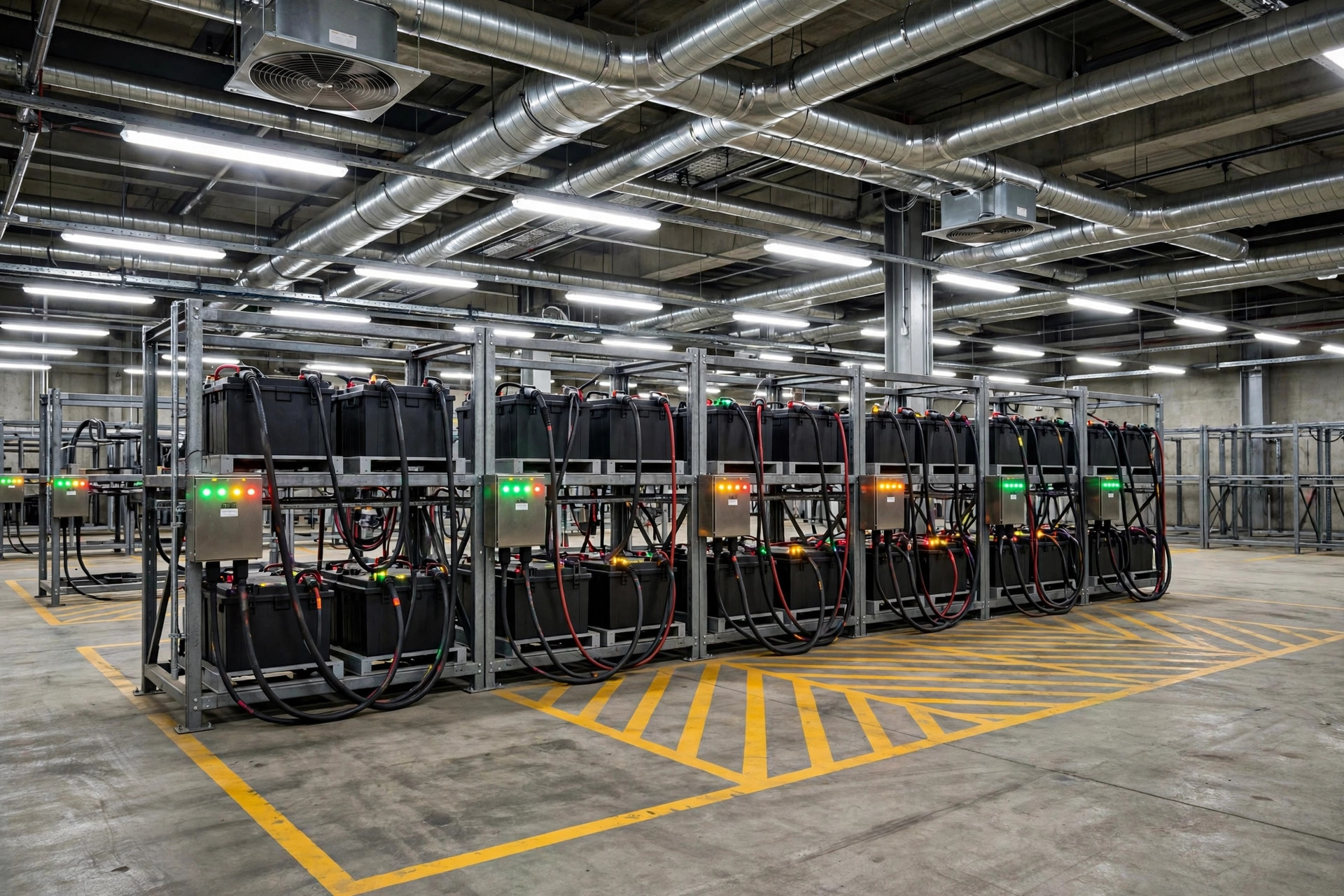
Go look at your battery charging room. Where is the exhaust fan? If it's mounted halfway down the wall, your ventilation system is mostly decorative.
Lead-acid forklift batteries start gassing hydrogen once charging passes about 80% state of charge. Hydrogen is colorless, odorless, hits its lower explosive limit at 4% concentration in air, and weighs roughly one-fourteenth of what air weighs. Think of it this way: it only goes up, and it goes up silently. Everything about forklift battery charging room ventilation requirements comes down to that one physical fact — hydrogen pools under the ceiling in an invisible danger layer, and ventilation exists to dilute it and carry it out.
Charging Room Ventilation Starts at the Ceiling: Hydrogen Only Rises
The counter-intuitive truth first: "just open a window" is the most widely repeated wrong advice in this business.
A window sits mid-wall or lower. It ventilates the middle band of air. The 12–20 inches of hydrogen-rich layer hugging the ceiling? A window can't touch it — hydrogen is far too buoyant to sink down to window height and wander out on its own. Picture it as a layer of "upside-down water" clinging to the ceiling; if the exhaust opening isn't placed right next to it, it might as well not exist.
So exhaust goes high — upper wall or ceiling. Intake goes low — near the floor. Cool air enters at the bottom, pushes the hydrogen up and out, and you get a complete convection path. High-in/high-out, low-in/low-out, or high-only designs are all violations of this principle. Get this line wrong and everything downstream is wasted effort.
What 1910.178(g) Actually Says
OSHA 1910.178(g) covers battery charging and changing for powered industrial trucks. Honestly, it's written in frustratingly vague terms — which is exactly why consultants can weaponize it. The real requirements, translated into human language:
- Charging happens in a designated area, separated from general operations.
- The area must have adequate ventilation to prevent explosive gas mixtures — note that OSHA gives you no CFM number. "Adequate" is yours to justify. Check OSHA's official site for the latest requirements; don't trust a consultant's rule of thumb.
- Acid protection: PPE for handling and watering batteries, plus flushing facilities in the charging area for immediate eye and skin rinsing.
- Eyewash and emergency shower must be accessible and functional — not locked in a cabinet.
- No smoking or open flames in the charging area, with conspicuous signage.
See the pattern? The standard sets goals, not drawings. Whether your ventilation counts as "adequate" comes down to your argument chain: hydrogen source (how many batteries charging at once) → room volume and ceiling height → opening placement and exhaust path → concentration monitoring. Break one link and it's "inadequate."
That's why an OSHA inspector checks three things first in a charging area: one, whether the exhaust opening is up high — it instantly reveals whether you understand hydrogen's behavior; two, whether acid flushing and eyewash are present and working — the hardest physical requirement in the clause; three, ventilation and alarm maintenance records — proof the system isn't install-and-forget. He doesn't care how expensive your equipment is. He cares whether you take "hydrogen goes up" seriously.
Three Ventilation Tiers: The Selection Line Is All That Matters
An equipment engineer looks at selection and sees only the dividing lines. When it comes to forklift battery charging room ventilation requirements, there are three tiers, no middle ground:
| Natural ventilation | Mechanical exhaust | Hydrogen-linked exhaust | |
|---|---|---|---|
| Principle | High/low openings drive convection | Exhaust fan forces air changes | Hydrogen sensor drives fan speed |
| Fits | Few batteries, rooms with top-and-bottom openings, low ceilings | Most enclosed charging rooms | Dense battery counts, large rooms, staff working inside |
| Biggest trap | Openings blocked by freight, windows closed in summer | Fan on a timer nobody maintains, filters clogged | Sensor mounted at wrong height, never calibrated |
| Cost gradient | $ | $$ | $$$ |
Draw the selection line with three questions:
First, count batteries charging simultaneously. More batteries, more total hydrogen. Past a certain point, natural ventilation physically can't keep up — that's a physics ceiling, not a "try harder" problem.
Second, look at the room's openings. If a dedicated charging room can get an exhaust opening near the ceiling and an intake near the floor, and those openings won't get blocked by daily operations, natural ventilation deserves a serious look. If the room is enclosed with no way to open up high, go mechanical. Don't agonize.
Third, look at people. If staff work inside the charging room regularly — watering batteries, doing maintenance — hydrogen-linked exhaust earns its keep: the fan ramps up automatically when concentration rises, with audible and visual alarms. Whether that money is worth it hinges on one scenario — whether people spend time in there — not on how fancy the hardware is.
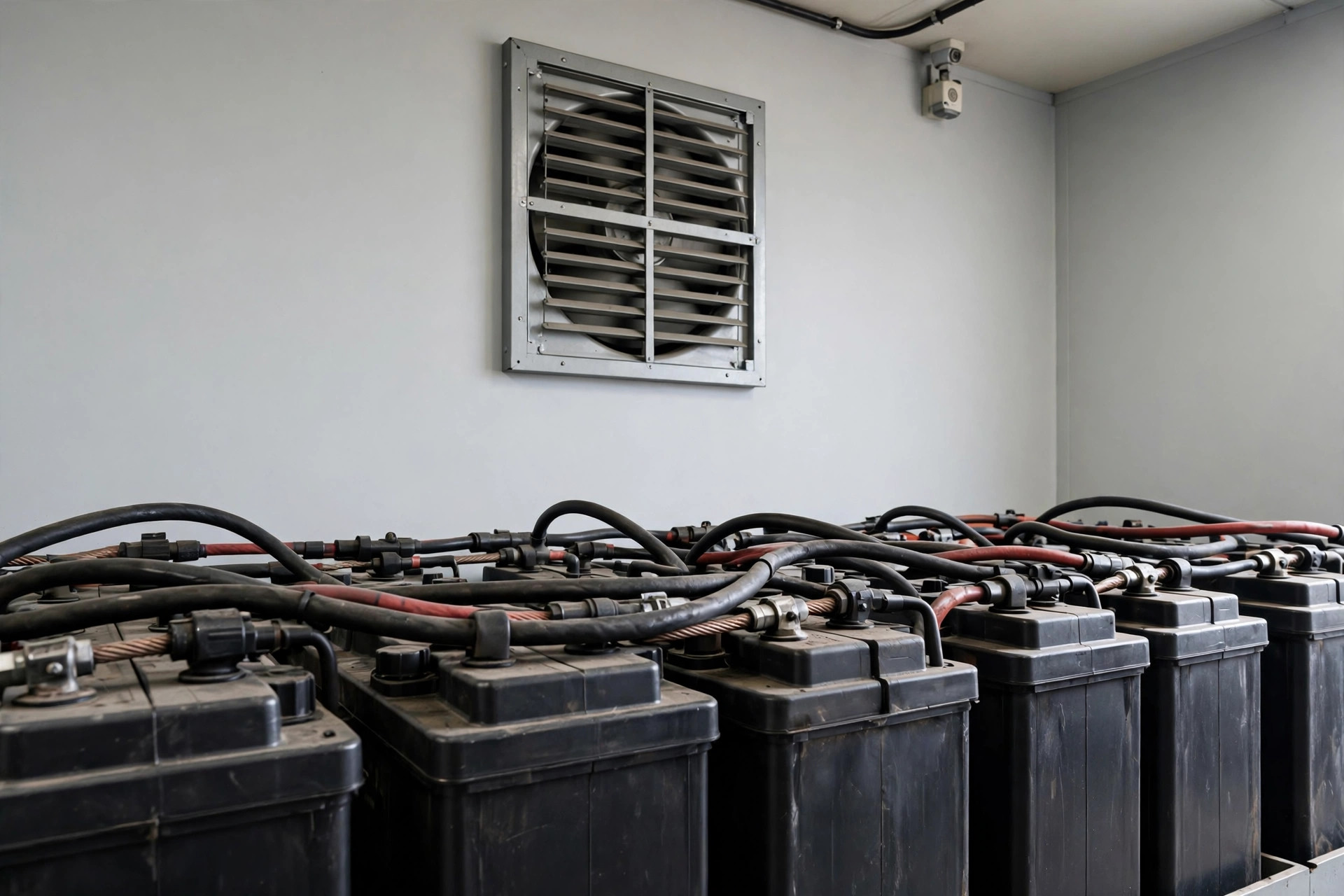
Hydrogen sensor placement has exactly one rule: under the ceiling, near the exhaust opening, above the batteries. I've seen too many sensors mounted at chest height on the wall — that's measuring for the humans, not for the hydrogen. Hydrogen lives at the ceiling; the sensor must live just below it. And calibrate on schedule. An uncalibrated sensor is no sensor.
The Maintenance Trap: Systems Die From Neglect
Here's a scenario. A 3PL running a couple dozen forklifts had its "charging area" as yellow lines painted in a warehouse corner. After an OSHA visit, they committed to a dedicated charging room: framed walls, an exhaust fan, hydrogen alarms, an acid flushing station. The retrofit itself wasn't complicated; what complicated the budget was the downtime during construction and the ongoing maintenance labor. But that cost isn't in the same universe as the cost of hydrogen reaching 4% under the ceiling. The most valuable item on their punch list wasn't the fan — it was the inspection sheet taped to the door. Because next time the inspector comes, that sheet is what he'll read.
A sense of scale helps here: double the batteries charging at once, double the hydrogen generation. Ventilation load scales linearly. So "we've always charged this way and nothing happened" is not an argument — it just means you used to have fewer batteries. Plenty of warehouses didn't design their ventilation wrong; they kept adding batteries and never upgraded the system, until one day it quietly wasn't enough.
The inspection sheet doesn't need to be fancy. Once a week, five items:
- Exhaust and intake openings — blocked by pallets or freight?
- Fan running normally, no strange noise, filters cleaned?
- Hydrogen alarm self-test — does the audible/visual alarm actually sound?
- Eyewash and shower flowing, access path clear?
- No-smoking signage present, and is anyone sneaking a smoke in there?
Sign it, date it. That sheet is your evidence for "adequate ventilation" under 1910.178(g).
Two pseudo-needs worth shooting down. First, "bigger fan is better" — wrong. Exhaust capacity has to match intake size. Starve the intake and the biggest fan just pulls the room into negative pressure until the door won't open. Second, "lithium means we can ignore ventilation" — lithium-ion doesn't gas hydrogen during charging, true, but most warehouses run mixed fleets. As long as one lead-acid battery is charging in that room, the hydrogen math still applies. Don't use lithium as an excuse.
Is the money worth it? Look at one number: the price of the most expensive traction battery in your fleet. A compliant charging-room ventilation retrofit costs less than a single battery. Nobody wants to do the math on a hydrogen explosion.
By Da Liu, Automation Engineer