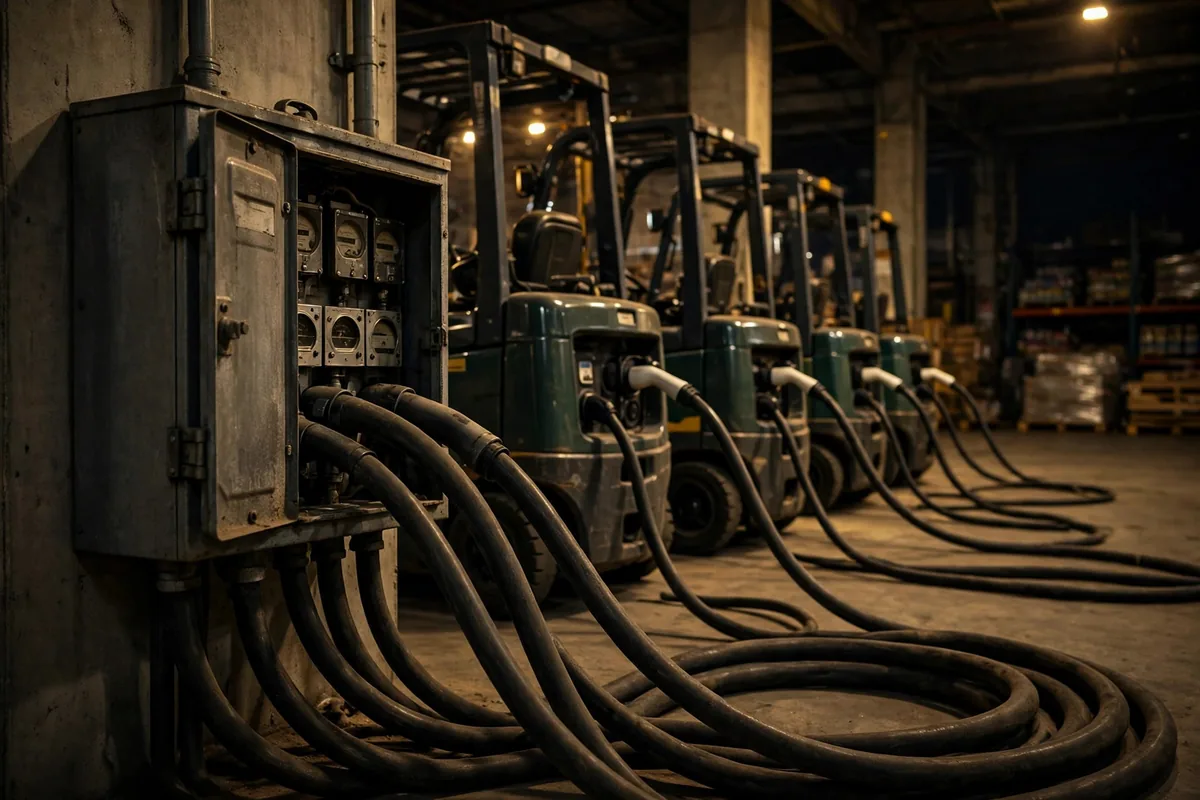
Let me tell you something about forklift battery charging room safety warehouse work. After all these years on the road, the room in a warehouse that worries me most is not the cold storage, not the hazmat corner. It is the forklift battery charging room. It looks like nothing — a few chargers, a row of batteries, a door everyone keeps shut. But trouble in a charging room never arrives with a bang. It builds up slow. In the winter of 2022, I was waiting on a load at a warehouse out in the Inland Empire, stuck for more than three hours, sitting in the break room next to the charging room. That room's door stayed shut all day, the fan never ran, and the fellow who went in to swap a battery came out saying he felt dizzy. The shift lead waved it off: "You get used to it." I told him straight — this is not about getting used to it. A charging room with no air moving is asking for real trouble. They fixed it later, added ventilation, kept the door cracked open, and nobody complained about dizziness again. Forklift battery charging room safety, the whole subject, really comes down to three things: the gas, the liquid, and the order you do things in. Get sloppy on any one of them and you are borrowing trouble.
Risk One: Hydrogen Ventilation — the Charging Room Safety Risk You Cannot Smell
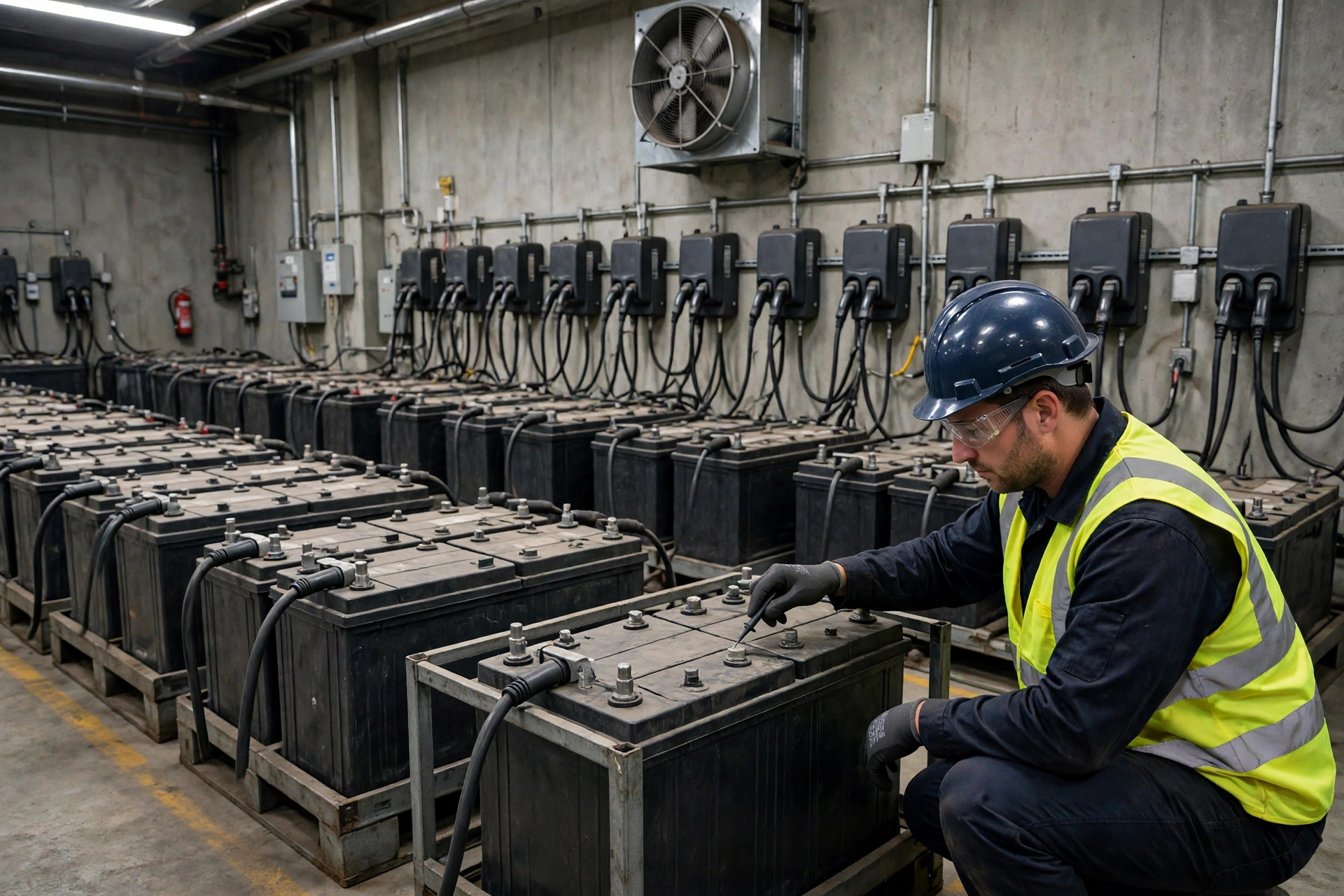
Lead-acid batteries give off hydrogen gas while charging. That is the most overlooked risk in the charging room. You cannot smell hydrogen, you cannot see it, and it rises and gathers up high — under the ceiling, around the light fixtures. A charging room with the doors shut and the fan off is basically a jar collecting that gas. Plenty of drivers will tell you, "I have charged batteries for ten years and nothing happened." That is not safety. That is luck that has not run out yet. Here is the counterintuitive part: the most dangerous thing in a charging room is not the open flame you can see. It is the gas you cannot detect at all. You know enough to step back from a flame. Gas just sits there quietly until a switch sparks or a plug gets pulled, and then it is too late to step back.
My simple routine when I walk into a charging room is to check three things: is the fan running, is there a window open, is the door left cracked for air? Then I look up near the ceiling for a vent. Keep the door from shutting tight while charging, and do not switch the fan off to save a few cents on electricity. As for exactly how much ventilation is required and how the vents should be laid out, the rules and the equipment makers' guidance differ by place and by setup, so go by the latest official guidance — I am not going to quote you a number I cannot stand behind. In the summer of 2023 I saw the opposite case at another warehouse: they had blocked the exhaust vent to keep dust out and ran only the air conditioner on recirculate, with eight forklifts charging at once. The room got hot and stuffy, and the drivers' eyes stung going in. They reopened the vent and the problem went away. Ventilation costs a little electricity. A room full of trapped gas costs a lot more.
Risk Two: Acid and Electrolyte — Do Not Treat the Water Jug as a Joke
The second risk is acid and electrolyte. Topping up water, checking levels, moving batteries — contact with electrolyte is a regular thing. The real danger is not some big dramatic accident. It is small habits. The jug you use for topping up sits next to the drinking water. The rag you wiped a battery with gets tossed anywhere. The safety goggles hang on the wall and nobody ever wears them. Back in 2019, at a warehouse in Texas, I watched a young driver top up a battery without goggles. A splash caught his eye. He spent a long while at the eyewash station flushing it out, and he was lucky it was right there. He told me afterward he knew he should have worn the goggles — it was just "one jug of water, why bother." Nine times out of ten, charging-room injuries come from that exact sentence: just this once.
So my rule is about placement, not preaching. Keep the goggles and gloves right beside the charger, where a hand reaches them without thinking. Do not lock them in a cabinet. Test the eyewash station once a month — press it and make sure water actually comes out — instead of discovering it is clogged when someone needs it. Mark the topping-up jug clearly and store it separately, never mixed in with drinking water. If electrolyte gets on skin or clothes, flush with plenty of clean water right away and then get it checked, do not tough it out. Safety gear only works when it is within reach. Make it inconvenient and the best-written policy on the wall is just wallpaper.
Risk Three: Charging Order and Fire Clearance — Charging Room Safety Basics
The third risk is charging order and fire clearance, and this is where cutting corners is most tempting. The right order is: connect the battery first, then switch the charger on; when it is done, switch the charger off first, then disconnect. Reverse that order and you invite sparking. And do not mix chargers around: different batteries take different chargers, and the wrong voltage or current heats a battery up. A little heat is a warning. A swollen, leaking battery is the bill coming due. In 2021, a fleet I knew shared charger cables between two units to save time, and the batteries ran hotter and hotter until a whole set had to be scrapped early. One set of batteries costs more than several fans and a wall of goggles combined.
Fire clearance is the same story. Do not stack pallets, cardboard or odds and ends next to the chargers, and keep the aisle wide enough for two people to walk through side by side. That is why every forklift battery charging room safety warehouse checklist I have seen puts clearance in its own row, separate from the charging steps. The fire extinguisher belongs by the door, where a hand finds it, not hidden behind a battery. A charging-room fire does not take one forklift. It takes the whole row of batteries with it. The worst case I saw was a charging room doubling as a storage closet, with cardboard boxes stacked within an arm's length of a charger. When I asked, the answer was "just for a few days." In a warehouse, "a few days" is the least reliable phrase there is.
| Quick check | What good looks like | Warning sign |
|---|---|---|
| Ventilation | Fan running, door or window cracked, exhaust vent clear | Doors shut tight, fan off, room hot and stuffy |
| Acid protection | Goggles and gloves within reach, eyewash tested, water jug marked and separate | Gear locked away, eyewash never tested |
| Charging order | Connect first, then power on; power off, then disconnect; charger matched to battery | Live plug pulls, mixed chargers, hot tangled cables |
| Fire clearance | Aisle clear, extinguisher by the door, nothing stored beside chargers | Boxes and pallets piled by chargers, extinguisher blocked |
Do the math and it is not close. A fan running a few extra hours, a few spare pairs of goggles, an extinguisher checked on schedule — that money is nothing next to a battery set scrapped early, a driver with an eye injury, or a charging room shut down. There is also a real trade-off here: charging everything in one room at once looks efficient, but a dozen trucks in one room means more gas, more heat and more risk concentrated in one place. Spreading it out and staggering the schedule is more hassle, but it spreads the risk too. The shortcuts that save you time are usually the ones that cost you the most.
I will leave it with an old saying from the road: in the charging room, slow is fine, but cheap is dangerous. Take two minutes at the start of every shift and walk the room: fan running, goggles where they belong, aisle clear, charger matched to the battery. Those two minutes are the most practical part of forklift battery charging room safety warehouse routine there is. Do not wait until something happens to go look up the rules. The rules will not move as fast as the accident already did.
By Shifu Zhao, Trucking Veteran (15 yrs)