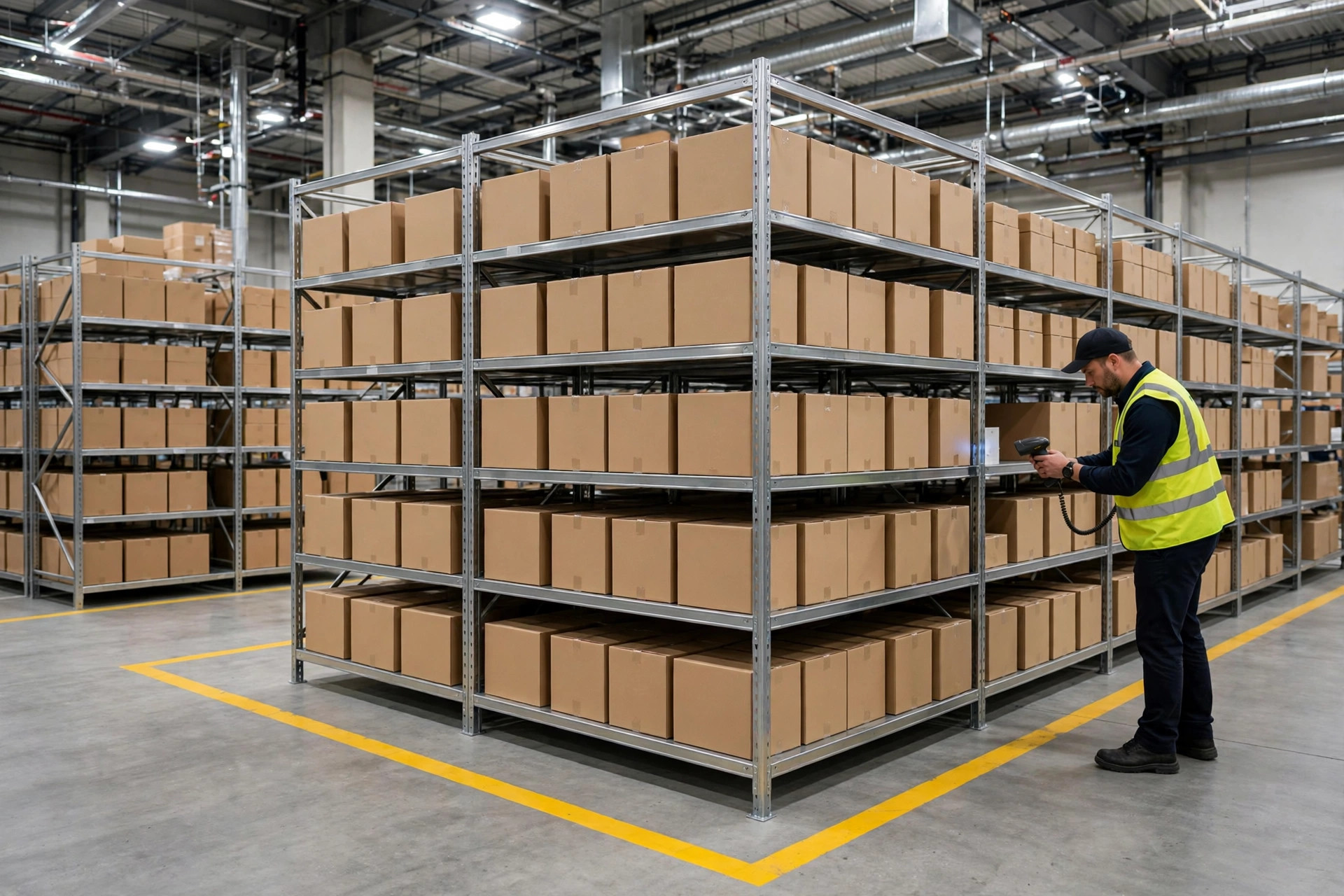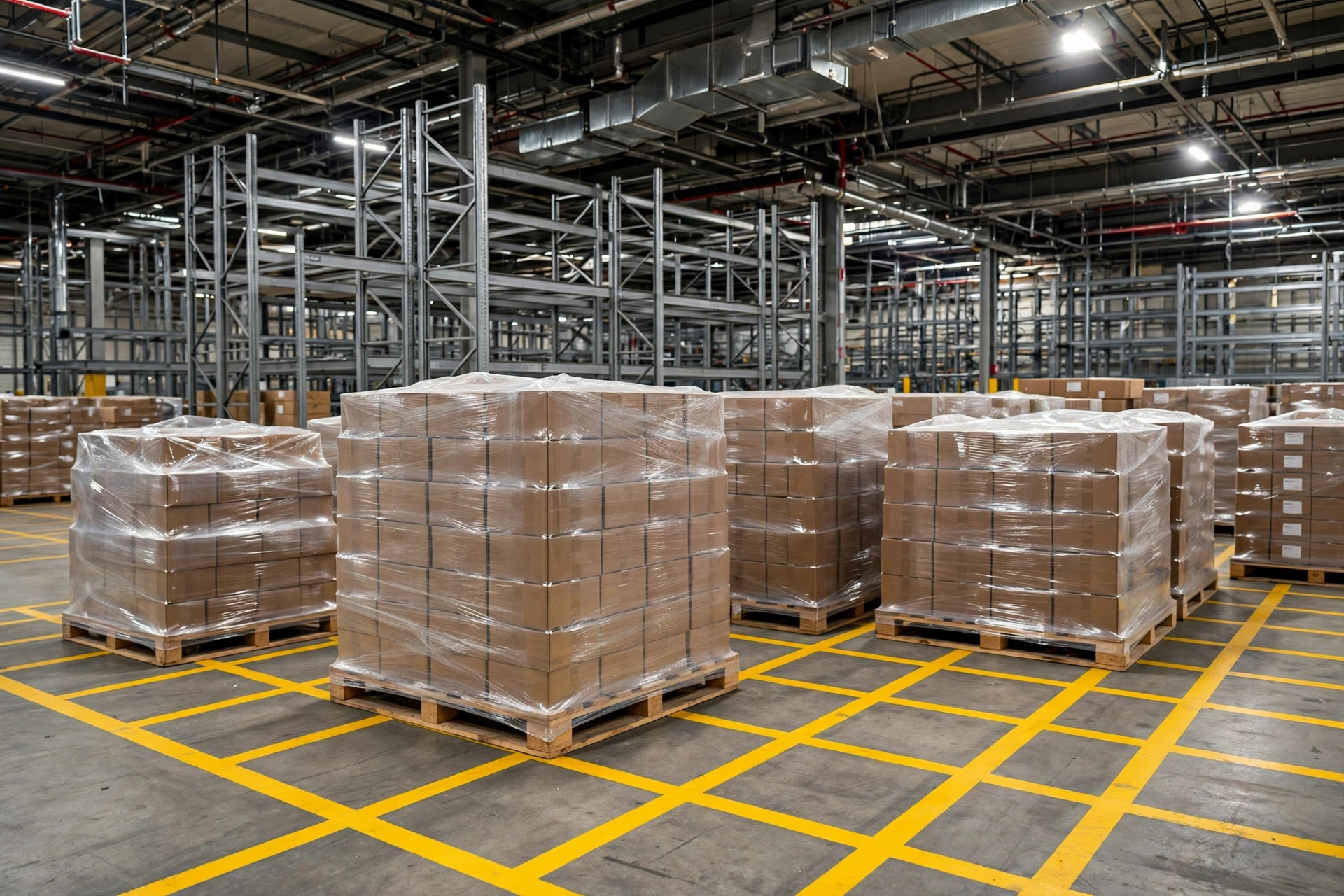
Here's the answer up front: floor storage areas don't have rack numbers, but they absolutely can have location codes. Use a four-part code — zone, aisle, lane, level — like B-03-05-2, meaning Zone B, aisle 03, lane 05, level 2. Paint the zones on the floor in yellow, spray each lane's code at its head, and model bulk locations in the WMS with the same location master data you use for racking, marked as bulk type. Get those three things right, and a few-hundred-pallet floor storage area goes from "ask the old-timer" to "scan and find" in about two weeks. Here's why, how, and the failure modes I've watched happen across 30-plus go-lives.
Why bulk areas need location coding more than racking does
Counterintuitive, but true: racking without location codes is merely slow. A bulk area without location codes is unmanageable.
Racking has physical structure as a backstop — the forklift driver roughly knows where aisle 4, level 3 is even without a system. A bulk area is a few hundred pallets sitting on concrete. One replenishment move and every position changes. Worse, bulk areas constantly mix SKUs on a single pallet: this pallet holds product A today, and tomorrow half a pallet of product B gets stacked on top. Without codes, the WMS ends up with one giant virtual location called "bulk area" holding hundreds of pallets. The inventory numbers balance, but nobody knows which pallet holds what.
In the summer of 2024, I was implementing a WMS for a small-appliance e-commerce warehouse in Dongguan. Their bulk area held 600-plus pallets of promo and slow-moving stock. The project manager told me, "Don't bother coding the bulk area — stock moves every day, codes would be useless." Three weeks after go-live, a returns wave hit, and the team needed a batch of humidifiers received in July. The system said "bulk area." Six hundred pallets searched for an entire afternoon, found in a corner with roughly a third of the cartons crushed. Root cause: treating the whole bulk area as a single location.
Floor location coding in five steps: from floor paint to WMS go-live
Step 1: Draw the zone map before you buy paint
Don't start painting. Take a tape measure and paper, and split the bulk area into A/B/C zones by velocity: A for fast movers, closest to the shipping dock; C for dead stock, in the back. Cap each zone at 8 aisles and each aisle at 12 lanes — beyond that, forklift drivers start miscoding. That's the ceiling I've settled on across 30-plus projects. Don't test it.
Pallets per lane depend on forklift turning radius and fire-code clearances — typically 4 to 6. Leave real turning room between lanes. Squeezing in two extra pallets by narrowing the aisle is a mistake you can't undo.
Step 2: Paint the floor, spray codes at the lane head
Yellow floor paint, lines around 10 cm wide. Spray the code at the head of each lane (e.g., B-03-05); mark levels with waterproof stickers on the pallets. I've seen this failure three times: someone uses ordinary paint to save money, forklifts grind it off in three months, and the whole area shuts down for repainting. Use epoxy floor paint or heavy-duty yellow marking tape — pricier, lasts two to three years.
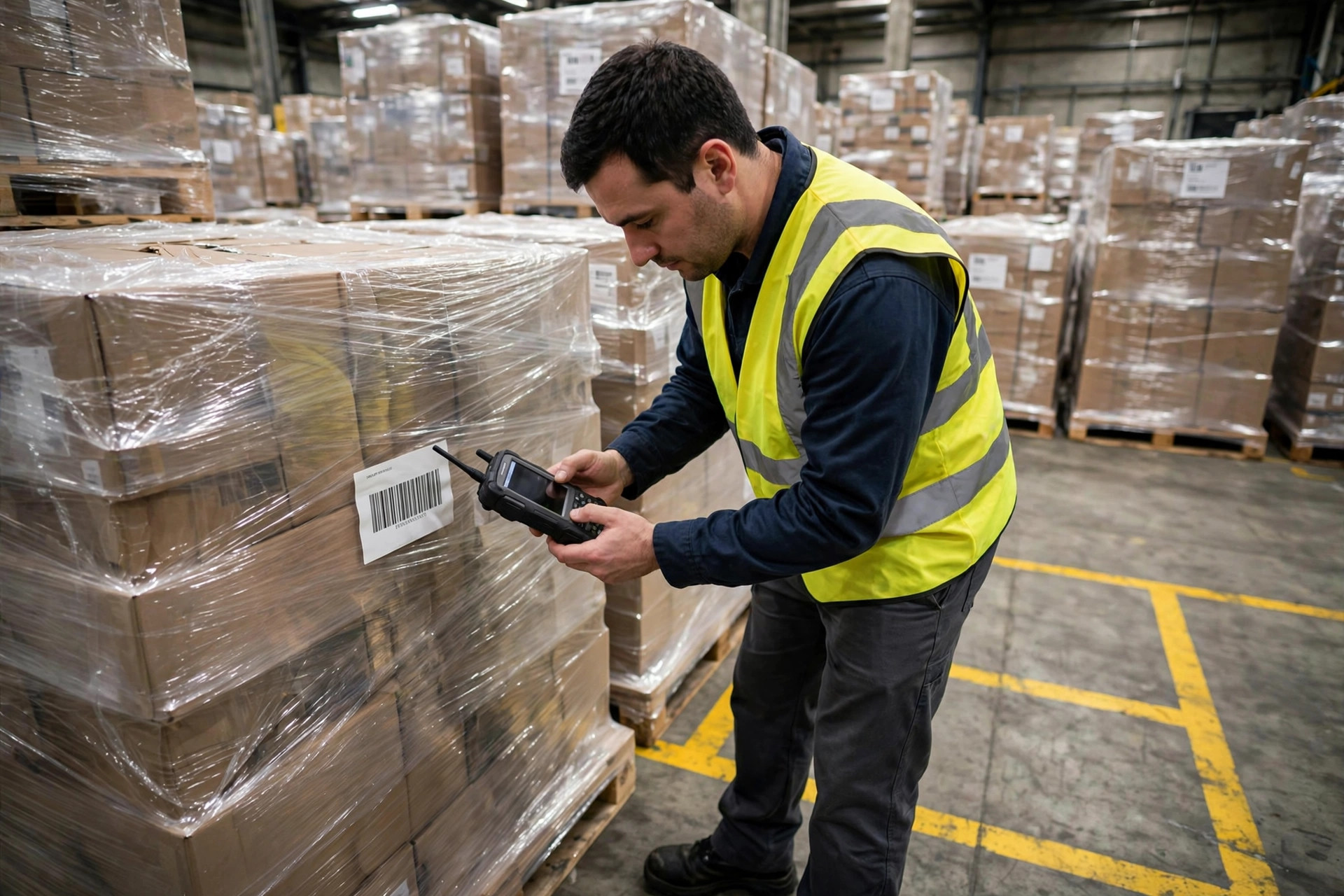
Lock the four-part code: zone (A/B/C), aisle (from 01), lane (from 01), level (from 1, bottom-up). Bulk stacks usually run 2–3 levels high, and the level must live in the system. Print the location code on the pallet license plate (LPN); scan to bind at receiving and putaway, and get it right the first time.
Step 3: WMS modeling — bulk locations share the same master data as racking
This is the step that matters most, and the one most people get wrong.
Bulk locations must live in the same location master data as racked locations, with location type set to bulk. Fill in every capacity attribute: pallets per lane, max stack levels, weight limit. Never create one giant "bulk area" location to save effort — that personally dismantles your WMS location management.
For mixed-SKU pallets, use license plates: LPNs hang under a location, one location can hold multiple LPNs, each LPN records SKU and quantity. Cap the mixing. My iron rule: no more than 3 SKUs per pallet, same product family only — say, all small-appliance accessories. Beyond that, cycle counting becomes torture.
Step 4: FIFO by lane, not by pallet
Bulk areas can't do strict per-pallet FIFO — pulling the middle pallet out of a lane means moving the whole lane. The workable method is lane-level FIFO: whole lanes move first-in-first-out, and the WMS allocates outbound picks from the oldest-received lane first, opening a new lane only when the current one is empty.
Late in 2023, a 3PL warehouse in eastern China called me in for a rescue. Their bulk area supposedly did FIFO, but drivers always grabbed the outermost pallet for convenience, so inner pallets sat for the better part of a year — dozens of pallets of food products went short-dated. We switched to lane-based allocation with the outbound order naming the lane directly, plus "oldest lane" floor markings. Two weeks later the short-dated backlog was nearly cleared. FIFO in a bulk area isn't a technology problem, it's a discipline problem — the rule has to be simple enough that a driver never has to think.
Step 5: Cycle count by lane, never wall-to-wall
Bulk areas are made for cycle counting: Zone A weekly, Zone B biweekly, Zone C monthly. Scan the lane head plus pallet LPNs with a PDA; only trigger a recount when a lane's variance crosses a threshold — say, more than 2 pallets. Never do quarterly wall-to-wall counts like racking areas — shutting a bulk area down for half a day kills outbound flow, and the boss will kill you.
The math: what floor location coding actually saves
| Without coding | With coding | |
|---|---|---|
| Finding one pallet | 10–20 minutes of shouting and tribal knowledge | A few minutes, scan to the lane and level |
| Counting | Half-day shutdown, variance around 2% | Cycle counts with zero outbound impact, variance under 1% |
| FIFO | Wishful thinking, short-dated stock as a lifestyle | Lane-based allocation, enforced by the system |
| Mis-ships | Wrong pallet from a mixed stack, routinely | LPN validation, caught at scan time |
The cost? For a few-hundred-pallet bulk area: epoxy paint and labor, half a day of painting; half a day of WMS configuration; you already own the label printer. Total investment is typically in the low thousands of dollars. The payback is the finding-time saved every day — for a 10-person warehouse, saving an hour or two of searching daily pays the project back within a month. I've run this math for clients more than ten times. Nobody has argued with it.
Where floor location coding fails: the go-live-night checklist
- Codes stop at the lane, no level. I've seen this failure three times. The driver double-stacks, and the WMS knows the lane but not which level — the code is decoration. Levels go in the system.
- Cheap paint. Ordinary paint grinds off in three months; epoxy lasts two to three years. Every time I've stood on the floor on painting day, I've said this sentence.
- Unlimited mixing. A location with a dozen LPNs turns cycle counting into agony. Iron rule: max 3 SKUs per pallet, same family.
- Code ranges collide with racking. If racking also has a B-03, one PDA scan lands in the wrong zone. The first segment must be instantly distinguishable — prefix bulk zones with F (Floor), or use a dedicated zone range.
- Go-live-night checklist: □ lane-head codes all sprayed □ bulk-type locations built in the WMS □ capacity attributes filled □ drivers trained (3 pallets hands-on each) □ cycle-count calendar scheduled. Don't go live missing one.
No rack numbers in a bulk area is not the problem. Treating the floor as racking — coded, modeled, disciplined — is the fix. Get the rules detailed, the WMS model right, and the floor discipline enforced, and a bulk area can run cleaner than racking.
By Lin Xiao, WMS Implementation Consultant