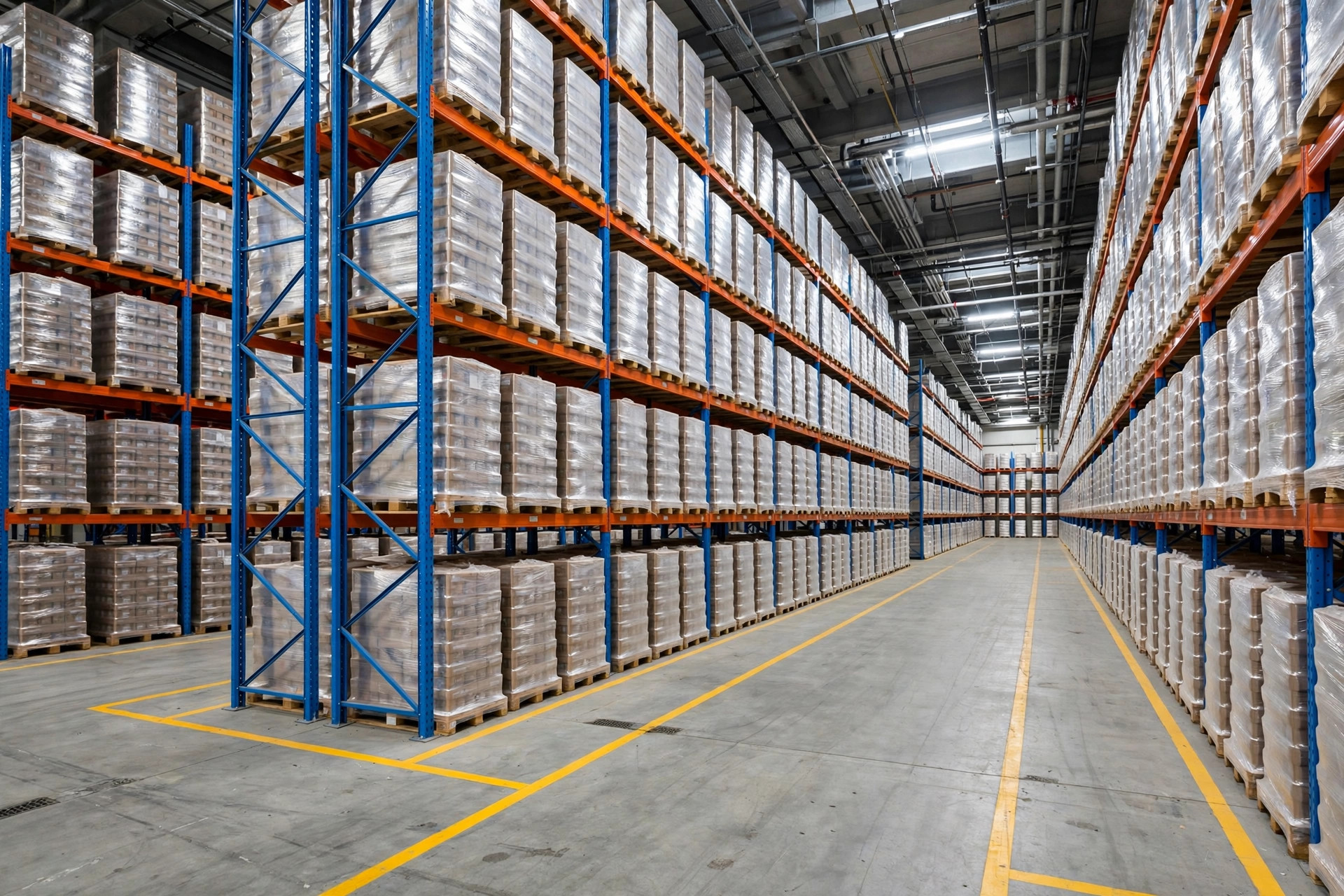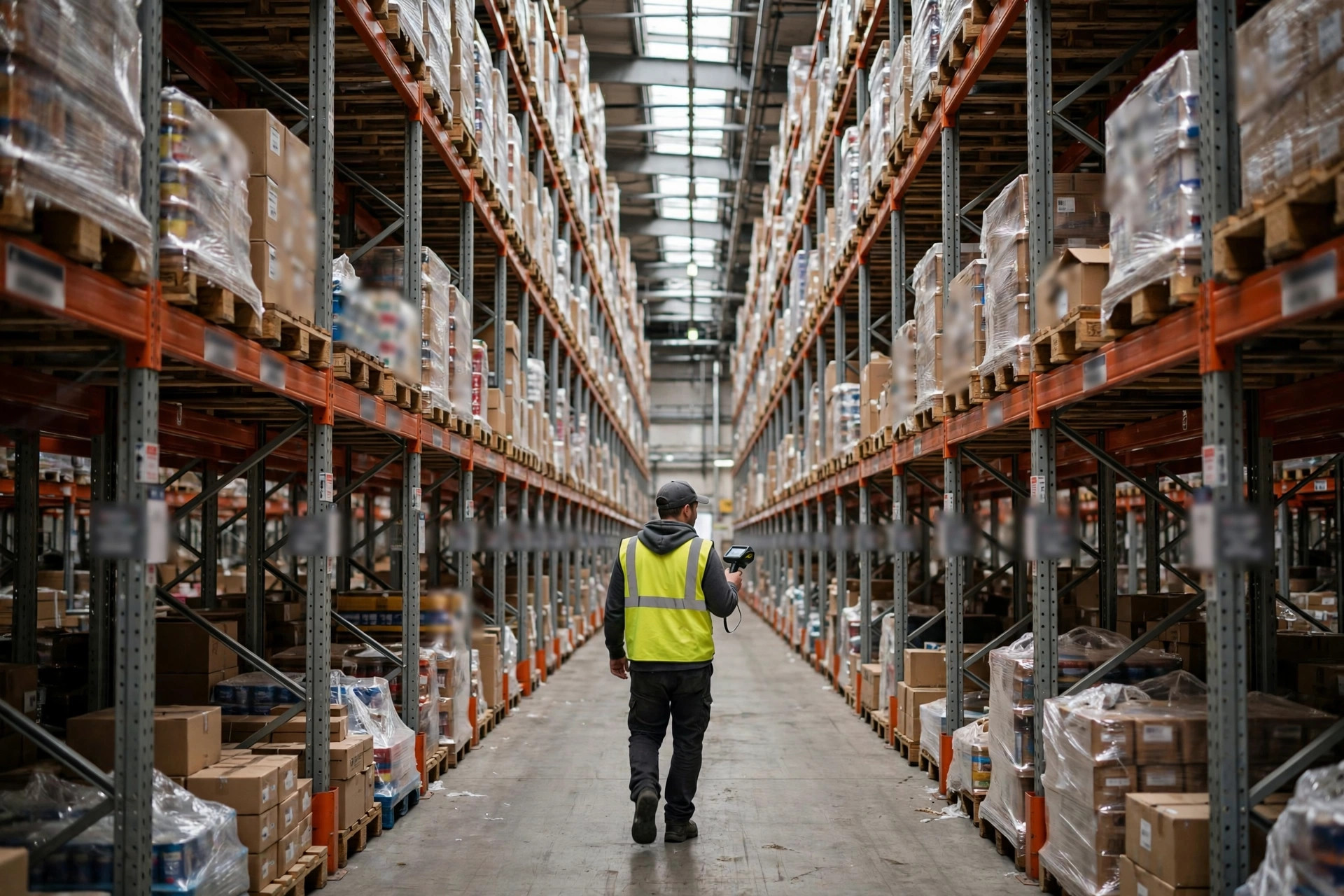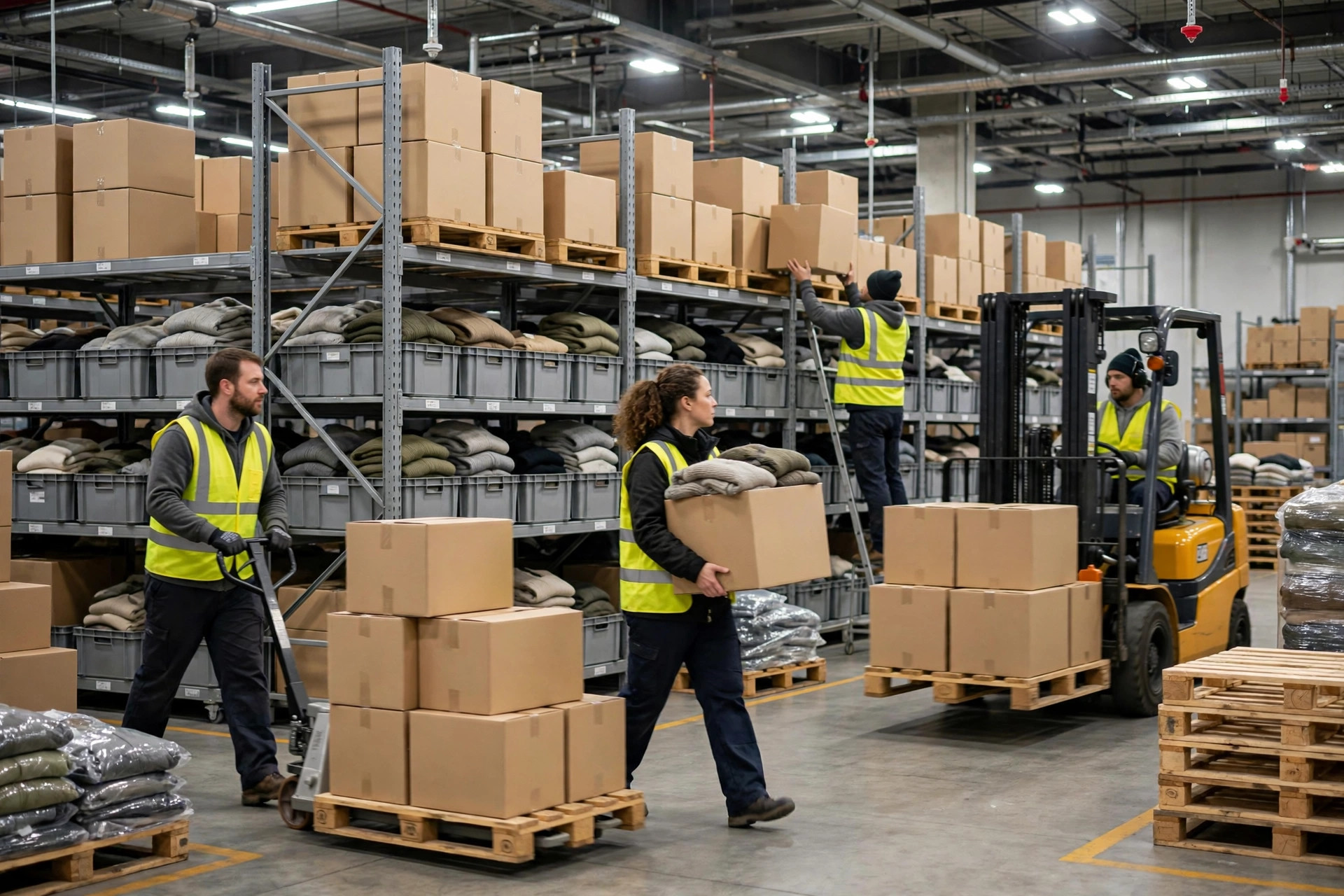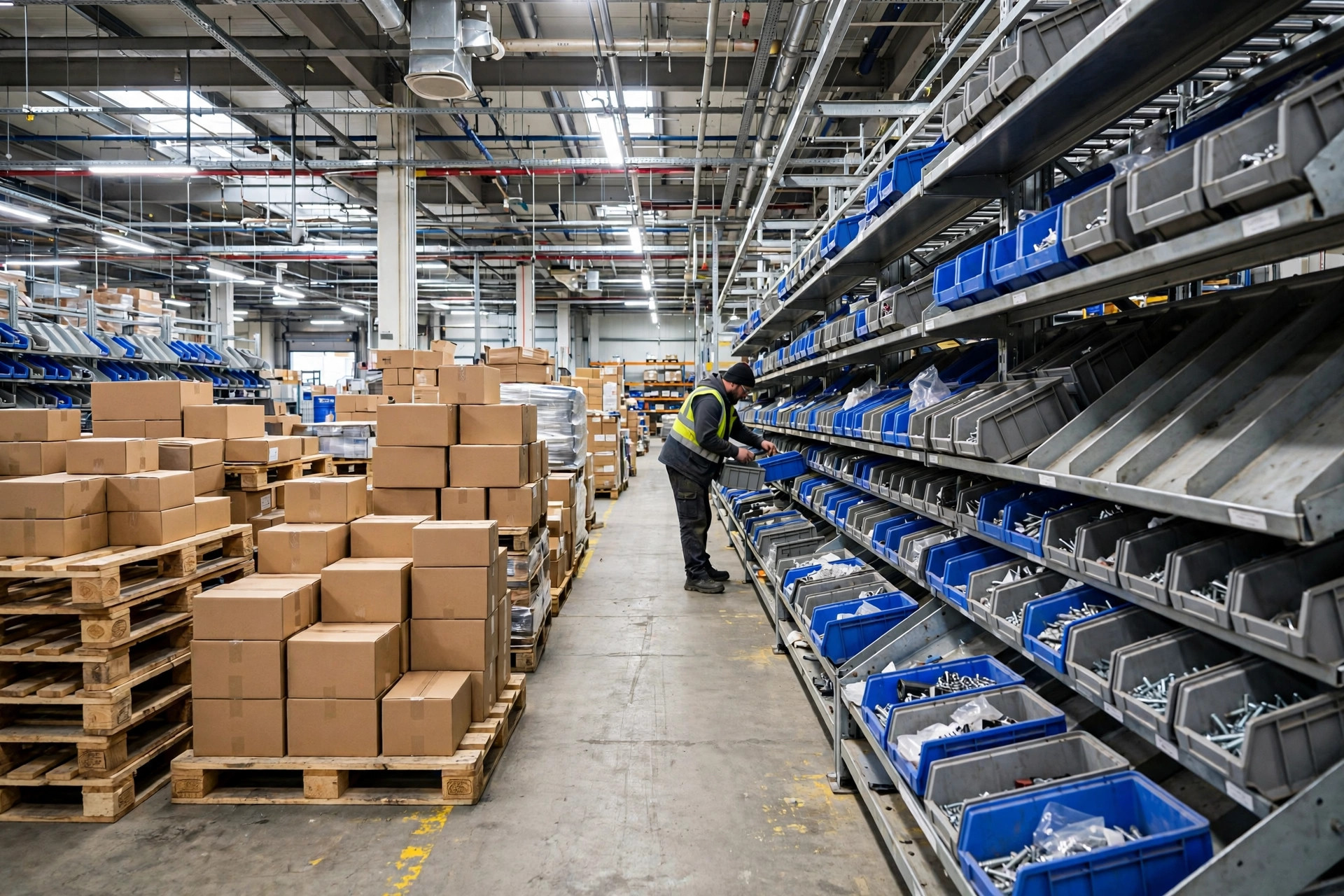
Here's my verdict up front: if your small-parts zone picks fewer than 300 lines a day, keep floor-stacking it. If it picks more than 500 lines a day, rack it now. These aren't numbers I made up — they're what twenty years of walking California warehouses taught me, one facility at a time. I've seen too many operations get this backwards: cheap-rent warehouses with modest volume blowing six figures on racking for looks, and high-rent facilities where pickers dig through floor-stacked cartons every day. This article gives you a costing model you can plug your own numbers into, and then you'll know exactly which side you're on.
Don't Buy Racking Yet — Run These Two Calculations First
Floor stack versus racking in a small-parts zone is really a fight between two costs: space cost and labor cost.
Space cost is simple: footprint (sq ft) × rent ($/sq ft/year). Floor stacking looks cheap because there's no racking investment, but it eats floor space. The same 500 SKUs might need 2,000 sq ft floor-stacked but only 700 sq ft on flow rack. With Inland Empire warehouse rents running $8–14 per sq ft per year, that difference is thousands of dollars a year.
Labor cost is the other side: pick time per line (minutes) × daily lines × 250 days × labor rate ($/hour). Floor-stacked small parts mean bending, digging through cartons, and hunting — I've timed it at 45–60 seconds per line on average. On flow rack, it's reach-and-grab: 20–30 seconds. Thirty seconds a line sounds trivial until you multiply it out.
The formula:
Annual labor delta = (floor-stack seconds per line − racked seconds per line) ÷ 3600 × daily lines × 250 × labor rate
Racking is worth it when this annual labor delta pays back the racking investment in 1–2 years. If it can't, the rack is decoration. If it can and you're still hesitating, you're throwing money on the floor every day.
Don't guess the two inputs. Pull 30 days of small-parts pick lines from your WMS and average them for daily lines. For seconds per line, shadow a picker for half a day and time 30 lines, dropping the top and bottom five. Most warehouses discover their assumed "40 seconds a line" is really 75 — managers always underestimate how much time floor-stack searching eats.
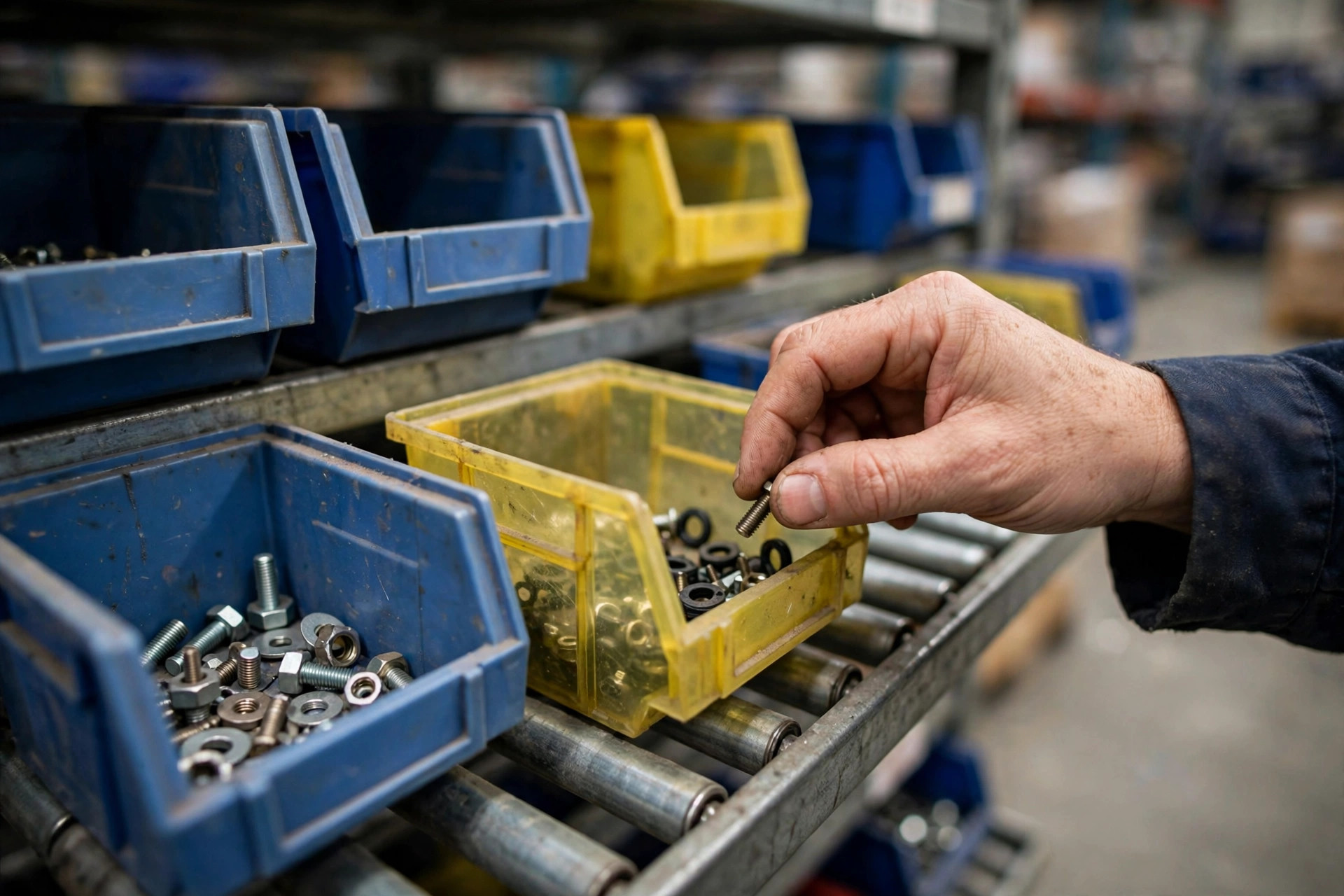
One more thing: racking has its own trap, and it's not whether to rack but what to rack with. Small-parts zones usually come down to two options: static shelving or flow rack. Static shelving is cheaper — one carton per slot — but replenishment and picking fight over the same face, and it falls apart once SKU count grows. Flow rack costs 30–50% more, but replenishment feeds from the back while picking happens at the front, so the travel paths never cross. Around 300 lines a day, static shelving is fine. Push past 500 lines on static shelves and your replenishment crew and pickers spend all day yielding to each other in the aisle, giving back half the efficiency.
Floor Stacking Looks Cheap — Until You Count These Three Hidden Costs
Most people cost out rent and racking and stop there. These three hidden costs of floor stacking are where the real margin leaks out.
The first is search time. Floor-stack zones live in fear of mixed SKUs: cartons piled three high, and picking the bottom one means moving the top two first. I walked an auto-parts warehouse where the floor-stack small-parts zone averaged 90 seconds a line with a high mispick rate. After racking, the same zone dropped under 30 seconds. Search time never shows up on any report, but it burns labor hours for real.
The second is crush damage. Small parts usually ship in paperboard boxes or poly bags. Stack them high and the bottom boxes deform, seals pop, and dust gets into everything. A customer receives a crushed box, and the return, replacement, and support tickets cost far more than the box itself. For 3PLs this is the nightmare scenario — whose fault the damage is becomes a contract argument.
The third is cycle counting. Floor-stack zones are always the disaster area at inventory time: cartons get shuffled around, and the WMS book quantity never matches reality. Two full physical inventories a year, and the floor-stack zone drags the whole schedule. Once racked — one SKU per slot — you can cycle-count 20 slots a day and push inventory accuracy from around 90% to 98% or better. That gap decides whether you win the contract when a client audits your facility.
Two Scenarios, Worked Out
The numbers below are an illustrative model — the logic holds, and you plug in your own warehouse's numbers.
Scenario A: a self-operated hardware distributor, 800 small-parts SKUs, 200 pick lines a day, suburban warehouse at $8/sq ft/year, labor at $22/hour. Floor stacking takes 1,500 sq ft — $12,000 a year in rent. The racking option: $25,000 in flow rack, 600 sq ft footprint, $4,800 a year in rent. Labor delta: 30 seconds saved per line × 200 lines × 250 days × (30/3600) hours × $22 ≈ $9,167/year. Rent saved $7,200 + labor saved $9,167 = $16,367/year, so the $25,000 rack pays back in about eighteen months. This warehouse can rack — but it's not urgent. Floor stacking still works.
Scenario B: an e-commerce 3PL, 3,000 small-parts SKUs, 650 lines a day, rent at $13/sq ft/year, labor at $24/hour. Floor stacking needs 3,000 sq ft — $39,000 a year. Racked: 1,000 sq ft at $13,000 a year, $40,000 racking investment. Labor delta: 650 × 250 × (30/3600) × $24 ≈ $32,500/year. Rent saved $26,000 + labor saved $32,500 = $58,500/year. The rack pays back in under nine months. A warehouse like this still floor-stacking is throwing about $160 in the trash every single day.
See the dividing line? Under 300 lines a day, the labor wasted on floor stacking can't catch up with the racking investment — keep stacking. Over 500 lines, every day of hesitation costs money. Between 300 and 500, look at rent: expensive rent means rack now, cheap rent means you can wait.
My Verdict: Who Racks Immediately, Who Keeps Stacking
Rack immediately if you check two or more of these boxes: over 1,500 SKUs, over 500 small-parts lines a day, rent above $10/sq ft/year, or 3PL clients who demand high inventory accuracy. Don't overthink it — put in flow rack, slot your A SKUs in the golden zone (the two waist-height levels), and it pays back fastest.
Keep floor-stacking if: a few hundred SKUs, under 200 lines a day, a cheap suburban lease, self-operated with no client audits. Just run the floor stack properly: fixed zones by SKU, pallets with big labels, and a weekly 5S pass. Spend money where it matters, not on racking for show.
Then there's the third play — the hybrid layout — which fits most warehouses in the middle. Split by ABC: A SKUs (70–80% of lines) go on flow rack closest to the pack stations; B SKUs stay floor-stacked but on pallets with fixed slot locations; C SKUs go to the far-end floor-stack area. Racking investment is a third of full racking, but you capture about 80% of the labor efficiency. Of the warehouses I've worked with, this is the best bang for the buck.
The hybrid only works if the zoning rules are rigid, not "use your judgment." A-zone flow rack sits within about 30 feet of packing, with aisles wide enough for a pick cart plus a person to pass. B-zone floor stack rings the A zone — one SKU per pallet position, labels facing the aisle, big enough to read from 15 feet away. C zone goes far. Re-run the ABC analysis monthly, because small-parts ABC is never permanent: peak season turns C SKUs into A SKUs, and if you don't re-slot in time, the whole exercise was pointless.
One last cost people skip: safety. Floor stacks above head height risk toppling cartons — even the draft from a passing forklift can rock them. Fire inspectors watch aisle clearance and the space under sprinklers closely, and a shutdown order costs more in lost days than the racking ever would. My hard rule for floor-stacked small parts: no more than three high, never block aisles, never stack under sprinklers. Racking cuts these risks in half by design. Count that in the math too.
Something you can do tomorrow: take a sheet of paper and log your small-parts zone's daily pick lines for five straight days, then time 30 lines with a stopwatch for the average seconds per line. With those two numbers, the formula above gives you an answer in ten minutes. And time both rookies and veterans — their seconds-per-line can differ by 2x, so average them for a real number. Stop going by feel. Feel is expensive on this one.