We had a client on the Ethiopia coffee export lane, importing specialty coffee and buying direct for the first time. Good beans, washed Yirgacheffe, a lovely cupping score, and a price they were happy with. Then the container arrived, the doors swung open, and the client's face went pale. The sacks nearest the door felt damp. The beans had white spots on them. The whole lot dropped a grade.
The client called me and asked the obvious question: the coffee was fine when it left origin, so how did it go bad on the way? I did not argue about whose fault it was. I asked three questions instead. Was moisture tested at the origin warehouse? How many days did the coffee sit in the Addis Ababa consolidation warehouse before stuffing? And once the box reached Djibouti Port, how long did it wait for the vessel? Three questions, and the client had the answer. On this lane, most of the money is not made or lost on the ocean. It is made or lost in every handoff between the highlands and the sea.
Start with the size of the trade. In the 2024/25 season Ethiopia exported 7.43 million bags of coffee, each bag 60 kilograms, worth about 2.89 billion US dollars. It is Africa's largest coffee producer, and roughly 5.9 million farmers grow the crop. With that much volume moving through the chain, one weak warehouse link costs real money. Green coffee is a fussy cargo. The beans trade moisture with the air around them, so a damp warehouse invites mold, kills the aroma, and can drag a whole lot down a grade.
Ethiopia Coffee Export Starts in a Damp Highland Shed
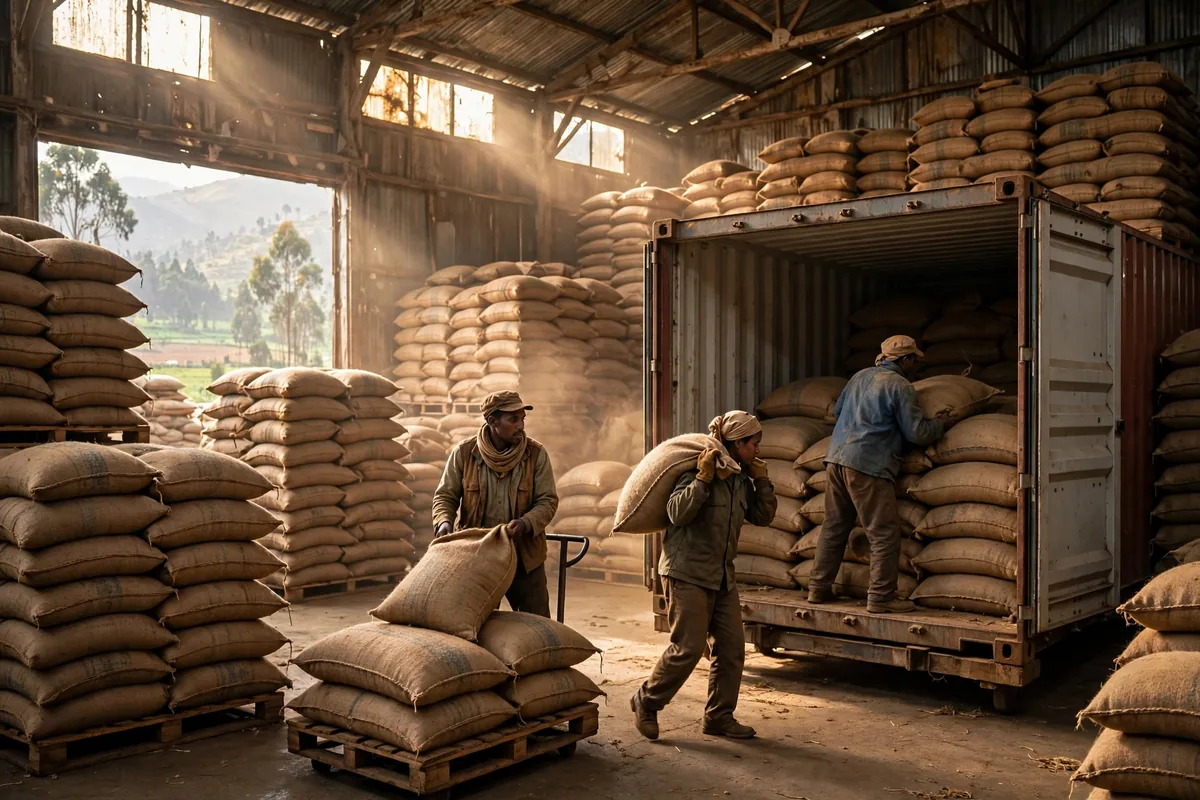
The growing regions sit on the high plateau, Yirgacheffe and Sidamo country, and when the rains come the air is thick with water. Plenty of first-stage processing sheds are still mud-brick walls under a tin roof. The floor sweats, sacks sit straight on the ground, and beans that tested fine coming off the drying beds can test over the limit two weeks later. The trade's accepted safe line is well known: bean moisture between 10 and 12 percent, warehouse temperature 15 to 20 degrees Celsius, relative humidity 50 to 60 percent. Three simple numbers, and holding them through a highland rainy season takes real discipline.
One origin warehouse we work with does it the boring way, and it works: every sack goes on a pallet, off the floor and away from the walls, with air gaps between the stacks. Moisture is tested on intake, and anything over the limit is set aside for re-drying. Each sack gets a hermetic liner inside the jute, which keeps moisture out and keeps smells from drifting between lots. None of that is glamorous. All of it decides whether your coffee lands as specialty or as second grade. Here is the counterintuitive part: an origin warehouse does not need fancy equipment. Ventilation, pallets, and testing often beat an expensive machine. You can buy equipment. You cannot buy habits.
The Ethiopia Coffee Export Stuffing Math: Grades, Pallets, and Waiting for a Full Box
Coffee comes in from the regions and funnels into consolidation warehouses in Addis Ababa for grading and stuffing. Same region, same process, one container, with grade and moisture matched lot by lot. Bags are sampled before stuffing, and a failed sample sends the lot back. This is where patience gets tested. Stuff a half-empty box and the freight per bag is painful. Wait for a full box and the coffee sits, losing a little life every day.
Here is a worked example, with assumed figures: a lot of 1,000 bags at 60 kilograms each weighs 60 tonnes. If moisture drifts down from 12 percent to 10.5 percent in storage, the lot loses roughly 1 tonne, all of it water walking out of the beans. Losing water is the small problem. The big one runs the other way. A damp warehouse pushes moisture up, mold risk climbs with it, the grade drops, and the loss dwarfs a tonne of weight. So the stuffing math is never only about freight. It is freight plus time plus quality risk.
Three ways to move it, and the trade-offs are plain. Small lots stuffed early move fast, but the freight per container is high. Waiting for a full box is cheapest on freight, yet the coffee waits longest. Shipping in parts and consolidating at the port is flexible, but port storage and handling add their own bill. No option wins every time. It depends on your volume, the sailing schedule, and how much delay your customer will tolerate. My rule of thumb: small specialty lots should not wait for a full box, because time costs more than the freight saved. Commodity lots can wait, but put a hard cap on the waiting time in the contract.
Ethiopia Coffee Export Ends at the Port, Not at the Railhead
Once stuffed, the box rides the Addis Ababa-Djibouti Railway, about 753 kilometers, and a freight train makes the run in roughly 10 hours. The same trip by road takes two to three days. The line entered commercial operation in January 2018, and it is the lifeline of a landlocked country: about 95 percent of Ethiopia's imports and exports move through Djibouti Port.
The railway is fast. The real risk sits at the port. A box that reaches Djibouti does not always board a vessel right away. A schedule change leaves it waiting in the yard. Djibouti sits on the Red Sea, the sun is fierce, and the day-night temperature swing is wide. A box bakes all day, cools at night, and condensation forms inside. Drops fall on the sacks, the beans pick up moisture, mold follows, and every careful step before the port was wasted. So settle the port handoff before the box leaves Addis: how many days can it sit, is there shaded storage, and what is the backup sailing if this one is missed? Put it in the operating instructions, not in a phone call made after the box arrives.
There is one more cost buyers often forget: the port itself. Ethiopia pays Djibouti substantial port-related fees every year, and the exact figures should be checked against the latest published numbers. The logic is simple, though. One gateway means no bargaining power. When you negotiate a landed price, build in the port charges, storage, and any demurrage. Do not stare only at the farm-gate price.
Three Questions to Ask Before You Sign
Ethiopia coffee export is a relay, and it is not about how fast any one leg runs. It is about whether the beans are still dry and still on grade at every handoff. The origin warehouse guards moisture, the consolidation warehouse guards grading and waiting time, the railway guards the clock, and the port guards the sailing. One dropped baton wastes the rest.
Next time you negotiate, ask three questions. Is the moisture standard and the testing method written into the contract? If a lot loses its grade to moisture, who pays? And what is the cap on consolidation waiting time, with what remedy if it is breached? Get those three answers in writing, and your coffee stands a real chance of arriving the way it left the highlands. Ask one extra question before signing, and you will have one less argument after the box lands.
By Susan, 3PL Sales Director