Over the past two years, the edge vs cloud AI debate in warehousing has produced a curious pattern in vendors' marketing materials: the same vendor will pitch "real-time edge AI" in one paragraph and "cloud-based unified orchestration" in the next, while the question customers actually care about — where should my inference run — rarely gets a straight answer. Based on publicly available industry observation, this debate is not a winner-take-all technology contest. It is an engineering decision that should be made task by task, because different tasks differ sharply in their sensitivity to latency, reliability, cost, and data security. Applying a single deployment model to every task is itself a symptom of a missing decision framework.
The Phenomenon: Three Tasks, Three Timescales
Warehouse AI inference tasks fall roughly into three categories by time sensitivity, and time sensitivity is the first determinant of deployment location.
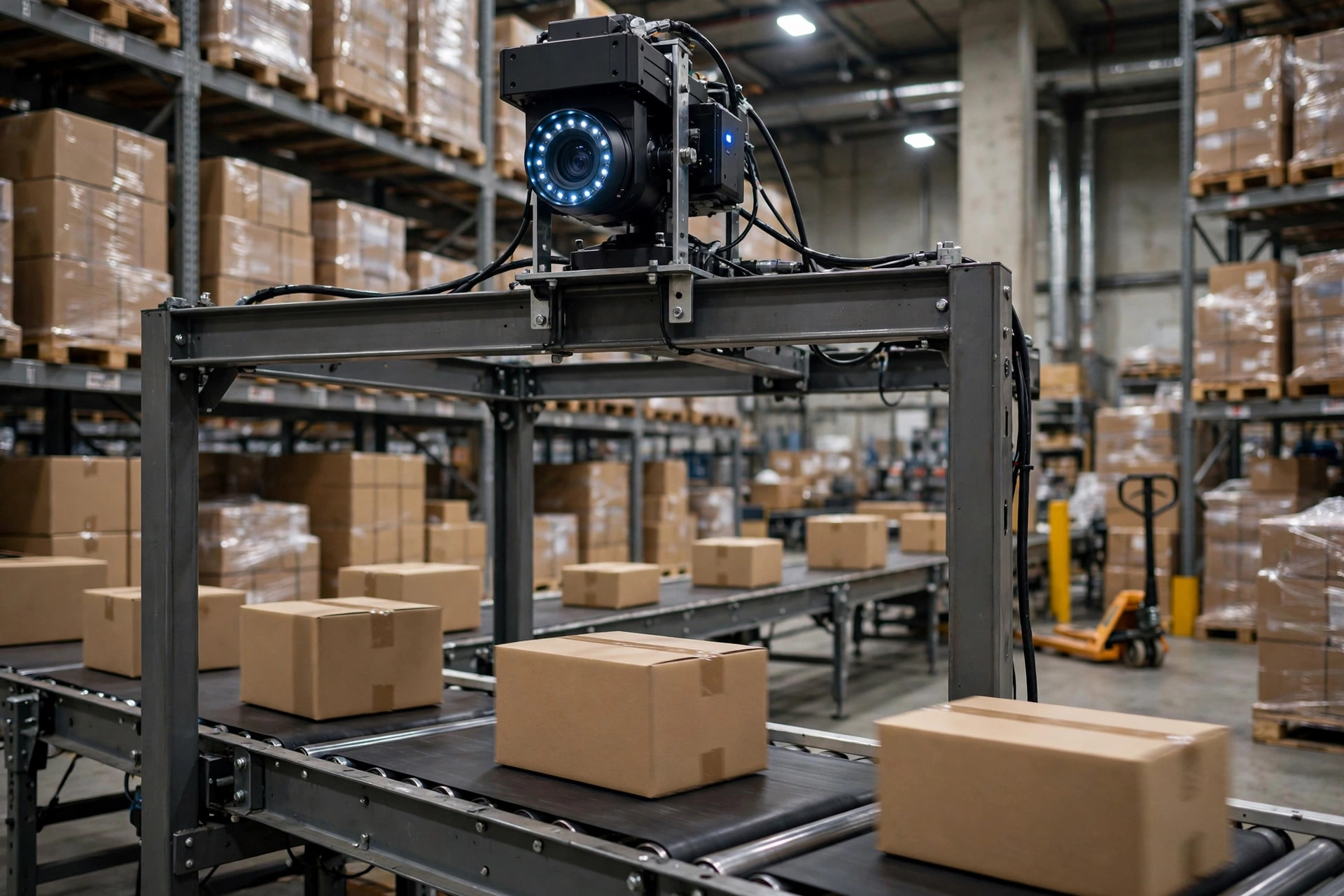
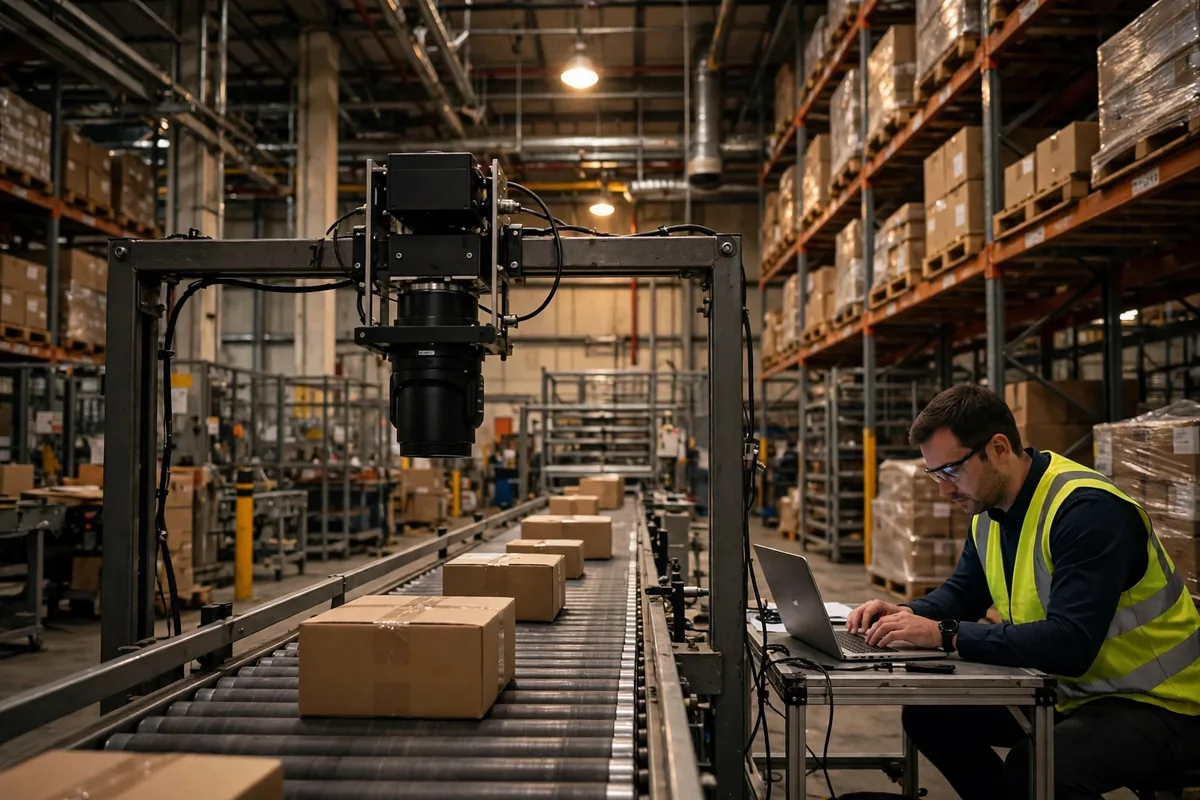
The first category is vision inspection: barcode reading on conveyors, damaged-parcel detection, dimensioning, and exception interception at sortation chutes. These tasks share one property — they are directly coupled to physical action. Within a second of the camera capturing a parcel, a robotic arm or diverter must act. If inference latency exceeds the mechanical cycle time, the whole line slows down or stops. In other words, the latency budget for vision inspection is typically measured in tens of milliseconds, and any round trip across a wide-area network is unacceptable.
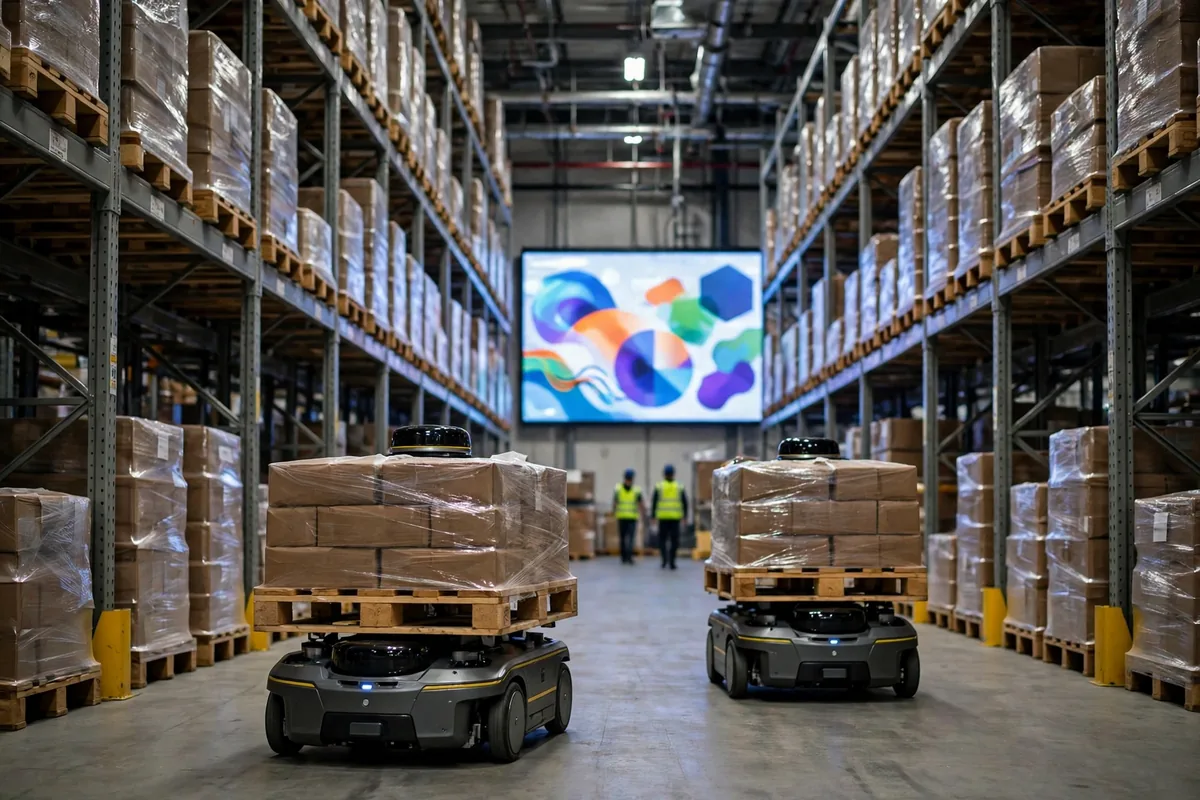
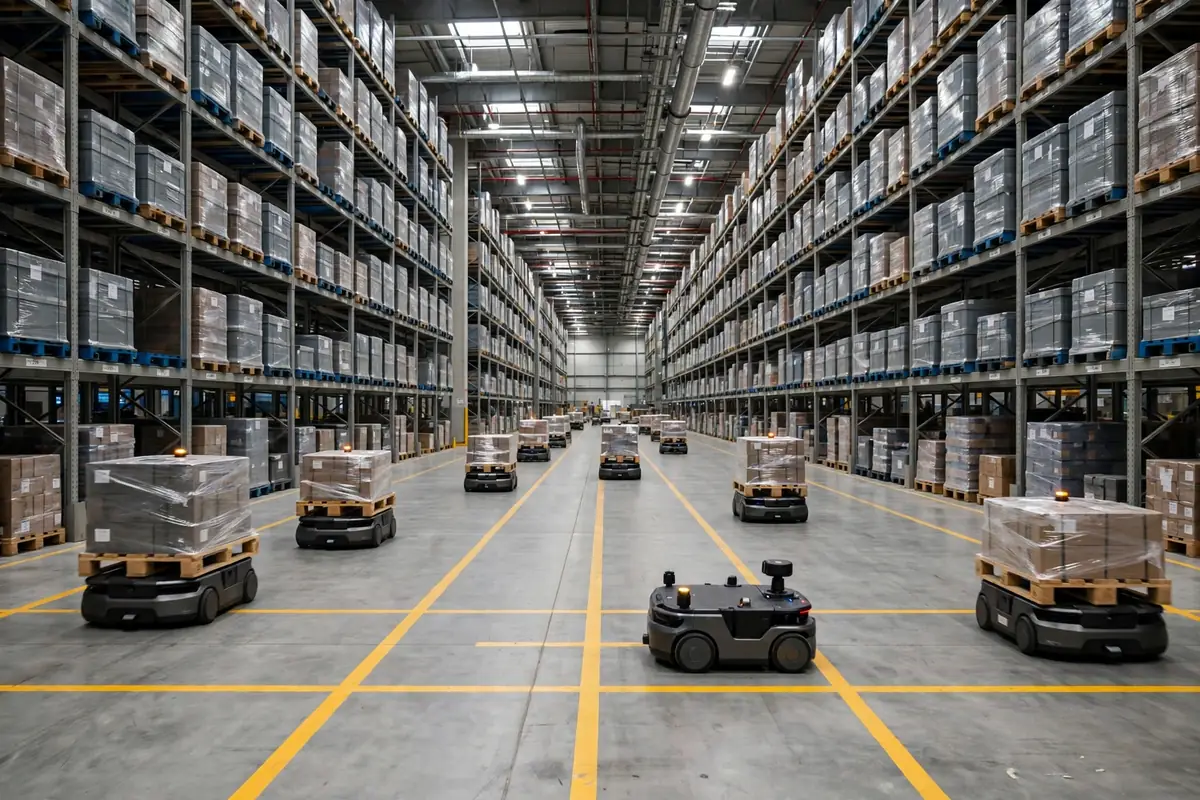
The second category is AMR and equipment scheduling: path planning, task assignment, and traffic control. What these tasks need is a global view — the real-time positions of dozens or even hundreds of units, task queues, and congestion states — rather than millisecond response at a single point. Scheduling decisions operate on a cycle measured in seconds, which leaves room for choice: they can run on a local server or in the cloud, with the deciding factors being system scale and tolerance for network outages.
The third category is forecasting: demand prediction, replenishment suggestions, labor rostering, and equipment failure warnings. These tasks run on historical and batch data, and their outputs remain valid for hours or even days. They have almost no real-time requirement but the highest demand for compute power and data breadth.
The timescales of these three categories differ by orders of magnitude. Forcing them into one deployment architecture guarantees unnecessary cost somewhere.
Four Dimensions: Edge vs Cloud on Latency, Offline Resilience, Cost, and Data Security
On latency, the edge advantage is physical: data never leaves the warehouse, so inference round trips can be held to milliseconds. Cloud round trips depend on network quality, typically ranging from tens to hundreds of milliseconds with a long tail of jitter. For vision inspection coupled to mechanical cycle times, that gap is decisive. For forecasting, it is entirely irrelevant.
The offline dimension is often underestimated. A warehouse network outage might be a severed fiber line or a failed campus switch, lasting anywhere from minutes to hours. If vision inspection and equipment scheduling depend entirely on the cloud, an outage means a stopped line. If inference runs locally, core operations continue during the outage, and only forecasting and report synchronization pause. The right question to ask when evaluating offline tolerance is concrete: if the network goes down for an hour, how many orders can this warehouse still ship? The answer directly determines which tasks must stay local.
The cost dimension requires a full accounting, not just a comparison of compute unit prices. Cloud pay-as-you-go looks flexible, but vision inspection runs 24/7 without pause, and over time the combination of cloud inference charges and data transfer fees often exceeds the depreciation of a one-time edge hardware investment. Conversely, forecasting is intermittent and batch-oriented, so elastic cloud compute is cheaper — there is no need to own hardware permanently for peak capacity that is used once a week. The counterintuitive point is that many assume "moving to the cloud saves money," yet for continuous inference workloads, the cloud bill is precisely the line item most likely to run out of control — not because the unit price is high, but because usage never stops.
The data security dimension depends on the nature of the data itself. Parcel exterior images and in-warehouse operation footage typically carry little commercial sensitivity, so transmitting them off-site is relatively low risk. Customer order data, a shipper's inventory structure, or surveillance footage containing workers' faces requires stricter compliance assessment before crossing the network boundary. Customers in Europe and in certain regulated industries face explicit restrictions on data leaving their premises, and in those cases edge deployment is not a performance choice but a compliance prerequisite.
| Dimension | Edge deployment | Cloud deployment |
|---|---|---|
| Latency | Millisecond-scale, stable | Tens to hundreds of ms, with jitter |
| Offline resilience | Core operations continue | Depends on network; outage means stoppage |
| Cost structure | Upfront hardware + low marginal cost | No hardware + ongoing usage charges |
| Data security | Data stays on-premises, compliance-friendly | Transmission and storage compliance must be assessed |
| Best-fit tasks | Vision inspection, real-time control | Forecasting, cross-site coordination |
Two Cases in the Same Warehouse
Consider two realistic scenarios. The first is a sortation line retrofit at a third-party logistics warehouse in East China: at conveyor speed, vision inspection must complete its judgment before each parcel reaches the diverter, and any single cloud jitter event causes a mis-sort. The project team ultimately deployed the inspection model on edge servers beside the line, with the cloud handling only model updates and performance statistics. The logic was simple: the task's time budget did not permit crossing the network.
The second is replenishment forecasting for a retail chain: data comes from dozens of warehouses, the model retrains weekly, and the output is a two-week replenishment recommendation. Running this in the cloud is natural — the data is already distributed, compute demand concentrates in the training window, and idle consumption the rest of the time is near zero. Forcing forecasting onto edge servers in every warehouse for the sake of a "unified architecture" would mean paying for compute capacity in each site that is used once a week. Plainly uneconomical.
Placed side by side, the conclusion is clear: deployment location should follow the task, not the vendor's marketing line.
A Hybrid Path: Edge and Cloud in Layers
For most warehouses, the realistic answer is hybrid deployment, and the key to hybrid deployment is clean layering rather than simply "a bit of both."
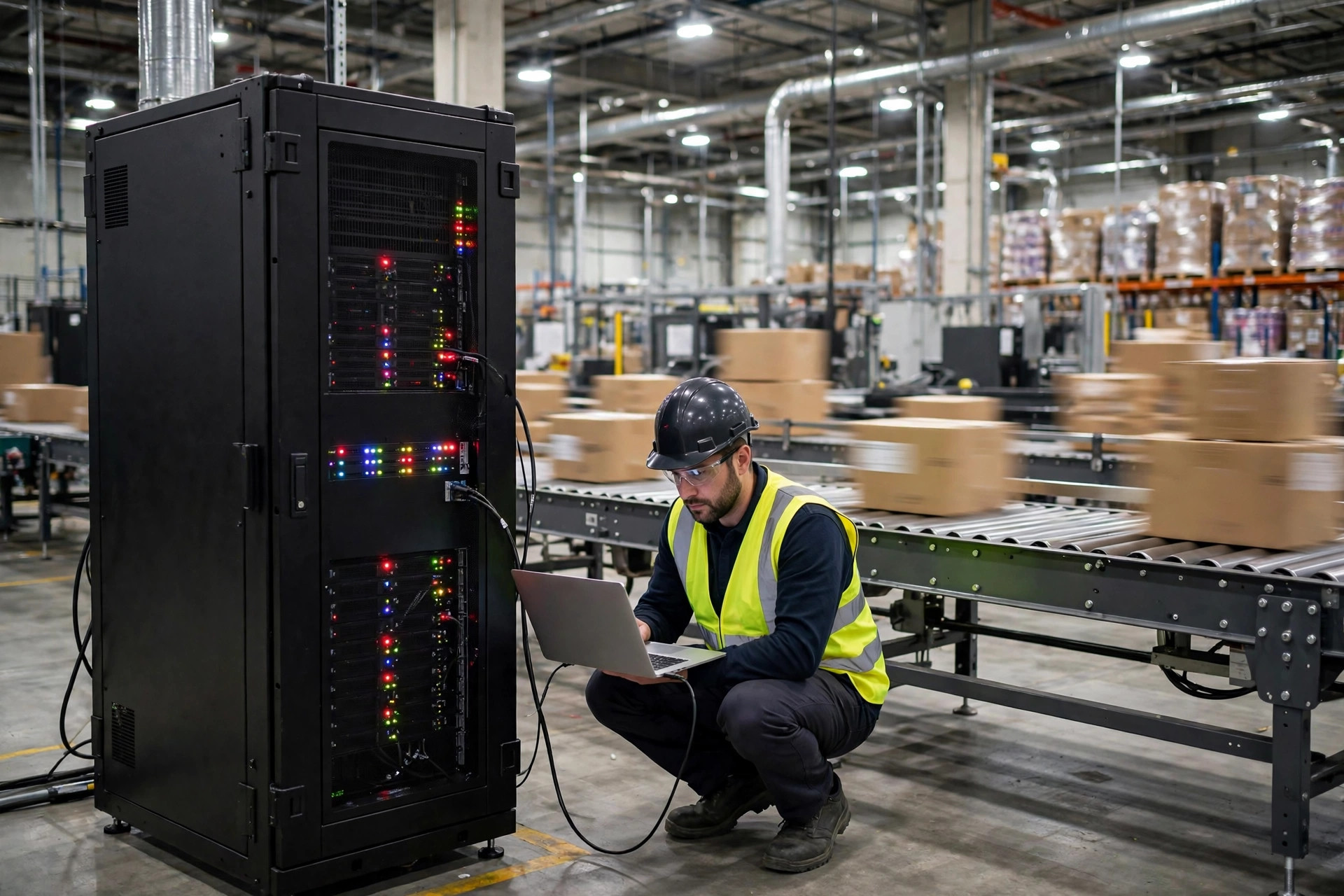
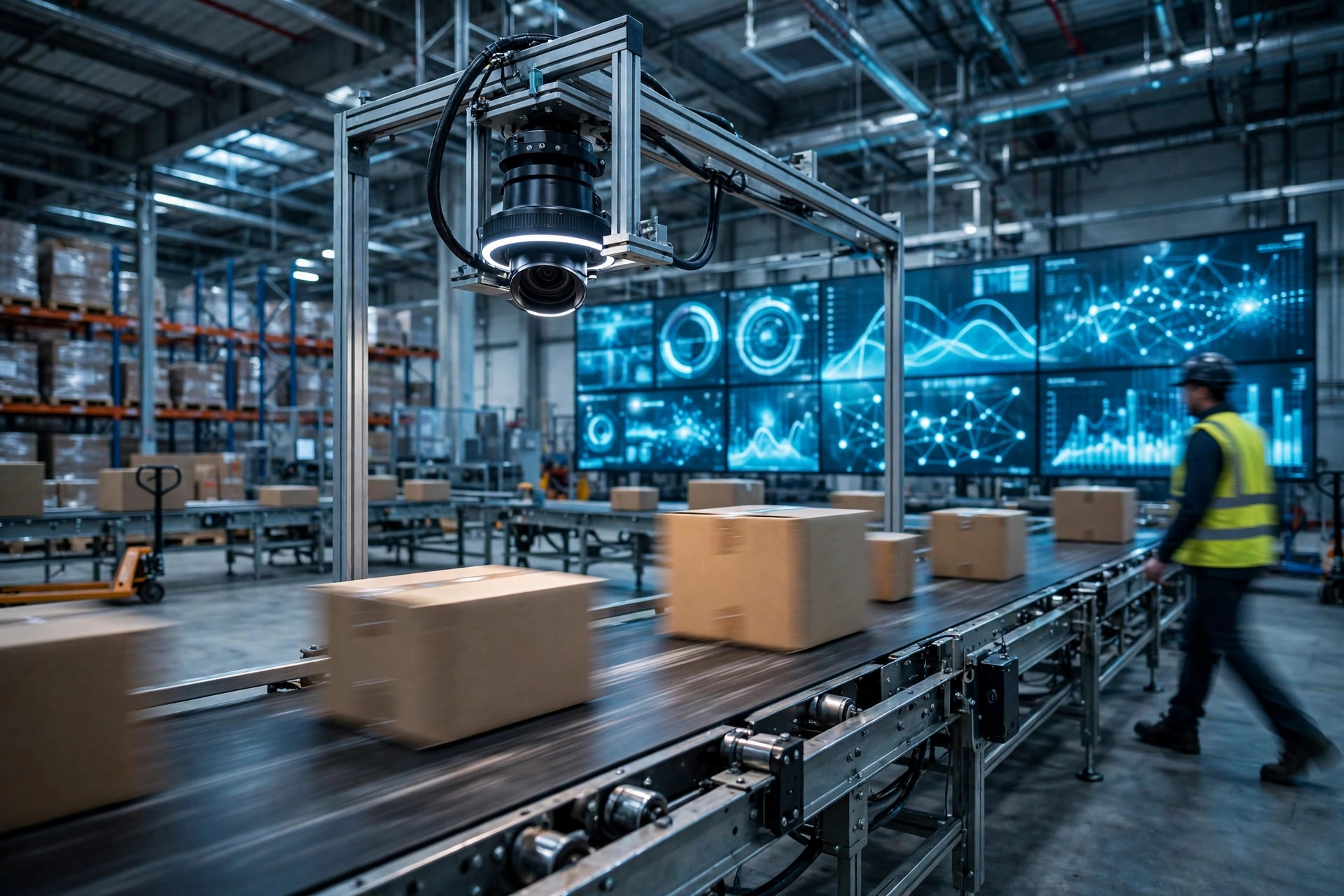
A workable layering is as follows: the edge layer runs real-time inference — vision inspection, emergency-stop judgment, single-machine control. A local or regional layer runs scheduling — AMR task assignment, traffic control, wave optimization — deployed on in-warehouse servers or a campus data room, balancing a global view with offline resilience. The cloud runs forecasting and coordination — demand prediction, cross-warehouse transfer recommendations, model training, and version management.
Three sequencing suggestions apply when implementing this. First, pin real-time tasks to the edge to protect operational continuity; this is a non-negotiable baseline. Second, keep the scheduling layer local first and move it to the cloud only when scale grows and genuine cross-warehouse coordination demand appears — do not pay cloud migration costs early for imagined scale. Third, manage models centrally from the cloud: training, versioning, and staged rollout are cloud responsibilities, while the edge only pulls and runs models, preserving cloud iteration speed without making the inference chain depend on the network.
One boundary deserves emphasis: edge deployment does not end at "buy a server." Model update mechanisms, remote maintenance of the edge fleet, and data backfill after outages are routinely underestimated workloads. If a team cannot maintain a fleet of edge devices, forced edge deployment introduces new failure points — in which case a compromise of "local server plus cloud fallback" is more robust than pure edge.
Ultimately, the edge-versus-cloud choice is not a matter of technical faith but an arithmetic problem of cost and risk: split by task, score across four dimensions, and check whether the team's operational capability can support the chosen architecture. Over the coming years, as edge chip performance keeps rising and cloud inference costs keep falling, the dividing line will keep moving — but the "split by task" framework itself will likely outlive any specific deployment recommendation.
Will warehouse AI deployment eventually default to the edge with the cloud as the exception, or the other way around? That depends on which grows faster in the next cycle — real-time task volume or cross-warehouse coordination demand — and the answer will probably only become clear after the next wave of large-scale retrofits.
By Dr. Chen, Supply Chain Researcher