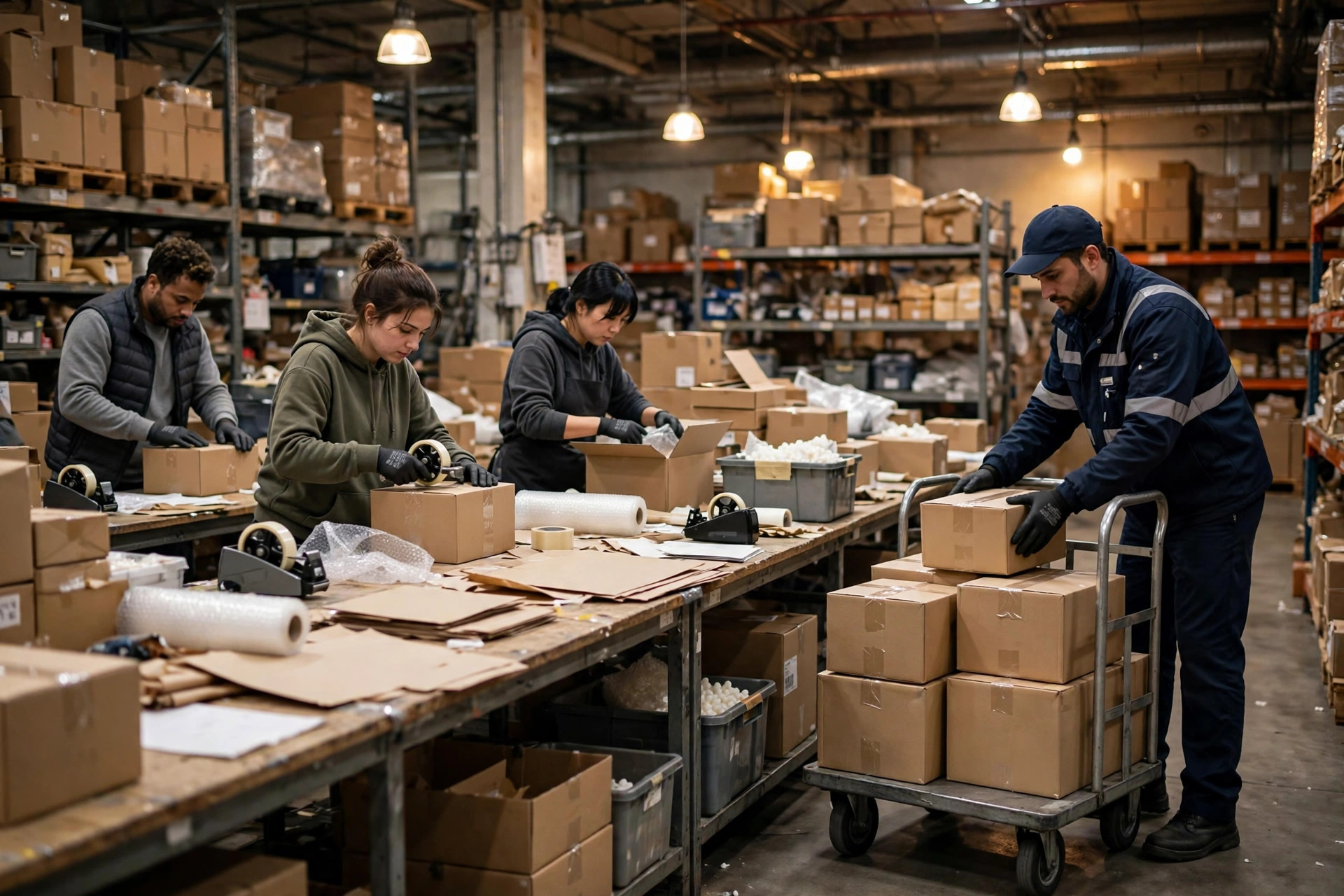
Start with the total, because that is where packaging hides. A seller shipping 8,000 parcels a month watches per-parcel packaging cost drift from $1.90 to $2.40, and that is $48,000 a year. Nothing got better. Customers did not receive a nicer unboxing experience, returns did not fall, and nobody thanked the seller for the extra air in the box. Packaging cost is easy to miss because it arrives on a dozen purchase orders: boxes on one, tape on another, bubble wrap on a third, paper fill on a fourth. Each line looks small. Added together, they are a budget line of their own. I only trust one method here: break packaging down to cost per parcel, then trace each cent back to a decision.
The Box Is Not Insurance
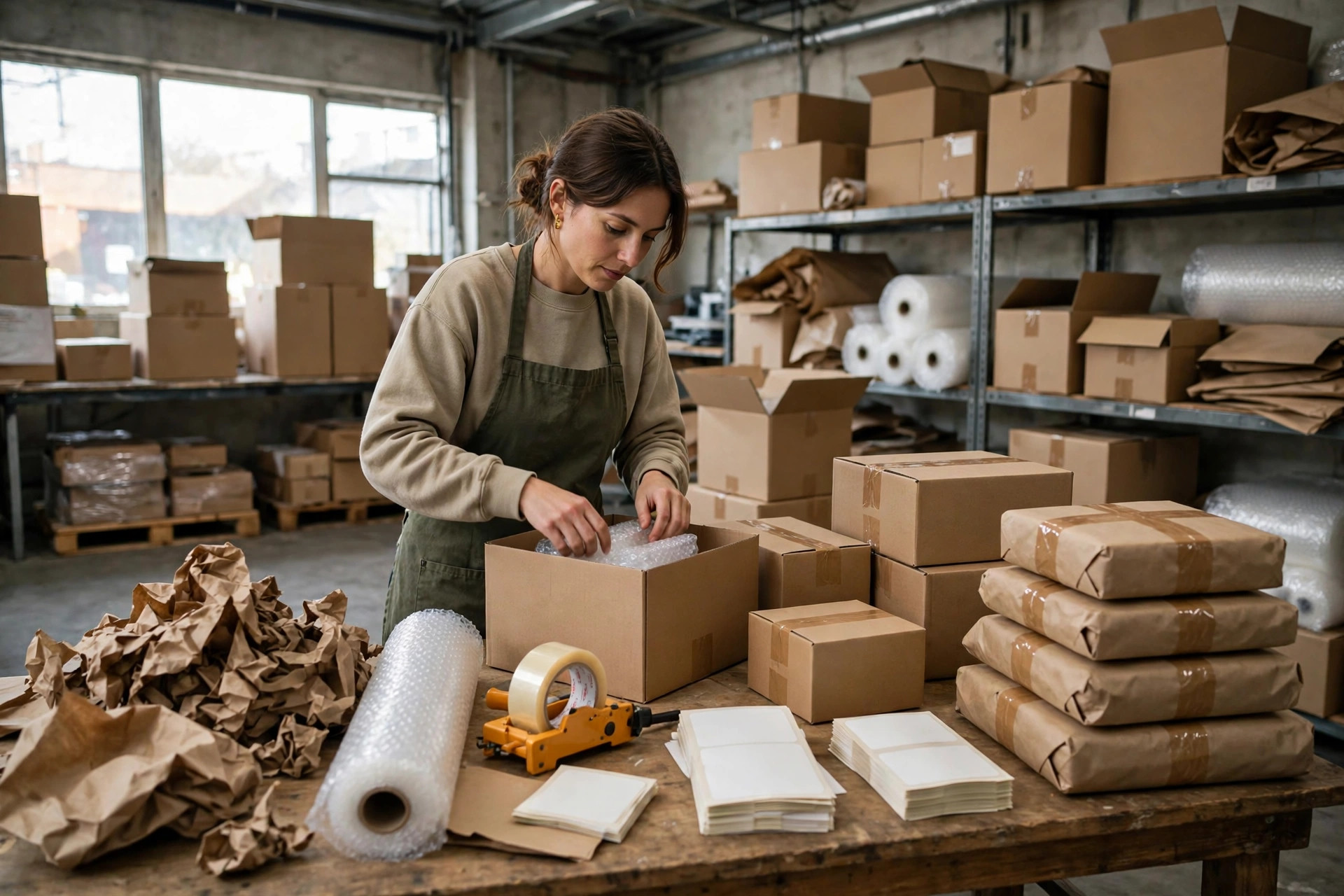
In March 2025, an independent home-goods seller in Ontario, California asked me to look at his numbers. His main product was a ceramic mug weighing 0.6 pounds, shipped in a 10×8×8-inch box stuffed with bubble wrap, about 8,000 orders a month. His logic was straightforward: a bigger box means the mug is less likely to break. The ledger told a different story. The box cost $0.68, bubble wrap and tape added $0.41, and packing took about 80 seconds per parcel. Packaging alone came to $1.42 per parcel, before any dimensional-weight effect on freight.
We ran a one-week comparison. The same mug went into an 8×6×6-inch box with honeycomb paper corner protection and recyclable paper padding. The box dropped to $0.44, fill dropped to $0.22, and packing time fell to roughly 55 seconds. Per-parcel packaging cost fell to $0.97. Damage barely moved: 11 damaged parcels in the big-box week, 9 in the small-box week. A mug breaks or survives based on whether it is held still and whether its corners are protected, not on how much empty space surrounds it. More empty space means a longer distance for the product to rattle, which means more fill is needed just to occupy the void.
Here is the counterintuitive part, and it is the heart of this article: the cheapest-looking box is often the most expensive parcel. I do not mean the lowest-priced box on the supplier list. I mean the "one big box for everything" shortcut. A universal box saves SKU management, but every order pays for extra fill, extra dimensional weight, and extra packing labor. Carriers calculate dimensional weight differently, and their current rules and rates should be checked against the official carrier policy in force at the time of shipping. The direction, though, is certain: each step up in box size pushes dimensional weight toward the next tier. Shipping a small item in a large box is paying freight on air.
The fix is unglamorous. Sort the last three months of orders by product size into three tiers: small, medium, large. Assign one primary box per tier plus one backup box. That primary box should cover more than 80% of orders in its tier, with the backup handling the rest. More than five box types and management cost starts eating the savings; fewer than three and some product is always being forced into the wrong box. Interior dimensions only need to exceed the product by about 2 to 3 centimeters on each side. That space is for cushioning, not for the product to move around in.
Fill Material Is a Trade, Not a Price
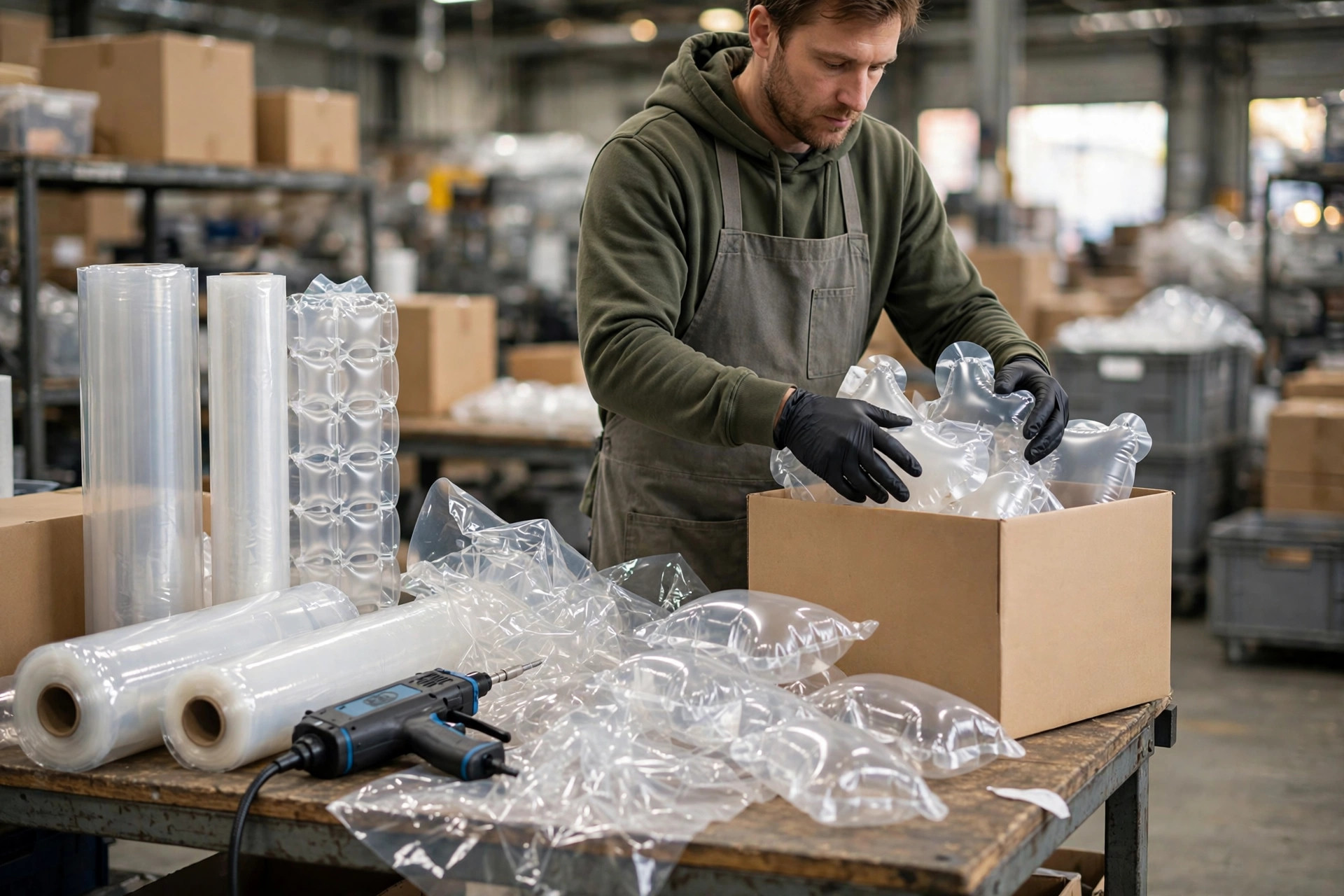
Fill materials look like a simple price comparison, but the real comparison includes damage, labor, and customer experience. The table below uses typical U.S. purchasing ranges as illustrative planning figures, not any one supplier's quote. Actual prices depend on your supplier.
| Fill material | Cost per parcel (USD) | Packing speed | Best for | Hidden cost |
|---|---|---|---|---|
| Bubble wrap | 0.30–0.45 | Medium | Fragile, irregular items | Bulky to store |
| Honeycomb paper / paper pads | 0.18–0.30 | Fast | Most household goods, small appliances | Weak against moisture |
| Air pillows | 0.12–0.20 | Fast | Light items that tolerate pressure | Requires an inflator investment |
| Foam peanuts | 0.25–0.40 | Slow | Heavy, high-value goods | Poor unboxing experience, hard to recycle |
On unit price alone, air pillows win. The ledger does not stop at unit price. In July 2025, a skincare set seller in Dallas, Texas, shipping about 12,000 parcels a month, switched from foam peanuts at $0.32 per parcel to air pillows at $0.16. That saved roughly $1,920 a month on fill. But complaints about messy packaging rose, and each customer-service contact took about eight minutes. At loaded labor cost, that added back nearly $900 a month in hidden handling. The net saving was about half the headline figure, and it cost review ratings along the way.
Damage cost must be counted in full. One damaged parcel does not cost the product price. It costs the product plus reshipment freight, new packaging, packing labor, and service time. For an $18 product, a single damage incident realistically lands between $28 and $35 all-in. Cutting the damage rate from 0.5% to 0.3% on 10,000 monthly parcels means 20 fewer damaged parcels, saving $560 to $700. Put that number next to the fill upgrade in the same table. Fill that costs $0.10 more per parcel adds $1,000 a month on 10,000 parcels. If it only cuts damage by 0.1 percentage point, it saves under $350. That money was wasted. Fill that costs $0.05 more and cuts damage by 0.3 percentage points is a clear win. The comparison, not the sticker price, decides.
Put All Three Ledgers on One Page
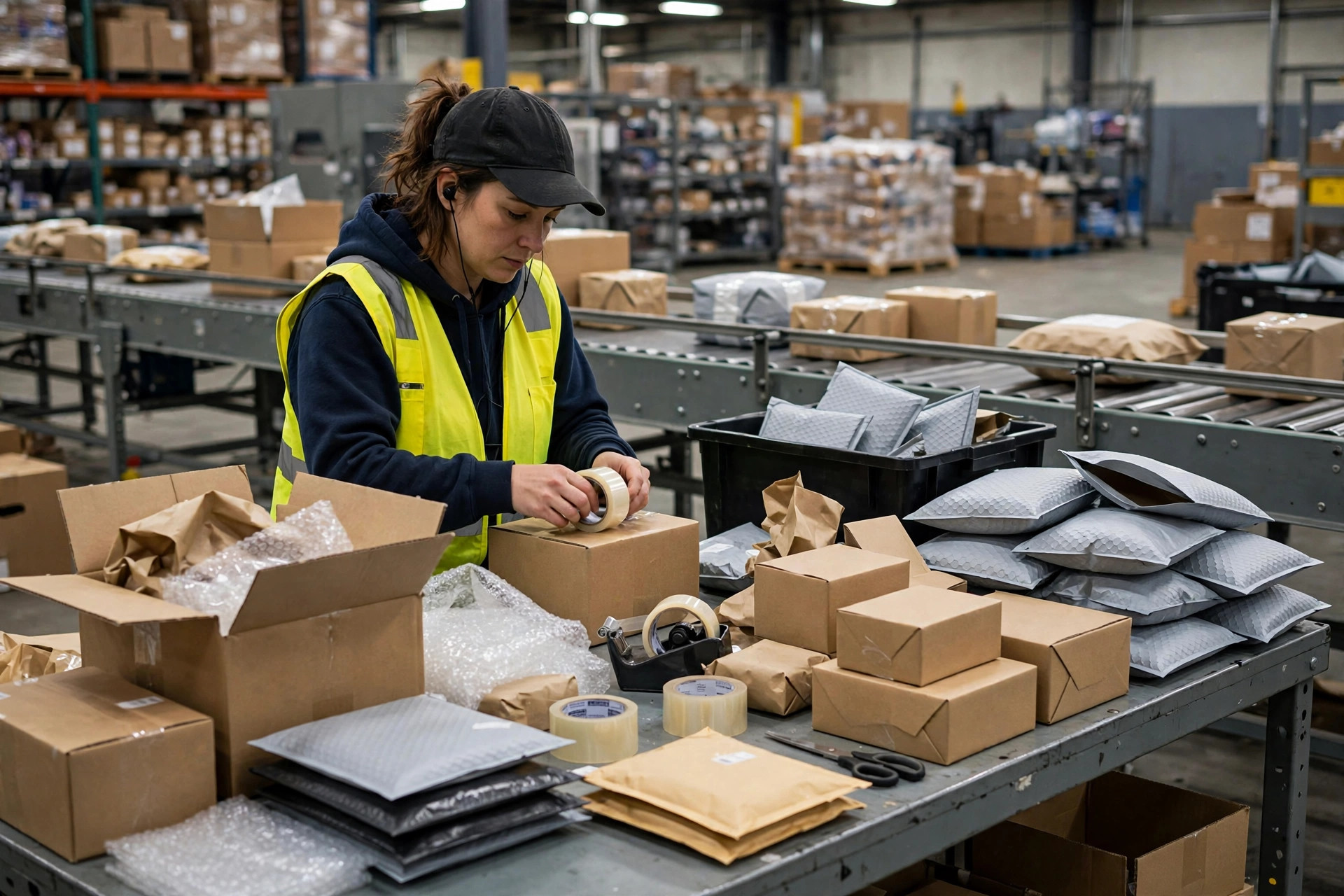
Per-parcel packaging cost has four parts: box, fill, consumables such as tape and labels, and labor. Labor is the one sellers most often leave out. The difference between 90 seconds and 55 seconds of packing time, at $18 an hour, is $0.175 per parcel. On 10,000 parcels a month, that is $1,750. Sellers who fight for $0.05 off a box price while letting a packing step waste 30 seconds are saving pennies and spending dollars.
The table below is built to be copied. Fill in your own numbers and compare three states: current, one box size smaller, and a different fill material.
| Cost item | Current (USD/parcel) | One size smaller (USD/parcel) | Different fill (USD/parcel) |
|---|---|---|---|
| Box | 0.68 | 0.44 | 0.68 |
| Fill material | 0.41 | 0.22 | 0.16 |
| Tape and labels | 0.12 | 0.12 | 0.12 |
| Labor (time converted) | 0.40 | 0.28 | 0.33 |
| Subtotal per parcel | 1.61 | 1.06 | 1.29 |
| Monthly total at 10,000 parcels | 16,100 | 10,600 | 12,900 |
Breakeven is just as simple. Suppose switching box sizes costs $3,000 one time for new stock, setup, and packer training, and it saves $5,500 a month. Payback is under one month. An air-pillow inflator costing $800 that saves $1,600 a month pays back in two weeks. Any packaging change with a payback period longer than three months should wait; do the sub-one-month changes first, then talk about long-term optimization. The right sequence is box size first, fill second, automation last. Reversing that order only automates a wasteful process faster.
One more lever is routinely ignored: return packaging. Returned products going back on the shelf do not all need a new box. My rule is two tiers. Returns in good condition get inspected and reused in their original box, with only a new label added. Returns with a damaged box get fresh packaging. Reuse is not cheapness; it spreads packaging cost across more shipments. With 600 monthly returns, reusing half saves roughly $300 a month in boxes and fill, before counting less waste.
So here is the calculable conclusion. Multiply monthly parcel volume by per-parcel packaging cost and you have the packaging ledger. If boxes exceed 45% of that per-parcel cost, check whether the box is oversized. If fill exceeds 30%, check whether you are paying to fill empty space you created. For any fill upgrade, convert the damage-rate improvement into dollars at your volume and average order value before approving it. Once those three numbers are on the page, packaging stops being a mystery and becomes a decision.
By Lao Zhou, Logistics Cost Analyst