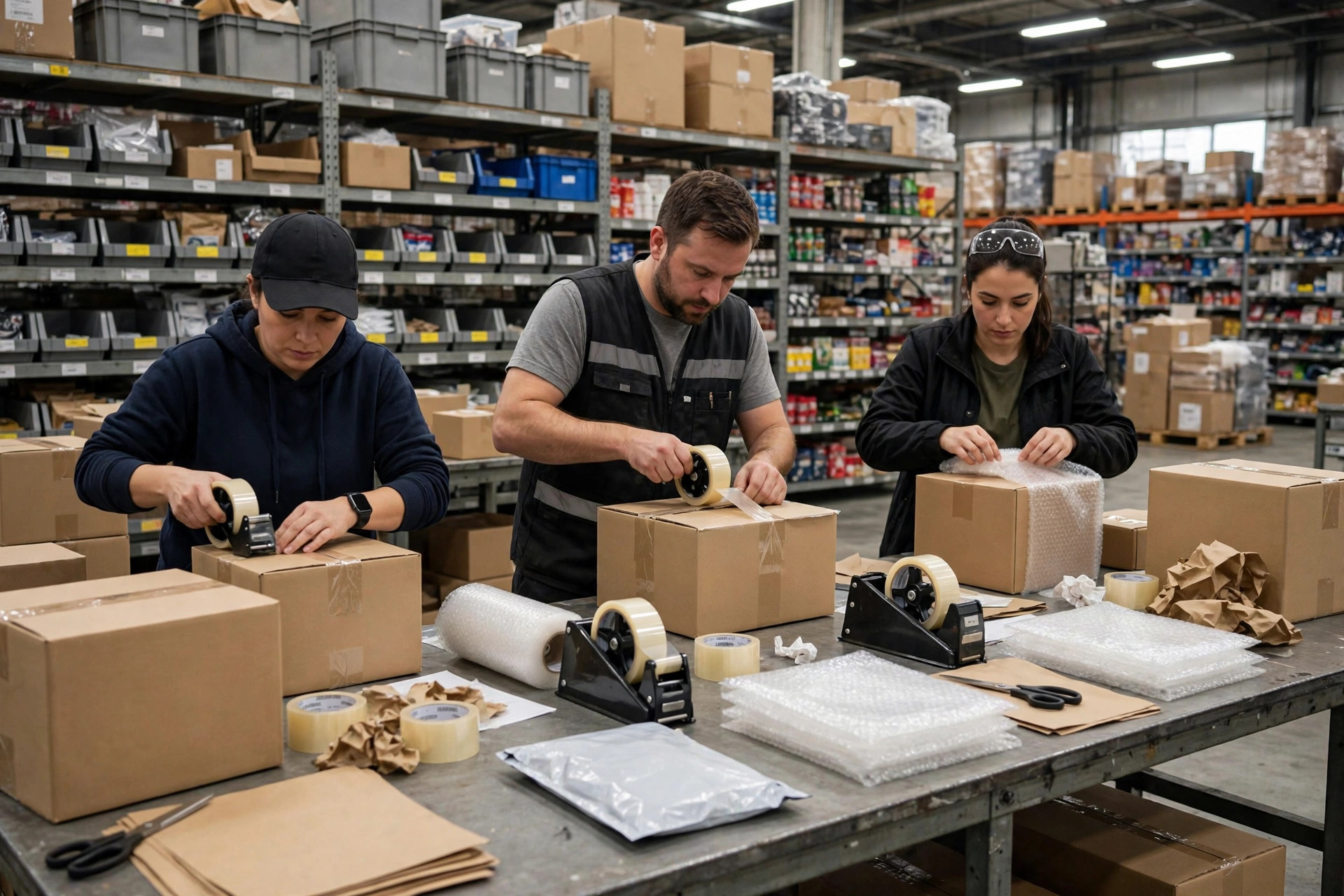
I have never seen an eBay operation fail because packing was too slow. They fail because the rhythm is wrong. Auction orders arrive like a drumbeat on a timer — unpredictable in volume, all landing at once. Buy It Now orders trickle in all day, steady and quiet. A warehouse that tries to dance to both beats at the same time usually trips over its own feet.
I know a seller in Riverside, California — started in his garage nearly ten years ago, now running a 3,000-square-foot warehouse with more than 400 SKUs, roughly half on auction, half on Buy It Now. His summary of the business: "Fulfillment on eBay isn't about packing speed. It's about tempo. Auctions are time bombs. Buy It Now is a slow river. The people break before the process does."
He is right, and the tricky part is that platform rules and warehouse actions are wired together. Get the rhythm wrong and ship times slip, seller metrics follow, traffic thins out, auctions get no bids — a slow spiral.
The gavel falls, and your clock starts ticking
An eBay auction does not end with a shipment. After the hammer falls, the buyer gets four days to pay — that is eBay's unpaid-item window — and the seller's promised handling time only starts counting when payment lands. Those four days are a cushion and a variable at the same time: some buyers pay in seconds, others wait until day four.
The Riverside seller's fix is simple and absolute: every auction he runs ends on Sunday evening, Eastern time. The four-day payment window then lands Monday through Thursday, and the warehouse processes paid auction orders in two fixed batches a day — 10 a.m. and 3 p.m. The rhythm becomes predictable. Scatter your auction endings across seven days instead, and somebody spends all week refreshing the dashboard asking "who paid yet," which is a full-time job disguised as a side task.
The trade-off is real. Sunday evening is eBay's prime time — more eyeballs, livelier bidding — but the two hours after the auctions close bring a flood of simultaneous payments and "when will it ship?" messages. His customer service team and his warehouse team are the same people, so Sunday night is the hardest two hours of their week. He did the math: two hours of overtime buys five days of predictable fulfillment. Worth it.
One more trap: auction inventory is one-unit-one-auction. The moment it sells, it is locked; if it goes unsold, it has to be relisted. Auction SKUs need their own zone in the warehouse, and sold units should move to a staging area within 24 hours. Do not let them sit on the pick face occupying a slot, and never let "it sold but we can't find it" happen.

The most dangerous setup of all is dual-listing the same unit: one auction and one Buy It Now listing, both showing quantity one. The auction bidder locks it while a Buy It Now buyer checks out — oversell. eBay's tolerance for canceled-out-of-stock orders is thin, and every cancellation stains the account. His iron rule: a SKU with exactly one unit on hand is never dual-listed. If you insist on dual-listing, the auction carries the one unit and the Buy It Now listing goes up only after the auction ends, sold or not. Dual-list only with two or more units, and keep the combined listed quantity at or below physical stock. Better to undersell than oversell.
Best Offer: the order that isn't an order yet
Enable Best Offer on a Buy It Now listing and you invent a new creature: the maybe-order. eBay gives the seller 48 hours to accept, decline, or counter each offer. During those 48 hours, what happens to the inventory?
I have seen two approaches. Reserve the unit the moment the offer arrives: you ship instantly on acceptance, but a tire-kicker can lock a hot SKU for 48 hours while the Buy It Now listing shows out of stock — real orders lost to a phantom. Or reserve nothing and pick after acceptance: inventory turns faster, but if the unit sells via Buy It Now in the meantime, you are writing an apology and a refund, and the account takes the hit.
His verdict is crisp: under fifty dollars, never reserve; over fifty dollars, review offers twice a day in batches. The logic is straightforward — cheap SKUs live on velocity, and the opportunity cost of locked inventory is too high; expensive SKUs carry enough margin per unit to justify paying a little inventory cost for deal certainty. That fifty-dollar line comes from his own margin structure. Every operation should draw its own line from its own numbers, not copy his.
Set up auto-accept and auto-decline rules no matter what. Below a floor, auto-decline; above a ceiling, auto-accept. Nobody should be waking up at night to answer offers, and a 48-hour clock managed by human memory will leak — every missed window is a missed sale.
Counter-offers deserve a policy too. His is one-and-done: at 80 percent of list price or above, accept; between 70 and 80 percent, counter once at 90 percent, take it or leave it; below 70 percent, auto-decline. No back-and-forth. eBay bargain hunters decide fast, and three rounds of haggling usually ends with the buyer drifting to another seller. The warehouse side of this: the instant a counter is accepted, the unit must flip from available to reserved in the system — not tomorrow at pick time, when it may already have sold via Buy It Now. That flip cannot depend on a human remembering. It has to happen through eBay's inventory sync or a listing tool, automatically.
Four hundred SKUs, ten units each: staying sane
Multi-SKU, low-depth inventory is the normal state of an eBay seller, and it is where fulfillment most often breaks. Four hundred-plus SKUs, under ten units each on average. At that shape, safety stock cannot be set in units — it has to be set in weeks of sales. Two weeks of cover per SKU, reorder below that. Auction SKUs are the exception: auctions are a clearance mechanism, so when it is gone, it is gone — no replenishment.
Ship time is the last red line. eBay grades sellers on shipping performance, and too many late shipments drag down the account — badly enough, and traffic gets throttled. The exact thresholds change; check eBay's current seller standards rather than trusting any number in a blog post, including this one. The warehouse response, though, is fixed: a daily order cutoff (his is 3 p.m. — paid before cutoff ships same day), labels pre-printed, common packing materials within ten feet of the pack bench, and a half-shift on weekends so Friday night orders do not rot until Monday.
He also runs a deliberately low-tech ritual: twenty minutes every Monday morning, pull every order that sat unpaid-for more than 24 hours after payment without shipping, and ask why. Stockout? Missed pick? Just forgot? Four weeks of that took his late orders from a dozen-plus a week to under two. The data does not need to be fancy. It needs to be watched.
If you are running the mixed model, here is one thing you can do tomorrow: move every auction ending to the same evening. Start with the ending time — it is a free dial to turn — and the warehouse tempo changes immediately. Then ask the harder question on Monday morning: is your bottleneck the pack bench, or the person confirming payments? In most small operations I have seen, it is the second one — and that is a staffing decision, not a process problem.