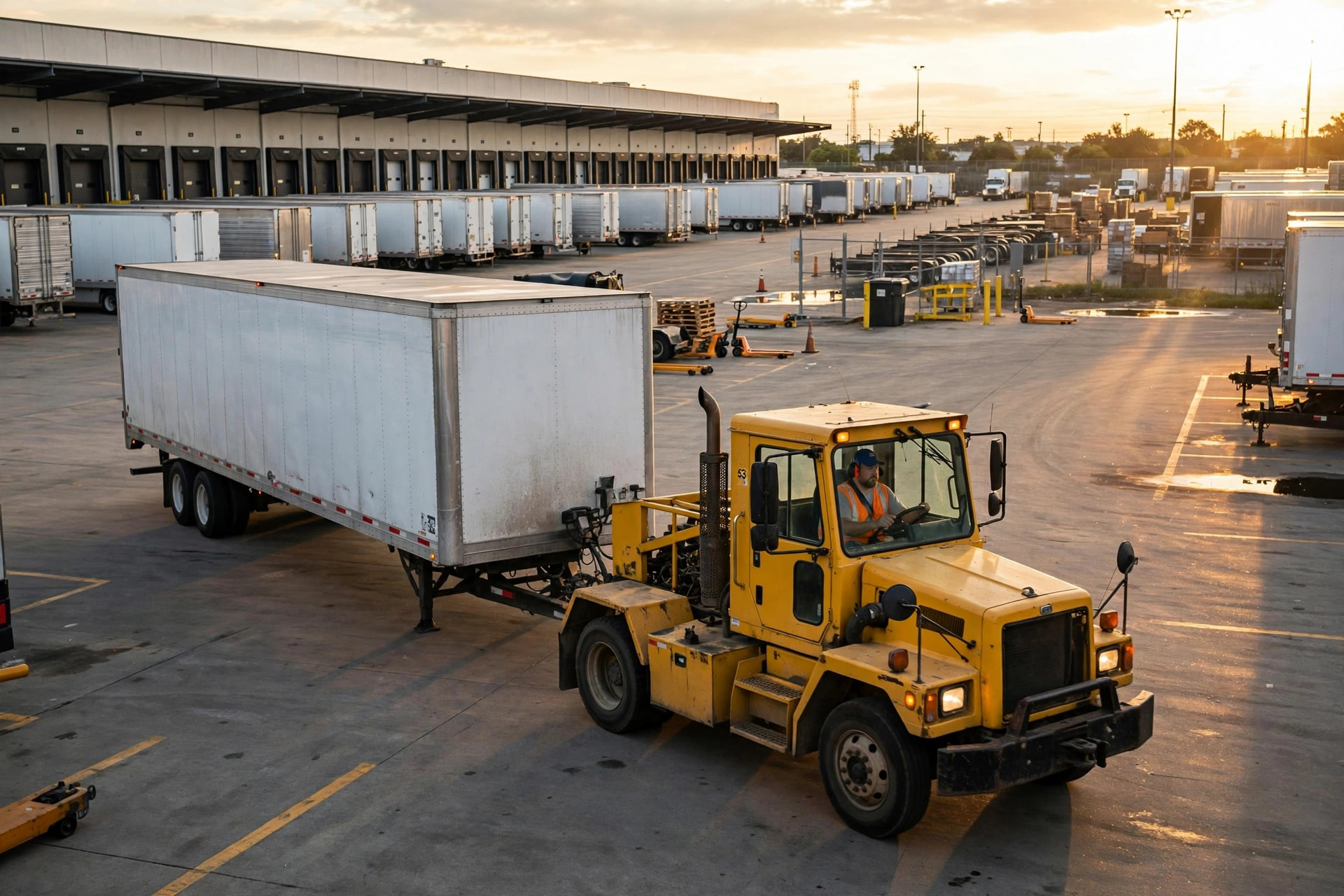
Here's a question worth sitting with: two DCs, same forty doors, same volume — why does one yard run drop trailers like clockwork while the other's crew starts every morning hunting for equipment?
I've watched plenty of operations treat "drop trailer" as "rent a bunch of trailers and park them in the yard." Driver drops an empty, hooks a loaded one, everybody's happy — in theory. But the trailers are just the beginning. The real work lives in the yard: how big the pool is, how the lot is zoned, where every trailer is and what state it's in, and whose trailer has been squatting in your lot for three weeks. Get those wrong and drop trailer is just expensive parking.
How Many Trailers? Start With Dwell Days
The blunt version: build the pool too small and drop trailer is a waste of money; build it too big and every extra box is a steel rectangle burning cash every month.
The formula I've used for twenty years hasn't changed:
Pool size = average daily trailer turns × average dwell days × buffer factor (1.2–1.5)
Unpack it. Daily turns should be your peak-season average, not the annual average — you build the pool for the peak. Dwell days: how long a trailer sits from gate-in to gate-out. Fast unload operations run one to two days; if receiving waits on QA, three to five is normal. The buffer depends on how much control you have over your carriers: 1.2 if it's your own fleet, 1.5 if you're juggling a dozen for-hire carriers — and even that might be thin.
A real example. A 450,000-square-foot DC out in Fontana, California, running about 40 trailer turns a day in peak, three-day average dwell, and a messy mix of carriers: 40 × 3 × 1.4 = 168, so they sized the pool around 170. That number wasn't a guess — it came from reviewing the dwell report every week, adding trailers when turns ran hot two weeks straight, returning them when the pool sat fat for two weeks.
One trap I have to flag: people size the pool for loaded trailers and forget the empties. Drop trailer only works when empties are always available and loads are always ready to pull. I size the total with the formula, then split it — say outbound is sixty percent of the business, so the empty pool gets forty percent — and then adjust weekly based on how often the empty pool runs dry. Any yard that's run out of empties once knows exactly how ugly that day gets.
Paint the Yard First: Empty, Loaded, Bad Order, Ready
Pool sized, next question: where does everything go? The worst yard I ever walked had loaded, empty, and bad-order trailers mixed together — finding one empty meant three laps around the lot. A yard like that will defeat the fanciest YMS on the market, because there's no physical order underneath it.
My zone map is dead simple — four zones: empties, loaded awaiting unload, bad order, and ready outbound (loaded, waiting on pickup). Paint them in different colors, put up signs a driver can read at a glance from the cab.
There's a real trade-off here: the finer you slice the zones, the clearer the management, but the lower your utilization — one zone sits empty while another overflows, and then what? My take: four zones is the floor for a new operation; don't get fancy early. Once things run smooth, you can subdivide the loaded zone by carrier or temperature with traffic cones — not permanent paint. Paint you commit to on day one, you regret by month three.
The bad-order zone gets ignored the most, and it's the one that bites. A trailer with dead brake lights or a bald tire parked among the good ones will get grabbed by a driver in a hurry, and when something happens on the road, that's your problem. Put bad orders in a corner, lock it, and only the spotter driver and the repair vendor hold keys. One trailer repaired, one released, one logged. Primitive. Works.
A Status Board Beats GPS (Until It Doesn't)
Zones painted, now the hard question: with 170 trailers, where is each one, what's its state, and how long has it been sitting?
The big-facility answer is GPS on every trailer, live positions in the YMS. Great — and expensive: hardware plus annual fees per unit adds up fast for a mid-size yard. My judgment: do the cheap thing properly first, then talk about the expensive thing.
The cheap thing is a status board. Whiteboard, TV screen at the guard shack, whatever. One row per trailer: trailer number, carrier, current location (door number or zone), status (empty/loaded/bad order/ready), gate-in date, days sitting. Gate-in gets logged by the guard, moves get called in by the spotter driver, gate-out gets closed by the guard. Reconcile three times a day at shift handoffs.
It sounds embarrassingly low-tech, but I'll say it plainly: any yard that keeps this up for three months cuts its "lost trailer" rate in half. Because most lost trailers aren't stolen — they're forgotten. The board forces you to look at the "sitting 10+ days" list every single day, and problem trailers surface on their own.
Once that's solid, bring in the YMS. Two things matter for trailer pools: first, digitize the board — every trailer gets one record, keyed on the trailer number, not the license plate (trailer numbers are the industry's common language; plates change when the power unit changes). Second, tie the pool to the appointment system. Tomorrow's appointments become "expected" records in the YMS ahead of time, with empty-pool slots reserved, so the driver walks up to the guard shack and gets a parking assignment instead of a phone call. When appointments and the pool talk to each other, drop trailer finally closes the loop.

Count Twice a Year — Cheaper Than Losing One Trailer
Finally, auditing. Trailers are big, valuable, and mobile — the easiest asset in a warehouse to quietly evaporate.
Some numbers for perspective. A 53-foot dry van rents for roughly $400–$750 a month in the current market, based on published rates from multiple national rental listings. One unmanaged trailer sitting in your pool burns close to ten grand a year. Worse is per diem: one carrier's published drop-pool agreement spells it out — free time of the spot day plus two days, then $35 a day, $50 a day from day 11, $200 a day from day 21. A forgotten trailer doesn't cost you linearly. It compounds.
So here's my cadence: a light monthly count plus a real annual audit. The monthly one is easy — the spotter driver does a lap, checks trailer numbers and positions against the board, half a day, done. The point is flagging anything sitting over 14 days and calling the carrier on each one: still need it? No? Get it out. The annual audit is the real thing: freeze the yard for two hours, open every trailer, reconcile board, YMS, and physical count three ways, and close every variance the same day.
One detail that matters more than it sounds: manage by trailer number. Plenty of yards log license plates, but a trailer can get a different power unit and the plate changes; the trailer number is stenciled on the box and follows it for life. YMS records, board entries, audit sheets — trailer number everywhere, plate as backup only. Build that habit now and thank yourself in three years.
If you take one thing from this and use it tomorrow: before you leave tonight, have the guard shack list every trailer that hasn't moved in two weeks, and call the carrier on each one tomorrow morning. The first time most yards do this, they clear three to five zombie trailers — and the rent and per diem saved buys the whole crew a very nice dinner.