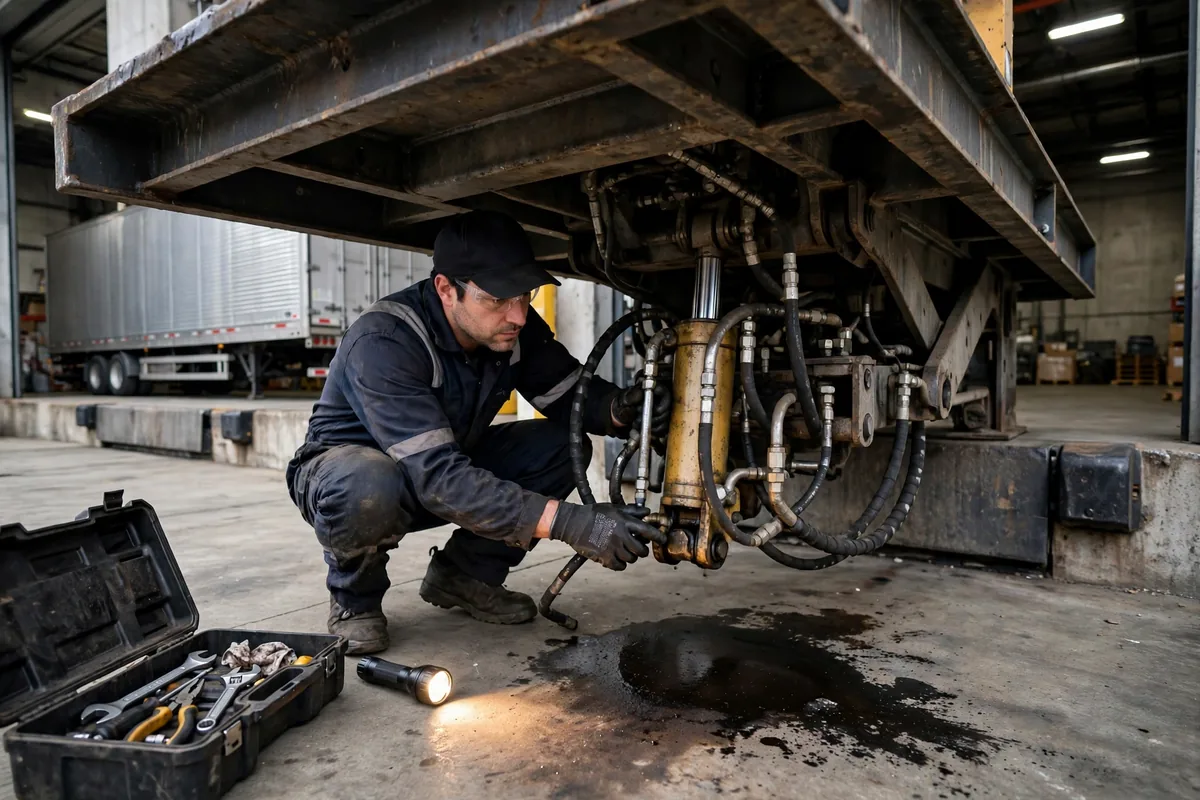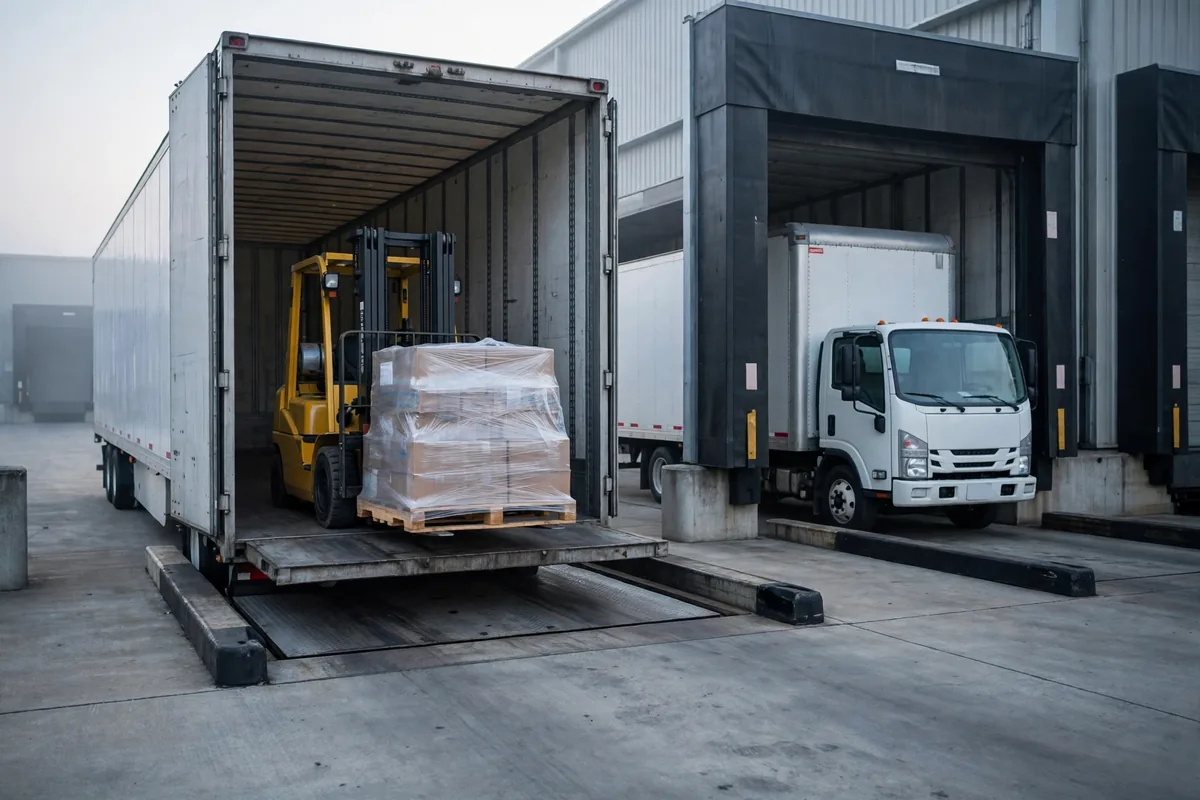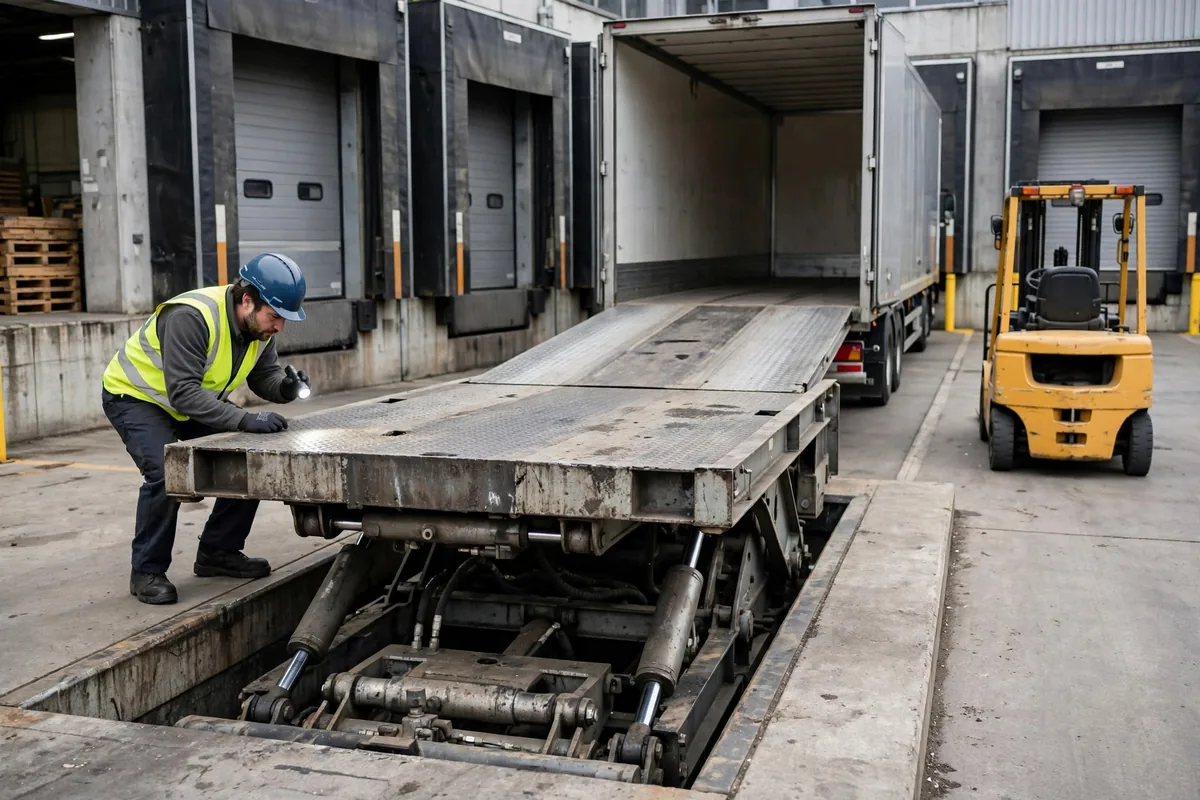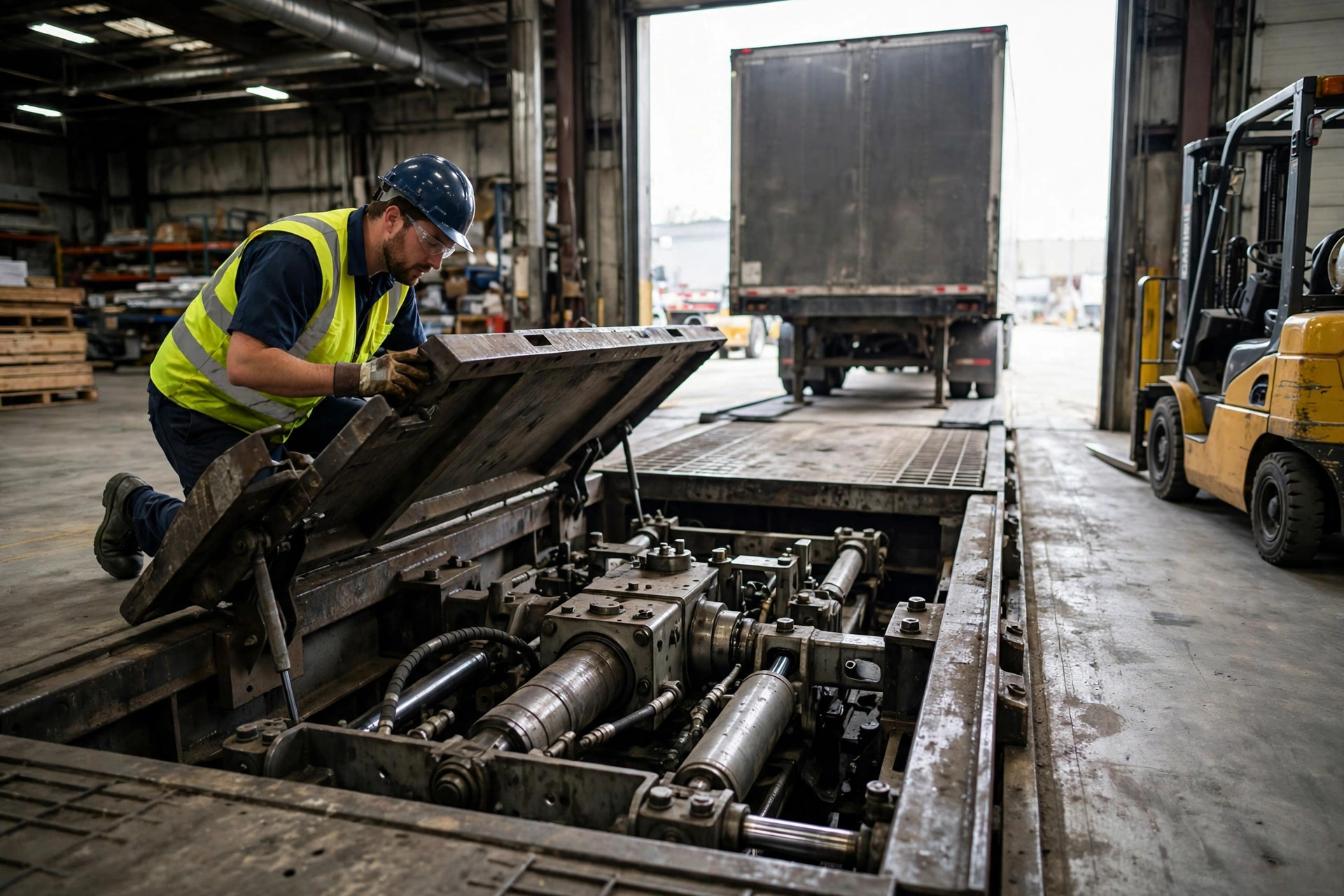
Tuesday, 6:40 in the morning. I had just walked into the warehouse when Lao Wang, our shift lead at door 7, stopped me at the entrance. "Boss, dock leveler 3 is stuck again. The forklift has been waiting twenty minutes." I walked over. The deck was stuck halfway up, a small patch of hydraulic oil seeping into the pit. That unit went in back in 2016, and we had fixed it five times in three years — this was the third time with the same problem. Right then I made myself a promise: from now on, repair or replace would not be a gut call. We would grade it.
Let me be straight with you. One repair is cheap. Five repairs add up to more than a new unit. And worse, it always breaks at the busiest hour of the morning, when one dead door means a whole lane of freight going nowhere, drivers honking, forklifts queuing, and people inside standing around waiting.
Grade It First: How Bad Is This Dock Leveler, Really?
What we do now is simple. Grade the failure first, then talk about repair or replace.
Grade one is small stuff: worn seals, a strange noise from the deck, a control button that works only sometimes. Half a day, no door closure. Grade two is middle stuff: a leaking hydraulic cylinder, tired springs, a lip that will not retract. Fixable, but it needs scheduling — pick a slow window and do not book trucks at that door while it is down. Grade three is structural: a bent deck, a cracked hinge, a sinking pit, rusted-through frame members. Do not hesitate. Replace it. Repairing a grade three is putting a sick unit back to work.
While you are grading, check one number: whether the rated capacity still fits the job. Over here, levelers are designed and tested to ANSI MH30.1. Pit-mounted units commonly carry a comparative industry rating from 20,000 to 80,000 lb, and edge-of-dock units usually run 20,000 to 35,000 lb. The number that matters is dynamic load, not static load — the moment a loaded forklift rolls onto the deck, the front axle pushes down far harder than the parked weight suggests. The rule of thumb: heaviest forklift plus heaviest load, times a 2.5 safety factor, then round up to the next rating. If your warehouse has moved to heavier forklifts since the leveler went in, the old unit may already be running overloaded, and no repair fixes that.
I will not repeat the daily upkeep routine here. This guide to hydraulic and mechanical dock leveler maintenance covers it in detail — follow that. This article is only about the repair-or-replace call.
The Repair Bill and the Replacement Bill Are Two Different Bills
In the winter of 2024 we ran the numbers on door 3. These are worked-example figures, so swap in your own rates. A major overhaul on that hydraulic unit was quoted at a little over $6,000. A new unit ran about $18,000 on the same assumptions. Look at those two numbers alone and repair seems like the obvious answer. But the repair bill is not just the quote. You have to add the downtime.
That overhaul meant closing the door for two days. Door 3 handles 14 trucks a day. Trucks queued at the gate, freight did not ship, drivers waited, forklifts waited, people inside waited. At our pace that month, two days of disruption cost us roughly another $5,000 in overtime and delays. So one repair really cost close to $11,000, while a new leveler would run steady for ten years. Repair once and you come out ahead. Repair twice and you lose. Repair three times and you are fooling yourself.
There is also a bill that never shows up on a quote, and it is about people. With door 3 down, Lao Wang had to move 14 trucks' worth of work to other doors, forklift drivers made extra runs, and the night shift had to keep two extra people late. The veterans never complained out loud, but they kept score: this door always breaks, so the schedule is always chaos. An unstable dock makes for an unstable roster. I have told that to plenty of fellow managers.
| Option | Direct cost (worked example) | Downtime cost (worked example) | True cost |
|---|---|---|---|
| One major overhaul | About $6,000 | About $5,000 | About $11,000 |
| A second overhaul within a year | Another $6,000 | Another $5,000 | About $22,000 cumulative |
| Replace outright | About $18,000 | One install day, about $2,500 | About $20,500 |
The table is blunt: if you are going to repair it twice in one year, replacing it outright is cheaper. Our rule now is simple: if the same unit needs two grade-two repairs inside 12 months, the third time it goes straight to replacement. No more repair orders. I took that table to my boss when I asked for the replacement, and the approval took ten minutes. Before, when I asked from gut feeling, one question stopped me cold: "Can you guarantee it will not break again?" Now I have grades and numbers, and nobody can pick holes in it.
Hydraulic and Mechanical Dock Levelers Do Not Break the Same Way
Hydraulic failures mostly live in the oil circuit: aging cylinder seals, weeping hose fittings, a noisy pump. The good part is the target is clear — swap a seal, replace a hose section, half a day and you are done. The bad part is oil hides its problems. A small seep today becomes a puddle tomorrow, and oil in the pit makes forklift tires slip, which is a safety problem bigger than the breakdown itself. A hydraulic unit's working range is typically 12 inches above and below dock level, and the lip needs at least 4 inches of overlap on the trailer bed. Measure both after every repair. One inch short is a hazard. On spares, keep seals and hoses on the shelf — do not wait for a leak to start ordering.
Mechanical units run on springs and a pull chain. Simple structure, no oil to leak, fewer repairs in normal use. But when a mechanical unit breaks, it breaks big: a snapped spring or a jammed chain leaves the deck dead, and the repair takes two people working together. Mechanical units fit quiet doors — a few trucks a day, a manual pull here and there, no real burden. On a busy door, an operator pulling the chain dozens of times a day wears out, and the springs wear out fast too. On spares, keep a spare set of springs so a break means a swap, not a wait.
Here is the counterintuitive part: the most expensive thing is not a new unit. It is the downtime dragged out by repair after repair, and one safety incident you failed to prevent. A deck giving way under a forklift — the repair bill, the shutdown, the injury claim — every one of those costs more than a new unit. Any warehouse manager should have that math in their head.
One last reminder for my fellow managers: keep a logbook for every dock leveler in your building. How many repairs, how much money, how many days down. Two grade-two repairs inside 12 months means the third time you replace it, you do not repair it. A logbook never lies to you. Your gut does.
By Chen Feng, Warehouse Operations Manager