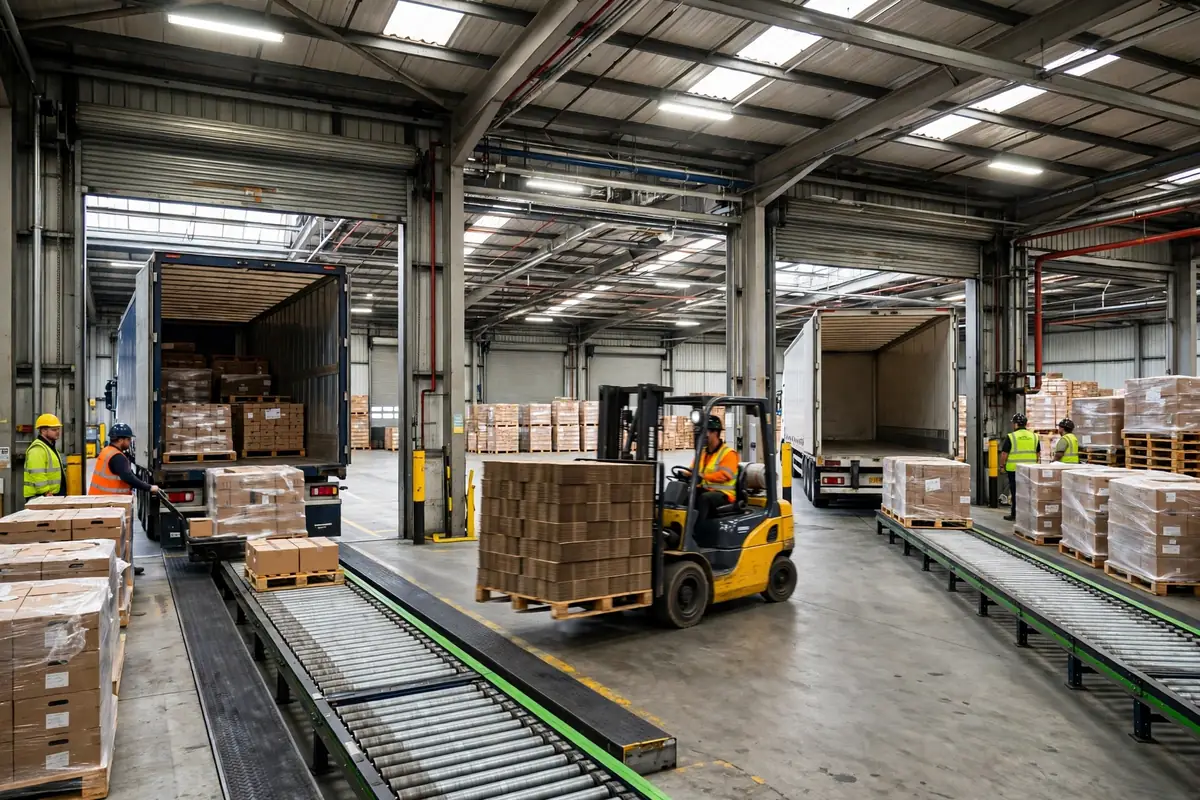
Here is the verdict up front: cross-docking is not an advanced model. It is a money-saving tool that only works under specific conditions. Freight arrives, never sits down, and goes straight out — it sounds beautiful, but only if your freight is fast, consolidated, and predictable. Miss one of those three, and cross-docking becomes a headache you built yourself.
Put plainly, cross-docking saves money by cutting out the storage step — no putaway, no storage, no second pick. But every dollar saved gets bet on coordination: arrivals must be on time, sortation must be fast, and information must match reality. If any link breaks, the savings turn into penalties and customer complaints overnight.
I have seen too many warehouses treat cross-docking as a cure-all. The one I remember best was a 3PL handling fast-moving consumer goods. In 2024 they took on a cross-dock project for a big client who promised 30 full truckloads a day and orders placed a day ahead. The first two months looked great: freight spent less than 6 hours in the building on average, and storage costs dropped sharply. Then month three arrived. Orders got more fragmented — one truckload had to be split across a dozen stores. Arrival times started drifting, morning trucks showing up in the afternoon. The sortation area turned into a mountain, crews worked past midnight, and the next morning there were still trucks waiting at the gate. In the end even the client admitted it: run as a cross-dock, this business lost money.
Every cross-dock has two sides. The warehouses that make it work share three traits, and all three are non-negotiable.
The first number: is your freight fast enough?
The first calculation is velocity. The shorter freight stays in the building, the more cross-docking pays. Once freight starts staying overnight, the storage savings no longer cover the sortation labor.
How do you judge it? Look at two numbers: daily inbound volume and order lead time. Volume has to be steady — 20 trucks a day and 5 trucks a day are two completely different businesses. Orders have to arrive early — you need to know at least half a day ahead where tomorrow's freight goes, or it arrives with nobody knowing what to do with it, and it just sits there waiting for instructions. At that point it is not cross-docking anymore. It is temporary storage.
My hard rule when I run the numbers for a client: if more than half the freight can move in and out within 12 hours, cross-docking is worth a serious look. If more than half of it stays overnight, do not touch it. Overnight freight needs putaway, management, and cycle counting — add those costs back in and the cross-dock math goes flat.
The second number: who pays for the break-bulk?
The second calculation is break-bulk. Full-in, full-out is the comfortable form of cross-docking: a truckload arrives, gets split by store, and leaves. Almost no extra touches. But most real cross-docks involve breaking freight down — one pallet split into dozens of pieces for different orders and different stores.
The cost of break-bulk hides deep. Sortation needs floor space, breaking bulk needs labor, and broken orders need verification — one wrong piece is one customer complaint. I once ran the numbers for a warehouse: full-in, full-out cross-dock cost under 2 dollars per pallet in sortation; break it into more than 20 pieces and the cost more than tripled. The client only saw the storage savings. They never saw what sortation was quietly charging them.
So before taking a cross-dock project, ask one question: how far down does your freight get broken? Full-pallet direct shipping and piece-level sortation must be priced separately. Quote them as one blended number, and the loss lands on you.
The third number: can the information keep up?
The third calculation is the easiest to overlook: information. Cross-docking has no inventory buffer. When information stops, the floor stops. Advance shipping notices, orders, store allocations, carrier pickup times — all four must be in place before the freight arrives.
I have seen a warehouse where the orders were perfect in the system, but nobody tracked carrier pickup times. Freight was sorted and ready, and the truck showed up two hours late. The sortation area stayed occupied, the next inbound could not get in, and the crew was not sorting — they were waiting. The system never sees that waiting. The cost is real anyway.
Flip it around, and a well-informed cross-dock is a thing of beauty. I worked with a fresh-food warehouse where the supplier, the warehouse, and the stores were all connected. Two hours before arrival, they already knew which store every pallet was going to. Freight arrived, got sorted, and got loaded in one smooth motion — drivers barely waited. They have run that cross-dock for five years, and it only gets smoother, because the information cost was paid off long ago.
| Factor | Cross-docking fits | Cross-docking does not fit |
|---|---|---|
| Dwell time | Under 12 hours | Regularly overnight |
| Break-bulk level | Full pallet or light split | One pallet into dozens of pieces |
| Order lead time | Half a day or more ahead | Same-day orders |
| Information flow | All four inputs ready before arrival | Coordinated by phone on the floor |
The thing cross-docks fear most: returns and exceptions
There is one more thing almost nobody mentions when they talk about cross-docking: returns and exceptions. The cross-dock process is designed for forward freight — in, sorted, out, done. But the moment returns show up, the whole flow jams. Returned freight has no location, no process, and no owner, so it ends up piled in a corner of the sortation area.
I saw an apparel warehouse run a smooth cross-dock for six months — until the post-promotion returns wave hit. More than 800 pieces came back in three days, every one needing inspection, grading, and either restocking or return to the supplier. Returns swallowed half the sortation area, forward freight had nowhere to go, and the floor turned chaotic. The warehouse manager told me later: we costed the cross-dock, but we never costed the returns.
So my advice is to settle the exception process before the cross-dock starts. Where do returns go, who inspects them, how fast must they clear, and what happens when they do not — write all four into the process. If returns normally run under 5 percent, a small exception zone beside sortation is enough. If they run over 10 percent, keep returns handling separate from the cross-dock so returns never eat forward capacity.
Every cross-dock has two sides. It saves storage money, but returns handling spends labor and floor space. Cost the two sides separately and judge them together — that is the only way to know whether the project actually makes money.
Cross-docking is not right or wrong. It is only suitable or unsuitable. Fast freight, consolidated freight, accurate information — that is a money machine. Slow freight, fragmented freight, chaotic information — that is a money pit. Before you take the project, run these three numbers. Then decide.
By Lao Mi, Supply Chain Veteran (20 yrs)