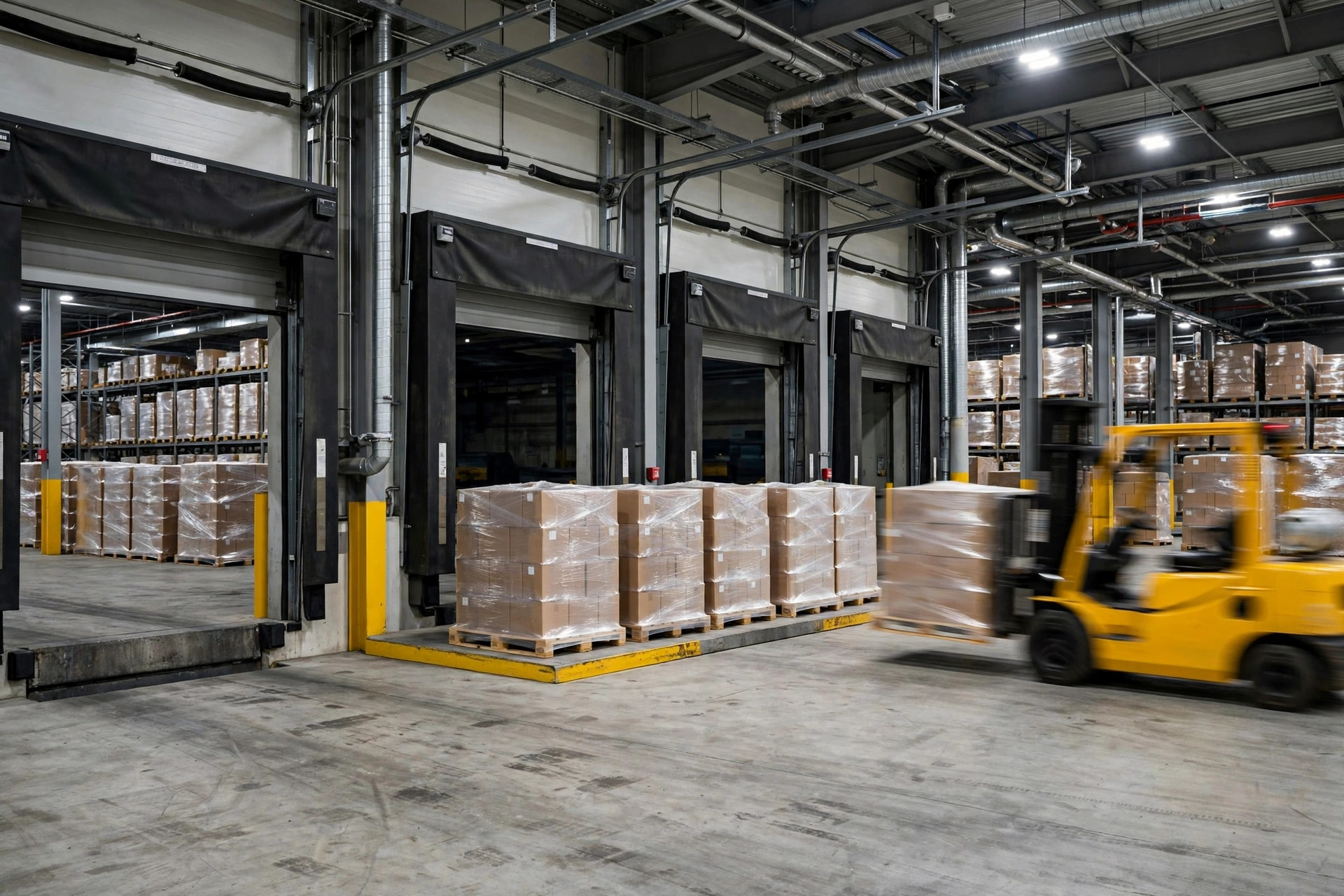
Six forty in the morning, the week before Black Friday. I walk into the warehouse and the receiving dock is already pure chaos — all eight dock doors occupied, five more trucks lined up outside waiting for a spot. Our ops director spots me from across the floor and shouts, "Chen Feng, let's run cross-docking this year! Freight goes straight through, the warehouse won't burst!" I'll be honest with you — for about three seconds, I was tempted. Then reality kicked in. Done right, it's a beautiful thing. Done wrong, it's a hole you dig for yourself. So today I'm opening up the books on two years of tuition my warehouse paid: before you try it, run three calculations first.
Calculation #1: The Money Cross-Docking Saves — Don't Celebrate Yet
Here's what this model actually eliminates. A pallet going through normal receiving touches seven steps: unload, inspect, put away, store, pick, check, load. Direct flow cuts the middle three — put away, store, pick. Freight hits the dock, gets sorted, and goes straight onto outbound trailers. Same day in, same day out.
The savings are real: no rack space tied up, no put-away and picking labor. We did rough math at our warehouse — put-away plus picking labor on one pallet, plus the rack cost of that pallet sitting for a couple of weeks, adds up to real money at scale. For high-volume, fast-turning freight, that's nothing to sneeze at.
But folks, never count only half the ledger. The model cuts three steps and adds three new costs back:
| Cost item | Normal receiving | Cross-dock |
|---|---|---|
| Put-away / picking labor | Yes | Gone — saved |
| Storage (rack space) | Yes | Gone — saved |
| Sort / breakdown labor | Low (pick by order) | High (touch every case, exhausting) |
| Coordination | Low | High (syncing drivers, stores, suppliers) |
| Mis-ship / rework risk | Low | High (one mistake = a whole trailer) |
We learned this the hard way last Black Friday. A big consumer brand's flagship paper-towel SKU — sixty-plus pallets inbound in a single day, all needing to go out to forty stores that same day. On paper, skipping put-away and picking looked like a win. In reality, the sort line drowned in sixty mixed pallets. We mis-shipped three trailers. Stores rejected them, everything came back, and we reloaded half the night. The extra freight and overtime wiped out every dollar we'd saved — and then some.
There's also a people cost nobody puts in the spreadsheet. One of my veteran sorters told me straight: "Chen, order picking follows a pick list. Direct flow is touch-every-case, eyes and hands never stop — way more exhausting than picking by the end of the day." So at our warehouse, direct-flow sort hours are costed at a higher rate. A lot of people never include that increase in their math at all.
Let me be straight with you: the inventory cost this model eliminates doesn't vanish. Most of it converts into in-transit cost and coordination cost — the extra hours freight spends on the road, the dozens of phone calls your dispatcher makes, the extra hands you keep on the sort line. If that conversion doesn't pencil out, you've just traded visible inventory for invisible headaches.
Calculation #2: Unstable Volume Turns Cross-Docking Into Punishment
This model has one mortal enemy: unstable volume. Normal receiving has inventory as a shock absorber — a heavy day here, a light day there, the warehouse absorbs it. Direct flow has no buffer. When volume swings, your people take the hit.
Slow days: the dock sits empty, your scheduled sort crew stands around with nothing to do, collecting paychecks while morale sinks. Peak days: freight piles up on the dock, the sort line can't keep up, and forklifts end up hauling everything back into rack storage anyway — so you did the dock-to-trailer shuffle for nothing and still have to do normal receiving on top of it.
Back in the spring of 2024, we took on an e-commerce client who swore up and down: thirty pallets a day, rock steady. First week reality: two days at fifty pallets, three days at barely ten, nothing on the weekend. The schedule fell apart. Mis-ship rates spiked on the heavy days; on the light days the crew had nothing to do — I'm joking when I say they were playing cards on the dock, but morale genuinely took a hit. After three weeks we pulled the plug ourselves and went back to normal receiving.
Now we have a shop-floor rule of thumb: if a category's daily volume swings more than about thirty percent either way, don't touch cross-docking. Either wait until volume stabilizes, or set an overflow plan up front — anything beyond sort capacity goes straight to normal receiving. No heroics. Every minute you try to muscle through is a minute you're stockpiling future mis-ships and rework.
Calculation #3: An Unreliable Supplier Will Sink You
The first two calculations are about your own house. This one's about someone else's — your suppliers. Direct flow removes the inventory buffer, which means every supplier problem lands directly on your sort line and detonates on the spot:
- A delivery two hours late: the whole dock crew stands around, and the outbound schedule you built is garbage.
- Non-standard labels: carton marks don't match SKUs, so sorters have to open boxes and verify piece by piece — throughput gets cut in half.
- Mixed pallets with no sort sheet: congratulations, you've just adopted the supplier's sorting job as your own.
So now, before we talk direct flow with anyone, we look at the supplier, not the freight. Two hard gates: on-time delivery below ninety percent — no conversation. Non-standard carton or SSCC labels — fix them first, then we'll talk. One supplier spent a month re-labeling everything to get on our direct-flow list. He told me later the cleanup cut his own shipping errors too. Win-win.
And the positive case: a supermarket chain's standing milk replenishment. Every Tuesday and Thursday, seven in the morning, thirty pallets, never late, all standard SSCC labels, store orders in the system a day ahead. We've run that lane since June 2024 — two sorters, one dispatcher, done in a day, zero mis-ships. Remember this, folks: this model doesn't test how fast you can sort. It tests how punctual your upstream is.
How We Run Cross-Docking Now: What Goes Direct, What Goes to Rack
Once the three calculations were clear, we settled on a dirt-simple method: pilot with one supplier and one category for one month. Every evening during the pilot, we review three numbers: on-time arrival rate, mis-ship rate, and actual labor hours that day. The shift lead tracks it on a single sheet of paper pinned to the dock office wall. Don't laugh at the paper — when the on-time rate dips or a supplier's labels act up again, you see it at a glance. After a month, the data doesn't lie.
Here's our standing split:
- Goes cross-dock: on-time rate above ninety percent, clean labels, stable daily volume, customer or store orders in the system ahead of time.
- Goes to normal receiving: new suppliers still in the trial phase, promo-season volume spikes, messy labels, multi-SKU mixed pallets.
- Hybrid: in peak season, anything beyond sort capacity overflows to normal receiving. No heroics.
One more counter-intuitive lesson, free of charge: direct flow demands better people than normal receiving, not worse. The sort line needs veterans. The dispatcher needs to juggle a dozen trailers at once. A crew full of rookies, or a shift with a brand-new lead — don't let them near this operation. The error tolerance here is razor thin; one overwhelmed new hire and the whole line is doing rework.
Folks, cross-docking isn't off the table — it just can't be decided on gut feel. Run the three calculations with your own warehouse's real numbers first. If the math works, pilot one small category for a month before scaling up. If it doesn't, put the freight in the rack like an honest warehouse. A few extra days of inventory never embarrassed anyone. A dock in chaos with three mis-shipped trailers and a midnight reload — that embarrasses everyone.
By Chen Feng, Warehouse Operations Manager