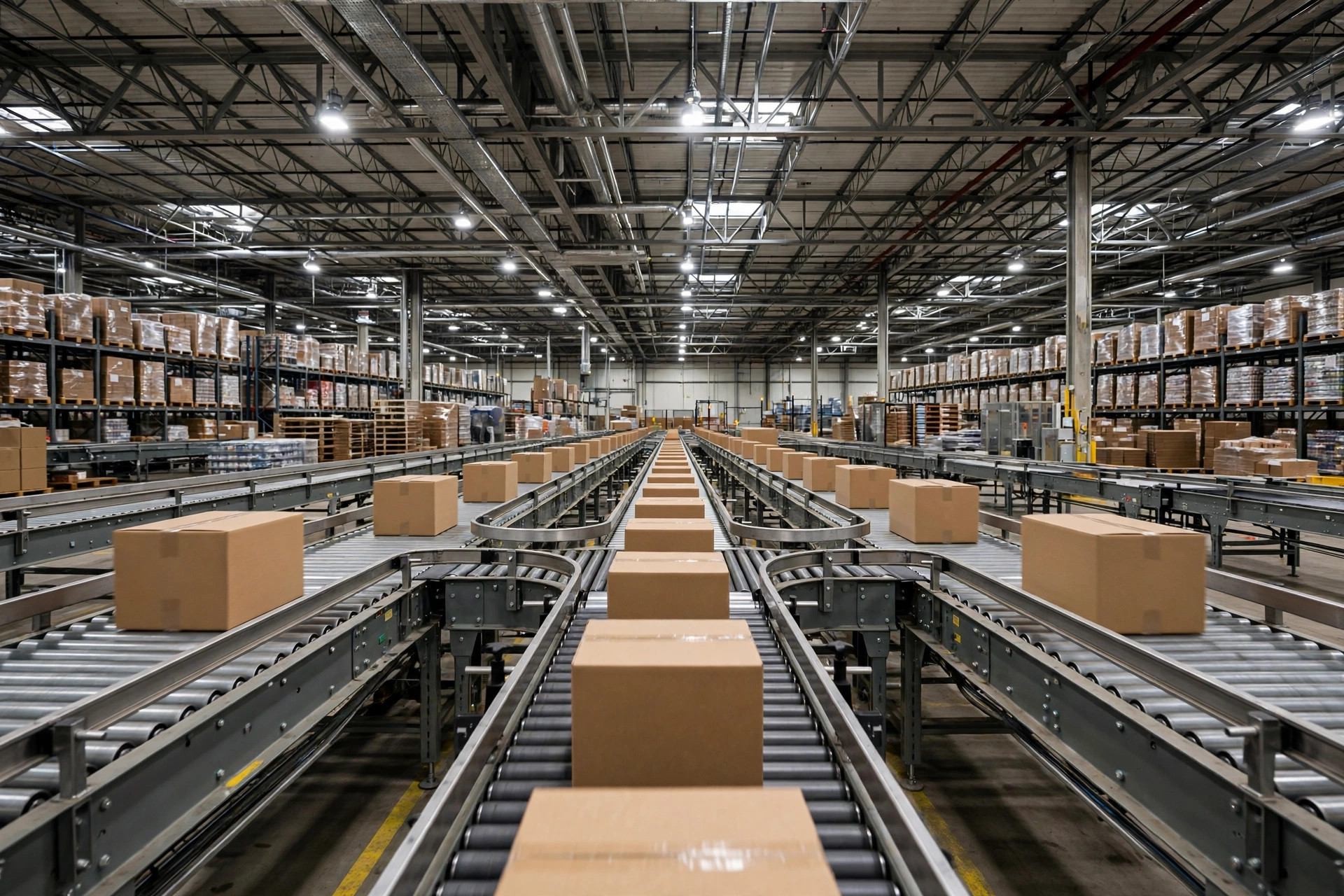
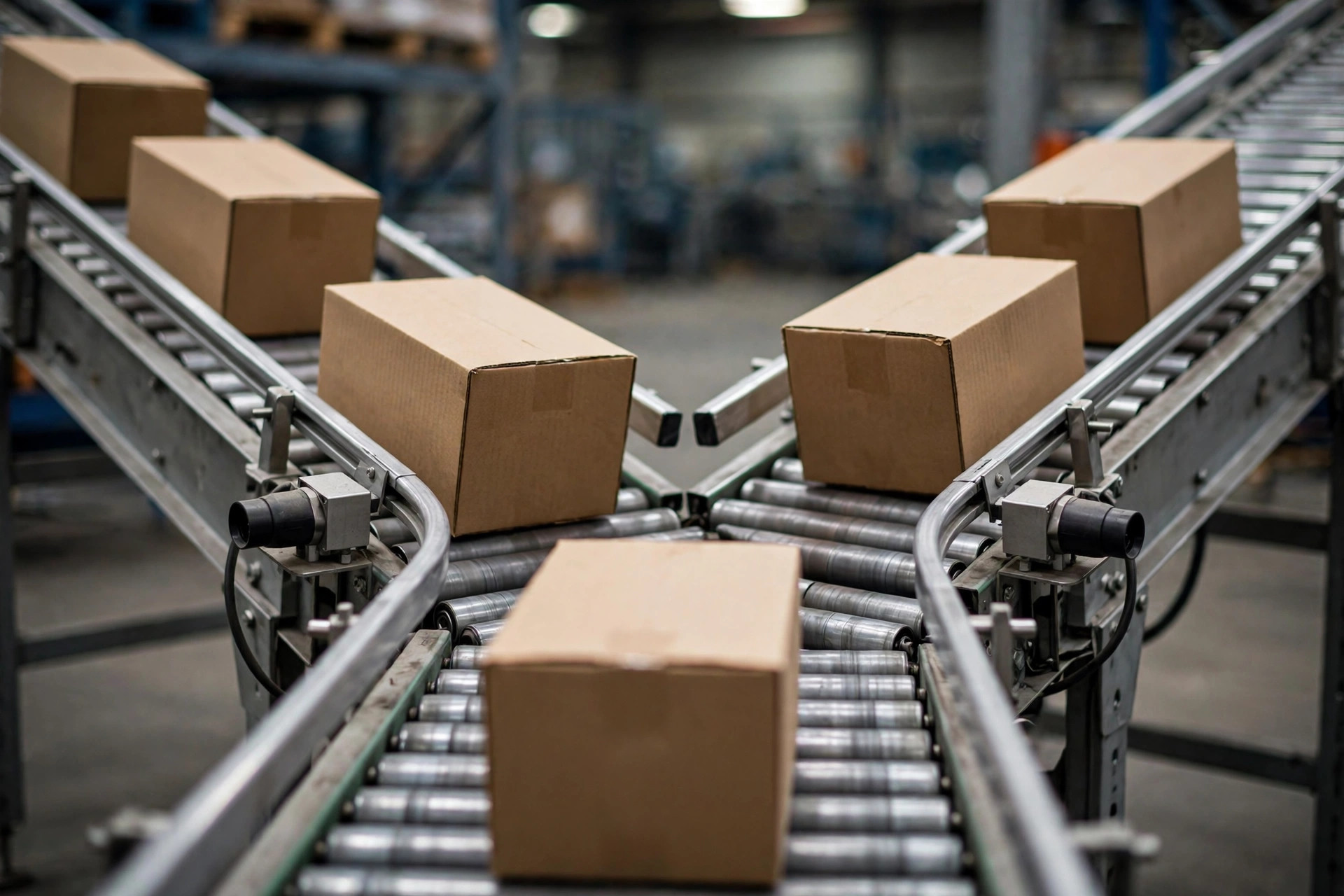
Conclusion first: whenever two conveyor lines merge into one, jams always happen in the same three places — the merge nose (the wedge where the two lines meet), the upstream metering zone (the 1–2 meters of accumulation before the merge), and the sensor logic (the code that decides whether the next carton may enter). I've seen this exact failure three times, and every client started with "the line is fine, it just jams occasionally." Every time, at least one of these three was wrong.
Why is the merge the most jam-prone spot on the whole line? Because it does the hardest job in the building: letting cartons from two upstream lines fight for one window on the main line — without colliding. A jam in sortation slows you down; a jam at the merge stops both upstream lines. The whole line dies.
Here are the three common merge designs, with their trade-offs:
| Design | How it works | Fits | Risk | Cost |
|---|---|---|---|---|
| Free-flow merge | Both lines feed freely; guide rails squeeze cartons in | Low volume, uniform cartons | Collisions at peak — jams guaranteed | Lowest |
| Slug release (metered) | Upstream lines release cartons at minimum spacing | E-commerce outbound, spiky volume | Complex logic, longer commissioning | Medium |
| Priority merge | One line has priority; the other waits for gaps | One line is replenishment or exception flow | Secondary line can starve at peak | Medium |
Across 30+ go-lives, I have never seen a free-flow merge survive peak season in a warehouse shipping more than 10,000 orders a day. Not once. Here is the counterintuitive part: a free-flow merge only works when both upstream lines are idle most of the time. People think "a merge is supposed to save money, so the simpler the controls the better." The money saved on controls gets paid back tenfold in downtime during peak.
Two projects I personally rescued
In 2023, a 3PL warehouse in Ohio went live. I walked through my go-live-night checklist item by item — but I skipped the merge section, because the vendor drawing showed a 45-degree merge and I thought "it's just an angle, how bad can it be." Bad. The first week, the merge jammed two to three hours a day. On site I watched two lines of cartons slam into the nose at 45 degrees, neither yielding, cartons wedging into the tip while the rollers kept turning. Cases tore open. Product spilled everywhere.
The rescue came in three steps. First, cut the nose angle from 45 to 30 degrees — reworked the guide plates and roller layout, two days. Second, added 2 meters of accumulation on each upstream line, with metered release logic in the PLC: if the position just past the nose is occupied, the merge line holds; after each release, wait at least one carton length before the next. Third, moved the photoeyes from 3 meters upstream to directly above the nose. After that, the merge never jammed again through the entire peak season. I ran the math afterward: during the jam week, 2.5 hours of downtime a day meant roughly 4,000 fewer cartons shipped daily, plus overtime for the crew clearing jams — while the whole retrofit cost under $20,000. Every dollar saved on the merge section is a down payment on future downtime.
The second project was an e-commerce warehouse in Southern California. The mechanics were fine — angle, rollers, all good. The jams came from a photoeye in the wrong place. The "main line occupied" sensor sat 5 meters upstream of the nose, and the PLC logic read "no carton within 5 meters = main line clear, release." But cartons had already passed that sensor and were queued at the nose. The merge line kept feeding cartons straight into the back of the main-line queue. Cartons stacked, barcode labels faced the wrong way — and that week their first-pass scan rate fell from 99% to 91%. Sortation errors doubled.
The fix took half a day: move the sensor to one carton position past the nose, and change the logic to "release only when the position past the nose is confirmed clear." A sensor's location decides whether the PLC sees the truth or five meters of history.
The three jam points, one by one
Jam point 1: The merge nose
The nose is a mechanical problem. No software can fix it. Step by step:
- Use a 30-degree merge angle, not 45. The wider the angle, the bigger the speed differential between the two carton streams, and the more they wedge at the tip.
- Match roller surface speed to the main line (field experience: belt lines commonly run 0.8–1.2 m/s — set yours to your line takt), and run the merge line 5–10% faster so cartons catch the main line instead of squeezing into it.
- Use UHMW (ultra-high-molecular-weight polyethylene) guide plates, not stainless steel. Cartons drag on steel — worse on humid days — and a carton that brakes on the guide will turn sideways and wedge.
- Leave at least 2 meters of straight run after the nose before the first curve, so cartons have room to straighten out.
Jam point 2: The upstream metering zone
This is a controls problem. Perfect mechanics can't save it.
- Give each merging line 1–2 meters of accumulation before the nose (zero-pressure accumulation is ideal; standard rollers work too).
- Write three iron rules into the release logic: (a) if the position just past the nose is occupied, the merge line holds; (b) after each release, wait at least one carton length before the next; (c) when both lines request at once, alternate releases round-robin — never fixed priority, because fixed priority starves the secondary line at peak.
- Set photoeye debounce to 50–100 ms (field experience). Too short and carton vibration causes false triggers; too long and release response lags, killing throughput.
- Program a "merge jam" alarm: if the nose photoeye stays blocked longer than 30 seconds (tune to your line speed), stop both upstream lines automatically and alarm. Without this alarm, upstream keeps feeding into the jam, and cleanup takes three times longer.
Jam point 3: Sensors and logic
Photoeyes are the merge's eyes. Eyes in the wrong place make even brilliant logic blind.
- The "main line occupied" photoeye must sit one carton position past the nose — not 3 or 5 meters upstream. The PLC needs the real-time state at the nose.
- Each merge line gets a "release request" photoeye at the metering zone entrance. A carton counts as requesting only when it reaches the entrance.
- Check photoeye alignment on a schedule: dust, tape glare, and carton debris are the most common sources of false triggers. This is a mandatory item on my go-live-night checklist.
- Keep a manual mode in the program: during peak, operators can force-release or hold either line. No automatic logic survives contact with the real floor.
Three projects' worth of failure points
First, the cost of one jam, for an e-commerce warehouse shipping 15,000 orders a day (typical scale in my experience):
| Item | Number |
|---|---|
| Cleanup time per jam | 10–20 minutes |
| Jams per day in peak | 3–5 |
| Effective shipping time lost per day | about 1 hour |
| Orders not shipped in that hour | about 600–800 |
| Peak season length | about 30 days |
30 days × 700 orders = 21,000 orders shipped late. Customer complaints, missed carrier cutoffs, bad reviews — none of that is easy to price, but each costs more than fixing the merge. What does the fix cost? Reworking the angle plus accumulation: under $20,000 (field experience, depends on line size). A pure logic change to the release sequence: nearly free. My verdict is firm: merge problems are always cheapest to fix early.
The failure-point list:
- The drawing says 30 degrees; the crew installed 45 because it was "easier." Nobody verified. On go-live night, measure the nose with a protractor.
- Photoeyes were installed but never aligned. They false-alarmed on day one, the floor got annoyed and muted the alarm — then nobody knew the merge was jamming.
- Release logic was written for one line only; the other line runs "always open." Both upstream lines need release control. One is the same as none.
- Carton size changed (say, standard cases to oversize) and nobody retuned the spacing parameters. New carton size = retune the merge. Put it in the SOP.
- The first scanner or weigher downstream sits too close to the nose (under 1 meter). Cartons get scanned before they've straightened out, and first-pass rate drops 5–8 points.
Go-live-night checklist: merge section edition
- Measure the nose angle with a protractor. Confirm 30 degrees. Photograph it and file it.
- Load 10 cartons on each upstream accumulation zone, trigger releases manually, and verify even spacing.
- Block the "main line occupied" photoeye and confirm the merge line holds; clear it and confirm release within 1 second.
- Simulate a jam: wedge a carton at the nose by hand, and confirm both upstream lines auto-stop and alarm within 30 seconds.
- Check every photoeye's alignment indicator. Wipe the dust off.
- Ask the floor supervisor: who retunes the merge parameters when carton size changes? Write the name down.
Pass all six and the merge is truly ready. Miss one, and expect a phone call on go-live day.
By Lin Xiao, WMS Implementation Consultant