I tell you this after fifteen years behind the wheel: when it comes to container loading weight distribution and cargo securing, the scariest thing on the highway is not traffic. It is following a truck whose container was loaded wrong. One autumn, on the highway near the Ningbo port area, I followed a container truck for miles, and the whole rig swayed through every curve like it had too much to drink, sinking left, then right. I got on the radio and told the driver to slow down. He came back and said the cargo inside had shifted, and he did not dare brake hard. That was the moment it clicked for me. Filling a container is not a skill. Loading one so it stays put, that is the skill.
Later, at a rest stop, that driver told me the story. The container had been loaded at a warehouse while the shipper was rushing a sailing. The crew, in a hurry, stacked all the heavy freight at one end and the light stuff at the other, with barely any bracing in between. Once the truck hit the highway, the weight pulled to one side, the cargo slid with it, and the whole container turned into a tumbler. He spent the trip white-knuckled and lost most of a day at the port getting the load restacked, nearly missing his sailing. The shipper kept apologizing on the phone, saying it would never happen again. I just thought: whatever time you save by rushing a load, the road will make you pay back double.
I saw the other side of the same problem at a warehouse near Yiwu, where I had gone to pick up a container. The crew was standing around an open container door looking miserable. The moment the door opened, the outer stack of cartons surged outward, and two workers had to throw their weight against it to keep it from falling on someone. It turned out the heavy freight had been loaded on top and the light freight underneath. After hundreds of kilometers of vibration, the light cartons at the bottom had been crushed flat, the whole stack lost its footing, and the door opening was all it took. Some of the outer cartons were torn and had to be unpacked and repacked, and that one container ate up the warehouse's whole afternoon. The shipper told me later he used to think loading meant stuffing freight in until it was full. That day taught him otherwise.
When Weight Distribution Is Wrong, the Container Tells You on the Road
After all these years on the road, I have a rough rule of thumb: whether a container will cause trouble is usually decided before it ever leaves the dock. Good container loading weight distribution comes down to one thing, a steady center of gravity. Heavy freight goes low, light freight goes high, and the left and right sides should not be wildly different, nor should the front and the back. Stack everything heavy at one end and the truck leans that way through every curve. Stack it all on top and the load lunges forward every time you brake. Every sway a driver feels on the highway is the center of gravity talking.
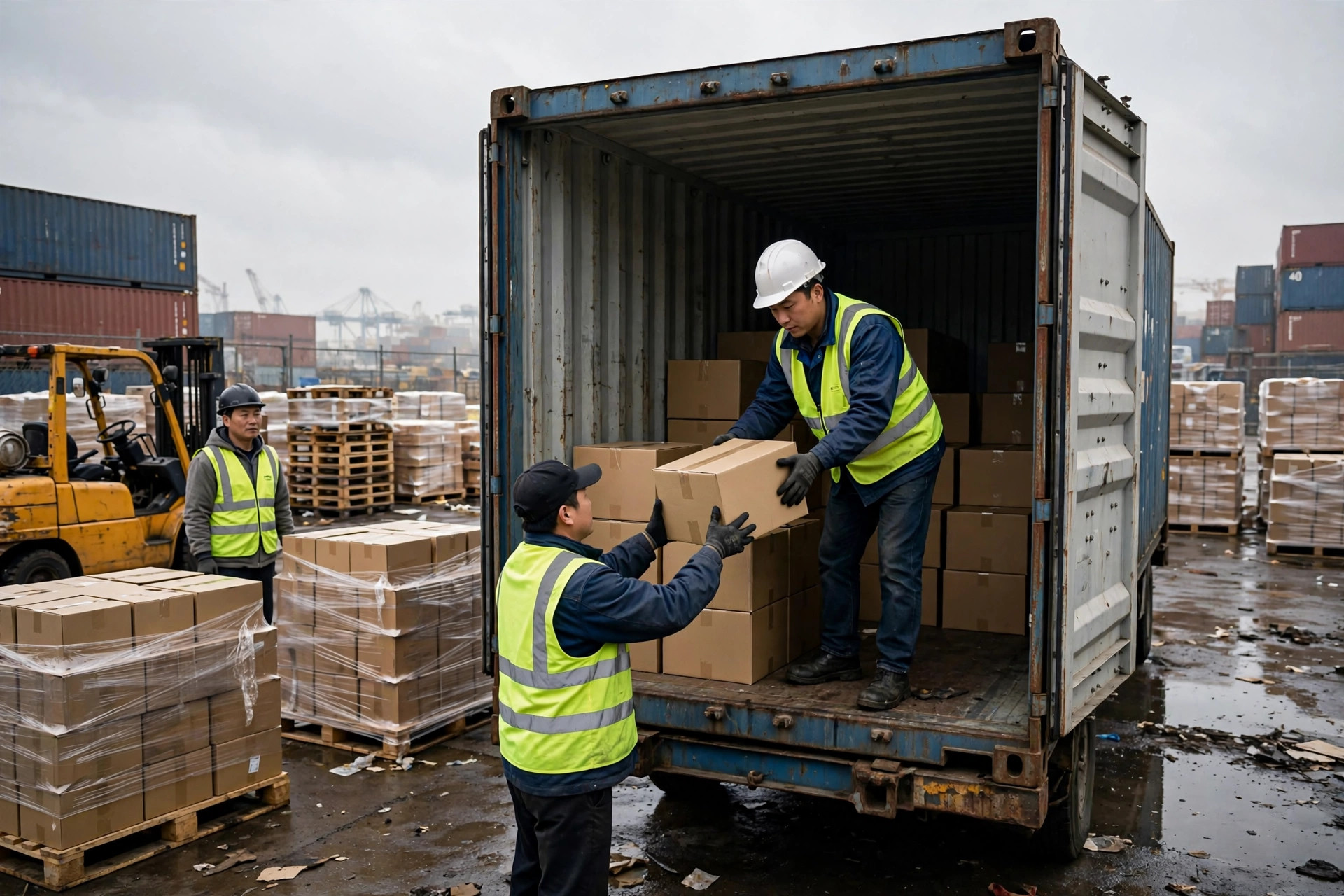
Here is my honest advice to shippers and warehouses: before loading starts, sketch the load in your head. Which shipment is heaviest, which one crushes easily? Set the heavy, sturdy freight low and near the middle first, then work outward and upward from there. Do not let the loading crew stack by feel alone, because feel goes out the window when people get tired. Before the doors close, step back and look: is one side higher than the other, is the stack by the door standing straight? That one look takes a few minutes.
Container Loading Weight Distribution and Cargo Securing Start With the Center of Gravity
Once the weight is placed right, then comes the securing. A lot of people think cargo securing just means adding more straps, but it does not work like that. Where the straps go, how the gaps are filled, and how the door is blocked all have to work together. If there are gaps between shipments, the freight has room to build up momentum on every bump, and once it gets moving, even strong straps will struggle to hold it. So fill the gaps with air cushions, lumber, or old cardboard, and let the freight brace against itself. The layer by the door matters most of all, because it takes the first force the moment the doors open. Whether the blocking board at the door holds decides whether opening day brings a surprise or a scare.
One thing that causes arguments at the dock is that drivers and warehouses barely talk to each other. The driver shows up to pick up the box, the warehouse hands it over once loaded, and nobody tells the driver how the weight sits inside. My habit is this: when loading is almost done, call the driver over to the open door and show him, heavy freight on this side, blocking board at the door, straps here. When the driver knows what is inside, he knows how to take the curves and the braking, and if something feels off, he can pull over and check early instead of finding out after the load has already slid. That conversation costs nothing, but it puts the driver and the warehouse on the same side.
Another step people skip is keeping a record. When the container is loaded, take a few photos with your phone: where the heavy freight sits, where the straps run, how the door is blocked. Those photos cost nothing, and if something goes wrong at the destination port, they are the most solid evidence you have when the blame game starts. Send a copy to the shipper and one to the driver, so everyone is working from the same picture.
I have run this math for shippers more than once, and the two ways of loading a container do not cost anything like the same money:
| Approach | What it costs now | What it costs when it goes wrong |
|---|---|---|
| Careful weight placement, securing, and photos | An extra half day of labor, plus straps and lumber | Rarely anything extra, and the sailing is made |
| Rush it, stuff it full, close the doors | Half a day saved | Restacking, rebooking, a missed sailing, and a claim dispute dragging on for days or weeks |
You do not need precise figures to see the point. Half a day saved now, traded for days of trouble later, is a bad deal however you count it.
Cargo Securing Is Not About Using More Straps
Now for a judgment that surprises people. Many folks assume a container packed tight to the roof is the safest kind, since the freight is wedged in and cannot move. I tell you, it is often the opposite. When a container is crammed completely full, the loading crew has nowhere to work: straps cannot be threaded through, lumber cannot be wedged in, and the freight just grinds against itself, bumping and scuffing on every rough stretch of road. The steadiest containers I have hauled often had a little space left on purpose, room for straps to pass and lumber to brace, so the load was held in place rather than just squeezed in place.
Straps follow the same logic, and tighter is not always better. A strap pulled hard enough to bite into a carton is damage you inflicted yourself, and at the destination the receiver will find crushed corners and assume the road did it. Straps belong on the strong points of the load, with a pad of stiff cardboard or a corner protector underneath to spread the force. Straps also hate rough edges, so run a hand around for burrs and splinters before strapping.
So here is my word of advice to shippers and warehouses, the same one I give every time. When loading a container, do not just count how much went in. Check whether the center of gravity is steady, whether the straps are in the right places, and whether the door is properly blocked. A sailing deadline is real pressure, I understand that, but no deadline is worth a load coming apart on the highway. A driver who asks how the weight sits, and a warehouse that hands over a photo, cost almost nothing and get a trip home safe. Better to spend an extra half hour at the container door than a whole day white-knuckled on the highway. That saying has held true for me all these years, and I do not expect it to change.
By Shifu Zhao, Trucking Veteran (15 yrs)