Let me be blunt: colombia avocado is hot right now, and hot markets make people sloppy. In 2024, Colombia exported about $309.4 million worth of Hass avocados, up 54.3% year on year, and shipments to the United States hit roughly 80 million pounds, up 166%. Those are real numbers. They are also the kind of numbers that make a newcomer think the money is in the fruit. It is not. The money is in getting the fruit there in one piece, and I have watched too many loads die on the way to believe otherwise.
Here is the two-sided truth. Demand is solid: Europe takes about 60% of exports, the United States about 40%, and the Netherlands alone accounted for 39.1% in 2024. Since the United States approved Colombian Hass avocados in 2017, the door has been open. Supply is solid too: Antioquia, Risaralda, and Valle del Cauca grow good fruit in mountain country, with dry matter high enough to ship well. The trouble lives in between, from the orchard to the packing house to the ports of Cartagena or Santa Marta. One weak link and the fruit turns black inside. Nobody refunds your freight on a black avocado. The buyer rejects the load, and you eat the whole container.
Colombia avocado wins in the mountains, not at the port
I have seen too many people spend money in the wrong place. One outfit rented cold storage right by the port, thinking proximity to the ship was safety, while their fruit was cooking in a mountain packing shed. With avocados, the first few hours after picking decide everything. Skip pre-cooling and the field heat stays in the fruit, respiration keeps burning, and the avocado warms itself inside its own box. By the time it reaches a cold room down the mountain, the flesh has already started to change. The skin still looks green. Cut it open and there is a black ring inside.
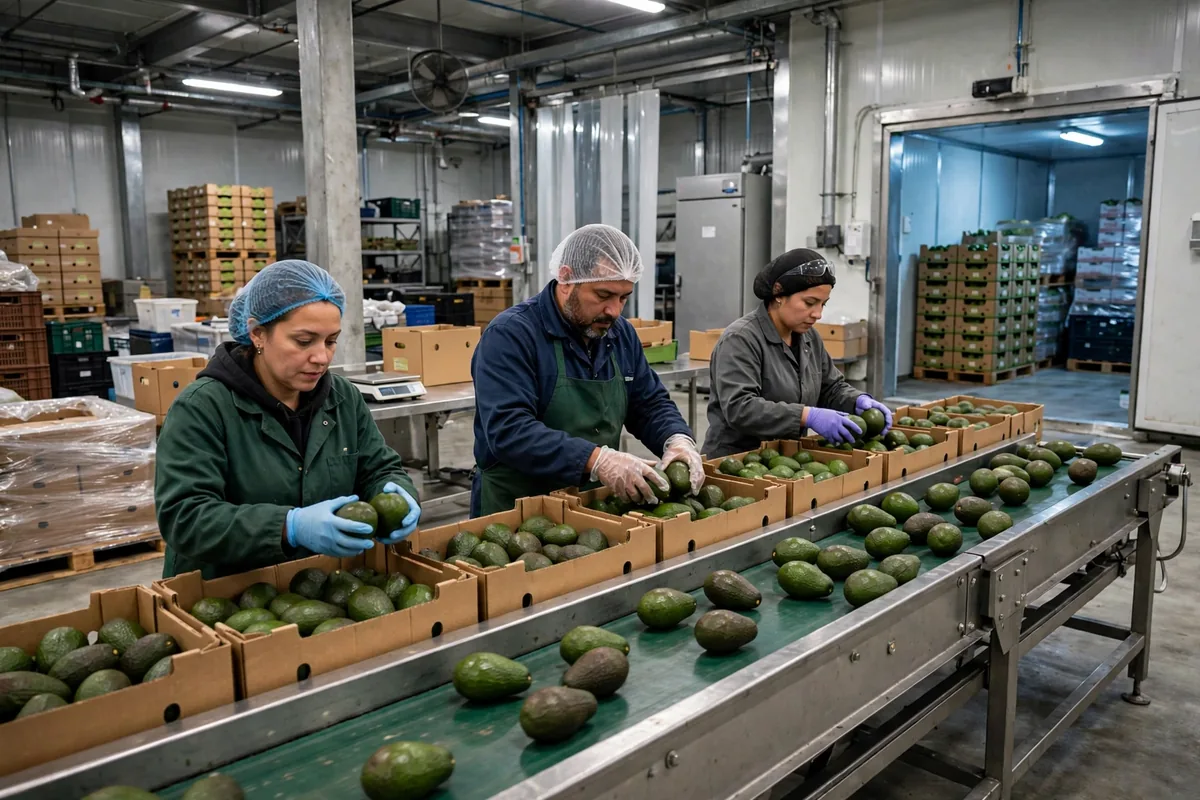
During the 2024 season I spent two days at a packing house in Antioquia. Their rule was strict: picking crews went into the orchards at six in the morning, and every fruit had to be in the pre-cooling room by noon, with the core temperature pulled down before it was allowed anywhere near the grading line. Grading was not about size. It was about maturity. Fruit picked from the same tree can sit at very different maturity stages, and if you pack them together, the ripe ones push the unripe ones along and the unripe ones bruise the ripe ones. Open that box at destination and nothing in it earns a good price. They graded into three bands by dry matter and firmness. The ripest fruit went by air or to nearby markets. Only the least mature fruit went on an ocean vessel. It sounds old-fashioned. The rejections and claims it prevented would pay for half the packing house in a year.
There is a small detail outsiders always miss: the stem. Cut it too short and the fruit knocks against its neighbors in the box, and every nick becomes an entry point for black spot. Leave it too long and it punctures the skin next to it, same result. The older pickers used curved shears and left a short stub, with a paper liner in the box. That is not fussiness. It is arithmetic: every black spot you prevent lifts the pass rate of the whole container.
Pre-cooling is the step you cannot skip
Pre-cooling, storage temperature, and ethylene control have to be read as one system. Separately, none of them saves you. Pre-cooling pulls the fruit down from the heat of the field. Cold storage keeps it asleep through the journey. Ethylene control stops it from ripening itself inside the box. Put a few overripe fruit in a container, ethylene climbs, and the whole load ripens at once. At destination you have a container of soft fruit, sold at a discount or rejected outright.
The sailing time to Florida is about three days, and to Philadelphia about five. That sounds short. Count the whole journey instead: the mountain road from the orchard to the packing house, the queue to get into the cold room, the wait at the port for the vessel, the days at sea, and the hours sitting on the dock after unloading before the fruit reaches the buyer's cold room. If any one stretch breaks the cold chain, the money spent on all the others is wasted. I tell clients the cold chain is a single line, not a set of segments. One stretch at ambient temperature means the whole line is ambient.
Air or ocean is a real choice, and there is no standard answer. Air is fast, lets you ship riper fruit with better appearance and lower loss, but freight can swallow most of the margin. Ocean is cheap and suits less mature, hardy fruit, but one delayed sailing or a congested port leaves the fruit sitting in the container for two extra days, and maturity runs away from you. My judgment: a new buyer, a first order, a relationship with no trust built yet, go by air, in small volume, and establish your reputation first. An established buyer, steady volume, grading already running smoothly, go by ocean and push the cost down. The mistake is doing it backwards: shipping the first order by ocean to save money, having half the fruit arrive black, and losing the buyer for good.
The table below is an illustrative example, with round figures put together to show the structure rather than any single shipment's real quotation:
| Item | Small air shipment | Full ocean container |
|---|---|---|
| Transit time | Same day to next day | About 3 to 5 days at sea plus port time |
| Suitable maturity | Higher, ready to sell | Lower, with room to ripen |
| Loss risk | Low | Medium to high, depends on port handoff |
| Freight share of margin | High, eats most of the margin | Low, suits volume |
| Best for | Opening a new buyer, samples | Established buyers, steady volume |
Read that table and the lesson is plain. Air versus ocean is not a contest of freight rates. It is a test of whether you trust your own grading and your port handoff. If your grading is unreliable, ocean freight is a gamble. If your port handoff is unreliable, air freight is burning money.
Colombia avocado to the United States: the sailing time is only the headline
Here is the counterintuitive part, and most newcomers get it wrong: colder is not safer. Avocados suffer chilling injury. Push the temperature too low and the skin spots, the flesh turns watery, and any buyer can see the cold damage at a glance. It sells worse than overripe fruit. What really kills quality is temperature fluctuation: one temperature in the cold room, another while the container is being loaded, another while it sits in the sun on the dock. Fruit bounced between temperatures spoils faster than fruit held steady at a slightly higher temperature. When I judge a packing house, I do not start with the size of its cold room. I start with whether it has continuous temperature records, and whether those records have gaps. A cold chain without records is a verbal promise.
Inspection at destination is the closing gate. Inspectors open sample boxes and check flesh color, firmness, and the share of black spot. Fail that and everything done earlier counts for nothing. I watched one load where the packing house, the grading, and the pre-cooling were all done right, and it still failed on the truck: the refrigerated trailer hauling fruit from the cold room to the port had its cooling switched off on the road to save fuel, and when the doors opened, warm air rushed in and condensation formed on the fruit. At inspection, black spot was over the limit and the whole container went at a discount. The fuel the driver saved was nothing against the loss on that load.
So my advice is one sentence: before you talk price and sailing schedules, write down your post-harvest process, from the moment of picking to the buyer's cold room, with who is responsible at each step, what temperature applies, and where the record lives. Any step you cannot write down is where you will lose money later. The market for colombia avocado is still growing, with exports to the United States expected at about 150 million pounds in 2025, so the opportunity is genuine. It only belongs to the people whose cold chain never breaks. By Lao Mi, Supply Chain Veteran (20 yrs)