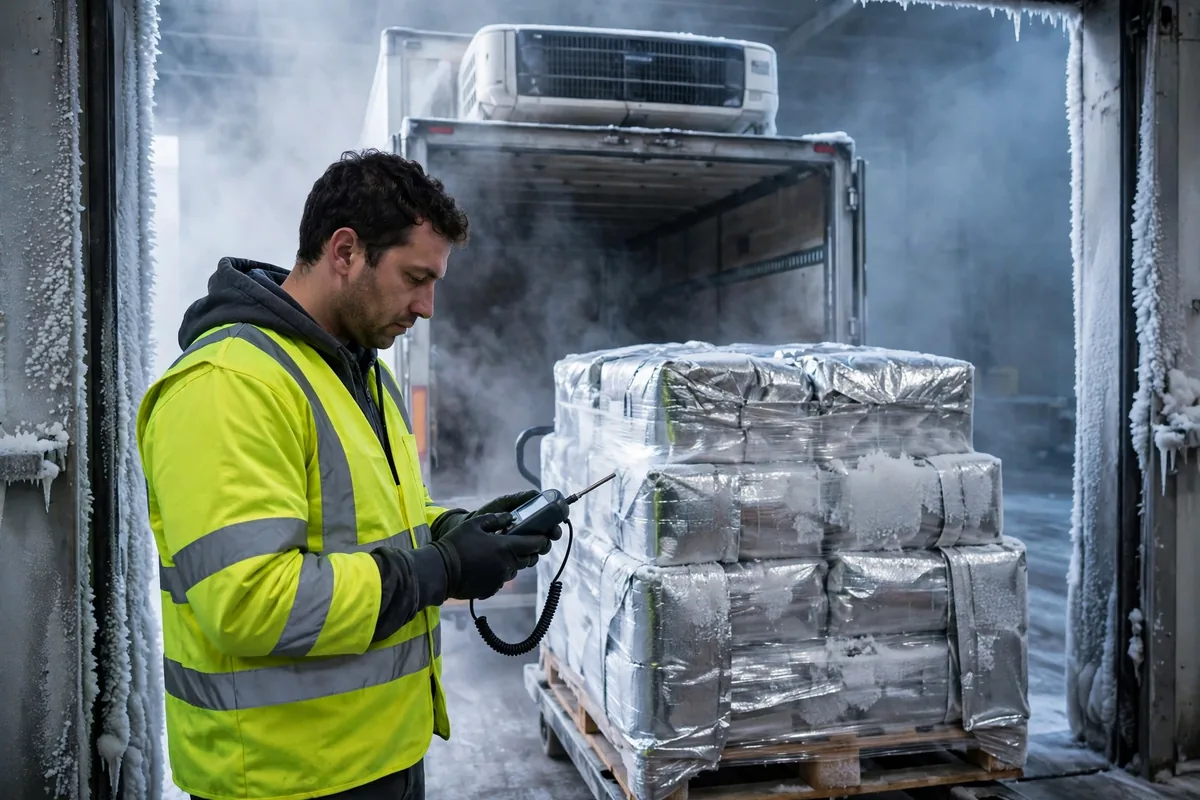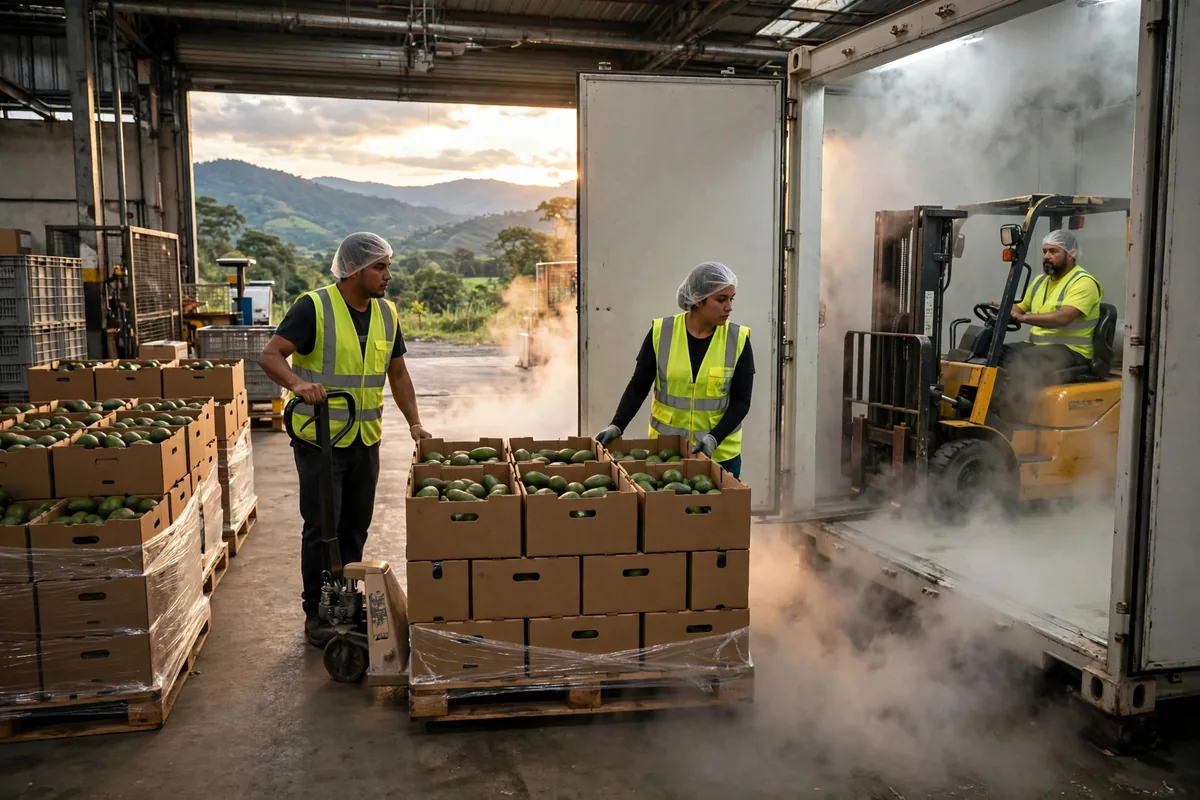
Let me be blunt: most sellers who lose money on the Colombia avocado export cold chain do not lose it during the 20-plus days at sea. They lose it in the few hours before the container is loaded. Set the reefer to 5°C, load fruit at 8°C pulp temperature, and the avocados will arrive soft in Rotterdam no matter how pretty the temperature log looks.
A friend of mine who imports Latin American fresh produce learned this the expensive way in October 2025. One 40-foot reefer, 1,920 boxes of Hass avocados, trucked from Antioquia to the port of Cartagena. It rained at the packing house that day, the fruit sat an extra half day, and pulp temperature came in at 8°C. The crew figured a strong reefer would pull it down in minutes, so they loaded anyway. At Rotterdam the buyer opened the container, sampled it, found too much soft fruit, and downgraded the whole lot. The discount on the balance payment wiped out the profit on that container plus the freight subsidy for the quarter.
A reefer holds temperature. It does not bring temperature down. If you are new to fresh produce export, memorize that line. Whatever pulp temperature goes into the box is roughly what comes out at the other end. A reefer is not a blast freezer.
Where the Colombia avocado export cold chain actually breaks
Colombia's momentum is real. In 2025 the country exported 201,479 tonnes of Hass avocados worth $375 million, with volume up 45.6% on 2024. Europe took more than 60% of it, and the Netherlands alone bought $134.2 million worth, making it the biggest single market. Antioquia, one department, accounted for 47% of national exports, and the country now has 55,000 hectares planted. When volume grows that fast, the weak links in the cold chain stop hiding.
I break the chain into four links: pre-cooling after harvest, the inland leg from packing house to port, loading, and the controlled atmosphere at sea. Pre-cooling is the one people underestimate most. Antioquia's orchards sit in the mountains, and fruit comes off the tree carrying field heat. The right move is to pull pulp temperature down to around 5°C within hours of picking, before the packing line. Some small packing houses do not have enough pre-cooling capacity, so fruit gets graded and boxed at ambient temperature and only enters the cold room the next day. The chain breaks at step one, and everything after that is damage control.
The inland leg is the second break point. The road from the mountains to the port crosses rough terrain, and in the rainy season trucks run late. When the truck arrives, the container may not be there; when the container is there, the sailing may not wait. And when reefer plugs at the port are in short supply, a box can sit in the yard unplugged, riding on insulation alone. A few hours of temperature drift might look like a small wiggle on the data logger. At destination it shows up as soft fruit.
The sea leg is ironically the most stable part. The standard Hass program runs at 5°C, 85–90% humidity, with controlled atmosphere holding oxygen near 5% and carbon dioxide near 5%, which slows respiration and ripening. Northern Europe takes 20–25 days, and a controlled-atmosphere reefer can stretch to around 35 days. If pulp temperature was right at loading, the ocean crossing mostly takes care of itself.
Here is the counterintuitive part: colder is not better. Plenty of newcomers want to set the box to 2°C, thinking it buys safety. Hass avocados suffer chilling injury below their comfort zone, and the flesh goes dark. Around 5°C is the sweet spot. Every degree off it moves risk up a notch.
Doing the math: avocado by sea versus air
Every new seller agonizes over sea versus air, so here is the honest comparison:
| Mode | Transit | Volume per shipment | Best for |
|---|---|---|---|
| Sea reefer | 20–25 days to Northern Europe | About 1,920 boxes in a 40-foot reefer | Sellers with volume and a steady buyer |
| Air freight | A few days | Small lots, priced per kilo | Samples, top-ups, holiday windows |
Air works for small trial lots. Ship a full container by air and freight eats the margin alive. Sea is the real route, but sea freight runs on certainty: whether your fruit holds its maturity over 20-plus days depends on what happened in the hours before loading. Treat freight rates as whatever the carrier quotes this week, and never trust a price list from last year.
There is another cost people forget to count. A rejected container does not just cost the value of the fruit. The downgrade, the discounted balance, the weaker negotiating position on the next order — all of it follows. In 2025 Colombia's average export price actually fell: volume rose 45.6% but value rose only 21.3%. The market is not short of avocados. It is short of arrivals with stable quality. Stable quality is what buys you pricing power.
What a seller can actually control in the avocado cold chain
My own approach is unglamorous, and it works. First, write pulp temperature into the contract as the acceptance standard, not the reefer setpoint. My person at the packing house measures pulp temperature on site. If it is too high, we wait. Pre-cooling is not done, we do not load. I would rather miss a sailing than load a container of soft fruit.
Second, line up the whole sequence before loading day: pre-cooling room, reefer truck, port plug, sailing. Four time slots, all confirmed. If any one of them might slip, I would rather delay a day than let a box sit unplugged in the yard.
Third, book controlled-atmosphere equipment early. In peak season reefers and atmosphere units both get tight, and if you end up with a standard reefer for a 20-plus-day voyage, you carry that risk yourself. I order three weeks ahead of the sailing, with a week of buffer built in.
Fourth, do not just admire the temperature logger's curve. A pretty curve does not mean good fruit. The soft-fruit rate and flesh-browning rate at arrival are the real metrics. I log every container's arrival feedback against the packing house, the harvest date and the sailing. After three months you can see clearly which packer is reliable and which sailing keeps causing trouble.
The window for Colombian avocados is still open, and a European market worth more than 60% of exports was not built in a day. But the window rewards the prepared, not the ones who simply ship the most volume. In the cold chain, the winner is not whoever buys the most expensive container. It is whoever is most stubborn in the hours before loading. I learned that the hard way, and the tuition was one container.
By Ah K, E-commerce Seller (5 yrs)