
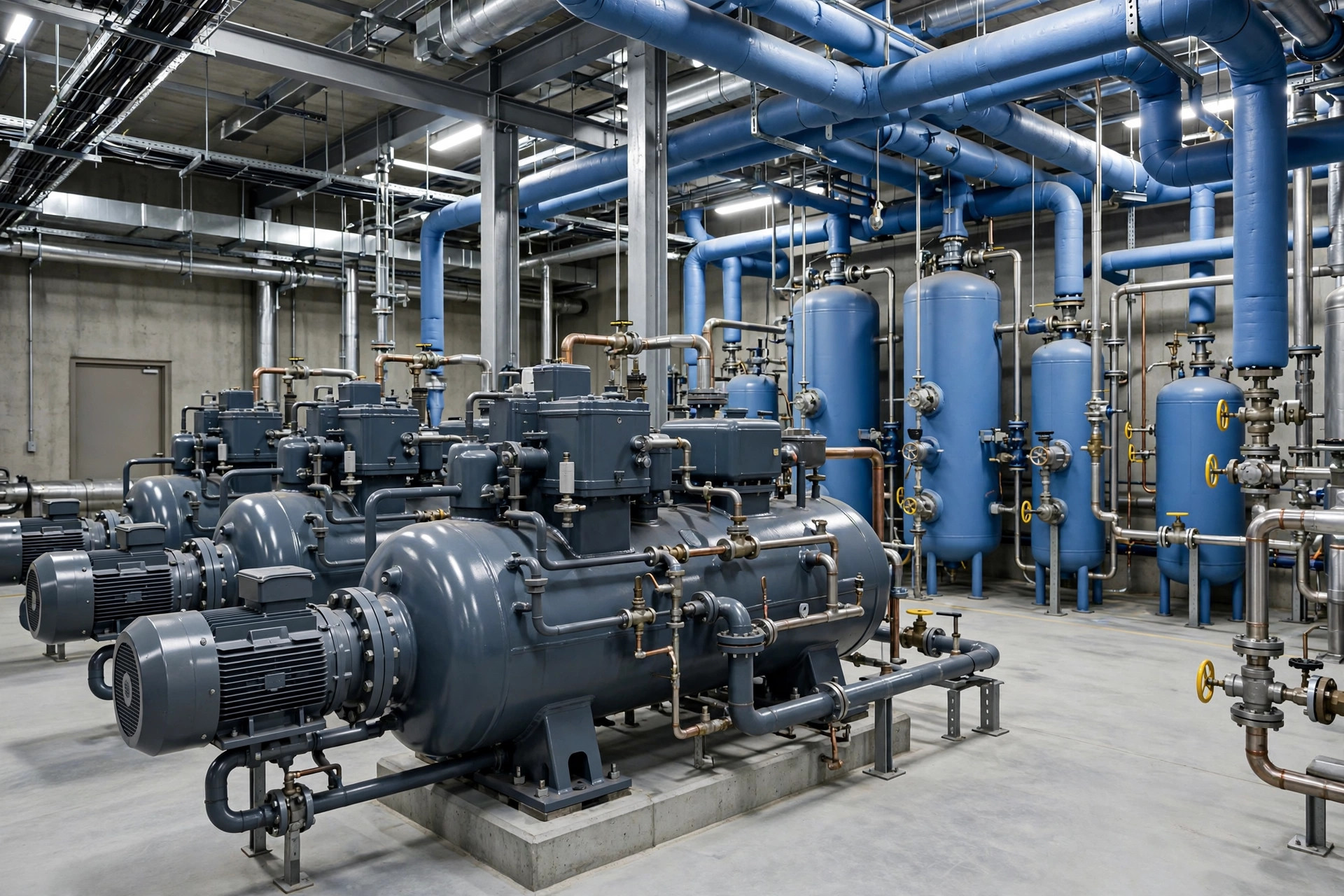
In the ammonia vs CO2 refrigeration warehouse debate, picking wrong is a 15-year mistake: the extra electricity burned over the next decade could buy half a compressor rack. I ran the numbers — this isn't a scare tactic.
If you're weighing the ammonia vs CO2 refrigeration warehouse decision, 2026 has actually simplified the choice. New builds in the US now come down to two serious options: ammonia or carbon dioxide. HFCs aren't banned outright, but the policy clock is ticking: under EPA's AIM Act, HFC production and consumption must fall 85% below baseline by 2036, with a 40% cut already in force for 2024–2028. Installing an R-404A system today is like buying a car the manufacturer has announced it will stop supporting in ten years.
Ammonia vs CO2 vs HFC: The Head-to-Head Numbers
Ammonia (R-717) is a natural refrigerant with over a century of industrial service. Its superpower is latent heat — moving the same heat with the smallest mass flow, so compressors work least. That's the physical root of its efficiency edge. ODP is zero, GWP is zero — a perfect environmental scorecard. The price is toxicity: ASHRAE Standard 34 classifies it B2 (newer editions split out B2L, lower flammability). OSHA's 8-hour limit is 50 ppm, NIOSH recommends 25 ppm, 300 ppm is immediately dangerous. Scary, until you learn its built-in alarm: the nose detects ammonia around 5 ppm, far below hazard levels — like natural gas at home, you smell the leak before the instruments do.
Carbon dioxide (R-744) is also natural, with GWP of 1 by definition, zero ODP, and an ASHRAE A1 rating (non-toxic, non-flammable). Its quirk hides at the critical point: just above 31°C. Past that line, the system goes transcritical, discharge pressures shoot past 100 bar, and compressor work climbs steeply. Think turbocharged engine: sips fuel normally, guzzles it floored across a 40°C desert. CO2 efficiency takes a real haircut in hot climates.
HFCs (R-404A as the representative) are synthetic, stable, and every technician can service them. GWP is nearly 4,000 — one kilogram leaked equals four tons of CO2. Regulators are closing in: beyond the federal AIM Act, California's CARB has required since January 1, 2022 that new cold storage systems over 50 pounds of charge use refrigerants below 150 GWP. R-404A at ~4,000 doesn't get through the door.
In 2019, a 100,000-square-foot frozen food warehouse near Fresno, California (-18°C) insisted on R-404A — lowest first cost, contractors ready. I put CARB's 150-GWP rule on the table: commissioning late 2020, the rule hitting in 2022, the system would be a grandfathered relic within two years, every future expansion constrained. We switched to an ammonia/CO2 cascade — ammonia in the machine room, CO2 on the warehouse floor. First cost ran ~30% above the HFC bid, but with a 20-year hold, the math worked.
People tell me "ammonia is too dangerous for our warehouse" — wrong target. Ammonia isn't the danger; ignorance is. Hundreds of thousands of tons of ammonia refrigeration have run in US food plants for a century, with IIAR and ASHRAE 15 covering ventilation, leak detection, and emergency response in black and white. The genuinely dangerous one is the "safe" HFC — colorless, odorless, leaking silently while your power bill climbs, until the EPA fine arrives.
Ammonia vs CO2 Refrigeration for Warehouses: Where the Break-Even Line Sits
Line one: scale. Under ~100 tons of refrigeration, CO2 or a patched-up legacy HFC system. Between 100 and 300 tons, CO2 and ammonia go head to head. Above 300 tons in a big freezer, ammonia's efficiency advantage scales with size — its home turf.
Line two: temperature. Below -25°C deep freeze, ammonia. At 0–4°C chilled, CO2 is very comfortable. Deep-freeze CO2 is possible, but complexity eats back part of the savings.
Line three: climate. Summers regularly above 35°C — Texas, Arizona, the Inland Empire — CO2 transcritical efficiency sags and ammonia holds steadier. In the Pacific Northwest or around the Great Lakes, CO2 is in its element. In 2021, a 50,000-square-foot 3PL cold warehouse in Dallas chose CO2 transcritical for its green credentials. Then a 100°F-plus summer kept the system transcritical for weeks, and the power bill blew past design estimates. They sized off catalog COP and never checked local weather data — the third time I've watched that exact mistake.
Line four: hold period. Flipping or vacating within 8 years? Nurse the old HFC system along — cheapest. Holding 12-plus? Go ammonia or CO2 and do it right once.
| Ammonia R-717 | Carbon Dioxide R-744 | HFC R-404A | |
|---|---|---|---|
| ODP / GWP | 0 / 0 | 0 / 1 | 0 / ~4,000 |
| Safety group (ASHRAE 34) | B2 (lower flammability) | A1 | A1 |
| Toxicity / leak awareness | Toxic; detectable by smell at ~5 ppm | Non-toxic; asphyxiation risk at high concentrations | Non-toxic, odorless; leaks go unnoticed |
| Operating pressure | Moderate | High (100+ bar transcritical) | Moderate |
| First cost | Medium (machine room + safety investment) | High (high-pressure components cost more) | Low |
| Efficiency (large/low-temp) | High | Medium (derated in hot climates) | Medium |
| Maintenance bar | High: certified ammonia technicians required | Medium-high: pricey high-pressure spares | Low: everyone can service it |
| Policy risk | Minimal (natural refrigerant) | Minimal | High (AIM Act cuts deepen yearly) |
| Best fit | Large warehouses, deep freeze, long hold | Mid-size facilities, temperate/cold regions | Extending old systems, short-term bridge |
Worked example — illustrative magnitudes from typical industry ranges, not a quote; have your engineer rerun them against actual loads. Take a 50,000-square-foot freezer at -18°C, roughly 200 tons of refrigeration, 6,000 hours a year at $0.15/kWh:
- Option A (R-404A): first cost indexed at 100; annual power highest, indexed at 100. But the 2029–2033 cut (70%) makes top-ups and leak compliance climb yearly — the back five years are the pain zone.
- Option B (CO2 transcritical): first cost ~130; annual power ~90 in temperate regions (hotter climates push this up).
- Option C (ammonia): first cost ~120 including machine-room safety; annual power ~80 — the lowest draw per ton of refrigeration.
Over 15 years, B and C very likely beat A on total cost — A loses the back five years on policy exposure and power. Run the ammonia vs CO2 refrigeration warehouse comparison on 15-year total cost, not first cost: that's the number that settles every debate I've sat through.
The Maintenance Traps Nobody Puts in the Brochure
Ammonia's trap is oil. Ammonia and compressor oil don't mix — oil settles at the bottom of evaporators, and scheduled oil draining is mandatory. Skip it and heat-transfer efficiency visibly degrades. Then copper: ammonia attacks copper and copper alloys, so copper tubing anywhere is an automatic fail — written in stone in the IIAR standards. Above certain charge sizes, OSHA PSM and EPA RMP kick in (check current thresholds on the official sites) — emergency plans and drills become a fixed cost line.
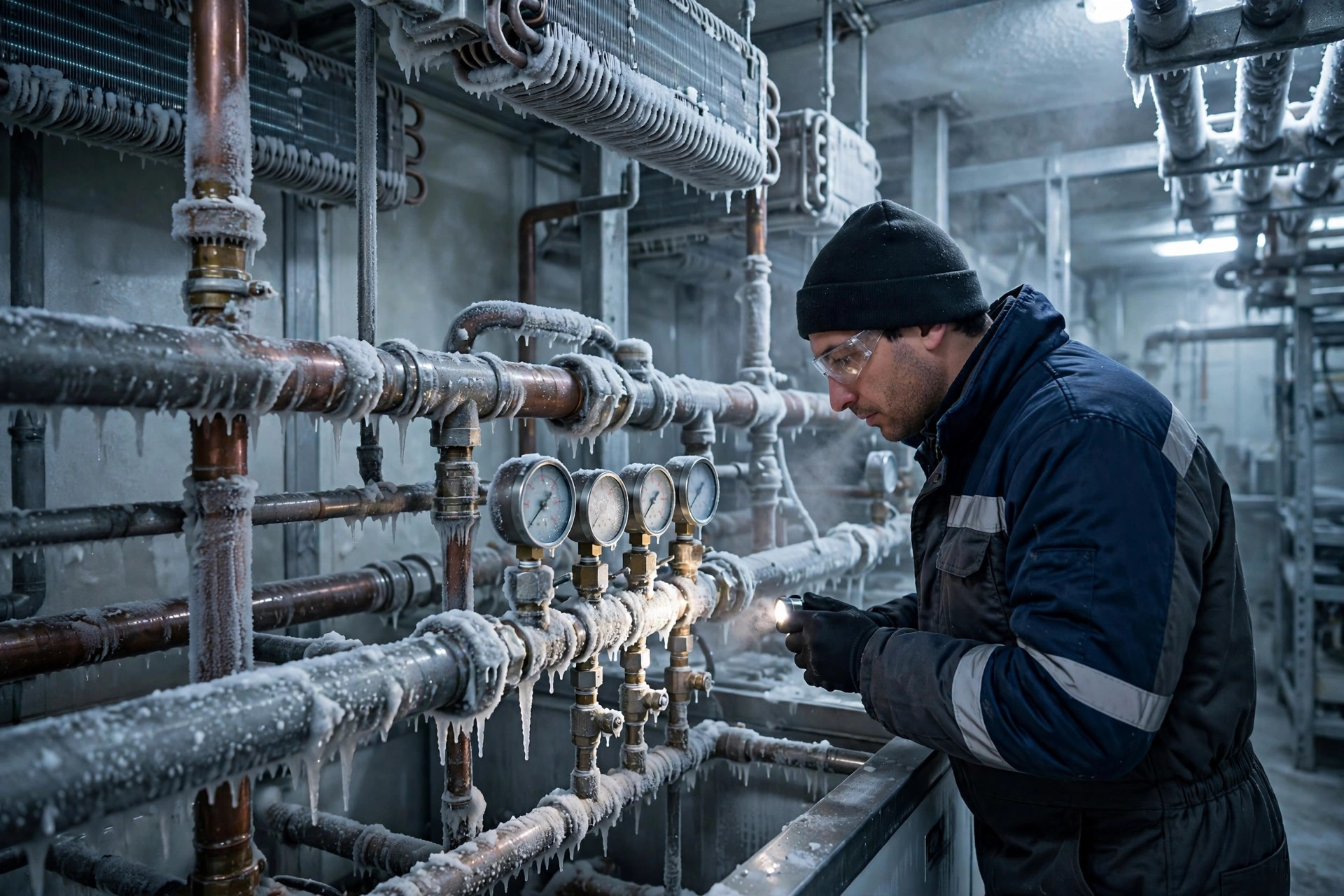
CO2's trap is pressure. In a 100-plus-bar system, safety valves, rupture discs, and high-pressure hoses are all specialty parts — when one fails, lead time is measured in weeks, not the same-day availability of HFC parts. And water: CO2 plus moisture forms corrosive carbonic acid, so dryer filters must be changed on schedule — excess moisture is a slow poison that shows up three years later.
HFC's trap is leakage. EPA leak-repair rules set hard thresholds for large systems, and violations bring fines. The sharper pain is money: with only 30% of baseline allowances left after 2029, R-404A gets scarcer and pricier every year. Installing HFC today for the low first cost plants a price-hike time bomb for your future self.
The Counterintuitive Bit
The most dangerous refrigerant is actually the safest — that's ammonia. Detectable at 5 ppm against an OSHA limit of 50 ppm: a 10x early-warning band, a built-in smoke detector. The "safe" HFC is colorless and odorless — it can leak itself empty unnoticed, until the power bill and the EPA notice arrive together. Safety was never about the label; it's about whether respect for the refrigerant is written into your operating procedures.
The one number that decides whether the money was well spent: 15-year total cost of ownership per ton of refrigeration. First cost is only a third; power and policy exposure are the rest. New large warehouse? Ammonia — or an ammonia/CO2 cascade — with confidence. Mid-size in a temperate zone? CO2 is genuinely attractive. Nursing an old plant on HFC is fine too — just don't expect it with you in 2035. For most operators, the ammonia vs CO2 refrigeration warehouse choice resolves itself the moment you run that number.
By Da Liu, Automation Engineer



