We have a client who imports fresh cherries, and last summer they learned an expensive lesson that I still tell new clients about. A container arrived at the warehouse, spot checks showed the fruit temperature was over the limit, and the shipper filed a claim with the carrier. The carrier answered with one line — "temperatures in transit were fine" — and kicked the ball back. All the client had was a single temperature reading taken at arrival. One lonely data point does not hold up at a negotiating table. Most of that container ended up sold at a discount, and nobody fully owned the loss. That case taught me the real rule of cold chain claims: cold chain temperature logger claim evidence is not about who argues loudest. It is about whose evidence chain has no gaps.
Here is an insider truth from the provider side. Most cold chain disputes are not really about whether the temperature exceeded the limit. They are about whether the evidence chain is broken. A claim has to pass three gates: is the data continuous, does the data belong to this exact shipment, and who held the goods during the over-limit window? Fail any one gate and the other side has a reason to say no. So a temperature logger is not a "just install one" item. It is a "install it so the other side cannot wriggle out" item.
Cold Chain Temperature Logger Claim Evidence Starts With Placement, Not the Device Brand
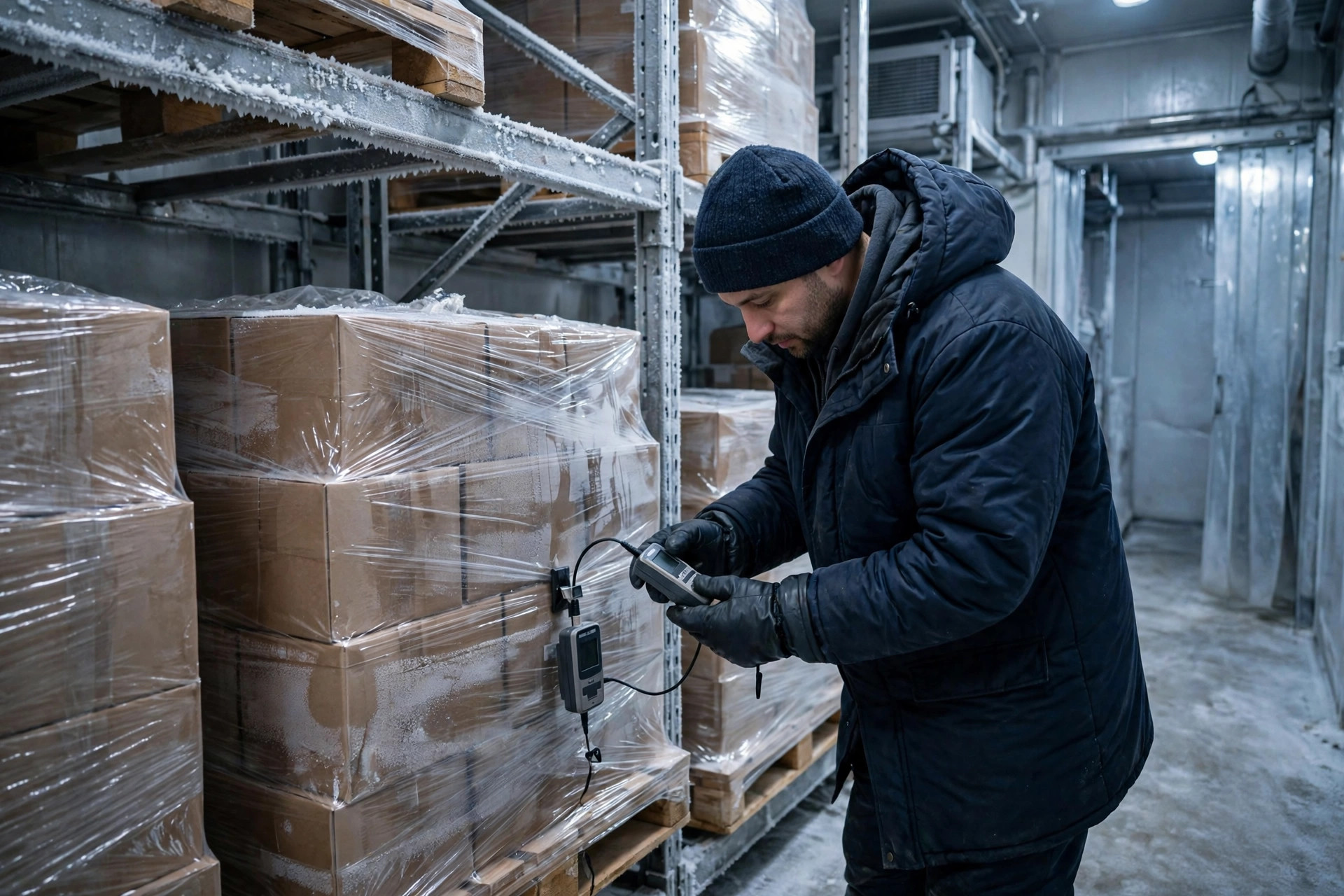
Another client of ours distributes vaccine cold chain accessories, and they learned about placement the hard way. Their logger sat only in the middle of the truck. The shipper argued that goods near the door ran warmer, both sides talked past each other, and the data lost credibility because it was not representative. We switched to multiple points per truck: one near the door, one mid-cargo, one near the reefer outlet. Three points corroborating each other cut the arguments down dramatically.
Device selection matters too, and the details belong in the contract appendix — not just the words "temperature logger provided." Sampling interval, accuracy, and tamper-evident timestamps all need to be written down. My rule of thumb: for fresh produce, sample at least every 10 minutes. The device needs a current calibration record, because expired calibration is the first thing the other side attacks. And agree the data export format in advance, so claim day does not turn into a discovery that the other side's system cannot produce a file you can use.
One easily missed point: whose logger is it, and who retrieves the data? A shipper-owned or third-party device reads cleaner in a negotiation than a carrier-owned one on high-value cargo. For everyday general cargo, a carrier device is fine — but the retrieval process and the deadline for delivering raw data must be in the contract, for example "raw data files delivered within 24 hours of arrival." Never accept "provided promptly." That phrase has no teeth.
The Timeline That Turns Temperature Data Into Claim Evidence
The claims that actually get paid all share one thing: a clear timeline. We had a dairy client whose shipment ran 30 hours in transit, with the logger showing an over-limit window from hour 8 to hour 11. We laid that window against the handover records, and it fell squarely inside the carrier's linehaul leg — not the loading wait, not the unloading wait. Once responsibility was locked to a leg, the negotiation changed from "is there a problem" to "how much," and that is a completely different conversation.
So my practice is to build a "temperature-responsibility timeline" for every shipment. The horizontal axis is time, marked with five nodes: loading complete, departure, transfer, arrival, unloading complete. The vertical axis is the temperature curve. Over-limit periods are highlighted and matched to whoever held the goods at that moment. Inadequate pre-cooling, reefer failure on the road, excessive transfer dwell, unloading delays — each segment has a different responsible party. Without that picture, both sides just argue from feeling.
| Claim evidence item | What it proves | What happens when it is missing |
|---|---|---|
| Continuous raw temperature file | That the excursion actually happened | A spot reading becomes a lone, weak exhibit |
| Device calibration record | That the data is trustworthy | The other side attacks accuracy and discounts the data |
| Loading/departure/arrival/unloading timestamps | Which leg owns the excursion window | Responsibility for the window becomes unresolvable |
| Handover notes and signed receipts | Who held the goods in each segment | Verbal understandings get denied afterwards |
| Damage photos and inspection report | The monetary size of the loss | Temperature argued without loss value stalls the payout |
Here is the counter-intuitive part: an excursion does not automatically mean a total loss, and you should not open by claiming total loss. Our experience is to grade the claim first. A brief, minor excursion with goods passing inspection supports a freight reduction or partial compensation. A long, severe excursion with failed inspection supports a full-value or discounted-value claim. Graded claims look professional, and the other side finds it easier to concede the first tier — which means you actually get paid faster. A claim letter screaming total loss on day one usually buys you delay, until you tire out first.
Negotiating Advice: Write the Cold Chain Claim Terms on Signing Day, Not on Claim Day
Too many clients read the contract only after something goes wrong, and by then it is too late. For cold chain contracts, I insist on at least five temperature logger and claim terms up front. First, device model, quantity, placement points, and sampling interval in an appendix. Second, a hard deadline and format for raw data delivery. Third, a precise excursion definition: does a single-point breach count, or only a sustained breach over a set duration, and what is the threshold? Fourth, who inspects damaged goods and who advances the inspection cost. Fifth, the dispute path and its time limit — negotiate first, then escalate, within how many days. The more specific the clause, the less arguing the claim needs.
There is also a pricing logic to get straight. A cold chain service with a full evidence chain does cost slightly more than a "just move it" quote. The difference pays for devices, calibration, and data handling labor. But show the client the other side of the ledger: one disputed high-value shipment without an evidence chain can cost a large fraction of the cargo value, while with an evidence chain you can at least pin responsibility down and negotiate from strength. Framed that way, the evidence service stops looking expensive and starts looking like value.
One final operational habit: keep your own copy of the data. That is what good cold chain temperature logger claim evidence looks like in practice — complete, timestamped, and in your hands, not only in someone else's system. Once raw files arrive, shipper, carrier, and warehouse should each hold one. Data that lives only in the carrier's system can vanish with an account change, a system migration, or a retention expiry. Photograph paper handover notes, archive electronic files by shipment number, and do not delete anything inside the claim window.
Next time you negotiate a contract, remember to ask these three questions: how many logger points, what sampling interval, and within how many days do I get the raw data? A supplier who cannot answer those three should give you pause, no matter how cheap the quote looks. In cold chain, temperature data is your leverage. You barely notice it on a normal day — and on the day something goes wrong, it is real money.
By Susan, 3PL Sales Director