Cold chain packaging validation is the test most warehouses get backwards. A supplier hands over a handsome qualification report, the warehouse starts shipping in that shipper, and product still arrives out of temperature. The report was genuine. The box was not defective. The problem is simple: the supplier qualified their box, and you have to protect your lane. Change the lane, and the qualification stops applying.
Think of it like a sorter rated at 300 cartons an hour: put it in your building, with your carton mix and staffing, and it runs 200. An insulated shipper works the same way: box, coolant, payload, ambient profile, and last-mile dwell time combine into one real-world hold time. Leave out any one of those variables and the conclusion is fiction.
What cold chain packaging validation actually tests: the curve, not the clock
Cold chain packaging validation does not test "how many hours this box lasts." It tests a complete temperature curve: from the moment the box is sealed, under a stated ambient profile, can the inside temperature stay inside the product's required band until the customer opens the box? A single hour figure sounds good in a sales deck. The curve is the honest document. Three things hide inside it: peak temperature, any sudden acceleration, and margin left at opening. Margin is your safety cushion.
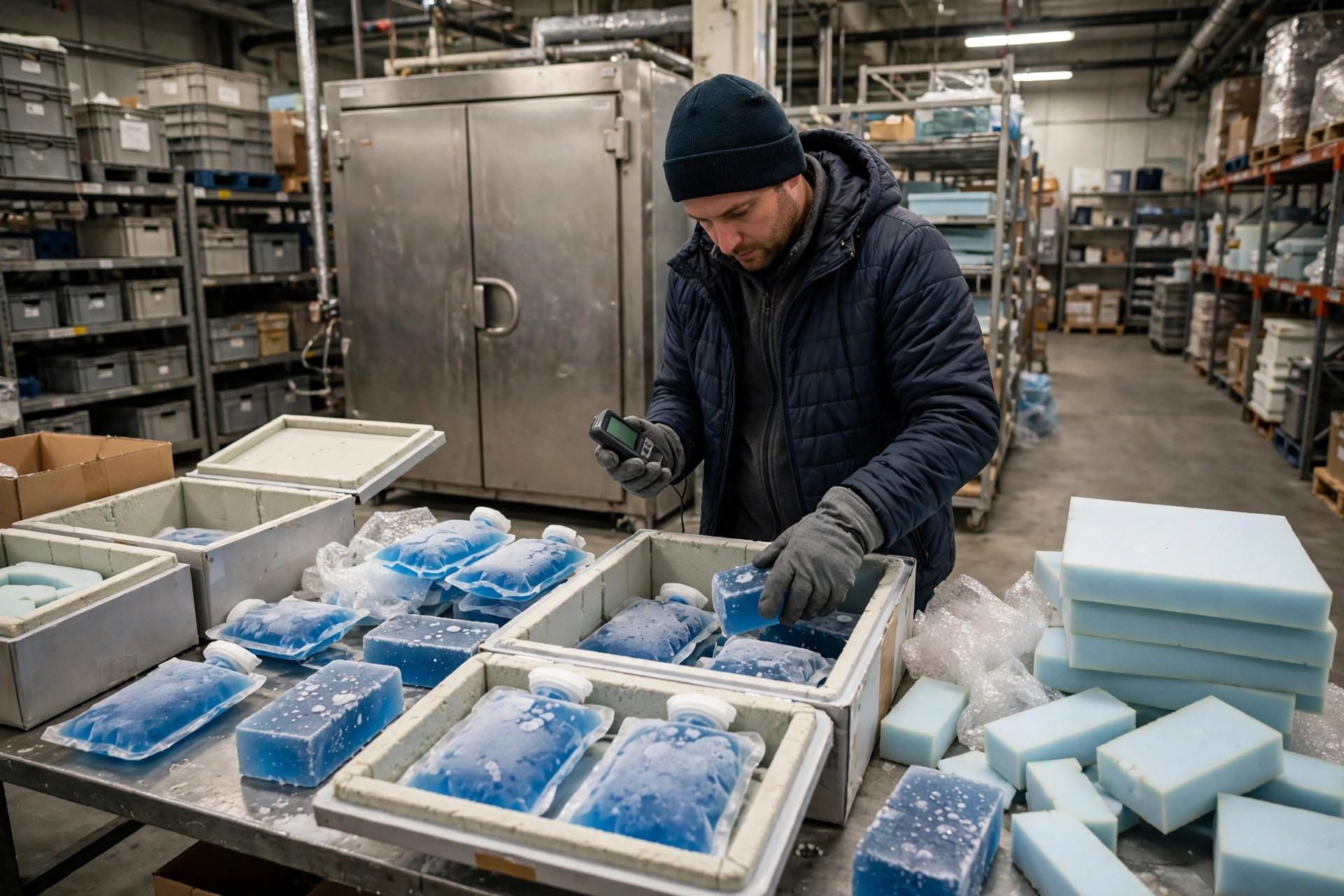
Warehouse-side qualification runs in three gates, like any equipment go-live. Design qualification is the paper gate: box spec, coolant type and quantity, pack-out method, and product temperature band, all matched on paper. Operational qualification is the test gate: pack to procedure, place probes, run the full simulated lane, and check the curve. Performance qualification is the live gate: real orders, real lanes, real last-mile dwell, run repeatedly to see whether results hold. Skip any gate and the rest is gambling. I have seen warehouses go live on paper alone; both types meet the same fate at peak season.
Why a supplier's cold chain packaging validation report cannot sign off your lane
A supplier's "pre-qualified" claim is not fake. It is simply true under the supplier's conditions: a standardized ambient profile, textbook pack-out, full coolant load, no sun-baked doorstep, no second sort. Your parcel may wait an extra half hour at a sortation dock, sit in the sun outside an apartment building for twenty minutes, or ship at a third less payload because the order mix shifted.
I worked with a fresh-food warehouse in eastern China that learned this on a new summer lane. The supplier's report was clear, the shipper passed under the standard summer profile, and in week three, three consecutive customer complaints landed with out-of-range opening temperatures. The warehouse re-ran three boxes itself, and the probe data told the story immediately: the box was fine, the last mile was not. On summer afternoons, the delivery van queued outside residential compounds, and boxes sat in the sun for close to an hour before handoff. The internal temperature curve went steep in that final stretch and crossed the limit. That stretch did not exist in the supplier's test, because their procedure had no "sun-baked doorstep" step. The fix was operational, not a new box: shaded transfer totes at the last mile, plus that dwell time written into the warehouse's own validation curve. Three re-test boxes passed, and the complaints stopped.
The dividing line is this: a supplier report is a selection reference, never a certificate for your lane. Your validation must be run on your lane data, with ambient profiles taken from your actual routes and dwell times taken from your worst case, not your average. Validating on the average is like sizing a roof for a sunny day and hoping the storm never comes.
Four changes that trigger re-validation, no exceptions
Too many warehouses treat validation as a one-time event, filed and forgotten until something breaks. Any one of these four changes means re-validation, with no room for negotiation:
| Change | Why it forces a re-run | Minimum re-test |
|---|---|---|
| Coolant change: brand, size, or freezing process | Coolant is the battery of the system; a new battery means a new system | One full simulated curve set, new versus old margin compared |
| Lane change: new city, new carrier, longer dwell | The ambient profile and dwell time changed, so the old curve no longer represents the new lane | Performance qualification on the new lane's worst case |
| Payload or product-mix change | Thermal mass inside the box changed, so the temperature climb rate changed | Re-run at the new minimum payload, the harshest case |
| Pack-out change: sealing method, void fill, probe placement | Airflow and heat paths inside the box changed with the procedure | Re-run operational qualification under the new procedure, probe position fixed |
The most overlooked trigger is payload. When order mix shifts, boxes often ship partly full, and people assume less product means safer shipping. It is the opposite: product itself is thermal mass, so a lighter load warms up faster under outside heat. Using full-load data to cover half-full boxes is one of the most common self-deceptions in cold chain work. Always re-validate at minimum payload.
A pharmaceutical distributor taught me the same lesson from the other direction. They switched coolant suppliers, judged the new coolant "the same spec," and skipped re-validation. On a winter lane, two shipments alarmed for low temperature — not overheating, overcooling. The new coolant froze harder and dumped its cold faster, dragging the box below the product's lower limit early in the trip. The warehouse then did the comparison properly: three boxes of old coolant against three of new, curves side by side. The new coolant needed different preconditioning time and placement. The purchase savings from the switch did not cover the cost of those two returns and re-inspections.
When a validation run fails, check three variables before you buy a thicker box
A failed run usually triggers the most expensive reflex in the building: "the box is no good, buy a thicker one." As an engineer, I dislike that answer. It costs the most and is often wrong. A failed curve dies in only three ways, and each has its own fix.
First, it climbs too fast from the start and never holds. That is usually undercharged or under-preconditioned coolant — the battery left the building half full. Check freezing time and coolant quantity. Second, it accelerates mid-trip, with a visible kink in the curve. That is usually a heat bridge: a poor seal, a void-fill gap, a probe pressed against the wall, letting heat in through one weak point. Check the pack-out procedure. Third, it holds fine and then blows the limit at the end. That is dwell time overrunning your margin. Check the lane and the last-mile operation, not the box.
The order of investigation matters: procedure first, configuration second, new box last. Procedure fixes are the cheapest; a new box is the most expensive. Reversing that order is how integrators get rich off your panic. Keep the failed report: it shows exactly which leg ate your margin.
Run the worked example and the economics become obvious. Suppose a lane ships 100 parcels a day: a full validation round of three replicate boxes plus labor costs well under a dollar per parcel. One temperature excursion, by contrast, easily costs hundreds of dollars once you add product value, return freight, re-inspection, and the customer you may not keep. If validation prevents a single excursion, it has already paid for itself. There is also a quieter benefit: when a complaint arrives, you answer with your own lane's curve instead of waving someone else's report at an angry customer.
Maintenance has its own traps, and they deserve naming. Coolant discipline slips first: short freezing times and too many freeze-thaw cycles quietly degrade performance while the logbook still says "qualified." Probe discipline slips second: an uncalibrated probe builds a beautiful curve on false data, so calibration intervals belong in the validation file. And seasons switch: a configuration qualified for summer is not automatically qualified for winter, because overcooling is also a failure. Summer and winter curves are both required. One curve is half a validation.
Here is the blunt version. A vendor's report is somebody else's medical checkup. Your lane needs its own. Done properly, validation buys three things: a defensible selection, evidence for complaints, and leverage with suppliers. Whether the money was worth it comes down to one number: the value of the product your lane last lost to a packaging failure, divided by the cost of one validation round.
By Da Liu, Automation Engineer