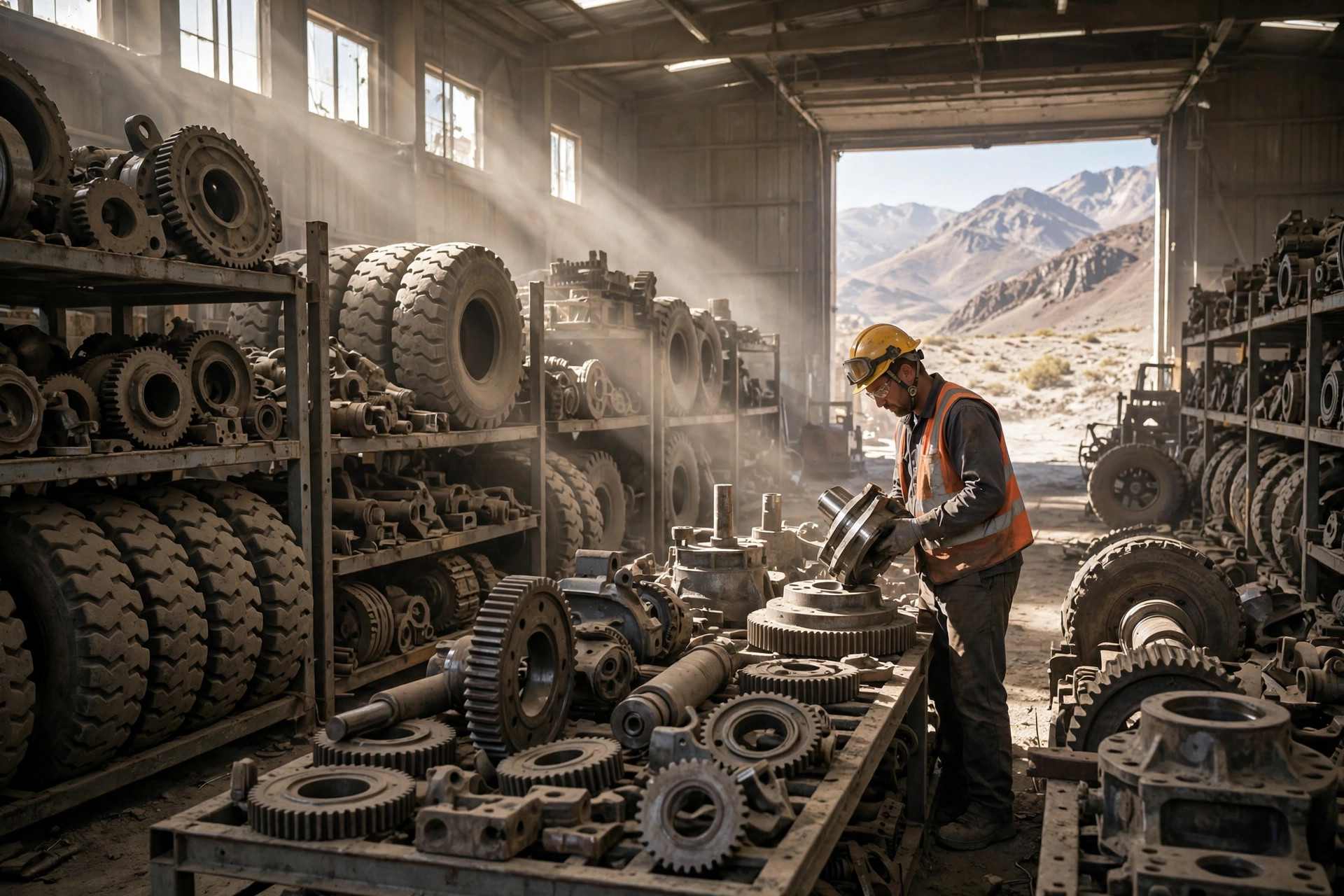
In the mining regions of northern Chile, there is a kind of warehouse that rarely appears in warehousing industry discussions. It is not large, it does not chase automation buzzwords, and most of what sits on its racks is not fast-moving stock — it is spare parts that might not move for months at a time. Yet those parts determine whether a mine keeps running. The ledger of a Chile copper-mine spare-parts warehouse looks like an inventory ledger on the surface, but worked through to the end, it is a downtime ledger: what a part costs is very often far less than what its absence costs once a machine stops.
Start with the environment this warehouse has to survive. Mining sites sit at high altitude, and the supply lines to them are long — from a port or a regional center up to the site, distance, elevation gain, and climate all add time to every replenishment. Dust is another everyday variable: fine dust gets everywhere, and it imposes extra requirements on how precision components are stored, sealed, and inspected before issue. A seal that would be optional in a coastal warehouse becomes a precondition for a part being fit to install. Temperature swings between day and night test packaging materials and the storage condition of certain components. Stack these conditions together, and the same part stored in a coastal city warehouse and in a mine-area warehouse carries a completely different risk profile.
A Spare-Parts Warehouse at Altitude: Distance and Dust Rewrite the Rules First
Consider a spare-parts service provider serving mines around the Antofagasta area. Its warehouse is not far from the mine sites, but it is not inside them either — and that location choice is itself a trade-off. The closer to the mine, the faster the response, but the higher the warehousing difficulty, labor cost, and replenishment cost. The farther away, the better the warehouse conditions and the lower the cost, but the longer the wait when something runs out. This provider's answer was to sit at a distance that allows same-day arrival without being fully exposed to mine-site conditions, and then to use tiered inventory to hedge the remaining risk. There is no standard answer for that distance. Road conditions and altitude differ from site to site, so the answer differs too.
Another scenario makes the point more sharply. A component on a critical piece of equipment fails, and the warehouse happens to have none in stock. What follows is not simply "order another one." It is a chain: confirm the exact model, pull from a regional center or order from abroad, clear cross-border procedures, then haul it up to altitude — and every link in that chain can add more delay. For import and customs requirements, check the official policy for the latest figure; any article that prints a fixed tax rate or clearance time as permanent fact is likely to be out of date by the time it is read. Through all of that waiting, the equipment stands still and the whole production rhythm is disrupted, and the scale of the loss usually dwarfs the price of the part itself. That is the core logic of spare-parts warehousing: what it protects is not inventory turnover, but continuous operation.
Three Tiers of Parts: Line-Stoppers, Regulars, and Slow Movers
Treating all spare parts alike is the most common source of waste in this kind of warehouse. Sorting parts by the consequence of running out changes the entire strategy:
| Tier | Character | Stocking policy | Consequence of a stockout |
|---|---|---|---|
| Line-stoppers | One missing part halts production, low interchangeability | Must be on hand near the mine, even at the cost of tied-up capital | Production interruption, largest scale of loss |
| Regulars | Consumption follows a predictable rhythm | Replenish to consumption rhythm, covered from a regional warehouse | Hurts efficiency, but workable short term |
| Slow movers | May sit for years, not cheap | Centralized storage, shared information, cross-mine transfer when needed | Large single impact, but infrequent |
The trade-off behind this table deserves unpacking. Holding line-stoppers ties up capital — that cost is visible. But what it hedges against is a stoppage, and the ledger has to be read on both sides. Counting only the inventory carrying cost will always produce the conclusion "hold less," and that conclusion collapses the first time a line actually stops. Slow movers point the other way: every mine holding its own copy of each is the most expensive arrangement. Several mines sharing information — and where feasible, sharing physical stock — spreads the cost of a single unit immediately, but it demands trust and a settlement mechanism between the mines, and that organizational cost is not small. Regulars are the easiest to manage and the easiest to neglect: their risk is not a single stockout but a replenishment rhythm stretched by high-altitude transport. If safety stock parameters are set from flatland experience, a stockout becomes a matter of time.
Here is the arithmetic as an explicitly illustrative example, not any mine's real figures: index the opportunity cost of one hour of downtime at 100 units, and the annual holding cost of one line-stopper part at 3 units. On those assumed numbers, if that part prevents even one short stoppage in a year, holding it pays for itself many times over. The point of the exercise is not the numbers themselves but the structure they reveal: when the scale of downtime cost sits far above holding cost, the strategy pivots from "save on inventory" to "guarantee no interruption." Conversely, a part whose stockout consequence is light deserves a completely different holding logic. The value of tiered management is exactly this — letting different parts be judged by different ledgers.
Regional Warehouse Layout: A Trade-Off That Punishes Sloppy Arithmetic
Seen at a wider level, the layout of Chile's copper-mine spare-parts warehousing is drifting slowly from "each mine for itself" toward "shared regionally." Two forces push in that direction. One is cost pressure: the waste of every mine holding its own slow movers is becoming harder to ignore. The other is the rise of third-party parts providers, which pool demand from several mines and improve both inventory depth and response speed at once. But the constraints on this trend are equally real: mines are not necessarily willing to share information about their critical parts, and settlement, liability, and priority in an emergency all have to be negotiated in detail. The arithmetic of a shared warehouse may be clear, but the trust behind sharing takes time to build.
One more variable is worth watching. Digital tools are changing the information base of spare-parts warehousing. If equipment operating data, failure records, and consumption history can be accumulated, parts tiering no longer rests only on veteran experience — it gains data behind it. That too has a precondition: data quality. Dust, temperature swings, and network conditions at mine sites all affect how reliably data can be collected, and field conditions have to be dealt with before any system goes live. As a trend judgment, regional sharing plus data-driven tiering looks like the more certain direction for spare-parts warehousing, but the speed of adoption will depend on how far each mine is willing to go on shared mechanisms.
In the end, the story of Chile's copper-mine spare-parts warehousing is not as simple as "build a warehouse at altitude." It is a bundle of trade-offs: how close to the mine, how much to hold of line-stoppers, who shares slow movers, how far to take data. Behind each trade-off sits a fresh pricing of downtime cost. And the question worth carrying forward may be the next one: when sharing mechanisms expand from parts into maintenance capacity and emergency response, will the competitive relationship between mines be redefined?
By Dr. Chen, Supply Chain Researcher