Excerpt: The chile cherry export cold chain sounds like a big-company game, but a small warehouse can play it — if it counts every cost and refuses to buy prestige equipment it cannot afford. Here is the chain from orchard pre-cooling to the Chinese New Year peak, told from a 3,000-square-metre warehouse floor.
Let me be honest up front about the chile cherry export cold chain: our little warehouse cannot afford to burn money like that.
Big warehouses talk about fully automated sorting, complete temperature control systems, and round-the-clock monitoring. We talk about something simpler: will this shipment arrive in sellable condition, how much will we actually make, and will the profit freeze to death halfway there? Chilean cherries look glamorous in a gift box. On the warehouse floor, every step is a race against time, and losing that race means soft fruit and complaints.
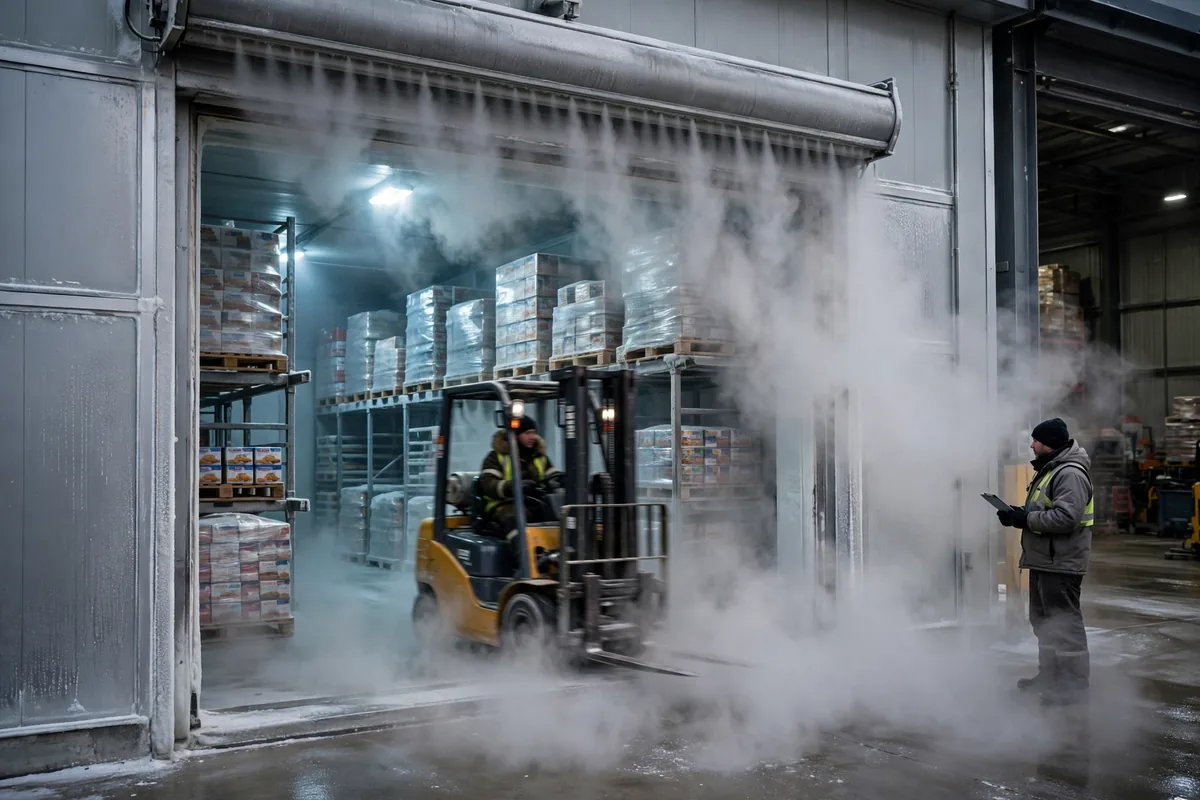
The chile cherry export cold chain is not complicated on paper. Cherries are picked, pre-cooled, held in cold storage, packed, shipped under refrigeration to the destination port, cleared, distributed to supermarkets or e-commerce warehouses, and sold into the Chinese New Year peak. What is complicated is every handover in between: who owns the temperature, who owns the clock, and who pays when something goes wrong. One weak handover can eat all the money saved earlier in the chain.
Chile Cherry Export Cold Chain Lesson One: Do Not Delay Pre-Cooling
A small warehouse owner near a Chilean growing region taught me this the expensive way. In December 2024, during peak season, he took in a cherry shipment from an orchard less than an hour away. He thought a short delay in normal temperatures would not matter, since the fruit would go into cold storage right away. The fruit sat warm for a few extra hours, and by the time it was cooled, its condition had already changed.
At the destination port, inspection found a noticeably higher share of soft fruit. The buyer deducted payment, and that shipment basically earned nothing. His summary stayed with me: the most expensive lesson was not equipment. It was "do not delay." Pre-cooling is a job for the earliest possible moment, and every hour in between has a price.
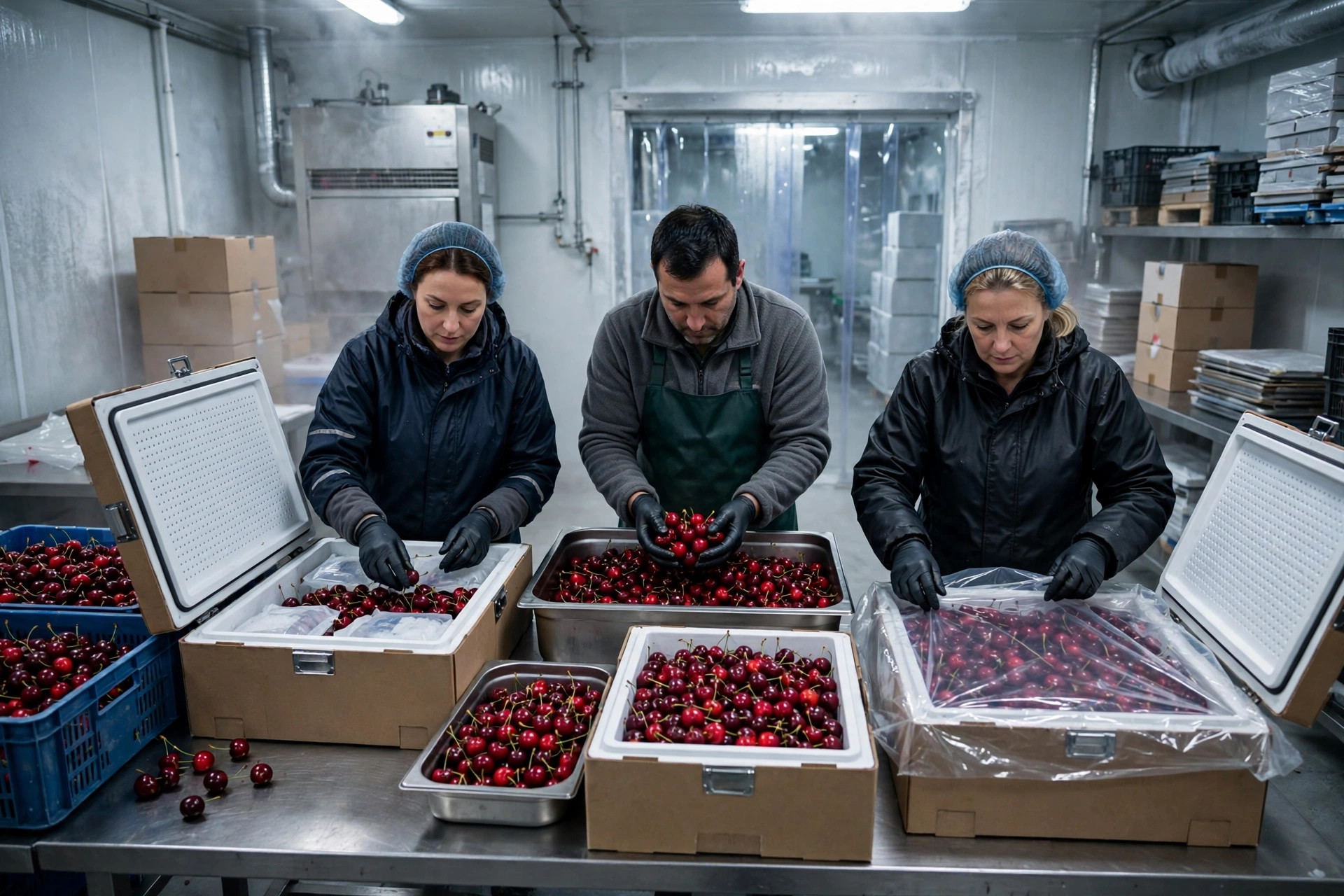
We do not own a pre-cooling station beside an orchard, so his workaround after that season was gloriously low-tech. He agreed picking times with the orchard in advance, pre-cooled the truck and boxes, and sent arriving fruit straight to the fastest pre-cooling lane — no queue, no waiting, no "leave it for a moment." It sounds basic. The next year, his damage complaints fell sharply.
My own lesson came from the other end of the chain. In January 2025, I temporarily stored about 400 boxes of cherries for a client, ahead of distribution before Chinese New Year. My warehouse has only two cold rooms, and the equipment is not new. Worried about temperature swings, I set the temperature very conservatively and kept opening the doors to check. The checking itself became the problem: every door opening let the temperature swing more. An older worker put it perfectly: "You are not watching the temperature. You are giving the cold air a holiday."
I changed to checking the temperature log at fixed times and stopped opening doors casually. The fruit stayed steadier. Small warehouses rarely fail because their equipment is too cheap. They fail because well-meaning people interfere too often.
Two Scenarios: Speed in Peak Season, Discipline After It
The first scenario is the rush before Chinese New Year. For a few weeks each year, supermarkets and e-commerce sellers all compete for cherries, shelf slots, and delivery windows. The winner is not always the biggest warehouse. It is often the team with the cleanest handovers.
I watched a small team handle this well. Two weeks before arrival, they had boxes, labels, pallets, and customs paperwork ready. When the fruit arrived, pre-cooling, quality checks, palletising, and loading followed a fixed order. Nobody hunted for boxes at the last minute. Nobody chased a missing document while the truck waited. Their shipment was not necessarily the first to arrive, but it had the fewest complaints, because every step had a signature and a record. When something went wrong, they could point to exactly where.
The second scenario is the reckoning after the peak. Once Chinese New Year passes, prices fall, and unsold stock becomes a hot potato. In February 2024, a friend held about 300 boxes of leftover cherries and decided to "wait and see if the price bounces back." After more than a week, the fruit only got worse. He eventually sold at a discount, and after freight and storage, the whole exercise earned almost nothing.
His lesson is now one of mine: cold chain stock has no "wait and see." There is "sellable" and "unsellable," and waiting is itself a loss.
Together, those scenarios explain small-warehouse survival: do not drop the chain in peak season, and do not get greedy after it.
The Small Warehouse Playbook for the Chile Cherry Cold Chain: Spend on the Inside, Not the Show
We cannot afford to burn money, so every dollar has to land where it protects the fruit or the profit. This is the table I check before accepting cherry shipments or similar cold chain work.
| Stage | Big-company approach | Small warehouse alternative | What it saves |
|---|---|---|---|
| Pre-cooling | Own station beside the orchard | Agree times, pre-cool truck and boxes, prioritise on arrival | Building cost, while winning time |
| Temperature monitoring | Full automatic alarm system | Fixed-time log checks plus manual review at key points | System cost, without dropping responsibility |
| Packaging | Premium custom gift sets for everything | Standard cold chain boxes, layered packing to the buyer's spec | Packaging cost, without dropping protection |
| Distribution | Own fleet, direct delivery everywhere | Shared loads with a regular carrier partner | Fleet cost, while protecting timing |
| Leftover stock | Hold in cold storage hoping for a rebound | Set a discount trigger in advance, clear at that line | Storage cost, and losses stop sooner |
This table is not an excuse to cut corners. It is the opposite. A small warehouse saves on show, not on substance. Temperature records, handover signatures, and protective packaging are non-negotiable. What we skip is the expensive display that the customer never sees and the fruit never needs.
Here is the counter-intuitive part: colder is not automatically better. Temperatures that are too low, or that swing up and down, can damage fruit just as surely as warmth. Stable temperature, fast handovers, fewer door openings, and less unnecessary handling often matter more than raw cooling power. Cold chain success is about stability, not about the biggest compressor you can buy.
There is also a hidden cost most people ignore: the cost of information. Where is the shipment? Where is the temperature record? Are the customs documents complete? If the answer requires five phone calls in peak season, you are already losing. My low-tech fix is a shared sheet with four columns: goods, truck, documents, and temperature records, updated at every handover. When a customer asks, I can answer in seconds. Trust is built exactly that way.
On numbers, I have to be honest rather than impressive. Temperature requirements, transit times, and loss rates vary by growing region, carrier, route, and year, so I will not publish a universal number table as if it were settled fact. For any specific temperature, sailing schedule, or clearance timing, check the latest policy from your carrier and the relevant official source. When I do costing, I use worked examples, not industry standards: for a 400-box shipment, if soft fruit rises by just a few percentage points, deductions and discounting can easily eat a third of the order's profit. That figure is an illustration, not a published loss rate — it is there to show how thin cold chain margins are, and how little room there is for one broken link.
Before I accept cherry work now, I ask three questions. Can pre-cooling happen on time? Is every handover recorded? Is there an exit line for leftover stock? If all three have clear answers, we talk price. If any one is vague, I would rather turn the job down. Chinese New Year cherries look sweet in a gift box. Spoiled cherries do not.
Big companies have their way of doing this. We have ours, and it works at our scale. A small warehouse has its own way to survive.
By Xiao Ma, Small Warehouse Owner