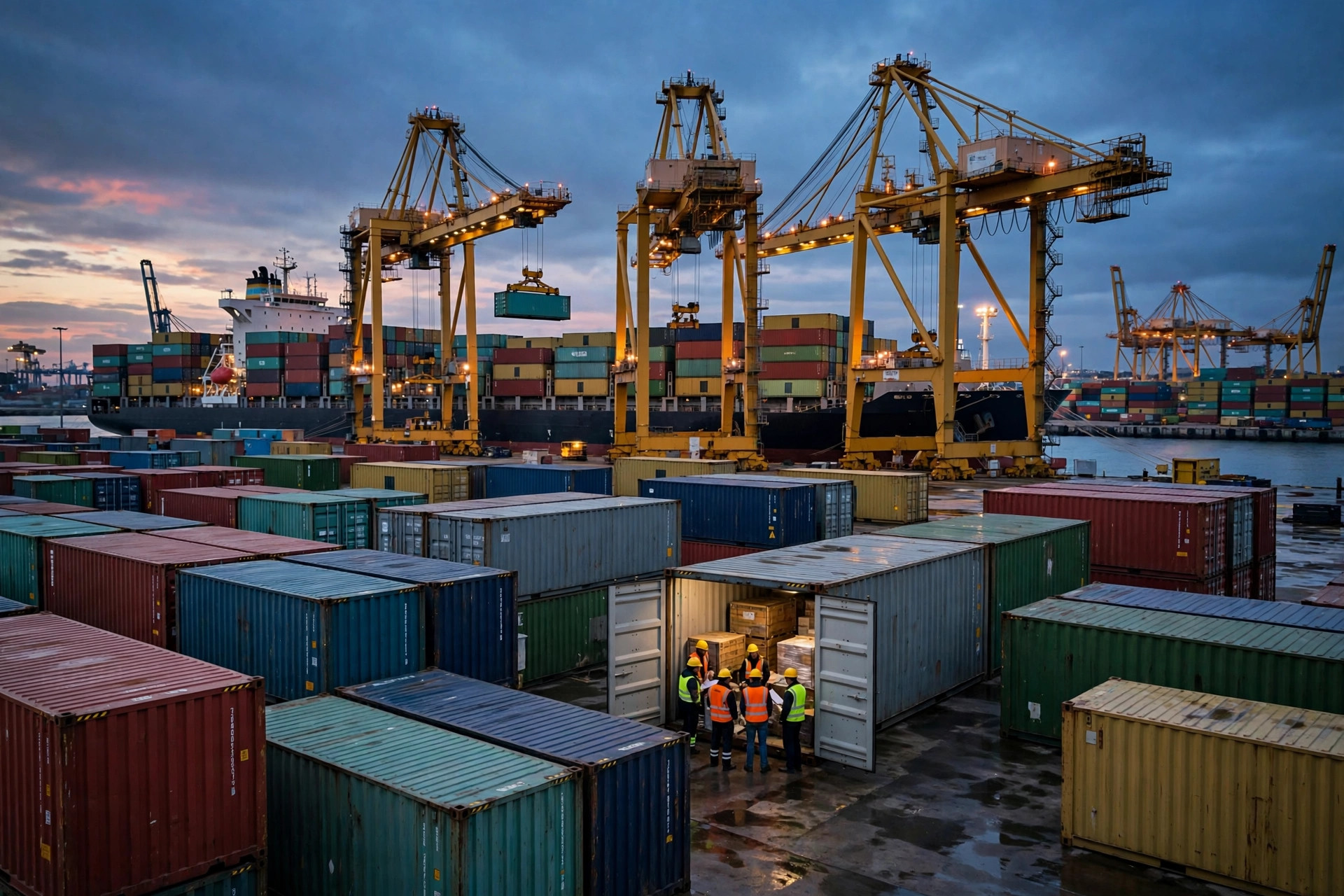
We have a client who makes stackers and compact conveyor lines. The year before last, riding high, he took an order from a European dealer. The machines tested beautifully at home, went into a container, and then got stopped during clearance at the European port. Not for quality. For paper. The technical file had gaps, the nameplate was missing required information, and the manual existed only in Chinese and English — no version in the destination country's language. The batch sat at the port for weeks while storage and demurrage charges climbed daily, and the dealer on the phone got less polite by the day. Afterwards the client said the truest sentence I have heard in this business: "I thought CE was a sticker. Turns out they audit the whole folder behind the sticker."
This happens constantly with warehouse equipment exports. So let me walk the ce certification warehouse equipment europe route properly: the path, the time math, and the traps. Next time you negotiate with a European buyer, ask about the file before you talk price.
What ce certification warehouse equipment europe actually examines
First, a correction most sellers need. CE is not a certificate some office issues to you. It is fundamentally a manufacturer's own declaration: I declare this product meets the EU rules that apply to it, and I take responsibility. Affixing the CE mark is signing your name in front of the entire European market. So the enforcement logic follows naturally: since you declared it, you must be able to prove it — and that proof is the technical file.
Which legal frameworks usually apply to warehouse equipment? The core is machinery safety. The EU is moving from the long-standing Machinery Directive toward the new Machinery Regulation, with a defined transition timetable; exactly how old and new rules overlap during the transition is something to confirm against the latest official EU legislation, but the practical advice is simple: a machine you are designing today should have its file built to the new regulation's way of thinking, not yesterday's. Depending on the machine, low-voltage, electromagnetic compatibility, and radio equipment rules may also apply — the moment your conveyor has a wireless remote, a scanner, or a connected module, the list grows. Which frameworks apply is a per-machine analysis, never a guess.
That is the first trap dealers set for themselves: copying the compliance conclusion from a "similar" product onto a different machine. A stacker and a conveyor line do not carry the same framework combination, and adding a wireless remote to the same conveyor adds another framework overnight. Buyers rarely ask about this. But when something goes wrong, liability travels back to the manufacturer.
The path, step by step: from applicability to the mark
After I helped that client dissect his port detention, we fixed ce certification warehouse equipment europe into six steps that now go straight into contract scheduling:
- Applicability analysis. List every EU regulation and harmonised standard that applies to this machine. This list is the table of contents for everything that follows.
- Risk assessment and design fixes. Assess risks the machinery-safety way and fix the design first — guarding, emergency stops, interlocks, warnings. Testing before fixing means paying for testing twice.
- Testing and verification. Send the machine to a competent laboratory and get the reports. Reports must match the final shipping configuration; change a critical component afterwards and the report may need supplementing.
- Build the technical file. Drawings, calculations, the risk assessment, test reports, the manual, the draft declaration — archived as one set, retained for inspection for the period the latest EU rules require.
- Conformity assessment and declaration. Complete the applicable route, then the manufacturer signs the EU Declaration of Conformity.
- Marking and nameplate. Affix the CE mark, complete the nameplate, include manuals in the destination languages — then, and only then, load the container.
Now the question everyone asks: when must a notified body get involved? It depends on which category your machine falls into. EU machinery law keeps a list of higher-risk machinery. For listed machines, if you have not fully applied the harmonised standards, a notified body must carry out the type examination; where standards are fully applied, an internal production control route may be available in some cases. Whether your machine is on that list, and whether self-declaration is open to you, has to be checked against the latest official EU legislation — never sign a contract because an agent waved his hand and said "everything can be self-declared." That sentence is exactly what my client's previous agent used on him.
Here is the counterintuitive part: notified body involvement is not automatically a cost to avoid. For a dealer, a machine with notified body backing is easier to sell and smoother to get accepted by end customers. The real waste is the opposite case — a machine that could legitimately be self-declared, where the seller was sold a full "certificate package" anyway. Money spent, and the paper bought carries little weight with EU market surveillance. The decision rule is one line: check what the law mandates for this specific machine first, then decide what to pay for.
Nameplate and manual: the cheapest step, the most expensive lesson
Back to my client's detained batch. What sank him was not a big failure. It was two "small" things: the nameplate and the manual.
A nameplate needs the manufacturer's name and address, model and serial number, year of manufacture, key ratings, and the CE mark. Miss one item and market surveillance can pick the machine apart. The manual requirements are finer still: installation, operation, maintenance, and safety warnings, complete — and in a language version the destination country accepts. Europe is not one language zone. Sell into Germany and you need German; sell into France and you need French. The one-English-manual habit from domestic shipping does not survive the crossing. Translating a manual costs very little. Sitting in a port for weeks because you did not costs a great deal.
One more quiet trap: dealer modifications. European dealers adapt machines for local customers — adding guarding to a conveyor, swapping attachments on a stacker. After a substantial modification, the compliance status of that machine may change, and under the EU approach the party making a substantial modification can step into the manufacturer's shoes, liability included. Write this into the distribution agreement: what may be modified, what may not, and how documentation and responsibility move when something is changed. Two extra pages in a contract are cheaper than two years of argument after an incident.
The time math: how certification eats your delivery schedule
Finally, the commercial arithmetic. The ce certification warehouse equipment europe timeline belongs inside the delivery schedule, not inside the legal department. Here is an order-of-magnitude reference from the projects we have scheduled with clients — actual durations depend on the machine's route and laboratory queues:
| Stage | Typical order of magnitude | Most common cause of delay |
|---|---|---|
| Applicability and risk assessment | Weeks | Machine configuration not frozen |
| Design remediation | Weeks to months | Guarding or interlock changes ripple through the structure |
| Laboratory testing | Weeks | Queues, retests after fixes |
| Technical file and declaration | Weeks | Drawing versions not matching the physical machine |
| Notified body assessment (if required) | Weeks to months | Peak-season queues, document back-and-forth |
Lay that table over a production schedule and the conclusion is unavoidable. If the buyer wants delivery in Europe in four months and you are only starting certification now, you will probably miss — not because the machines cannot be built, but because the paper cannot be finished. My practice is to write certification milestones into the sales contract: applicability completed, testing submitted, declaration signed, each with a date, and payment and shipment terms that shift automatically if a milestone slips, with responsibility assigned. Dealers grumble at first. After they have lived through one port detention, they push for the milestones harder than you do.
One negotiation detail: itemise certification cost in the quotation. What is included as standard, and what appears only because the buyer chose a special configuration — an extra destination language pack, an added radio function that pulls in another legal framework — price them separately. Folded into one lump sum, this is exactly the part everyone fights about later.
So, next time you negotiate a contract, remember to ask these three questions. One: is the list of applicable regulations for this model complete, and who confirmed it? Two: does this route genuinely require a notified body, and on the basis of which provision? Three: are the nameplate and the manual language versions actually in the schedule? Ask those three, and ce certification warehouse equipment europe stops being a lesson you pay port storage fees to learn.
By Susan, 3PL Sales Director