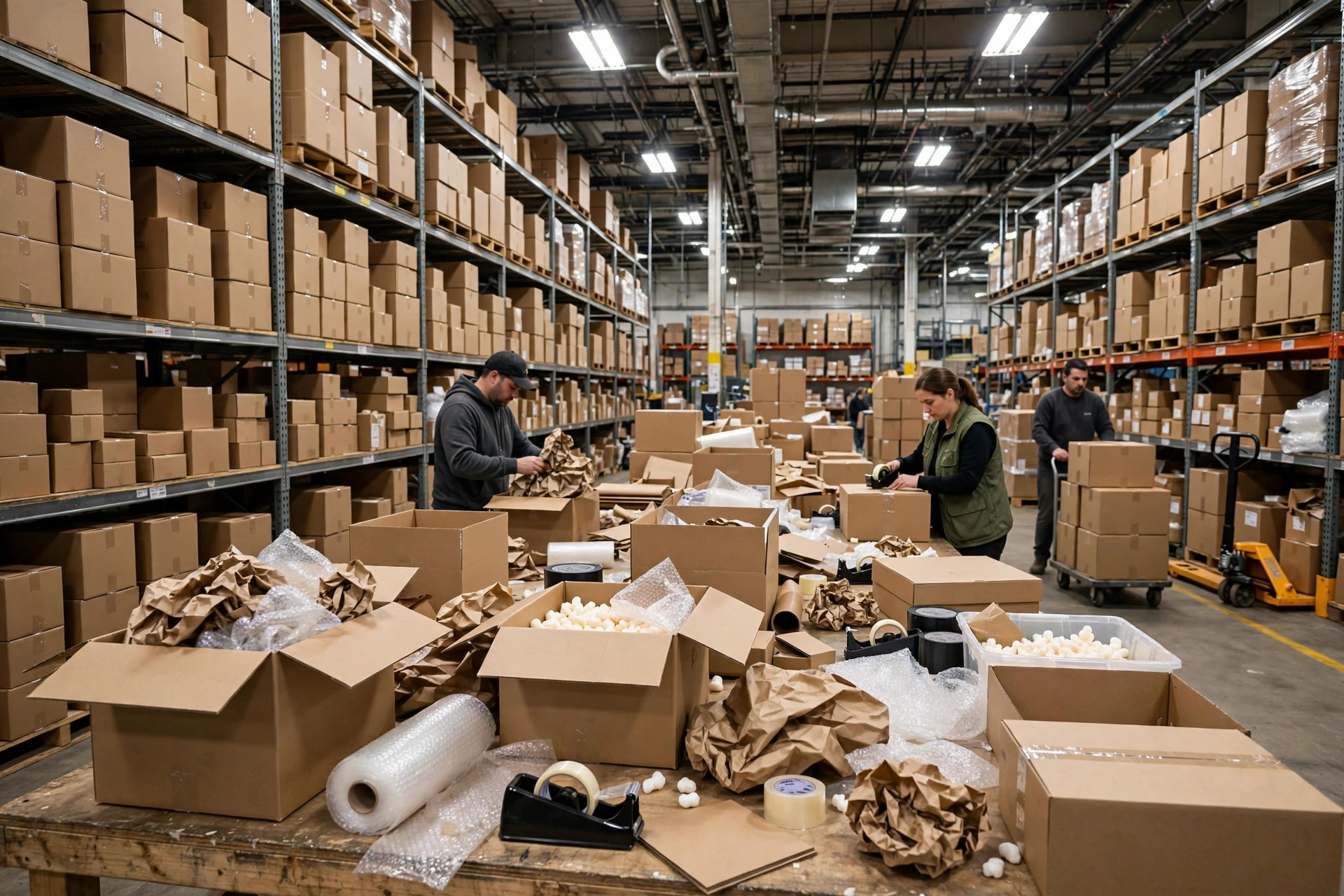
Walk into an e-commerce warehouse pushing 8,000 orders a day and the pack area tells you everything. Forty-odd carton sizes lined up on the racks — tall, short, fat, skinny, the full zoo. One packer told me his first ten minutes every shift went to digging small boxes out from under the big ones. I was at this facility in Fontana, California in 2024 for a process review, and that one little corner of the operation was quietly burning enough money to hire two more packers a year.
Box sprawl is endemic in e-commerce and 3PL warehouses, and it always starts the same way. A new product category arrives, someone adds a box size "just for this one." Ops over-stocks every size "just in case." Three years later you have 47 sizes, each holding a not-quite-right amount of inventory, and a rack nobody dares touch.
Start with an honest census
The first step isn't cutting — it's counting. Take a week. Measure every box, log weekly usage, photograph each size, and build the simplest possible register: box ID, dimensions, trailing-30-day usage, unit cost, footprint. It sounds dumb. Ninety percent of warehouses don't have this sheet; they run on the lead packer's memory.
Two ugly facts will jump out. First, a handful of sizes do all the work — usually 5 or 6 sizes cover 70–80% of orders, while the other 40 split the remainder. Second, the priciest boxes are the ones you use least. A few thousand units is a small run; the box plant gives you small-run pricing, often 30–40% above high-volume rates.
The Fontana site's census came back at 47 sizes. Only 7 moved more than 200 units a day. Eleven sizes moved less than a case a month. Pure shelf squatters. The worst offender was an 18×14×12 box with 60 units left, ordered three years earlier for an air fryer that had long been discontinued — the original label was still on the rack.
Once the register exists, add one more column: days idle. Anything untouched for 90 days goes straight on the kill list, no debate. That single cut removed 14 sizes at Fontana on the spot.
Consolidating 47 down to 9
The rule is one sentence: make orders fit the boxes, not boxes fit every order. Cluster three months of orders by the dimensional profile of what's inside, and most of them collapse into 5–6 standard sizes. The long tail gets "one size up plus void fill" — dunnage is far cheaper than maintaining a dedicated box size.
In practice it landed on nine: three small, three medium, two large, one oddball for long or irregular items. One tip from the trenches: favor the box plant's standard tooling sizes. Custom dies cost more per unit and stretch lead times — exactly the trap you're trying to escape.
Here's a starting grid you can steal: smalls at 9×6×4, 12×9×6, 14×10×8 for single small items and accessories; mediums at 16×12×10, 18×14×12, 20×16×12 for multi-item orders; larges at 24×18×16 and 28×20×18 for big or bulk orders; and one long skinny box — say 36×8×8 — for curtain rods, light tubes, and their awkward cousins. This "nine-grid" is the most common setup I see in West Coast e-commerce warehouses, all standard tooling, three-day lead times. Adapt it to your order mix; don't copy it blind.
One more detail people miss during consolidation: box height matters more than length and width. Same footprint, two inches shorter, and you fit another layer per pallet while shaving dimensional weight on every parcel. Three of Fontana's final nine were deliberately spec'd as low-profile versions.
Don't flip the whole building overnight. Pilot on two pack stations for two weeks and watch three metrics: pack rate, damage returns, and whether the packers complain. If all three hold, roll it out. Let old sizes deplete naturally — allow old and new to coexist during transition, and most sites finish the switch in 4–6 weeks.
The savings go way past cardboard
First, purchase price. Forty-seven sizes means forty-seven small orders and zero leverage. At nine sizes, per-size annual volume multiplies several times over — you graduate from "small customer" to "real account," and the discount tier is a different world. Across projects I've worked on, 10–15% unit cost reduction is the normal outcome.
Second, packaging inventory. Going from 47 sizes to 9 empties half the dunnage racks. Fewer locations to manage, faster cycle counts, dead stock essentially gone. All that quiet capital tied up in "we still have 200 of these, keep them" — gone.
Third, pack labor. No more hunting for the right box; one glance at the order and the packer knows which size. Fewer tape-machine size changeovers. Fontana's throughput went from the low 90s to around 110 units per packer-hour after the switch. That 20% is the difference between surviving peak with your current crew and paying premium temp labor.
Fourth — the sneaky one — dimensional weight. With too many sizes, packers grab whatever's handy, which usually means oversized boxes for small orders, and DIM charges pile up. Standardized sizes fit orders tighter, and the phantom DIM spend drops. Most warehouse managers have never run this number. The ones who do usually flinch.
Three ways the rollout dies
The first killer is ops' sense of security. Announce you're cutting box sizes and ops pushes back first: what if a big promo hits and we're out of boxes? The answer is a 20% safety buffer during transition and two weeks of pilot data on stockouts. Data beats meetings.
The second is the vanity box. Some brands insist custom-printed boxes look better. Fine — but customize only the 2–3 hero sizes and run the long tail on plain stock. Print costs only make sense amortized over volume.
The third is legacy inventory. You'll have meaningful stock left in several of the 47. Don't scrap it; schedule it out — burn old sizes on box-agnostic orders like B2B replenishment, and most sites clear it in a quarter. Whatever you do, don't let "we haven't used up the old boxes yet" delay the switch indefinitely. Every week of delay is tuition.
One more thing most people forget to model: payment terms and minimums. Consolidated volume doesn't just cut unit price — it gets you past the box plant's volume thresholds. Half of Fontana's 47 sizes never qualified for contract pricing and were bought at list. After the switch, all nine sizes made the contract price book, and payment terms moved from net-30 to net-45. Your finance team will be happier about that than about the cardboard itself.
A carton costs cents. Nobody thinks it's a big deal. But it touches purchasing, inventory, labor, and freight — one of the few levers in a warehouse where pulling once pays off in four places. Something you can do tomorrow: go count how many box sizes are actually at your pack stations. That number will probably startle you.