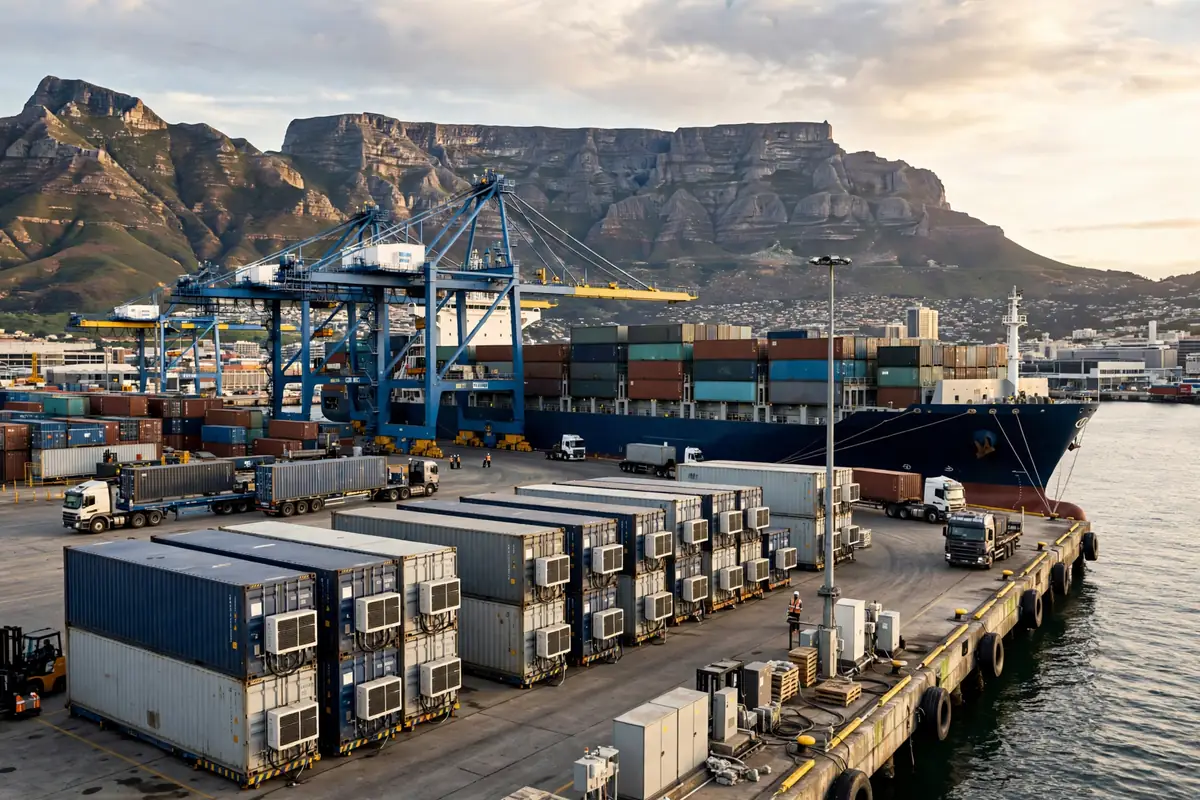
Let me tell you something. After all these years on the road, what I fear most is not the long drive. It is arriving at the port gate and finding the ship has not berthed, the boxes have not come off, and the warehouse is already calling to ask where the goods are. That is the Port of Cape Town in a nutshell, and it is the first thing to understand about cape town port warehouse logistics. The scenery is hard to beat, Table Mountain standing right there at the Cape of Good Hope, but when the long swell rolls in, the ship starts moving at the berth and the work on the quay has to stop. A shipper once complained to me that his reefer containers sat at Cape Town for ages, the shelf life of his fruit ticking away by the hour. I told him, do not just stare at the sailing schedule. The schedule is a plan. The real character of a port is what it has actually changed over the last couple of years.
Here is a number that surprises people. In the World Bank Container Port Performance Index, Cape Town ranked 400 out of 403 ports in 2024. That sounds terrible. But in 2023 it ranked 405 out of 405, dead last. In 2024 its score rose by 237.9 points, the biggest improvement of any port in the world. The ranking is still ugly. The direction has turned. Any driver will tell you the same thing: a truck breaking down halfway is not the disaster. The disaster is not knowing whether it is being fixed or falling apart. Cape Town is being fixed. It started from so far back that even moving fast has not caught it up yet.
Cape Town Port Warehouse Logistics: Hours in Port Are Hours You Wait
Vessel turnaround time is the number a shipper should watch closest. According to TNPA data, Cape Town cut that time from 103 hours in the 2023/24 financial year to 83 hours in 2024/25, and then to 74 hours in 2025/26. Three years, down by close to a third. That change is real. A ship that leaves a day earlier means boxes can be picked up a day earlier, and the warehouse plan goes wrong one day less. What frustrates me most on the road is a sailing schedule that changes again and again, with warehouse bookings falling apart behind it, and the driver arriving at the gate to find the cargo still on the ship.
There is another number worth keeping in mind. In February 2024, a single vessel loaded 1,726 reefer containers at Cape Town, a record. A reefer is not an ordinary box. It needs a plug, the right temperature, and priority, every one of them. Loading that many reefers on one ship shows this port still has a cold chain backbone. In the week of 20 July 2025, the container terminal handled 19,931 TEU against a target of 12,283 TEU, 62% above target. Targets are set by people, and beating one by that much means that week the work genuinely ran well. But let me be straight with you: one good week is not every week. A shipper who plans on the best week as if it were normal is asking for trouble.
After years of dealing with warehouses, I have a rough rule of my own: do not ask a port "is it fast?" Ask "when it is slow, how slow is it?" A 74-hour turnaround is an average. When the long swell comes, it still drags. Long swell is something every old driver around Cape Town understands: the swell rolls in from far away, the ship moves at the berth, and loading has to stop. Mooring tensioning devices have cut swell-related downtime by 92%, and that improvement is worth real money. But it has not gone to zero. The downtime that remains can still land on your sailing and cost you extra waiting. Anyone making a plan has to carry that uncertainty in it and leave a buffer, instead of cutting the schedule down to the last hour.
Cape Town Port Warehouse Logistics: Why Cargo Still Moves Through a Low-Ranked Port
People ask me, with a ranking that low, why does anyone still ship through Cape Town? The answer is simple: the cargo has to get there. Cape Town handled about 700,000 TEU in 2024, and container volumes in the 2025/26 financial year grew 6.5% year on year. The volume is not big, but it is growing. Fruit, flowers, and wine from the Western Cape cannot simply go elsewhere without a longer land journey to another port, and that land journey costs money and time of its own. A port and warehouse bill is never judged on the port alone. It is port plus trucking plus warehousing, all together.
Here is the comparison I use with shippers. Every number in it is one of the public figures above. I invent no other numbers, and the last column is left for you to fill in with your own quotes:
| What to compare | What Cape Town looks like | Fill in your own number |
|---|---|---|
| Time in port | 103 hours in 2023/24, down to 74 hours in 2025/26 | Your shipment's actual days in port |
| Cold chain | Record single-vessel load of 1,726 reefer boxes | Your reefer count and plug needs |
| How steady the work is | One week handled 19,931 TEU, 62% above target | Your actual pickup speed that week |
| Weather exposure | Swell downtime down 92%, but not zero | Your buffer days around the sailing |
This table is not here to prove Cape Town is good or bad. It is here to stop shippers deciding by feeling. Feeling lies. Hours in port do not. And here is a counterintuitive point: the most improved port is sometimes a better place to negotiate than a middle-ranked one. It is improving, the terminal and the warehouses want to keep the cargo, and there is room to talk. A middle-ranked port is steady, sure, but it does not need your one shipment, and the terms barely move. Cape Town's improvement is public, a score gain of 237.9 points, the biggest in the world, and that momentum is something a shipper can bring to the table: the service you give me should match the improvement you promise, with plugs, windows, and priority written into the contract.
I will tell you one more thing from the road. I once hauled a load to a warehouse near Cape Town, and the manager there told me what scares them now is not a late ship. It is several ships arriving at once: the yard, the trucks, and the warehouse all jam together, and the time saved earlier gets given straight back in congestion. The answer is to spread arrivals out and share the sailing schedule early, so the warehouse can hold labour and space ready.
Three Pieces of Advice for Cape Town Shippers and Warehouses
After all these years on the road, here are three pieces of advice for anyone shipping through Cape Town. They come from the road and the warehouse gate, not from a book.
First, leave an extra day of buffer around the sailing. Turnaround is down to 74 hours, but the long swell is still there, and nobody can promise the weather. Reefer cargo especially needs that buffer, because shelf life does not wait. A buffer is not waste. It is small money spent on certainty. The arithmetic below is a hypothetical illustration only: suppose holding one extra day of buffer for a reefer shipment costs a small, visible amount in storage and waiting, while one cold chain failure costs the whole shipment. You do not need me to tell you which side of that deal is cheaper.
Second, get reefer plugs and priority into the contract early, before the cargo reaches the port. A record load of 1,726 reefer boxes on one vessel shows this port can handle cold chain, but handling it is not the same as having a plug whenever you turn up. When the season peaks, plugs are the thing everyone is chasing, and if your contract does not mention them, you are the one standing in the queue.
Third, share the sailing schedule with the warehouse ahead of time. No surprises. The week of 20 July 2025 handled 19,931 TEU, 62% above target, and that week ran well because every link lined up. Whether your cargo lands in a smooth week like that one depends less on luck than on giving the warehouse the sailing date, the box count, and the pickup time a few days early. In this business, information moves faster than the truck, and only then can the truck move smoothly.
There is an old saying: a road is made by people walking it, and a port's reputation is made one sailing at a time. Cape Town is still climbing. The ranking looks bad, but the direction is right. Plan on the port it is today, leave a buffer, lock in the plugs, and talk to the warehouse early. Run it that way, and this route works.
By Shifu Zhao, Trucking Veteran (15 yrs)