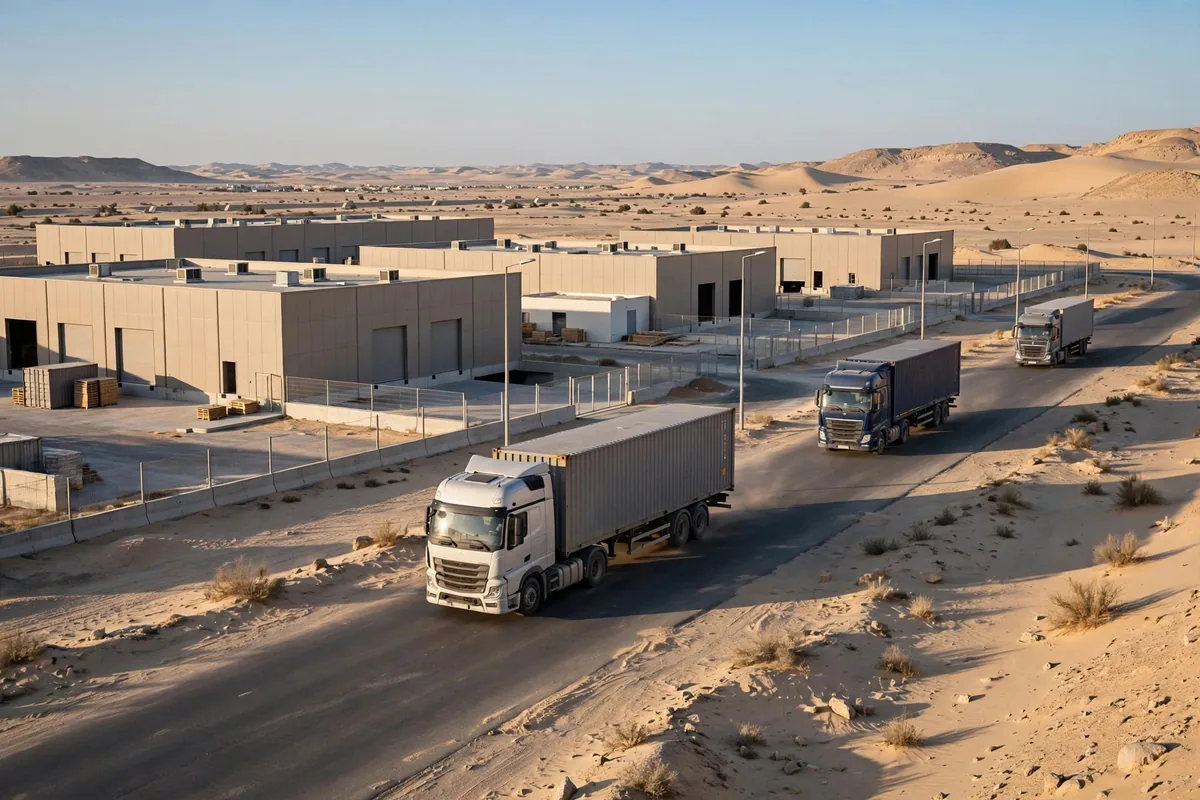
Something worth noting has been happening in the Cairo Egypt warehouse market logistics picture over the last couple of years: the big players are not waiting. They are concentrating their largest bets along Suez Road. In June 2025, Jumia opened Egypt's largest integrated warehouse on Suez Road in Cairo, a 27,000-square-metre facility. Talabat's distribution centre on the same road is also 27,000 square metres, processing around 1 million items a day, serving 12 cities, with plans to expand to 17. When two leading platforms put their largest warehouses on the same road, that is not a coincidence. It is a signal that Cairo's warehousing demand is moving from scattered and makeshift toward concentrated and upgraded. The only question left is whether ordinary tenants should follow that signal and take space early.
Cairo Egypt Warehouse Market Logistics: Three Sets of Numbers First
According to EMC data from the first half of 2025, Grade A warehouse rents in Cairo run around $10 per square metre per month, while Grade B sits at roughly $3–5. The gap between the two is close to two to more than three times. That spread tells its own story: Grade A space is not expensive because of its rent, it is expensive because it is scarce. Cairo's stock of Grade A industrial and warehouse space is limited, and demand is accelerating as infrastructure projects complete. When scarcity meets accelerating demand, the direction of prices is not hard to infer.
The second set of numbers sits on the canal. The Suez Canal carries around 12% of world trade, and revenue in the Suez Canal Economic Zone rose 38% year on year. DP World's Sokhna Logistics Park — an $85 million investment covering 300,000 square metres inside the Suez Canal Economic Zone, 10 kilometres from Sokhna Port, with phase one operational in 2025 — shows where capital expects volume growth to land first: on the canal corridor, not spread evenly across Egypt.
The third set of numbers returns to Cairo itself. A distribution centre processing around 1 million items a day does not serve one shop or one district; it serves a network of 12 cities, expanding toward 17. The logic of network expansion runs one way: the bigger the warehouse, the more cities it covers, and the more cities it covers, the more valuable the warehouse becomes. Jumia's 27,000-square-metre integrated warehouse on the same corridor confirms that Suez Road is becoming the hub for e-commerce and retail fulfilment in Cairo.
| Type | Rent level | What it means |
|---|---|---|
| Grade A | Around $10 per sqm per month | Limited supply, for tenants with demanding service and compliance needs |
| Grade B | Around $3–5 per sqm per month | More choice and room to negotiate, but facilities and location need checking item by item |
| Canal-corridor logistics park | Long-term positioning | A bet on corridor volume growth, not on today's rent gap |
Why Suez Road, and Not Somewhere Else
On the basis of those three sets of numbers, the explanation comes down to three causes. First, the demand side has changed. E-commerce order density has reached the point where large centralised fulfilment is necessary; scattered small warehouses cannot produce a daily throughput of around 1 million items, so a hub warehouse becomes a requirement rather than a preference. Second, the supply side has not kept up. With Grade A stock limited in Cairo, and new supply arriving more slowly than the demand released by completing infrastructure, scarcity is felt before prices move. Third, capital is voting with long-term positions. The first phase of DP World's Sokhna park became operational in 2025, an investment in the corridor's freight volumes over the coming years rather than in this year's rental return.
A counterintuitive point needs to be stated plainly here: the fact that the Suez Canal carries around 12% of world trade does not mean every warehouse in Cairo is valuable. Much of the cargo on the canal is in transit and never stops; cargo that does not stop generates no warehousing demand. What is genuinely valuable is a node that can convert passing flow into stopping, sorting and onward distribution. Suez Road is valuable because it captures both Cairo's local consumption demand and the corridor's logistics demand at once. A warehouse far from both of those demand pools gets no reflected glory from the canal.
Taking Space Early in Cairo: What Exactly Is Being Taken
Broken apart, taking space early means taking three things. The first is a scarce Grade A position. In a market with limited stock, the tenant who moves first locks in choice; those who come later accept what is left. The second is a window for rent negotiation. With demand accelerating as infrastructure completes, the tenant's bargaining room shrinks over time; negotiating early means negotiating at today's prices. The third is a network position. Talabat's expansion from 12 cities toward 17 shows that a hub warehouse's coverage radius is itself part of its competitiveness — holding the hub means holding the platform for expansion.
Each of those three, however, comes with conditions, and where the conditions fail, taking space early becomes occupying a hole. The following self-check table can be used directly:
| Self-check | Early move makes sense | Waiting is better |
|---|---|---|
| Does the business depend on fulfilment speed inside Cairo | Yes, order density has reached the tipping point | No, freight mainly passes through the canal |
| Can the tenant accept Grade A rent levels | Yes, and cost per order has been calculated | No, Grade B space is sufficient |
| Does the lease term cover the demand released after infrastructure completes | Yes, the term is long enough | No, a short lease keeps flexibility |
| Are the target warehouse's real conditions understood | Verified on site — facilities and transport | Only seen in marketing material |
The implication of this framework is that taking space early is not a bet on "the Cairo warehouse market" as a whole. It is a bet on three conditions holding at once: a scarce Grade A position, local fulfilment demand, and a lease long enough to cover the release of demand. If any one of the three fails, the conclusion changes.
The Trend, and the Questions Left Open
According to the picture as it stands, the Cairo Egypt warehouse market logistics landscape is at an inflection point: demand is accelerating, Grade A supply is limited, and the leading platforms have already used real money to make Suez Road the hub. That judgement rests on the data listed above, not on imagination about the canal. But an inflection point does not mean every tenant should act today. Several questions remain unanswered and are worth watching: whether infrastructure completion will release demand on schedule, when and at what scale new Grade A supply will enter the market, and whether the $3–5 Grade B price band will be pulled upward by Grade A scarcity.
If the answers to those questions come out favourably, the tenants who moved early will be glad they did. If they come out the other way, those who waited will be glad they did not lock in a high price early. The real dividing line in a market like this often falls not today but in the months when those answers become clear. What a tenant can do now is fill in the self-check table first, and then decide which side of the line it stands on.
By Dr. Chen, Supply Chain Researcher