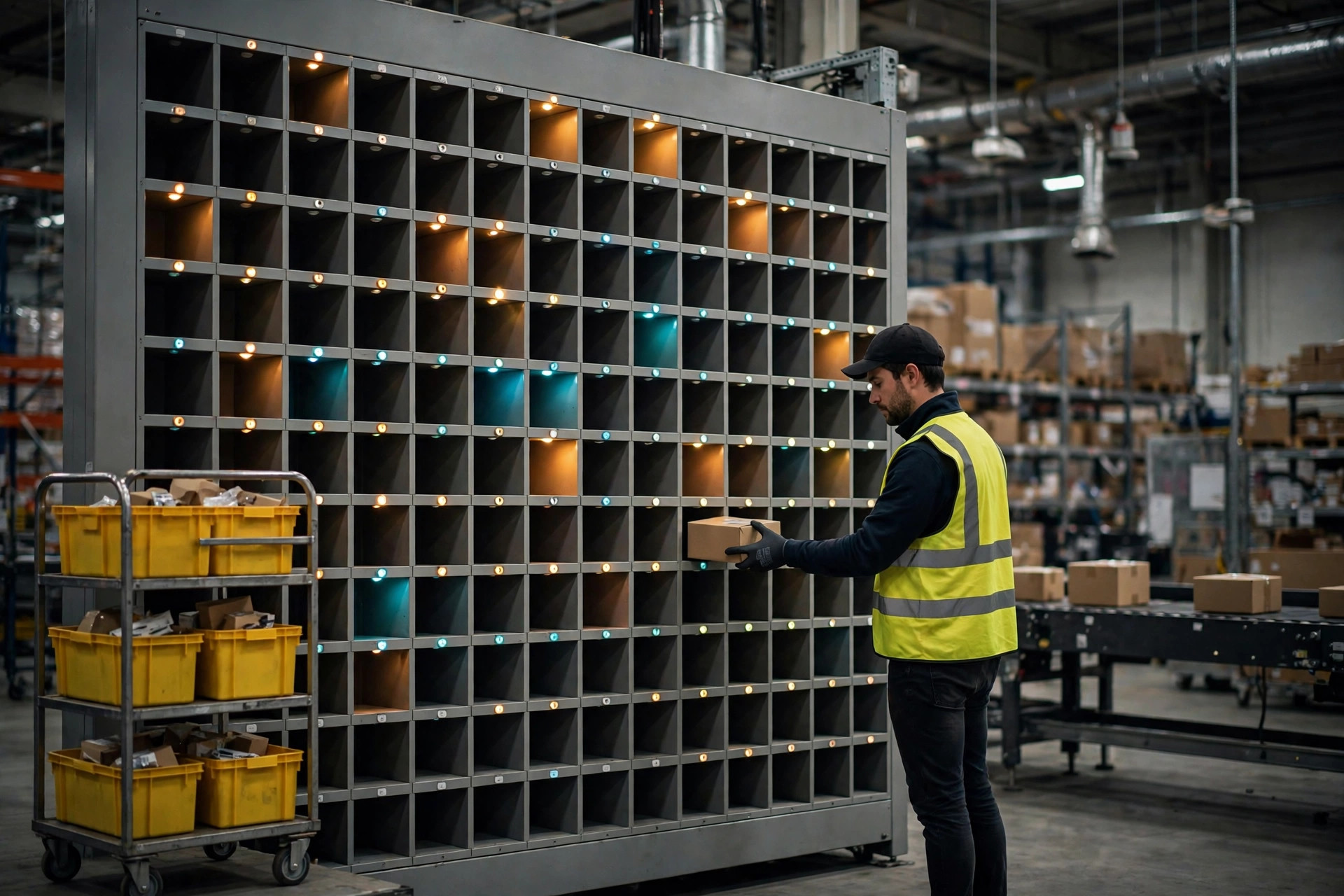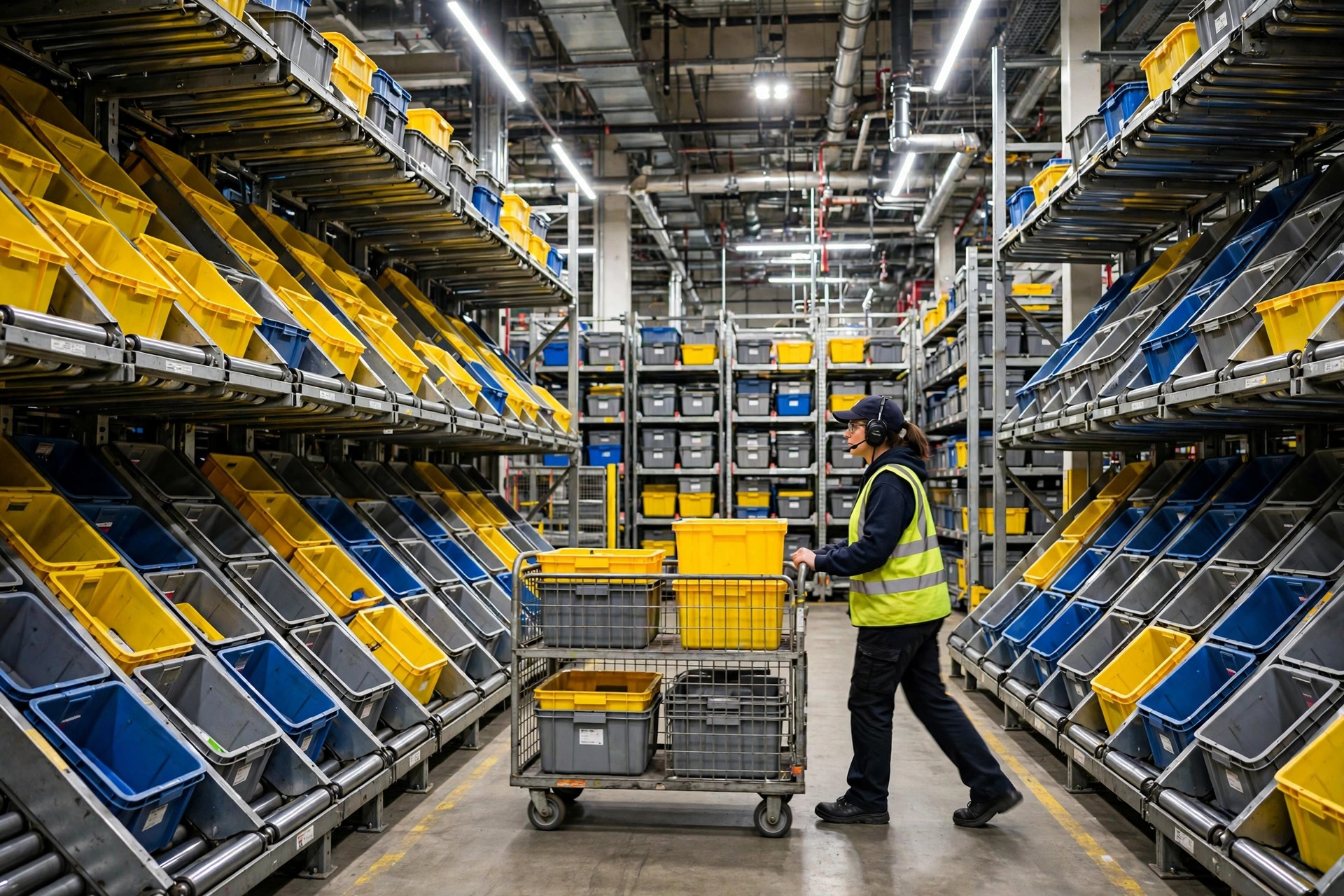
In the fall of 2023, a 3PL outside Los Angeles spent close to a million dollars on a put wall — and pick productivity went down, not up, from 65 lines per hour to barely 50. The wall was not the problem. The order profile was.
I was called into that building in October 2023: 120,000 square feet, a mix of small-parcel e-commerce and larger wholesale orders. The owner had just installed a put wall with pick-to-light, and it looked great — all those little lights blinking. But he was miserable. Since go-live, lines per hour per picker had dropped from 65 to just over 50, and he had hired six extra people whose entire job was standing at the wall sorting freight into cubbies.
The wall was innocent. His orders were the mismatch. More than half were wholesale orders averaging seven to eight lines each, with wide SKU variety and almost no overlap between orders. A put wall works like this: you batch-pick dozens or hundreds of orders in one pass, then sort everything into individual order cubbies. That only pays off when orders are small, short, and share the same SKUs. Run big multi-line wholesale orders through it and you have added a whole sorting step that did not need to exist — every unit touches an extra pair of hands, and the labor and time evaporate. Half the cubbies in that wall sat empty year-round. The most expensive decoration in the building.
I have remembered that job for years. Equipment vendors always sell you the best-looking slide: batch picking can multiply productivity several times over. There are published industry cases showing exactly that — single-order picking at 60 to 70 lines per hour, batch picking north of 200 lines per hour. But those were buildings whose order profiles fit. Get the profile wrong and the priciest wall on earth is furniture. Batch versus discrete was never an equipment debate. It is an order-profile debate.
Read your orders first
Before you touch any equipment, pull 30 days of order data and compute three numbers: average lines per order, SKU overlap, and orders per wave. Those three numbers practically decide the answer for you.
It is not complicated. Export 30 days of order-line detail from your WMS and pivot it — average lines per order falls right out. For SKU overlap, look at what share of SKUs in a wave appear in two or more orders. For wave size, look at how many waves you cut per day and how many orders land in each. Half a day of work and you have your answer.
My rule of thumb — and I flag this as experience, not gospel, because every building differs: if average lines per order sit at three or below, SKU overlap runs above thirty percent, and you can build waves of 200 orders or more, batch picking has a real shot. If average lines per order run five or higher and orders barely share SKUs, discrete picking wins. Stuck in the middle? Then it comes down to whether your wave volume can carry the overlap. If it cannot, stay away from the wall.
Too many buildings skip this math and buy the vendor's slide deck instead. That Los Angeles 3PL did. Numbers first, equipment second — that is the iron rule.
Put walls only eat small orders
Batch picking saves travel. A picker visits each location once and pulls everything every order needs, instead of walking the same aisle ten times. Industry analyses commonly put order picking at 50 to 60 percent of total warehouse labor cost, and most of that is travel and search time, not the physical act of grabbing the item. Cut travel and you cut the biggest line item in the building. That is the genuine value of batch mode.
The catch is the sort. Everything picked in bulk has to be broken back down into individual order cubbies. The smaller the order, the faster the sort. As lines per order grow, cubbies run short, sorters spend more time hunting for the right slot and verifying the order, and error rates climb with them. Typical buildings tolerate a 1 to 3 percent pick error rate; best-in-class operations hold accuracy above 99 percent, with industry survey medians around 99.3 percent. Mis-sort one cubby on a put wall and the entire order ships wrong — returns and customer-service cost double down on you.
So put walls are built for a sea of small orders: e-commerce smalls, beauty and personal care, 3C accessories — profiles with one to three lines per order and heavy SKU overlap. In those buildings, a put wall with pick-to-light can push per-picker output into the 150 to 200 lines-per-hour territory seen in published cases. Feed it big orders and it falls apart fast.
Count the full cost, too. The wall is only the equipment line. Behind it sit the sort labor, the cubby floor space, and the WMS sort-module development or license. Those six extra sorters in Los Angeles, at a fully loaded frontline wage in the mid-twenties per hour, burned through enough money over one peak season to buy half another wall. And per a 2026 market report, complete put-wall sort systems start around the million-dollar mark and climb from there. Money at that scale demands an order profile that deserves it.
Don't trash discrete picking yet
Discrete picking looks old-fashioned: one person, one cart, one order at a time. But it has something batch will never have — zero secondary sort, picked straight to audit and pack, the shortest possible error chain.
For buildings heavy on multi-line wholesale orders, bulky goods, or twenty to thirty thousand SKUs, discrete picking at a common industry range of 40 to 70 lines per hour looks unglamorous. It is, however, stable and forgiving, with no extra headcount, floor space, or systems bolted on for sorting. An auto-parts distributor told me they trialed batch: order overlap under ten percent, and before the wall was even fully installed they realized they would need nearly as many sorters as pickers. They returned the equipment — and the return freight alone cost them close to ten thousand dollars.
Never underestimate the "primitive" method. When your order profile is complex, one fewer process step means half the chances to get it wrong. Discrete loses on travel distance and wins on simple reliability — and in a big-order building, simple reliability is money.
Three signs it's time to switch
If you run discrete today, wait for these three signals before switching to batch.
First, volume has outgrown your headcount — peak season only ships if you double hiring — while average lines per order stay stuck at three or below. Second, SKU overlap keeps climbing: more than thirty percent of the orders in a wave are buying the same hot SKUs, which means batch mode's moment has arrived. Third, travel already eats most of your pickers' hours, so adding people only adds more walkers, not more shipped units.
And if you already installed a put wall but the sort zone is permanently understaffed, half the cubbies sit empty, and the error rate will not come down — do not hesitate. Cut the big orders back to discrete picking and run both lines in parallel. Plenty of mature buildings do exactly this: small orders go to the wall, big orders go to carts, and neither slows the other.
Equipment has no rank or prestige. There is only fit. A million-dollar wall matched to the wrong orders loses to a fleet of picking carts every time.
Tonight, pull your last 30 days of orders and compute average lines per order and SKU overlap. Once you have those two numbers, you will know whether a put wall is your medicine or your money pit. If the math comes back unclear, come ask me.