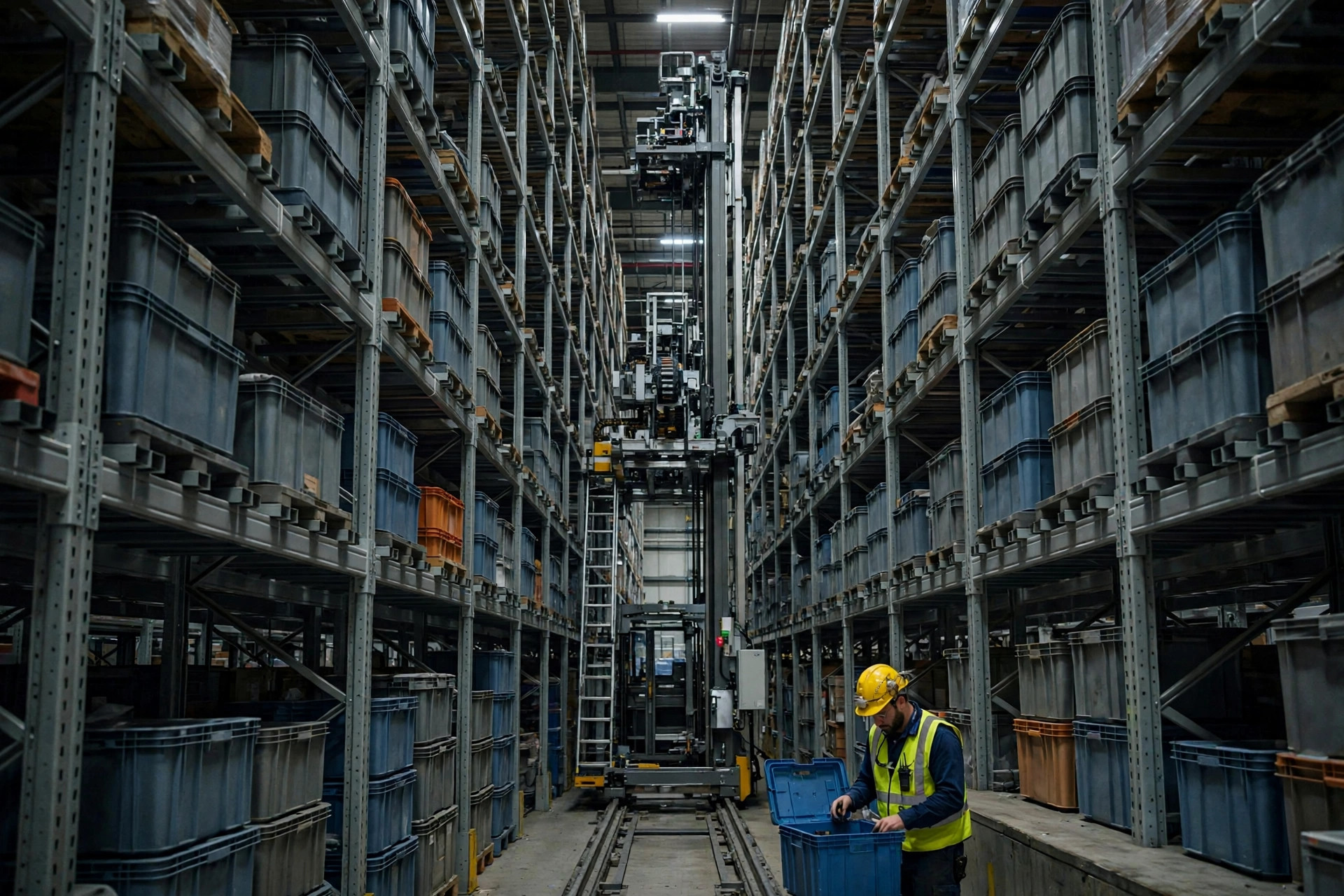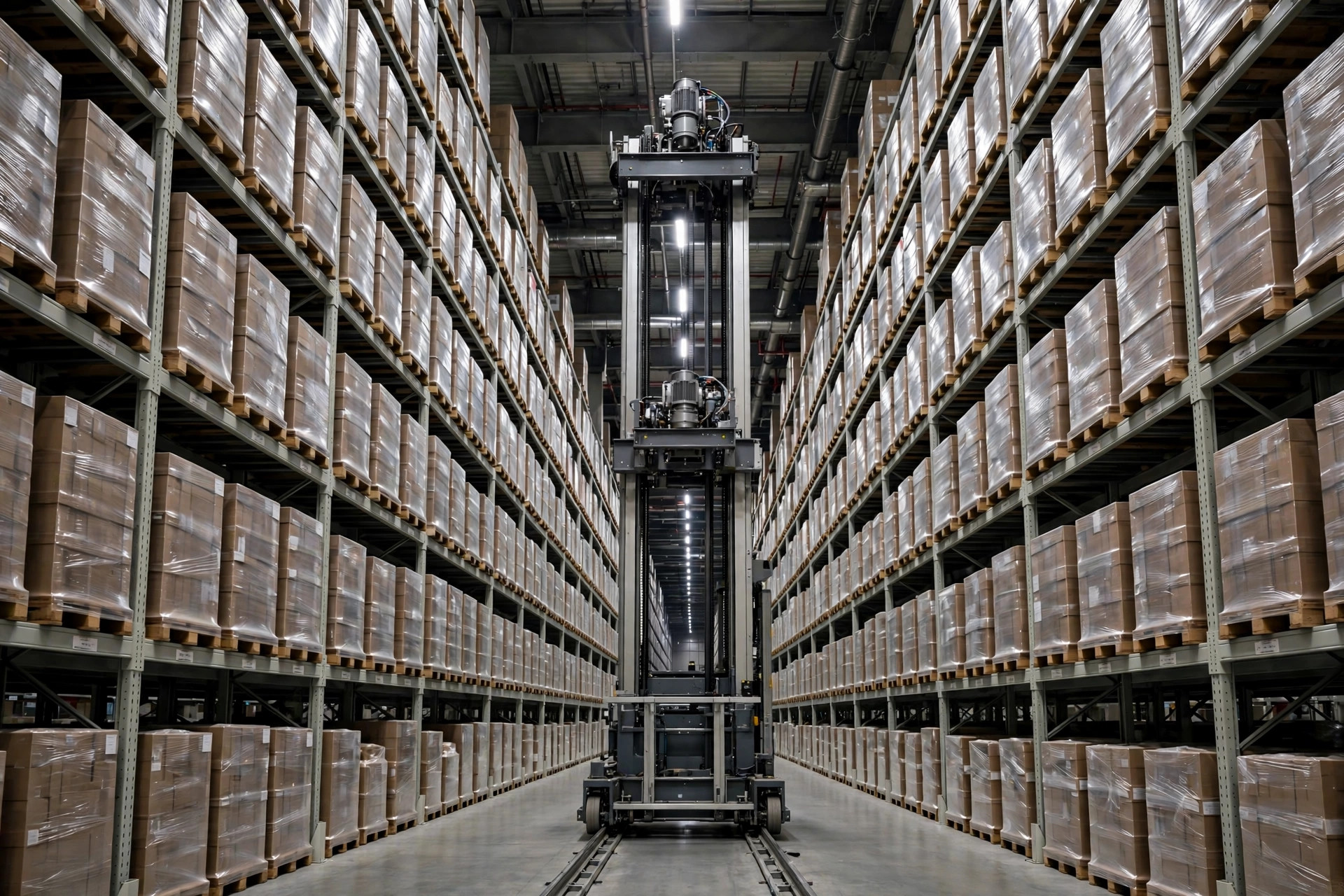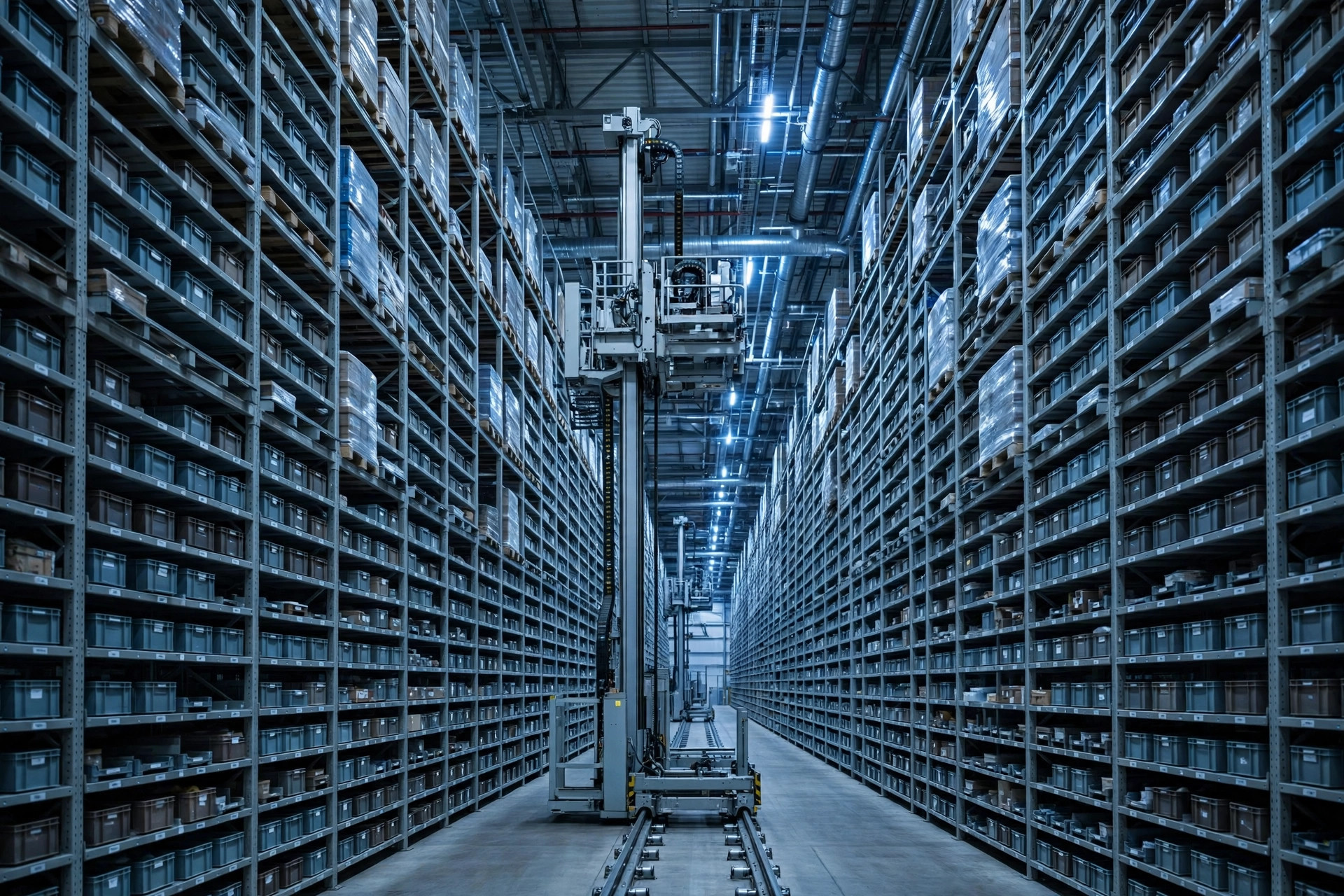
Let me tell you what an AS/RS looks like in the dark.
The lights cut out at 2:17 in the morning, during a commissioning run I was on at a 40,000-square-foot distribution center — six aisles, double-deep racking, stacker cranes that had just finished three days of full-load testing. When the power died, the only light left was the red glow of the emergency fixtures. I stood at the mouth of an aisle and watched six cranes freeze in place. One of them was hanging a pallet roughly forty feet up, less than two feet from the ceiling structure.
The shift supervisor's first question: "Is that load going to fall?"
No. It isn't. Stacker crane brakes are spring-applied, power-released — lose the power and the brake clamps down harder. The load is the last thing you should worry about. What should worry you are four things: how long your UPS will hold, what to do with a crane parked mid-aisle, the restart sequence when power comes back, and what a backup generator actually costs you.
Your UPS buys you a graceful shutdown, not production
Kill one myth first: the UPS is not there to keep you running. It exists so you can stop properly.
In an AS/RS, UPS power covers two things: the control system and the lighting. Nobody puts crane travel motors or hoist motors on UPS — the battery bank you'd need for those loads would be the size of a small room and priced accordingly. The moment power drops, every motion axis locks via its brake, the controls stay alive on UPS, and the system writes its last state, last position, and last command into memory.
What I typically see: 20 to 40 minutes of control-level UPS runtime. Think about what that means. A grid flicker of ten seconds? You barely notice. A two-hour regional outage? The UPS just makes sure the machines remember where they stopped, so you don't have to hunt for your inventory when power returns.
So at acceptance, I always ask for two things: the UPS discharge test report, and proof that someone has actually run a power-failure drill. A shocking number of emergency plans read beautifully — "on power loss, the duty officer manually confirms the status of each device" — and nobody has ever run the drill once. Beautiful on paper is worthless here.
A crane parked mid-air: hands off
The scenario that tests everyone's nerves is a crane stopped mid-air with a pallet hanging forty feet up.
My rule is one sentence long: until power is back, nobody hand-cranks anything and nobody climbs onto the equipment to touch the load. The brake is mechanically locked; the load is not falling. But if someone climbs up and the brake releases — or power suddenly returns and the crane resumes its memorized path — there is nowhere to dodge. This is not a hypothetical. I have been on a site where a tech nearly died doing exactly this.
The correct sequence: get every person out of the aisles, export the last-known positions of every machine from the still-living control system, wait for power, then wake the machines one at a time in the right order.
Here's the detail most people miss: those 20 to 40 minutes of UPS are your only window to export a complete snapshot — machine states, positions, and the in-transit task list (commands the WMS already sent to the cranes but that never finished). You will need that list to reconcile when power returns. Skip it and you get the classic mess: the system thinks a pallet was put away, when in reality it is still sitting on a fork forty feet in the air.
The restart order matters more than restart speed
Power is back. Don't hit start yet.
The most expensive lesson I have watched someone learn: a duty officer, in a hurry, started all six cranes at once. Two of them had drifted position references during the outage, misread their locations in the aisle, faulted against each other, and the whole line sat down for six hours.
My recommended recovery order — print it and tape it to the control room wall:
Bring up the shared systems first: lighting, fire protection, network, the WMS servers. Confirm they are healthy. Then bring up the cranes one at a time, one fully before the next: home each machine so it re-establishes its absolute position, run an empty round trip to confirm travel and hoist, and only then hand it production work. Recover one, verify one, move to the next.
Then reconcile: walk through the pre-outage in-transit task list against where the equipment actually is. If a position doesn't match, count it by hand before anything else. Never let the system guess. The cardinal sin of an AS/RS is an inventory record that doesn't match physical reality — one bad reconciliation and you spend three months paying for it.
A six-aisle facility: two to three hours if it goes smoothly, half a day if it doesn't. So in your emergency plan, write an honest recovery-time target. "Resume production in 30 minutes" is a number nobody believes, including whoever wrote it.
So: a diesel generator, or not?
The question every owner eventually asks.
My verdict is blunt: it depends on how often you lose power and for how long. If you're in a region with a stable grid and you see a flicker or two a year, each lasting minutes, a control-level UPS plus a real emergency plan is enough — a generator is pure cost. But if you're in California with its public-safety shutoffs, or you run three shifts around the clock where an hour down costs you serious money, a generator is production equipment, not a luxury.
And don't just price the generator. The real total: the generator, the automatic transfer switch, the fuel tank, noise mitigation, the environmental permit, the monthly no-load test runs, fuel shelf-life management. Add it all up — that's the number to compare against your outage losses. Also remember the generator takes tens of seconds to minutes to come online; the UPS covers that gap. They are partners, not substitutes.
One option people routinely overlook: talk to your utility. Some utilities offer interruptible-load contracts to large industrial users — you get a discount on electricity, and in exchange you can be asked to curtail at peak. Before signing, do the math: does the discount you save cover the cost of one curtailment event?
Three things to do this month
First: run a power-failure drill. Don't warn the shift team in advance — treat it like the real thing. One drill will show you exactly which parts of your plan are fiction.
Second: write the "export list for the UPS window" on a single page and tape it to the control room wall. When the power actually dies, nobody is going to flip through a thirty-page plan.
Third: ask your integrator this question — if the UPS runs out and the control system dies completely, do the cranes keep their absolute position references? Some systems hold them on batteries; when those batteries die, you're re-homing the whole facility on restart. Ask this before you sign the contract, when the answer is cheap. Ask it after commissioning, and it hurts.
The outage itself isn't the scary part. The scary part is discovering, in the dark, that your plan was written for someone else, your UPS was decoration, and your recovery sequence was made up on the spot. The more automated your AS/RS is in normal operation, the more it depends on your people when the lights go out.