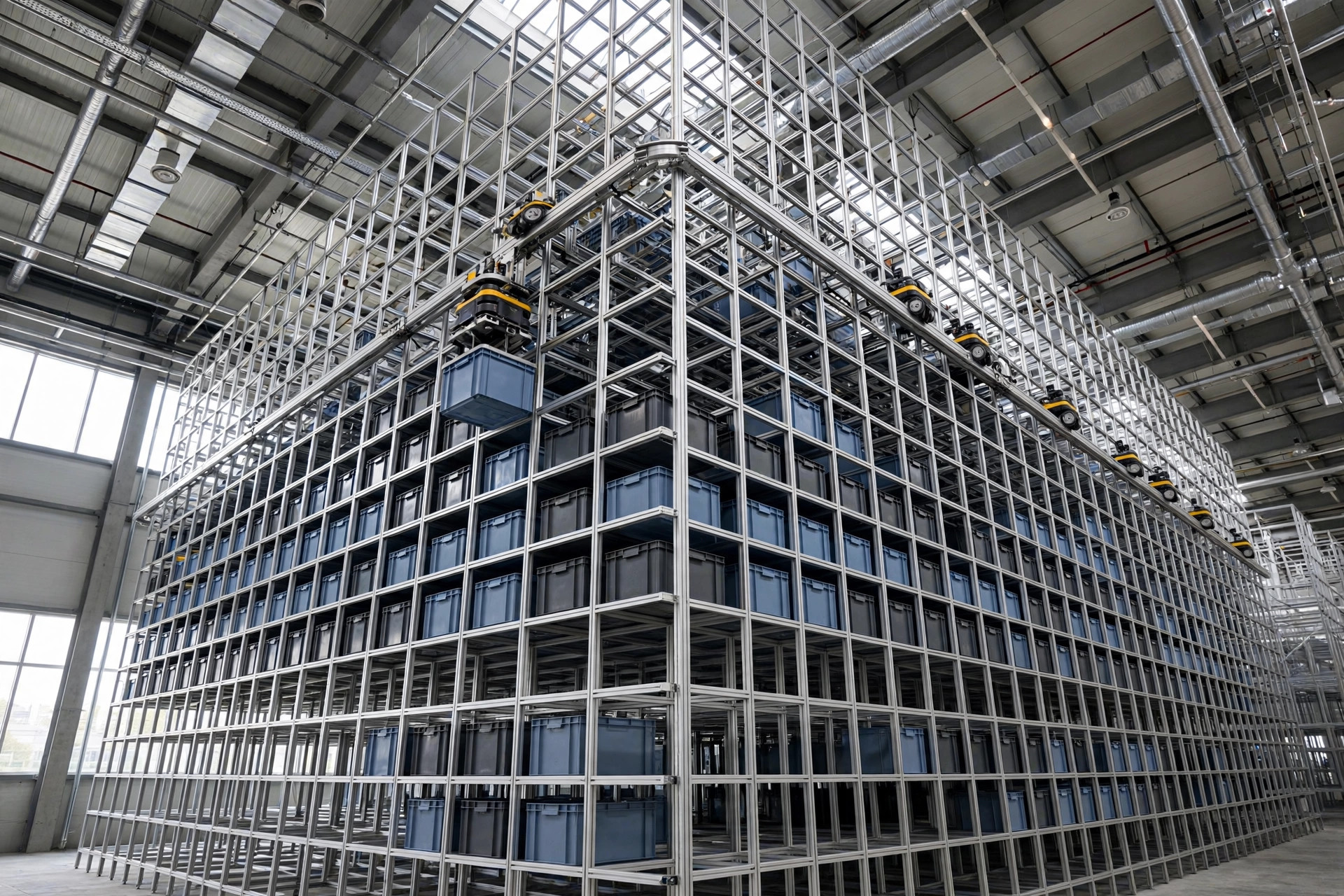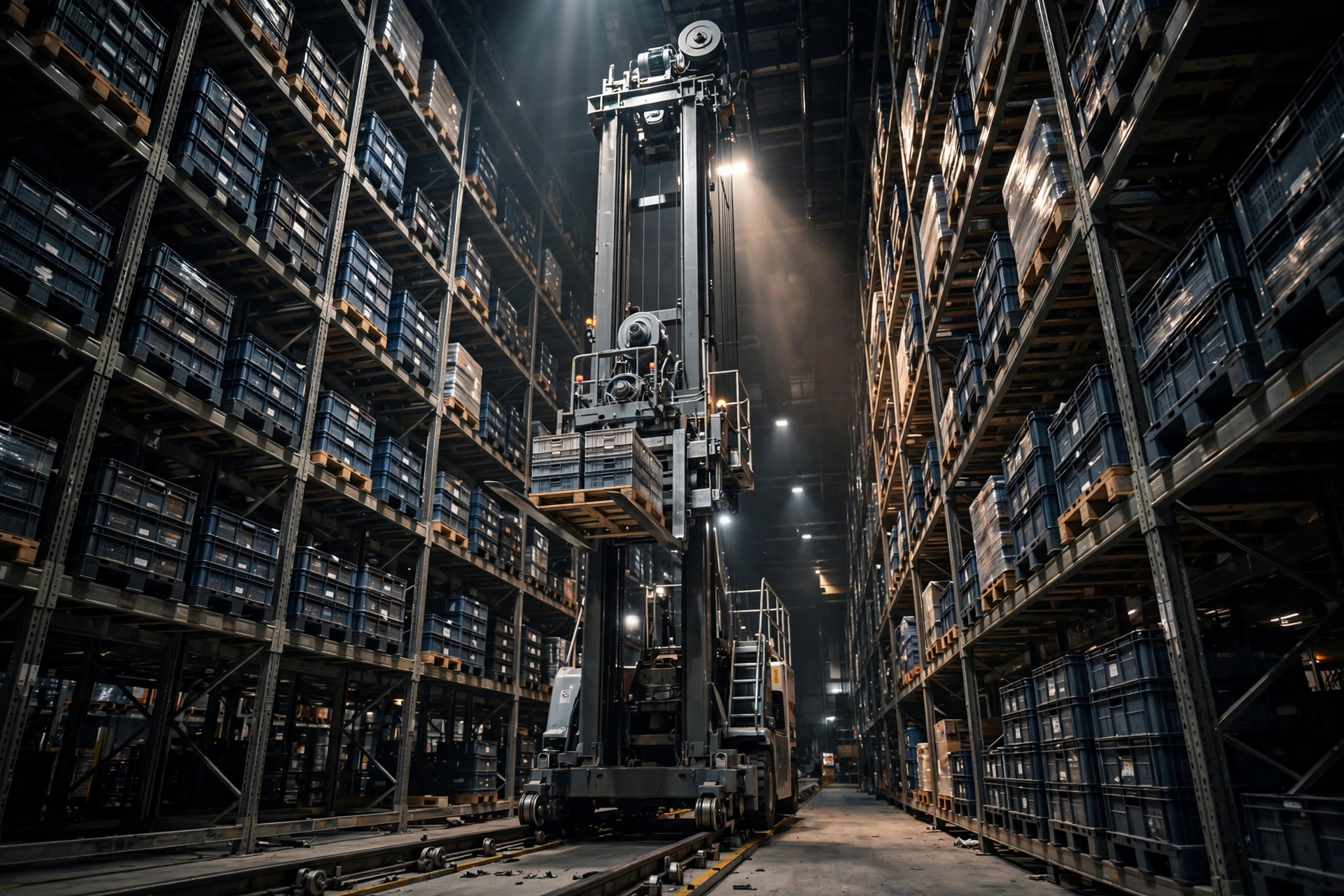
On inspection day, the fire marshal looked up at the top of the rack, turned to me, and said: the top level is too close to the sprinkler heads. This doesn't pass. It was a project I worked on in the Inland Empire — a 12-meter high-bay ASRS, ESFR heads installed, the system pressure-tested and passed. But operations had added half a level of product to the top bay in the final two months. The clearance went over the limit, and acceptance stalled for three weeks — pulling product down, redesigning the scheme, resubmitting for approval. What it cost would have bought half a forklift.
Here's my verdict up front: fire protection in an ASRS is never just "install the sprinklers and you're done." The sprinkler system, the rack height, the shelf type, and what you actually store are one linked calculation. Discovering they don't match on inspection day means paying in money and time.
This piece covers three things: how many levels of sprinklers you actually need, why any change to the racks forces a fire recalculation, and a self-check list to run before the inspector shows up.
How Many Levels of Sprinklers Do You Really Need?
Start with the basics: ESFR — early suppression fast response — heads are the most common ceiling sprinkler approach for high-bay warehouses today. Big water volume, fast response, designed to knock a fire down in its early stage. But ESFR has a height ceiling.
Under NFPA 13, K14.0 ESFR heads protecting rack storage are limited to ceiling heights of 35 feet (about 10.7 meters) — and that's without in-rack sprinklers. Larger-orifice K22.4 and K25.2 heads can push a ceiling-only design to 45 feet. The tallest currently listed ESFR schemes reach 48 feet without in-rack sprinklers.
The problem: a lot of automated high-bay warehouses sit right in that awkward zone. A 12-meter building (about 39 feet) might be covered by K25.2 ESFR. At 14 or 15 meters, in-rack sprinklers become mandatory. In NFPA 13's ESFR tables (16.2.3.1, 16.3.3.1, and their siblings), many options for ceilings above 40 feet explicitly require in-rack sprinklers.
The logic of in-rack sprinklers is simple: a fire deep inside the rack never sees ceiling water. In-rack heads sit between the levels, close to the fuel, and activate while the fire is still small — controlling it with far less water. A typical arrangement: quick-response heads rated at 160°F (about 71°C), minimum K-factor K5.6, horizontal spacing no more than 5 feet, vertical spacing every 10 feet, and no more than 5 feet of storage above the top level of in-rack heads.
Then there's the trap I see people fall into most: solid shelves. If your racks use solid shelves, ceiling-only ESFR is never enough regardless of height — you need in-rack sprinklers, because each shelf blocks water from reaching the fire below. This has to be locked in at the design-review stage, not discovered after the racks are erected.
One more: ESFR and smoke-and-heat vents are mutually exclusive. Venting carries heat away and delays sprinkler activation. I've seen two projects hit this wall because the architect and the fire consultant never compared drawings.
Why Does Touching the Racks Force a Fire Recalculation?
The sentence fire inspectors dread most is "we added a level later." A few hard numbers tie sprinklers and racks together — move one, and the whole calculation restarts.
First, clearance: the distance from the top of storage to the sprinkler deflector. Standard spray heads need at least 18 inches (about 45 cm); ESFR needs at least 36 inches (about 91 cm). The 18-inch rule is the most commonly violated requirement in occupied US warehouses — operations keeps stacking the top level higher to fit more product, and the clearance quietly goes over.
Second, commodity classification. Take cartoned expanded plastics — cardboard boxes where foam packaging exceeds 25% by volume. K25 ESFR cannot protect those. And 3PL commodity mixes keep changing: hardware in cartons today, small appliances with foam inserts tomorrow. The effectiveness of the fire scheme changes with it. Actual storage has to stay consistent with the fire design — and I'd get that responsibility written into the lease.
Third, flue spaces. Longitudinal and transverse flue spaces between rack rows let water and heat move vertically. Blocked flue spaces are the most common everyday violation — a picker stuffs an overhanging carton into the gap for convenience, and that's a fire hazard. Maintaining flue spaces is the operator's daily responsibility, not the fire contractor's.
So the fire scheme is not a one-time deal. Adding a level, changing commodities, swapping shelf types — every change should be checked back against the original NFPA 13 design conditions. The local authority having jurisdiction (AHJ) usually carries extra permit requirements for high-piled storage. Ask before you change; it's cheaper than being stopped after.

Run This Self-Check Before the Inspector Arrives
This is the list I walk through myself every time before an acceptance inspection:
One, measure clearances. Spot-check at least five locations: top of storage to the deflector — no less than 36 inches for ESFR, 18 inches for standard heads. Don't skip any area where the top level was raised.
Two, walk the flue spaces. Go down every aisle and check that longitudinal and transverse flue spaces aren't blocked by cartons or pallets. The gap between back-to-back racks is where stuff gets stuffed most.
Three, inspect the in-rack heads. On every level, confirm the factory protective caps are off — a capped head is a head that doesn't exist. Make sure heads aren't blocked by product or knocked crooked. Stacker cranes run all day in an ASRS; a bent head or two is routine.
Four, reconcile commodities. Take your current inventory mix and compare it against the commodity classification in the fire design. Watch for newly added plastics, foam-packaged goods, tires, or chemicals. If any showed up, get your fire consultant to re-evaluate.
Five, check shelves and modification records. Confirm the shelf type in the field matches what was submitted — and that nobody added mezzanine decks or extra shelf levels off the books. Every structural change needs a record.
Six, have the paperwork ready. NFPA 13 design calculations, the high-piled storage plan, sprinkler as-built drawings, and the latest inspection and maintenance report — the inspector will very likely ask. Missing documents can send you home even if the field conditions are perfect.
One last honest word: in an ASRS project, fire protection has to be in the room when the racks are designed. The smoothest projects I've seen had the fire consultant and the rack supplier sitting together at the first drawing revision, locking in sprinkler levels, flue space dimensions, and shelf types in one pass. The worst ones discovered the mismatch three weeks before acceptance — and every dollar spent fixing it then was a dollar that could have been saved.
What's the clearance from your top-level product to the sprinkler heads right now? If you're not sure, bring a tape measure tomorrow.