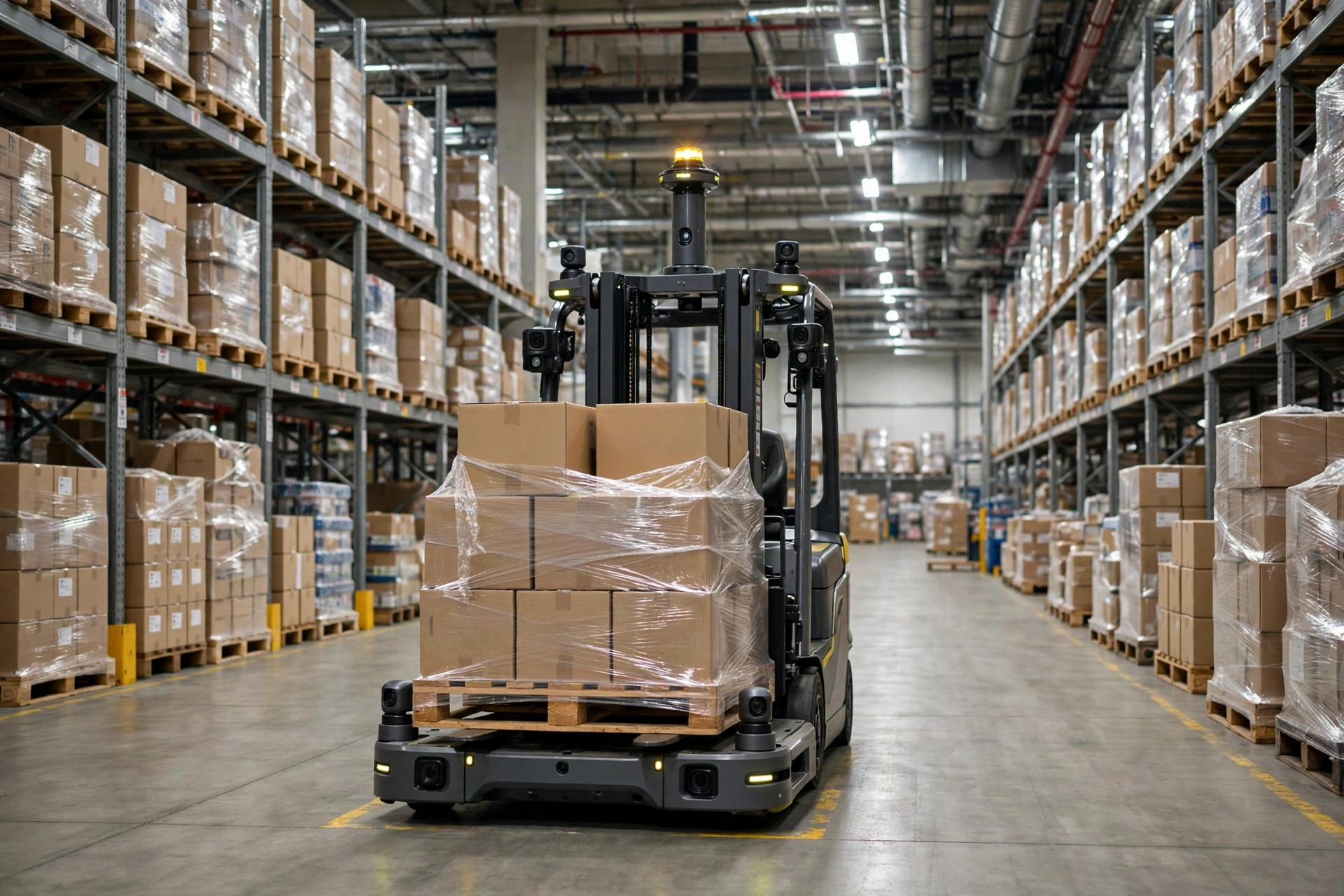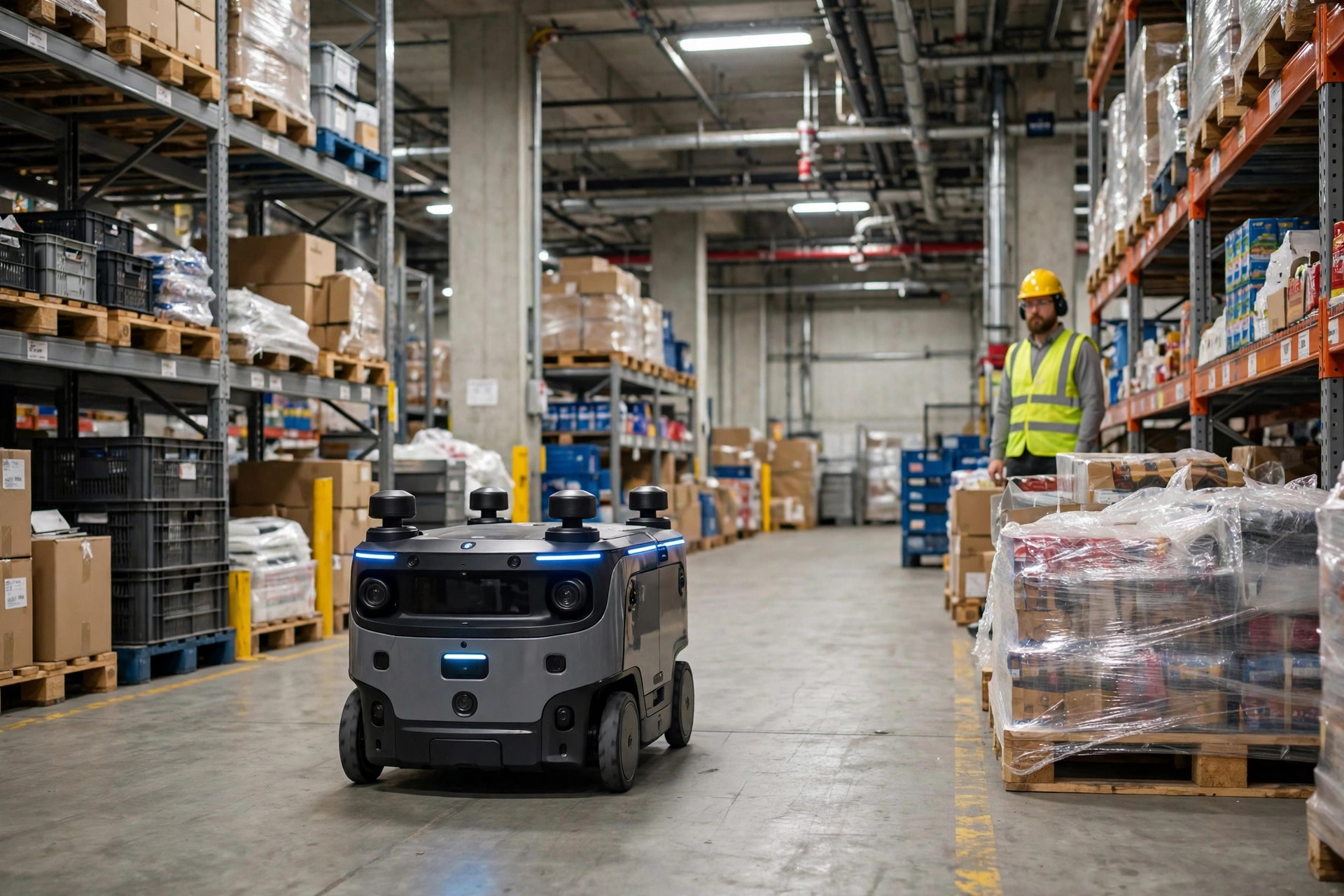
In the summer of 2024, the procurement director of a Midwestern 3PL called me with good news: they had just signed a contract for 18 AMRs at under $40,000 each, 1,000 kg payload, laser navigation — cheaper than the quotes they had received the year before. I asked what safety provisions the contract contained. There was a pause. "The spec sheet says it has LiDAR obstacle avoidance," he said. "That should cover it." Three months later, one of those AMRs, fitted with a third-party double-deck cart, clipped a rack corner during a peak-season night shift. Nobody was hurt, but the pick line sat idle for six hours. The first thing the insurer's investigator asked when he walked in was not about the robot — it was about the paperwork: was that attachment factory-made or third-party modified, and who was contractually responsible for the risk assessment?
The contract, of course, said nothing about either. That 3PL is not an outlier. Buying an AMR on payload, range, charge time, and price alone — while treating safety as a spec-sheet line item — is one of the most common traps in warehouse automation. The AMR safety standard RIA R15.08 exists precisely because of this gap: once a robot rolls off the showroom floor and into a warehouse, whose responsibility is safety?
What the AMR safety standard RIA R15.08 actually is
A fact worth restating: before R15.08, industrial mobile robot safety lived in borrowed standards. AGVs had their corner of R15.06; the mobile robot itself had no dedicated safety standard of its own. That changed in December 2020, when the Robotic Industries Association — RIA, now folded into the Association for Advancing Automation (A3) — jointly published ANSI/RIA R15.08 with ANSI, the first safety standard written specifically for industrial mobile robots.
The standard has three parts. Part 1 addresses manufacturers: how the robot itself must be designed to be safe. Part 2 addresses integrators: what a system that combines the robot with a specific application must satisfy. Part 3 addresses the user — the warehouse operator — and what responsibilities it carries in operation. The timing matters: Part 3, covering user-side responsibilities, was published in 2026. Only this year did the standard complete the loop and put "what the buyer must do" into the framework. For warehouses buying AMRs today, that timing is telling — the document is no longer just something vendors and integrators keep on a shelf. It now reaches directly into the buyer's hands.
What the AMR safety standard RIA R15.08 covers: the system, not the bare robot
Here is the misconception almost every buyer brings to the table: that a safety standard governs "the robot itself." R15.08 works the other way around — it governs the AMR system. A factory robot plus a shelving rack, a cart, a top-mounted pallet frame, or even a changed operating route: once its physical form or behavior is altered, it becomes a new system. The standard is explicit that when the OEM or a third party outfits an AMR with racks, carts, or similar attachments, the party doing the modification takes on system-level safety responsibility. (For the precise clause language, consult the standard itself or the A3 website.)
A second scenario, from a retail distribution center in California at the end of 2024. To survive peak season, the site had a third-party integrator bolt double-deck pick carts onto its AMRs, stacked to 1.8 meters. The robots carried LiDAR, and the spec sheet advertised 360-degree sensing — but once the cart went on, the lower half of the sensor's field of view was partially blocked by the cart's posts and freight. One night shift, a manual pallet jack cut across a turning zone from the side, inside the new blind spot. The AMR braked half a second late and scraped a rack upright. No one was injured. In the debrief, the integrator said "you told us to mount it this way," and the warehouse said "you mounted it, you own it." The contract named no responsible party, so they split the remedial costs between them. Under R15.08, the answer is unambiguous: whoever modifies the robot owns the system's safety. Before signing, a buyer should know exactly who adds the attachment, who validates it, and who signs for it.
Five user-side responsibilities: from "recommended" to "auditable"
Part 3 converts user responsibilities into an auditable list. I have condensed it into a buyer's checklist — five questions to put to vendors and integrators during procurement. Every question they cannot answer is a hole that will open up the day something goes wrong:
| User-side responsibility | What it means in practice | Who to ask during procurement |
|---|---|---|
| Risk assessment | Identify hazards and rate risks for every AMR route, in a written report | Is it included in the integrator's delivery? |
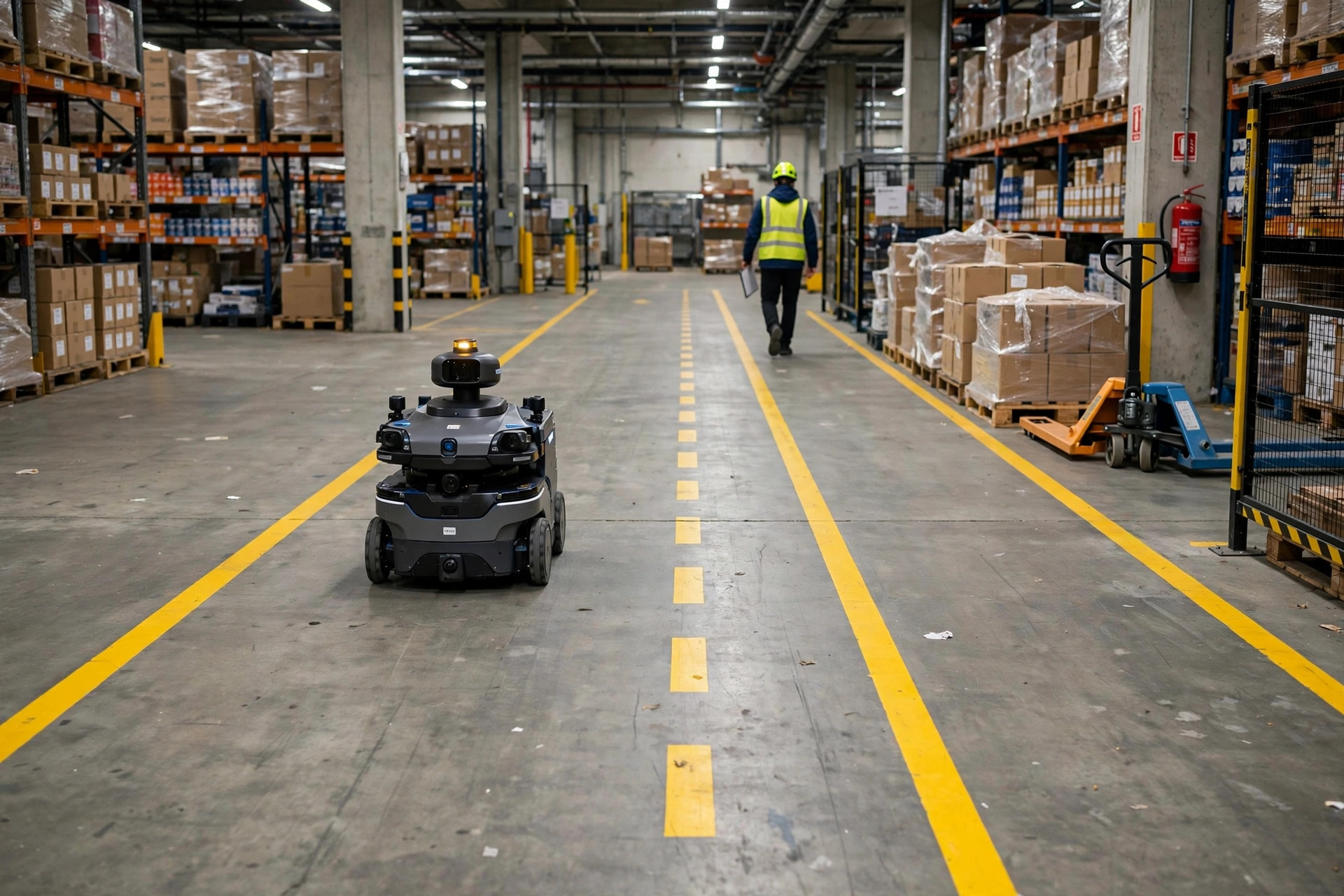
| Traffic separation | Physically or logically separate robot lanes from pedestrian walkways; mark intersections | The layout designer and site management |
| Speed limits and slowdown zones | Set speed caps by zone; force deceleration at blind spots, turns, and high-traffic areas | Can the vendor configure speed per zone? |
| Personnel training | Train everyone who may encounter AMRs — temporary workers included — and keep records | Who provides the training package, who retrains |
| Change management | Re-validate safety whenever layout, attachments, routes, or software versions change | Whose process governs changes, who signs off |
The list looks plain. Its sting is in the reality check: most warehouse AMR deployments satisfy two of the five at best. Traffic separation is a strip of yellow paint, speed limits are factory defaults, and the risk assessment report was never written at all.
Now the math. A competent third-party risk assessment plus traffic-separation design costs roughly $10,000 to $20,000 — a quarter to half the price of one AMR. It sounds steep. But go back to that Midwestern 3PL: what did six idle hours on a peak-season night shift cost? Idle labor standing around, late-order penalties, and the insurance adjustment that followed the investigation — any one of those items alone exceeds the assessment's price tag. The awkward truth about safety spending is that it always happens before anything goes wrong, and its entire return is "nothing happened." I have watched too many procurement teams treat "it hasn't happened yet" as proof that it never will.
The counterintuitive trade-off: the safer it stops, the more throughput it eats
Here is a piece of shop-floor truth that rarely gets said out loud. The instant an AMR's LiDAR detects an obstacle, decelerates, and stops is exactly where safety consumes throughput. The two logics are zero-sum: a wider slowdown zone means safer pedestrians and longer cycle times per trip; a more conservative stop threshold means lower collision risk and fewer trips per hour.
Most warehouses discover this about three months after go-live, in a quietly disappointing number: the vendor promised 120 trips per robot per day, and the fleet is averaging in the low 80s. Pull the logs, and the robots are not broken — they have spent nearly 40 minutes a day in "obstacle slowdown." They are, in a sense, too safe. The site manager's first instinct is to ask the vendor to shrink the slowdown zones. Shrink them, and the trip count recovers — and so does the risk.
This is where R15.08 earns its keep. It does not demand infinite safety, and it does not permit infinite risk-taking. It demands risk assessment first: identify the hazards, rate them, and then decide how wide the slowdown zones should be and where the speed caps belong. Tuning parameters without a risk assessment is like removing a load-bearing wall without a blueprint.
Where this is heading: safety as a gate, not a cost line
Zoom out. When Part 1 of R15.08 landed in 2020, compliance was a differentiator for advanced vendors. With Part 3 completing the framework in 2026, the standard now closes the triangle: manufacturer, integrator, user. My read is that within two to three years, safety clauses in AMR purchase contracts will move from optional to mandatory — insurers will move first, large retailers and 3PLs will follow by writing R15.08 compliance into supplier audits.
For vendors, this is a sorting event. Those that can produce complete safety documentation, offer risk assessment services, and support per-zone speed configuration will package "safety compliance" as a premium service. Those that sell bare robots and leave attachments to the customer will find the market getting harder, not easier.
Back to the Midwestern 3PL. They eventually commissioned the risk assessment, redrew their traffic separation, and separately validated the third-party carts — under $30,000 in total. The procurement director's takeaway: back then, the vendor would have agreed to almost anything to win the order.
So before you buy the robot, run through the safety checklist. Not because the standard demands it — but because after an incident, the first question will be addressed to you.
By Dr. Chen, Supply Chain Researcher