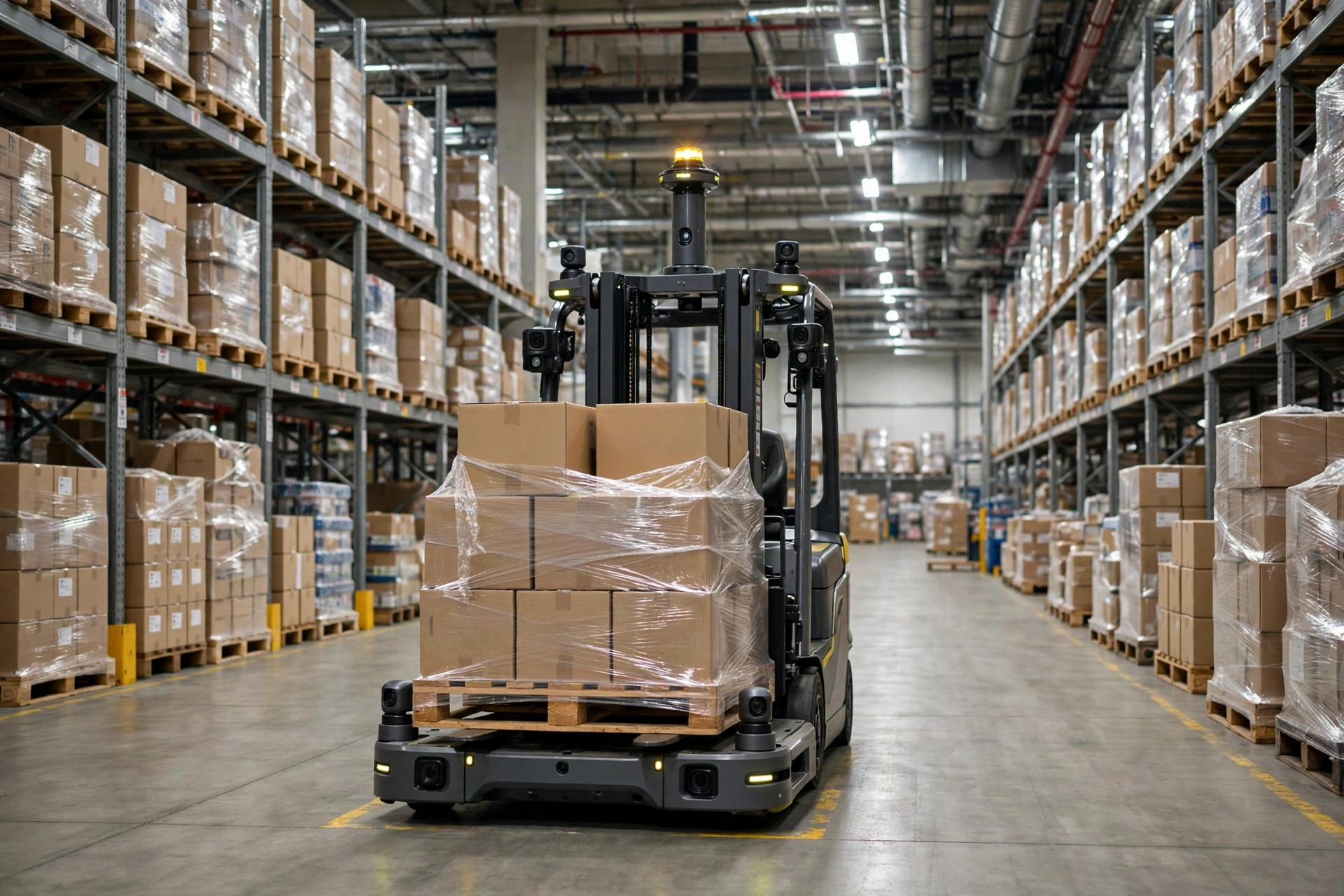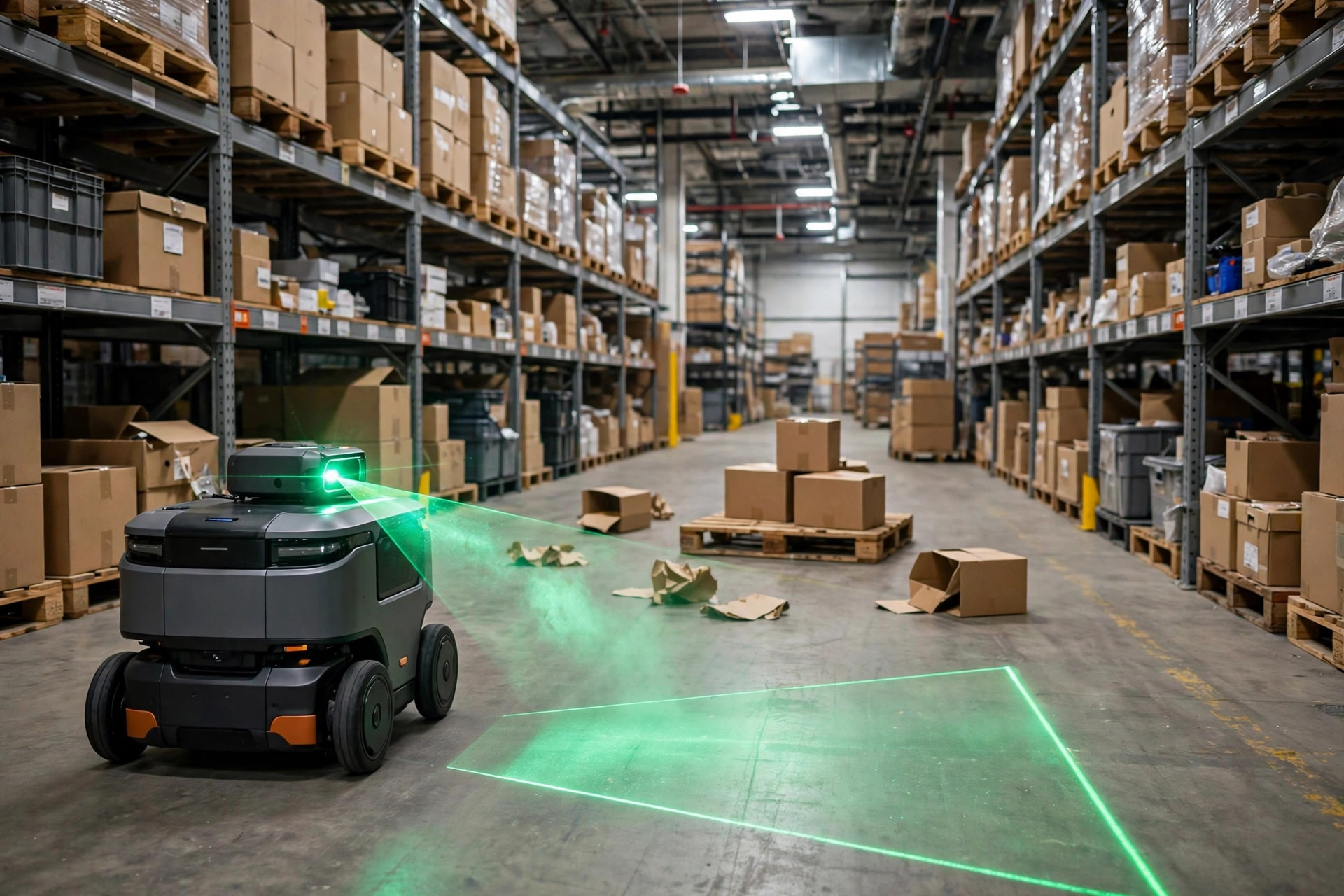
Think of it this way: a 2D LiDAR sees the world like a ruler sweeping sideways — and that sweeping ruler is exactly where AMR safety scanner blind spots are born. Whatever the ruler touches, it knows. Whatever sits below the ruler might as well not exist.
That's not a metaphor — it's literally how the hardware works. A 2D safety laser scanner on an AMR fires and receives on a single horizontal plane, typically mounted around 30 to 50 centimeters off the floor (varies by vendor). Anything above that plane — rack uprights, shelving, a human torso — it sees just fine. Anything below it — a flattened carton on the floor, an empty pallet, a coiled cable, a toolbox a tech set down and forgot, forklift forks left lowered — is invisible to both the navigation stack and the safety logic. That's the nastiest flavor of AMR safety scanner blind spots: the low-obstacle dead zone.
Two stories first. Both are real patterns from the last few years; I'll keep the names out, but anyone in this industry will recognize the shape of them.
First: an e-commerce pick zone with AMRs and people working side by side. Night shift, a fan blows an empty carton into the aisle — maybe 20 centimeters tall. The AMR rolls up, its 2D scan plane passes clean over the carton, the logic says "path clear," full speed ahead. The carton wraps around a drive wheel, the robot faults out, wheels spinning. Took the night supervisor forty minutes to dig it out. The pick task died and the downstream line waited half an hour.
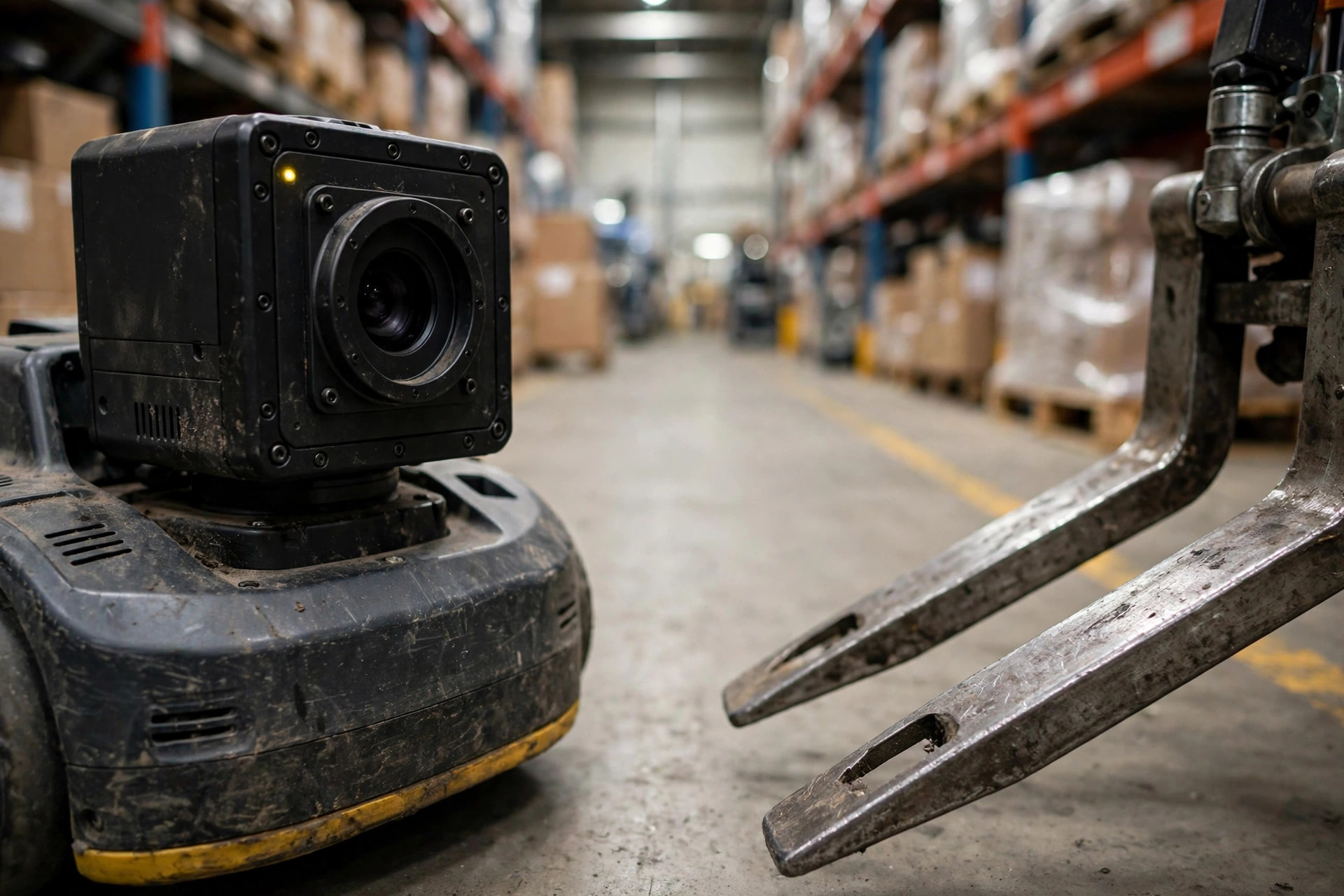
Second, and more typical: a 3PL warehouse where forklifts and AMRs share a main aisle. A forklift driver drops a pallet, leaves the forks parked about 15 centimeters off the floor, walks off to grab paperwork. The AMR comes down the aisle, scan plane above the forks, drives straight into them. Steel forks are thin and unforgiving — cracked the AMR's front bumper, roughly ten grand in repairs, three days of downtime. The post-mortem found the safety scanner was "working normally." Of course it was. By design, it couldn't see a thing.
Three fixes, compared before you spend a dime
A physics-level blind spot needs a physics-level fix. The industry has basically three moves. Here's the comparison table so you don't have to interrogate sales reps one by one:
| Fix | How it works | Rough cost | Covers | Still misses |
|---|---|---|---|---|
| 3D ToF camera | Downward-facing depth sensing — sees volumes, not slices | Several thousand USD per unit | Low obstacles, floor debris, dips and ruts | Reflective and transparent objects; heavy compute load |
| Low-mounted safety scanner | A second 2D scan plane near the chassis, close to the floor | One to two thousand USD per unit | Obstacles in the 10–20 cm band | Still a "slice" — under ~5 cm stays blind |
| Lower mounting height / stacked planes | Drop the main scanner lower, or mount two units staggered | Mostly installation and calibration labor | Balances human detection with low-object coverage | Too low invites false positives from floor glare and dust |
No silver bullet. 3D ToF sees the most but costs the most and needs real compute — plenty of smaller AMR controller boards can't keep up. The low add-on scanner is cheap but philosophically still "one more ruler," and anything hugging the floor still slips through. Lowering the mount is nearly free, but go too low and floor reflections and dust drive your false-alarm rate through the roof. Pick based on your floor, not the brochure.
Where's the line? When you must fix it vs. when 2D is fine
Verdict first, reasoning after.
Fix it — with 3D or a low scanner — if: AMRs share space with people or forklifts; your floor collects debris (e-commerce returns areas, de-palletizing zones); pallets and empty cartons get staged in aisles routinely; or you've already had a low-obstacle incident. Any one of those, don't cheap out.
2D is fine if: the AMR runs in a dedicated zone with real 5S discipline on the floor, or it only travels fixed, inspected routes that someone walks daily. And "the floor stays clean" has to be enforced by process, not by luck.
Now, the rant you've been waiting for — I'm allergic to fake requirements. Some vendors' proposals show an AMR with four safety scanners, one on each side, and the rep tells you "360-degree coverage, zero blind spots." That's sales poetry. Four 2D scanners are four horizontal slices; low obstacles stay invisible to all four. It's like being 800-degrees nearsighted and putting on four pairs of glasses — you don't get 3200-degree vision. Safety is a systems problem: sensor selection, mounting height, speed policy, floor management, people training. Skip any link and the money you spent on the other links is wasted. Any rep who tells you "install our scanner and stop worrying" — show them the door.
One more thing: AGV/AMR safety has an international standard, ISO 3691-4, with explicit requirements on personnel detection and safe stopping distances. Useful — but understand what it does and doesn't do. The standard guarantees "stop before hitting a person." It does not guarantee "stop before hitting a carton." Low obstacles are your problem to solve, on top of the standard.
The maintenance trap: installed and ignored equals not installed
Getting the fix installed is the starting line. Skip maintenance and you're back to square one in three months. The three traps I see most:
Dust. Warehouse floors kick up dust, it films over the scanner lens, and detection range quietly shrinks. I've seen sites that hadn't wiped a lens in six months wondering why false alarms kept climbing. Lens cleaning belongs on a checklist with a name and a schedule attached — not "whoever notices, wipes."
Calibration drift. AMRs vibrate and take small knocks all day. Mounting angles creep a degree or two, and two degrees at scanner height moves the scan plane several centimeters up or down — which directly changes what low obstacles you can catch. Whatever the integrator calibrated at commissioning needs rechecking every six months or so.
Metallic reflections. Forks, pallet nails, metal floor strips — they're mirrors to a LiDAR and produce ghost returns or dropouts. 3D ToF cameras don't love reflective or transparent objects either. When you run your POC, test against real forks and real pallets on your real floor. Don't sign off based on a test in the vendor's spotless demo hall — their demo floor is always pristine, and yours never will be.
So, the money question. Whether this spend is worth it comes down to one number: how many e-stops, collisions, or downtime events did low obstacles cause in your warehouse over the past twelve months? Add up repair bills, downtime cost, and the labor to dig robots out of messes, then put that next to the quote for the fix. If one incident a year costs as much as a 3D ToF retrofit, the math does itself. If your floor discipline genuinely keeps the ground clear at all times, 2D is fine and the money belongs elsewhere. Let the data decide, not the gut.
By Da Liu, Automation Engineer