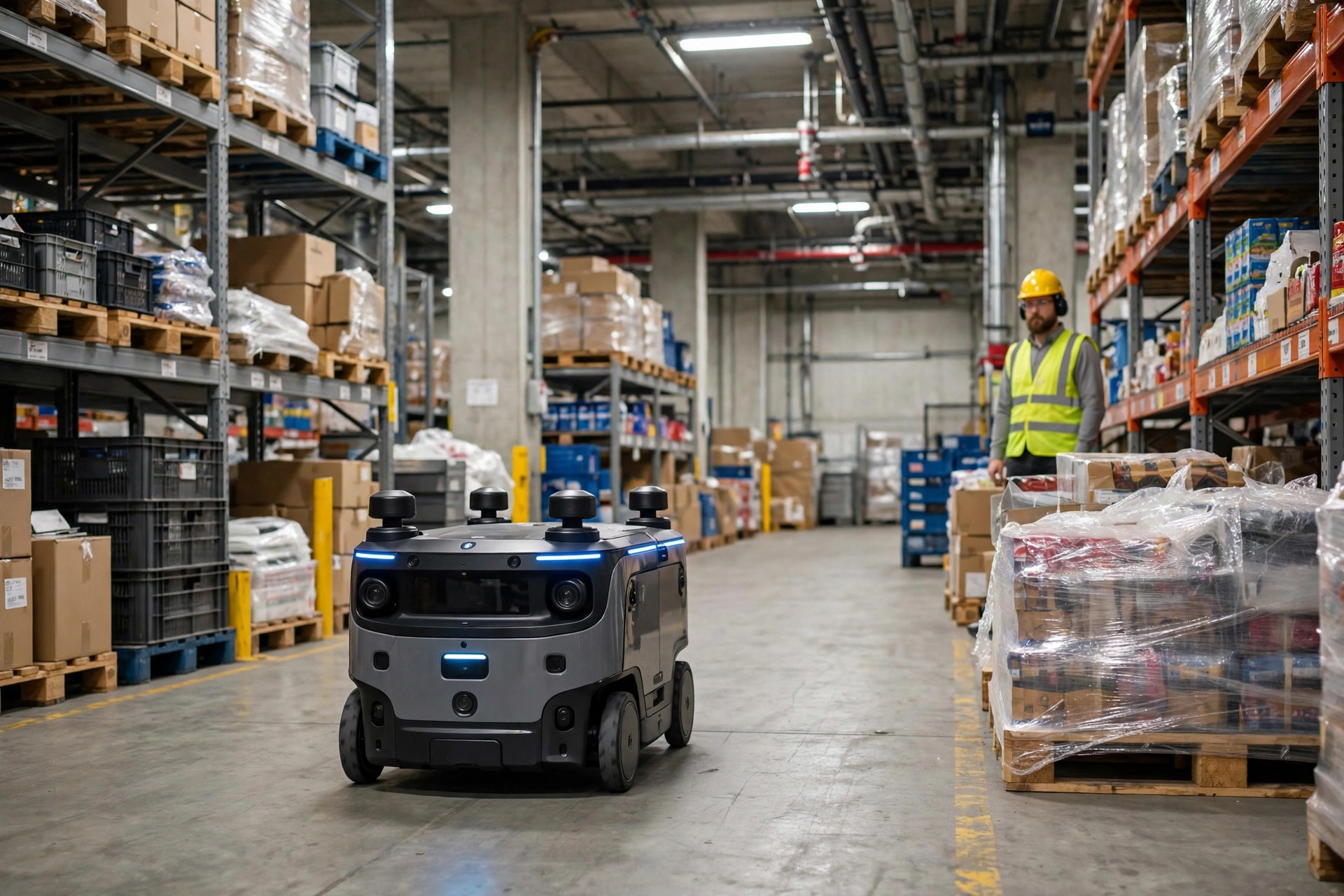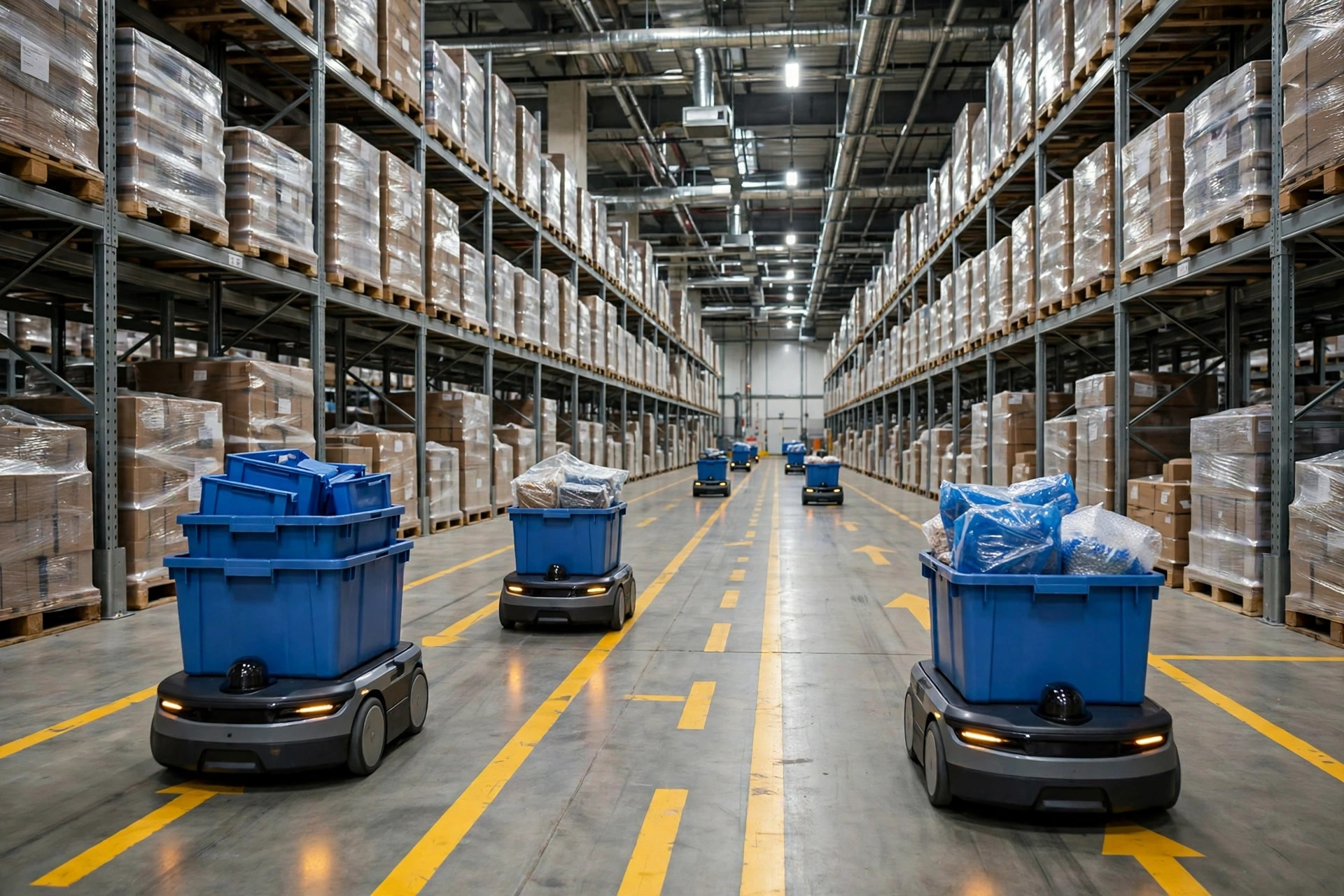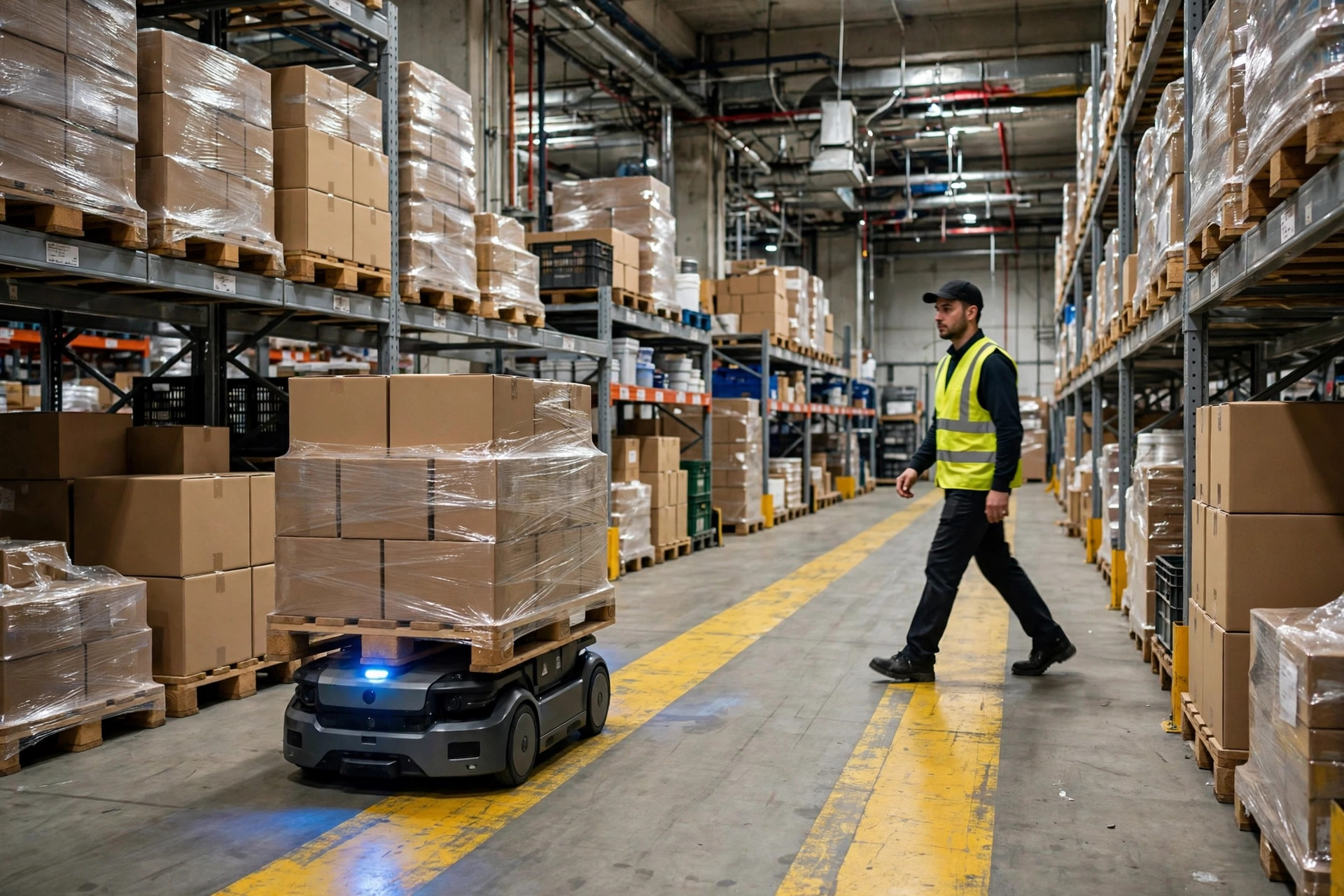
Here's the counterintuitive take first: in AMR pedestrian incidents, the most dangerous thing was never "the robot drives too fast." It's the human who assumes "it can see me." I've watched operators walk beside an AMR while checking their phones, and pickers cut across an aisle a meter in front of one — "it's got lidar, it'll stop." The lidar will stop. Physics won't negotiate. This article covers three lines of defense: how to set safety distance, how to zone people and machines, and how to configure e-stop logic. Hold all three and mixed traffic is genuinely deployable.
The Principle: How an AMR "Sees" You
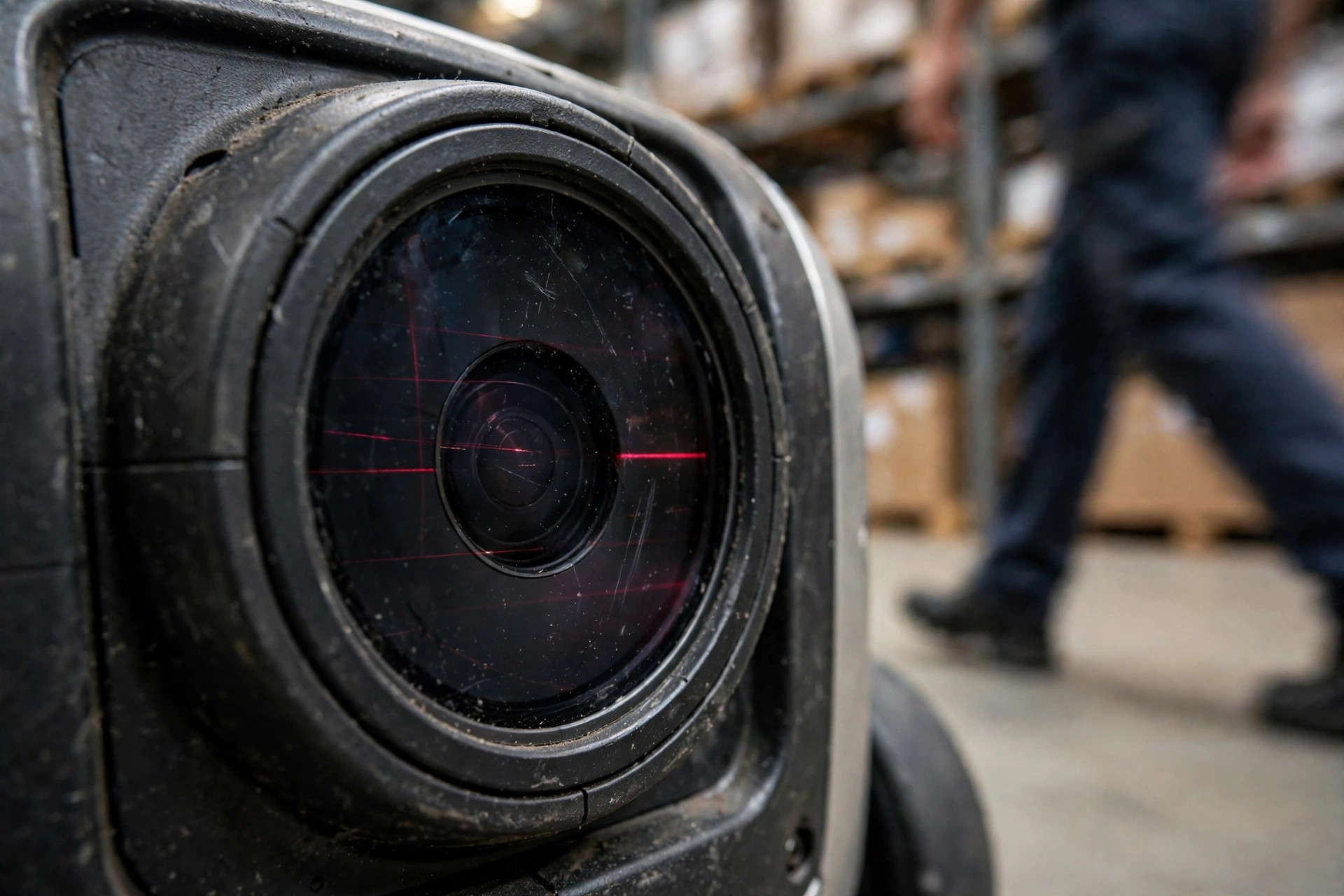
Think of an AMR safety system as "eyes + brain + brakes": the safety laser scanner sweeping a planar field around the vehicle, the safety PLC issuing commands the moment something enters a predefined zone, and the drive system's braking. If any link drops, your safety is paperwork.
The key parameter is stopping distance, because it determines how large the safety zones must be: stopping distance = reaction distance + braking distance, where reaction distance = system response time × speed and braking distance = speed² / (2 × deceleration). A rough estimate for a common case — a 1-ton-loaded AMR at 1.5 m/s, deceleration 0.6 m/s², response 0.3 s — gives about 0.45 m reaction plus 1.9 m braking, roughly 2.3 m total. That's why a 1-meter safety zone is wishful thinking: the distance the vehicle needs to stop, plus margin for human movement, means 2.5 m is the sensible starting point. Treat this as illustrative — your integrator's risk assessment for your site is what counts, since load, floor friction, and slopes all rewrite the number.
One blind spot people forget: the safety scanner sweeps a single plane, typically 20–30 cm off the floor. It sees your legs — not the pallet at chest height, not goods suspended on forklift forks. Inside those blind spots it genuinely cannot see you, which is why "it has lidar so it's safe" is an illusion.
On standards, two public facts: OSHA 1910.176 covers powered industrial trucks with general requirements on pedestrian safety and operator training — check OSHA's current published penalty schedule for fine levels. ANSI/RIA R15.08 is the safety standard written specifically for mobile robots; its core demands are a pre-deployment risk assessment and safety functions rated to the appropriate safety integrity level. Anything you're unsure about goes back to the standard text and your integrator's risk assessment — never to a salesperson's verbal promise.
Three Zoning Approaches Compared
There are exactly three ways to zone people and machines. No fourth. Here's the comparison table:
| Approach | How it works | Protection level | Efficiency impact | Fits |
|---|---|---|---|---|
| Physical separation | Fences and guarding fully enclose AMR routes | Highest | Lowest — people and robots never meet | High-speed AMRs, heavy loads (1 ton+) on main lanes |
| Virtual fencing | Safety zones switch dynamically; humans entering trigger slowdown or stop | Medium-high | Medium — frequent slowdowns hurt takt time | Pick zones, load/unload points where paths cross |
| Time separation | People and robots work different shifts or windows | Medium | High — AMR utilization takes the hit | Small warehouses, few AMRs, simple routes |
The selection threshold is clear: speed above 1.5 m/s, payload above 1 ton, or routes crossing dense pedestrian areas — don't hesitate, go physical. Virtual fencing is the realistic choice for most warehouses, but it has a prerequisite: safety zone calibration must be re-verified regularly. I saw an e-commerce site add a row of temporary racking before the 2024 peak season. The AMR routes didn't change, but the zone calibration still matched the old layout — the new racking blocked a corner of the scanner's field of view, creating a blind spot. Two weeks of minor scrapes nobody took seriously, until an AMR knocked over a tote there. Nobody was hurt, luckily.
Time separation sounds cheapest but demands the most discipline. Once AMR utilization drops, the whole ROI model breaks, and within three months the floor will quietly go back to mixed traffic — that's human nature. So my verdict is blunt: small site, few robots, simple routes — time separation is a fine start. But the moment volume grows, you'll pay for virtual fencing or physical separation anyway.
E-Stop and Slowdown: Three-Level Logic
Build the slowdown and stop logic in three levels — think of it like a car's adaptive cruise control, "far, middle, near":
Level one is the warning zone: a person enters the outer field, the AMR drops to crawl speed (say 0.3 m/s) and lights up or beeps — a reminder, not braking.
Level two is the protective stop zone: a person enters the inner field, the AMR stops immediately and resumes automatically once the person leaves. This level is hard logic in the safety PLC — it must stop even if the business system has crashed.
Level three is the e-stop: collision imminent or a safety PLC self-test fault — full power cut, brakes engaged. The e-stop circuit must be hardwired, not wireless, not software. Ask the integrator "is the e-stop a hard circuit or a soft command?" A vague answer is an instant disqualification.
Time to take aim at a pseudo-requirement: "just put a big horn on the AMR and let it blare all day." No. Warehouse ambient noise runs above 70 dB, so the horn must be painfully loud to be heard — and humans go numb to continuous alarms within days (alarm fatigue, well documented). A horn can only assist level one. Safety can never rest on the assumption that "someone heard it."
Selection Thresholds: Spend Where It Counts
Navigation lidar and safety laser scanners are two different things — don't let "it has lidar" fool you. Navigation lidar handles localization: precise, but with no safety certification. A safety laser scanner carries a safety integrity rating, costs two to three times more, and is the only "eye" allowed inside the safety loop. Wherever AMRs share space with people, the safety scanner is mandatory, not optional.
Same for controllers: a standard controller runs business logic, a safety PLC runs safety logic — two independent systems. When do you need 3D vision on top? Forklift-style AMRs, suspended loads on forks, or working heights above the scanner plane — whatever 2D can't see at height, 3D covers. These three line items (safety scanner, safety PLC, 3D vision) are the last place to cut in a safety budget. Every dollar saved here is a bet on probability.
Four Maintenance Pitfalls
About 70% of AMR pedestrian safety failures happen in the maintenance phase:
Pitfall 1: Dirty or knocked-out-of-alignment scanner optics. Warehouse dust is relentless — three months without cleaning and detection range drops measurably. Worse is a slight knock from a pallet: 2 degrees of misalignment opens a large blind spot 5 meters out. Countermeasure: optics cleaning on the weekly checklist, alignment re-verified quarterly.
Pitfall 2: Reflective floors and water. Freshly waxed epoxy or wet patches throw stray reflections at the scanner — false stops at best, missed detections at worst. Countermeasure: floor material goes into the risk assessment, and re-test after deep cleans.
Pitfall 3: Someone on the floor quietly raises the speed limit. Peak season hits, the shift lead thinks the AMRs are slow and bumps the limit from 1.2 m/s to 1.8 m/s — while the safety zones are still calibrated for 1.2. Countermeasure: safety parameter passwords stay with the equipment owner, and every change goes through a change process with a fresh risk assessment.
Pitfall 4: Firmware updates overwriting safety configuration. The update flashes in, safety zones and slowdown thresholds revert to factory defaults, but the floor layout changed two years ago. Countermeasure: re-validate every safety function after each update, with written records. ANSI/RIA R15.08's change management expects exactly this — don't skip it because it's tedious.
The Math: Whether It's Worth It Comes Down to One Number
The cost of one pedestrian collision splits into direct and indirect. Direct: medical costs, OSHA penalties (a single serious violation runs to five figures in USD — check OSHA's current published schedule), and downtime during the investigation. Indirect: workers' comp premiums rising for years, customers docking points on safety audits, crushed morale, harder recruiting — the warehouse world is small, and a site known for a serious incident pays more to hire.
A complete safety package — safety scanners, safety PLC, zoning retrofit, the risk assessment — typically runs about a tenth of the total AMR project budget. So here's the closing line: whether the money is worth it comes down to one number — one medium-severity incident, direct plus indirect, usually covers redoing the entire site's safety package twice over. Safety spending isn't a cost. It's the highest-ROI line item in the project.
By Da Liu, Automation Engineer