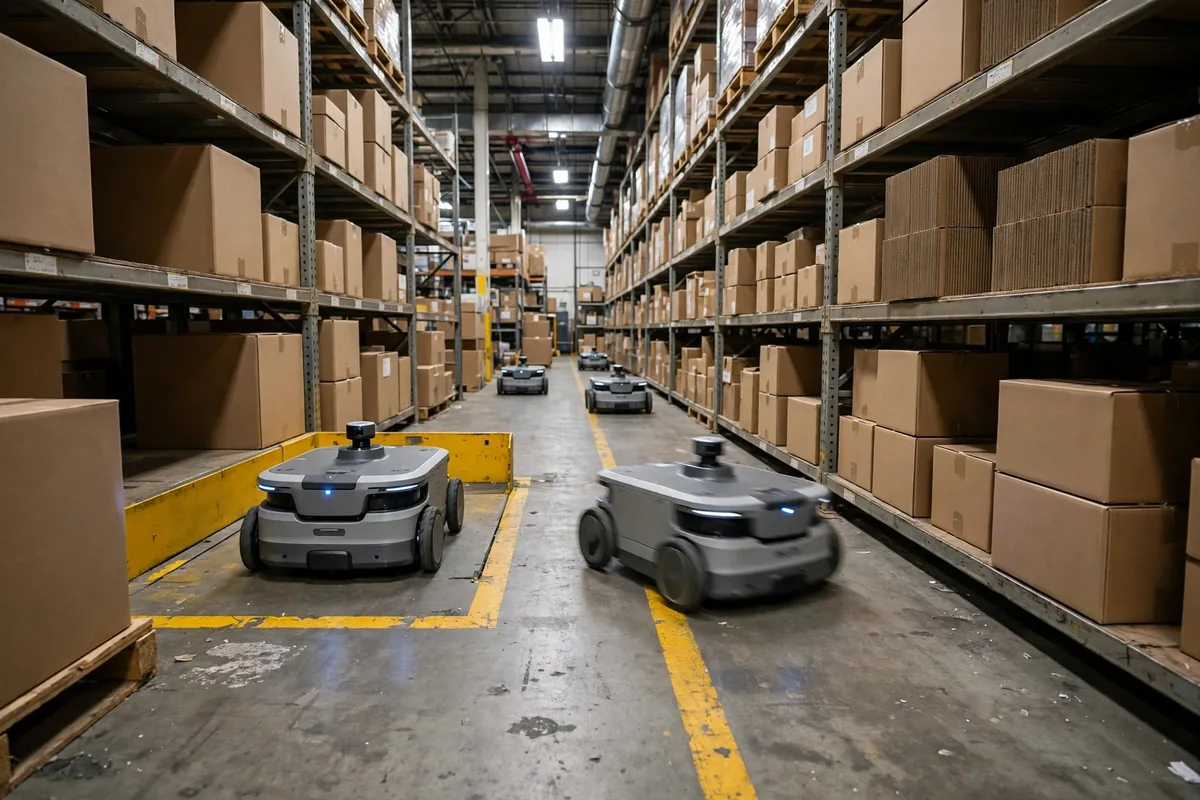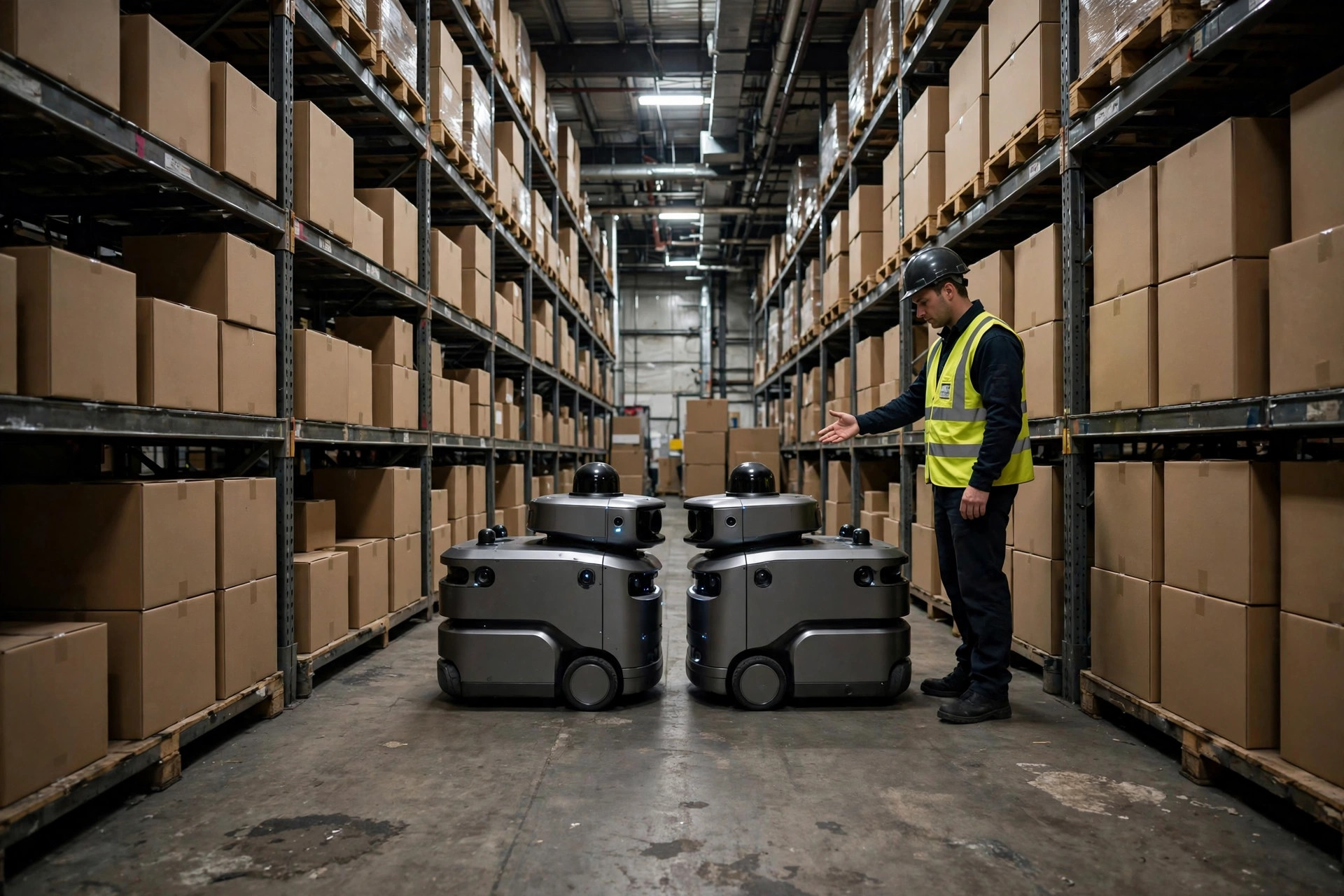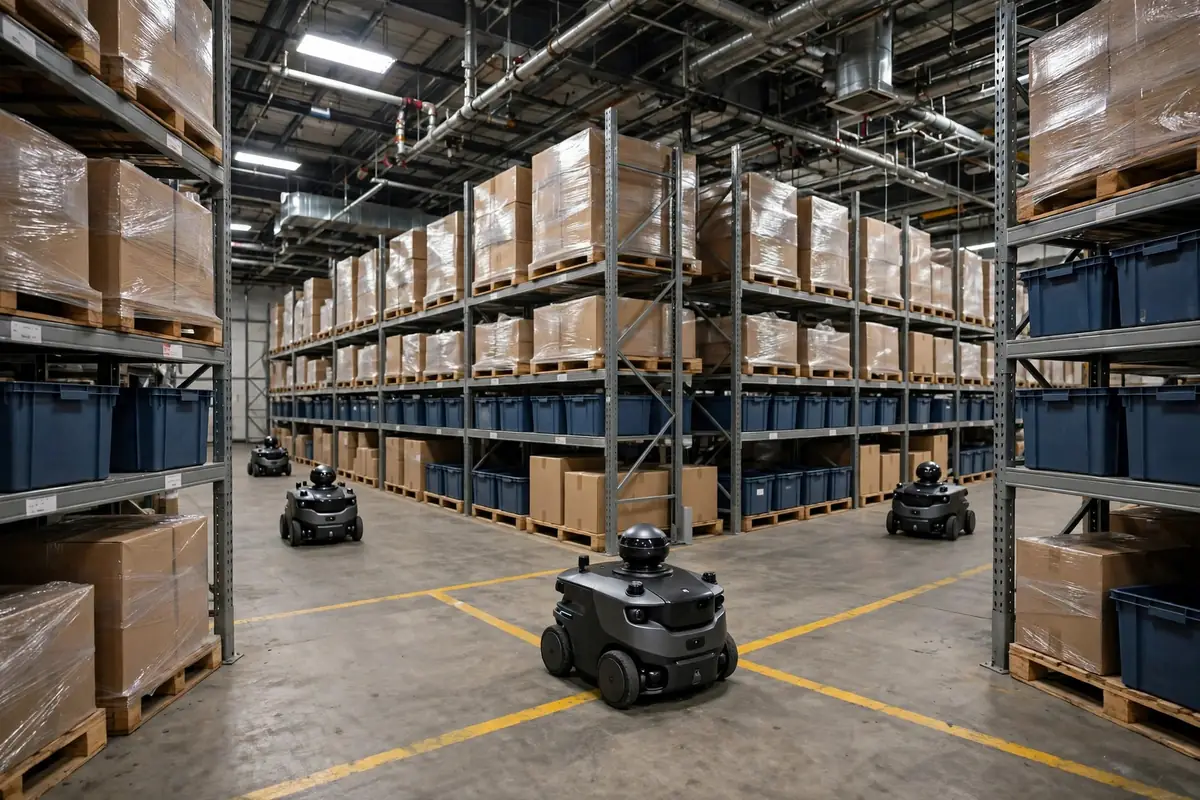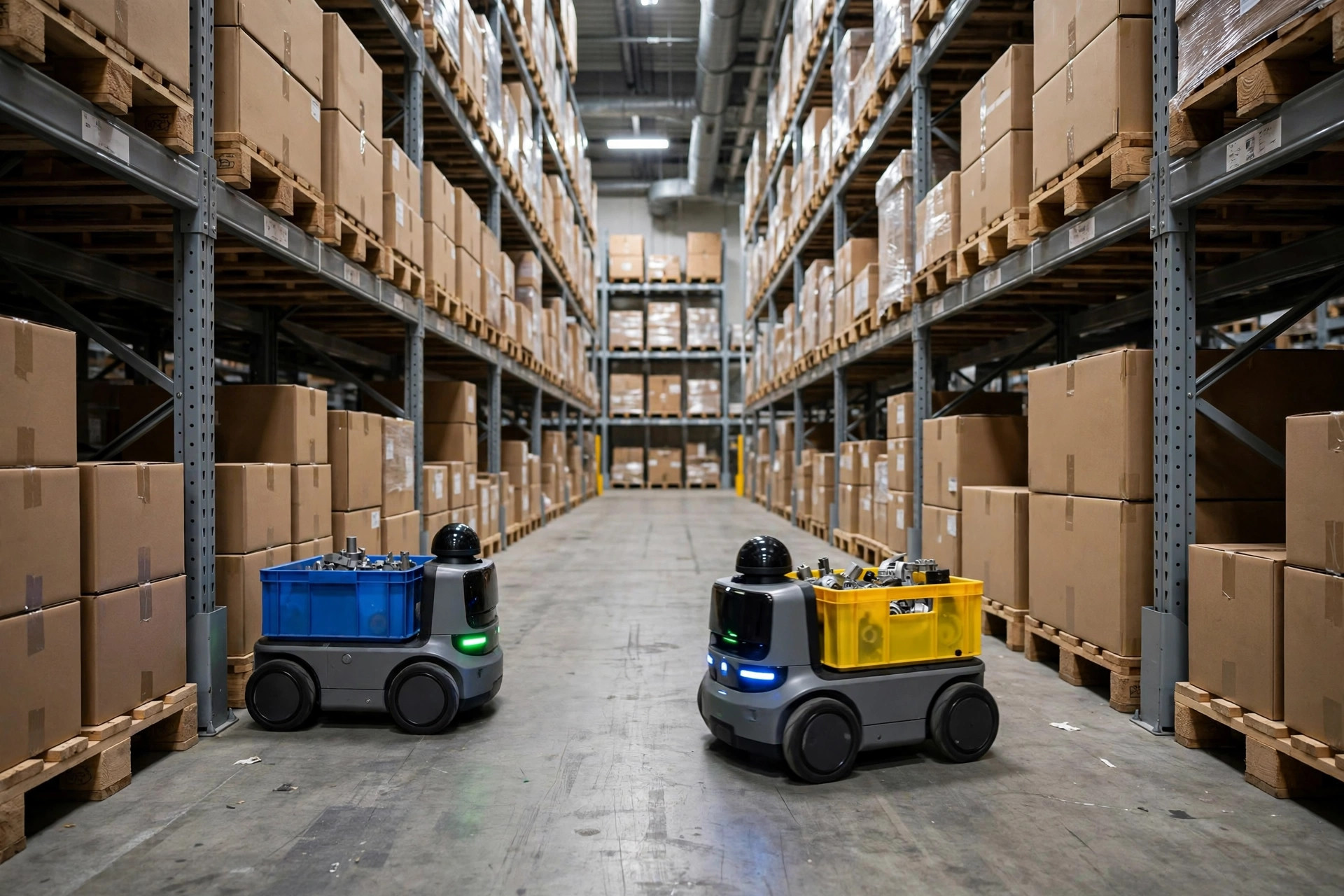
At 2:30 on a night shift in a 3C accessories warehouse in eastern China, two AMRs met nose to nose in the middle of a narrow aisle and stopped. One needed to go in to pick, the other needed to come out to deliver, and the aisle was only wide enough for one vehicle. The operator clicked "yield" three times from the control screen. Each robot turned in a small circle and stopped again. The shift finally got moving when someone walked down and pushed one robot back to a junction by hand. That aisle stayed blocked for more than forty minutes, three robots queued up behind it, and the outbound wave left an hour late.
That is what AMR deadlock in narrow aisles usually looks like. Nothing is broken. The algorithm did not suddenly get stupid. The problem is that nobody settled right-of-way before the robots ever met. Both robots are right, both have a valid task, and the system has no pre-agreed answer to who goes first, so it freezes. Think of it this way: it is like a narrow lane with no stop sign and no one-way marking, where two cars meet head-on. Even good drivers need someone to reverse, and reversing is much harder for an AMR than for a human driver.
Narrow-Aisle AMR Deadlock Starts With Right-of-Way, Not the Algorithm
When a jam happens, the first instinct is to tune parameters. Widen the obstacle-avoidance distance from thirty centimeters to fifty, stretch the wait timeout from ten seconds to thirty, and the night looks better for a day or two. Then a different wave comes through and the aisle jams again. Parameters can soften a symptom. They cannot fix a contest for the same stretch of floor when two directions claim it at once and no rule says who waits, who backs up, and where the waiting vehicle goes.
I worked with a warehouse whose aisles ran two ways, with entries at both ends, and tasks were dispatched in arrival order. On quiet days nothing happened. On peak nights, four or five robots would be in the same aisle system at once, inbound and outbound traffic mixing, and deadlock showed up seven or eight times a day. The engineers tuned the algorithm three rounds. Jams fell from seven or eight to four or five, and then stopped improving. We converted that aisle to a one-way loop, clockwise only, and deadlock disappeared the same day. The algorithm did not get smarter. The problem itself was removed by a rule.
You can understand this through the one-way street analogy. A city does not mark a street one-way because drivers are bad. It marks it one-way precisely because drivers are all reasonably good and still need a shared rule so they do not have to negotiate every encounter from scratch. AMRs are the same. Asking them to negotiate at every aisle entrance, no matter how fast they compute, will never beat a rule that is already written into the map.
There is a simple test for whether your warehouse has a right-of-way problem or a sensor problem. Look at where the jams repeat. The middle of a two-way aisle, a cross aisle junction, and the entrance to a charging area — if those three spots jam again and again, the rules are missing. The same spots jamming every week mean you should stop tuning parameters and change the road.
Traffic Rules That Prevent Narrow-Aisle Deadlock
Three rules are enough, as long as they are written into the map and the dispatcher rather than kept in one person's head.
The first is a one-way loop. If a narrow aisle can run one way, run it one way, even if each robot travels a little farther. Extra travel costs a few dozen meters per trip. A deadlock costs the whole aisle. Those two costs do not belong in the same comparison. Using that warehouse's own numbers as an illustrative example, before the change the aisle cleared roughly twenty-one pallets per hour net, and less on jam days; after the change to one-way running, each robot traveled about forty meters farther per loop, yet the aisle cleared a steady twenty-nine pallets per hour net. The detour looked like a loss and turned out to be a gain, because robots stopped waiting on each other.
The second rule is a passing bay. Where an aisle truly cannot run one way, you need widened spots at both ends and in the middle where one robot can pull completely clear, not half a body still sticking into the aisle. The bay must be marked on the map, and dispatch must plan around it: when two robots need the same aisle in opposite directions, the first one takes the bay and the second waits at the entrance. Two robots are never allowed into the same aisle at once. An aisle with no passing bay is like a narrow bridge with no shoulder. Sooner or later, two vehicles will meet on it.
The third rule is priority. When an outbound task meets a replenishment task, someone has to yield, and that order has to be settled in advance. My working order is outbound before inbound, full pallets before piece picking, and a low-battery robot heading to charge before an idle robot. Priority is not a slogan on the wall. It has to live in dispatch logic, so the lower-priority robot stops at the aisle entrance while the higher-priority robot clears. The clearer the priority, the fewer times a human has to intervene by hand.
The table below compares the options. Its figures come from that same warehouse's own runs, offered as an illustrative example rather than an industry benchmark. Another warehouse will get different numbers, but the ordering rarely changes.
| Approach | Deadlock risk | Extra travel | Dispatch complexity | Best fit | | One-way loop | Lowest | Some extra distance | Lowest | Aisles that can form a loop | | Two-way with passing bays | Medium | Almost none | Medium | Older warehouses that cannot form a loop | | Pure algorithmic avoidance | Highest | None | Looks low, firefighting is highest | Wide aisles, low density |
The selection line falls here: when an aisle fits only one robot and carries heavy two-way traffic, do not rely on pure algorithmic avoidance. Algorithms handle occasional meetings well. They do not handle structural head-on traffic. Once density rises, a structural problem needs a structural rule.
Narrow-Aisle Maintenance Traps After the Redesign
Setting the rules is only half the job. The first trap sits at the charging area. Chargers are often placed right at an aisle entrance, and when robots queue to charge, the tail of the queue blocks half the entrance. The next robot reads the aisle as open, drives in, and discovers a charging queue ahead. That 3C warehouse paid for this exact mistake, then moved its charging area a dozen meters inward, leaving a full clear entry and exit lane. A charging area should sit farther from the entrance rather than tight against it for convenience.
The second trap is changing the map without changing people's habits. After a one-way loop is drawn, veteran staff still push carts the old two-way way and drop temporary pallets in the new direction, turning a one-way road back into a two-way blockage. For the first week after a redesign, someone needs to watch the floor in person, and manual cart routes, temporary pallet spots, and exception handling all have to follow the new direction. Changing only the robot map fixes half the problem.
The third trap is judging uptime and MTBF by their averages. A good average does not mean the night shift is free of jams, and deadlock is exactly the kind of failure averages hide. I track aisle-level numbers instead: how many jams per aisle per day, how long each jam lasted, and how many robots queued behind it. When those three numbers fall for a full week, the redesign is genuinely working. However high the average uptime looks, if one aisle still jams three times a week, the night shift will still complain, and they will be right.
So before asking whether the algorithm is good enough, ask whether right-of-way was ever settled. What a one-way loop can solve should not be left to an algorithm to wrestle with. What passing bays and priority can state clearly should not be left to people on the floor to improvise. Whether the money was well spent comes down to one number: for the same aisle, did net pallets cleared per hour genuinely rise after the change. If it rose, the money was well spent. If it did not, the rules are still not right.
By Da Liu, Automation Engineer