The call came at 2 a.m., the week before Thanksgiving 2022. A 60,000-square-foot e-commerce warehouse outside Reno: four AMRs dead in the aisles, two more queued up in front of the chargers, outbound at a standstill for forty minutes. Twelve robots. Two charging stations. That was the whole story. Somebody had eyeballed "two chargers" during the project phase, reasoning that twelve robots split across shifts would manage fine. Nobody had done the math on what happens when all twelve run at once on a peak night and four or five need a charge at the same time.
After that night, I added a mandatory question to every AMR fleet review I do: how many chargers, and where. If the customer can't answer it, the fleet sizing isn't approved. Here's the math, laid out plainly.
How many chargers: do the math before you buy
The formula isn't complicated. Size for peak simultaneous charging demand, then add one spare.
Start with one robot's energy rhythm. Most mainstream AMR vendors publish specs in the same neighborhood: 6 to 8 hours of runtime on a full charge, 40 to 60 minutes to recharge (check your specific model's datasheet — don't take my word for it). So a robot running at full tilt needs roughly an hour on a charger for every seven hours of work. With twelve robots running hard, that's real, non-negotiable charging demand every single day.
Then figure out simultaneity. All twelve won't die at once, but on a peak night with every robot maxed out, three or four charging at the same time is completely normal. My rule of thumb: number of chargers equals fleet size divided by four, plus one spare. Twelve robots means three plus one — four chargers. If the Reno site had installed four instead of two, that Thanksgiving week would have been uneventful.
Adjust for duty intensity. A three-shift, robots-never-rest operation rounds up; a two-shift operation with natural pauses in the workflow can round down. But never cut the spare. Chargers break. Batteries age and charge slower. Skipping one charger saves a few thousand dollars; one dead night shift costs ten times that in overtime and late penalties.
There's a hidden variable too: battery aging. Lithium battery vendors typically quote around 2,000 charge cycles. Two years in, the same workload needs noticeably more frequent charging. If you size chargers for brand-new batteries, the math works on day one and stops working in year two. That "+1" in my formula is half failure redundancy, half aging headroom.
One more thing people forget: power. Four chargers fast-charging at once draw serious current. In an older building, if the transformer has no headroom, the breakers trip the moment all four chargers kick in — expensive paperweights. My habit: once the charger count is decided, have an electrician check transformer capacity before anything is ordered. If headroom is tight, derate the chargers or schedule the electrical upgrade first. That cost and lead time belong in the project plan, not as a surprise on installation day.
Where to put them: aisle ends or a central charging zone
Once the count is settled, the next question is placement. Two schools of thought, each with real trade-offs.
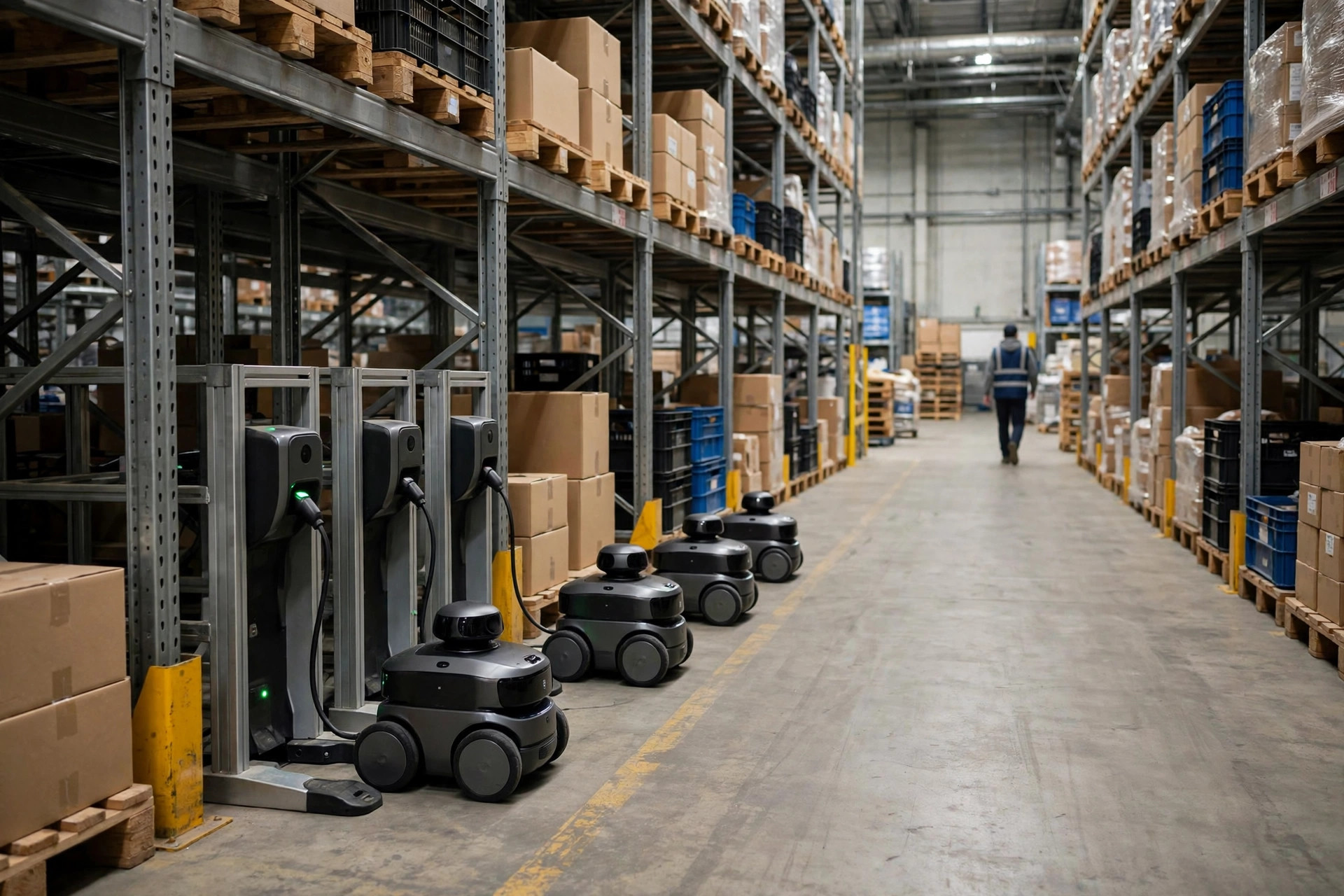
Aisle-end chargers sit close to the work. A robot finishes a job and docks around the corner — minimal deadhead travel. The downsides: they eat aisle space (a charger plus its safety clearance costs you at least a pallet position of width, and a narrow aisle becomes one-way), they get hit (one distracted forklift driver and your multi-thousand-dollar charger is scrap), and they're hard to manage (finding out which charger failed or which robot has been sitting there too long means walking the whole loop).
A central charging zone is easy to manage and maintain, but robots have to deadhead to get there. During peak, several robots traveling to the zone at once just moves the queue from the aisle to the zone entrance. And the farther the zone sits from the task area, the more deadhead time every charge costs — which adds up to a serious number over a year.
My recommendation is blunt: under ten robots, put chargers at aisle ends — proximity beats manageability at that scale. Over ten, build a central zone, but site it where the task hot zone meets the main aisle artery, not in the far corner of the building. And leave 20% expansion space in the zone layout. When the fleet grows from twelve to sixteen, you'll be glad you roughed in those two extra charger pads. The Reno site's fix was exactly this: a central zone next to outbound, four chargers installed at once. No dead night shifts since.
What charging queues actually cost you per year
People shrug at charging queues — "it's just fifteen minutes." Let me put a number on it. Eight robots, fifteen minutes of queueing each per day: that's two hours of fleet capacity gone, daily. Over 300 working days, that's 600 hours of robot capacity evaporated into waiting. And that ignores the cascade — a robot fifteen minutes late means its batch hits the conveyor fifteen minutes late, and packing and loading all slide downstream.
Queueing itself deserves better logic than first-come, first-served. Smarter setups prioritize by battery level and task urgency: the lowest battery charges first, and a robot about to run a high-priority task jumps the queue. Some fleet management platforms support this natively — ask about charging priority policies during selection. Without it, someone is manually shuffling robots at 2 a.m. during peak.
Beyond adding enough chargers, there's a second lever: opportunity charging. AMRs don't have to run the "drain it, then fill it" pattern. Lithium batteries don't mind shallow charge cycles, so the fragmented idle time — waiting on conveyors, waiting on loading, waiting on task assignment — can all top the battery up. Some fleet managers run dynamic dispatch by battery level: robots under 30% get short trips, and slip onto a charger between tasks. Done right, long full-charge sessions become rare and charger utilization actually improves.
But opportunity charging has a prerequisite: the chargers have to be where the robots already go. That's why count and placement are one calculation, not two. Enough chargers in the wrong spot means the fragmented top-up time gets burned on deadhead travel instead.
One-line verdict: chargers are sized to peak simultaneous charging demand, not to fleet count. Undersize them and you save a few thousand dollars to lose an entire night's outbound.