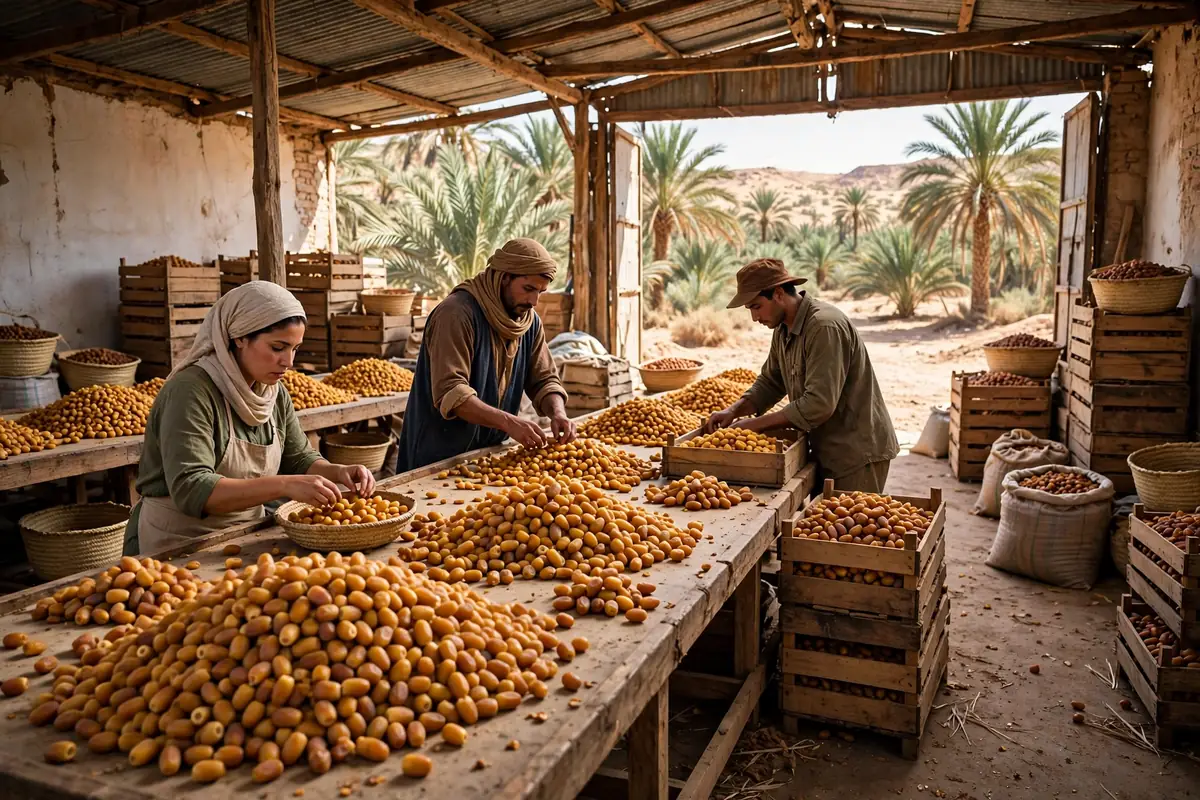
Algeria dates export warehouse storage is the part of the chain shoppers never see. On a European supermarket shelf, a pack of Algerian dates usually names Biskra or Tolga on the label. The price is not low, and the presentation is neat. Few shoppers ask what those dates went through before they were packed into a container. Algeria dates export warehouse storage looks, on the surface, like a question about buildings. It is really a question about how a country that grows a great deal of dates turns that harvest into export value.
According to the Food and Agriculture Organization, Algeria produced about 1.34 million tonnes of dates in 2024, roughly 13.3 percent of world output, ranking third in the world behind Egypt and Saudi Arabia. That figure invites a natural assumption: the third-largest producer should also be near the top of the export table. Yet according to UN Comtrade, Algeria exported about 26,481 tonnes of dates in 2024, worth 87.1 million dollars, ranking sixth among exporting countries. The gap between those two rankings is the account this article sets out to open.
Algeria Dates Export Warehouse Storage in Numbers: Big Harvest, Small Export
The first layer of the gap is the structure of varieties. Algeria grows more than 350 date varieties, but only one dominates exports: Deglet Nour. This semi-dry variety, translucent and delicately sweet, is often called the queen of dates. It grows mainly in the oases around Biskra and Tolga, and has held a geographical indication since 2016. Most of the other varieties are consumed at home or go into processing, and never meet export grading standards. In other words, of that 1.34 million tonnes, only the graded fraction ever passes through an export warehouse.
The second layer is the harvest window. Deglet Nour peaks between October and December, compressing the whole crop into a few months. When the season arrives, grading sheds and warehouses in the oases run at full load at the same time: dates picked in the morning need sorting the same day, lots with high moisture need drying before they enter cold storage, and any queue in that chain pushes losses upward. Exporters' catalogues commonly specify storage at 0 to 4 degrees Celsius with relative humidity of 65 to 70 percent, and a typical moisture content of 18 to 22 percent for Deglet Nour. Behind those numbers sits a hard constraint: dates fear both drying and mould. Too dry, and they lose weight and turn hard; too wet, and mould finds them.
Algerian officials report date exports reaching more than 90 countries, with Europe as the main market. Biskra sits about 400 kilometres from Algiers, so dates travel a real overland leg from the oasis to the ports of Algiers or Oran before loading. If the cold chain breaks on that road, the quality saved inside the cold store is quietly lost inside the truck.
From Drying Yards to Cold Stores: Three Gates of Algeria Dates Export Warehouse Storage
A scene from a grading shed in Biskra in the autumn of 2023 illustrates the point. In the third week of the harvest, four cooperatives' deliveries were on the floor at once: some dates still on the branch, others already two days on the drying yard. The order the shed manager worked in is worth noting. Moisture was measured before anything else, and that reading decided whether a lot went to the drying yard or straight into cold storage. The wettest lots were stored apart, never mixed with lots already at target dryness. On the grading line, the dates were separated into three grades by size, colour, and wholeness, while damaged and fermented fruit went into separate bags for processing, never into the cold store.
That sequence reflects the basic logic of the business: a date's condition before it enters storage decides its fate inside storage. A lot that goes into a cold store over-wet may look safe because the temperature has fallen, yet condensation can form inside the bag, and mould grows in cold, damp conditions just as it does in warm ones. The correct order is the reverse: bring moisture down to target first, then use cold storage to lock the state in. Get the order wrong, and the better the cold store, the larger the loss.
The three gates can be stated plainly. The first is drying and pre-cooling, which fixes the intake condition. The second is grading and packing, which fixes the value grade. The third is an unbroken cold chain, from the oasis cold store to the container at the port, held at temperature throughout. A failure at any gate shows up on the inspection sheet at destination.
| Storage method | Suitable lots | Quality risk | Where the cost sits |
|---|---|---|---|
| Ventilated store at ambient temperature | Short turnaround, lots already at target dryness | Wide temperature swings, fast weight loss | Low cost, high losses |
| Cold store, whole lots | Main export lots | Over-wet intake condenses and moulds | Medium, power and capacity dominate |
| Cold store plus graded packing | Premium retail orders | Lowest risk, but grading labour is high | High, covered by the price premium |
The counterintuitive point is that colder is not better. Dates chilled too far turn hard and lose their texture, and on thawing they can weep moisture. The real skill in export warehousing is not refrigeration capacity but stability: the size of the temperature and humidity swings matters more than the absolute values. That logic is shared with green coffee storage, where the enemy was never one particular number, but uncontrolled fluctuation.
Attribution: the Gap Sits Between Warehouse and Port, Not in the Field
Reordering the data makes the conclusion clearer. Algeria ranks third in date production and sixth in export value, and the places in between were not lost in the field. They were lost in the three links that follow the field: grading, cold storage, and the handover to the port. The bottleneck of algeria dates export warehouse storage is precisely the seam between those links. Tunisia exports the same Deglet Nour variety and has long earned more from it; the difference is not the variety but the density of grading sheds, the coverage of cold storage, and the efficiency of export documentation. Public reporting shows the Algerian government in recent years pushing dates toward direct export with fewer intermediaries, which is an adjustment aimed squarely at that shortcoming in the value chain.
A structural factor deserves attention as well. Domestic consumption of dates in Algeria is large, so much of the harvest was never intended for export. That means export warehousing competes not with domestic buyers for fruit, but with time. The harvest lasts only a few months, and grading-shed and cold-store capacity is a hard constraint. Whoever locks compliant fruit into cold storage first holds the ticket onto the ship. Warehousing capacity, in that setting, is not a cost centre; it is the mechanism that allocates export volume.
The following calculation is an illustrative example. Suppose a 20-tonne lot of Deglet Nour grades out at half first grade, three-tenths second grade, and the rest processing grade. If the first-grade fruit sits in cold storage for an extra month, the loss from weight loss and downgrading can exceed several times that month's power bill. Conversely, shipping early to save on power can cost more in downgrade claims at destination. A warehousing decision is, at its core, a search for the balance point between power, spoilage, and claims, not a campaign to minimise any one of them alone.
A Judgement on the Trend: Cold Stores and Grading Will Grow Before Output Does
On the evidence available, growth in Algeria's date exports will come more from warehousing and grading capacity than from planting more palms. Three reasons support it. First, the production base is already large, so the room for output growth at the margin is limited. Second, European demand for Deglet Nour is steady, and what is missing is a stable supply that meets grade. Third, geographical indication protection and the direct-export policy are both pulling value back into Algeria, and grading and cold storage are exactly where that value lands.
This judgement has its limits. Building cold stores needs power, capital, and maintenance, and grid conditions across the oasis regions are uneven. Grading standards need buyers to accept them; raising a standard unilaterally does not automatically earn a premium. A more open question remains: as more money flows into cold stores and grading sheds, will Algeria's date exports split into two tiers, with firms commanding warehousing capacity winning long-term orders while others remain raw-material sellers? If that split happens, warehousing will stop being a back-office function and become the front line of export competition. How fast it happens is a question whose answer will be found in the grading sheds of the next harvest season.
By Dr. Chen, Supply Chain Researcher